

How Does the Rise of Prediction Markets Impact Traditional Financial Instruments Like Options, Futures, or Betting Markets?
Introduction
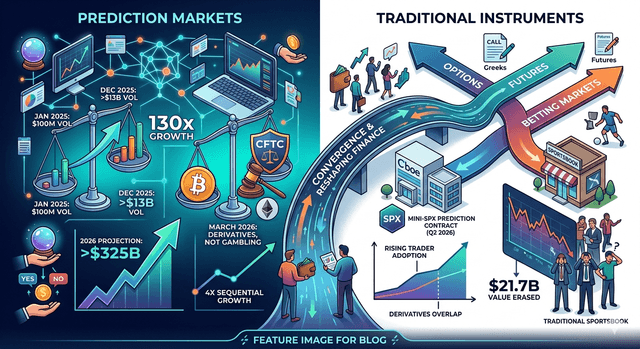
In January 2025, monthly trading volume across prediction markets was just $100 million. By December 2025, that number had exploded to over $13 billion, 130x increase in a single year. This explosive growth has transformed prediction markets from niche experiments into serious competitors against traditional financial instruments. The fundamental question is no longer whether prediction markets matter, but how they are reshaping the landscape of options, futures, and traditional betting markets.
The CFTC made its position clear in March 2026: prediction market contracts are financial derivatives, not gambling. This regulatory determination has profound implications for how these markets relate to traditional instruments that have operated for decades.
Prediction Markets vs Options and Futures: The Derivatives Overlap
Structural Similarities
At their core, prediction markets and traditional derivatives share identical mathematical foundations. When you buy a call option, you are purchasing the right to profit if a stock rises above a certain price. When you buy a "yes" share in a prediction market, you are purchasing the right to profit if an event occurs. The pricing mechanisms are remarkably similar, both relying on market supply and demand to establish probabilities that change over time.
The WSJ reported in February 2026 that risk-loving options traders are flocking to prediction markets in significant numbers. The attraction is clear: prediction markets offer the same leveraged exposure to outcomes without many of the complexities of options pricing. There are no Greeks to worry about, no implied volatility calculations, and no expiration dates to manage. The trade is simple: will this event happen, yes or no?
Cboe recognized this overlap and announced in March 2026 plans to launch its first Mini-SPX prediction market contract in Q2 2026. The product will use a traditional options framework, effectively merging prediction market concepts with established derivatives infrastructure. This represents a significant acknowledgment that prediction markets are not competing against derivatives. They are becoming derivatives.
Market Size Comparison
The growth trajectory has been extraordinary. Prediction market volumes grew nearly 4X sequentially to $64 billion in 2025, and are on pace to exceed $325 billion in 2026 based on year-to-date run-rate volumes.
To put this in perspective, consider that the entire U.S. options market processes trillions of dollars in notional value annually. But in terms of retail participation and active trading accounts, prediction markets are now capturing meaningful volume from traditional options traders. The median return for retail users on prediction markets since mid-2025 is -8%, compared to -5% on traditional sports bettingsuggesting that retail traders are treating prediction markets similarly to other speculative instruments.
The Regulatory Convergence
The most significant development came in March 2026 when the CFTC declared that prediction markets are derivatives, not gambling, and that insider trading laws apply. This classification ties prediction markets directly to the regulatory framework that governs options and futures.
For traditional derivatives traders, this means prediction markets are no longer a separate categorythey are simply another asset class within the broader derivatives universe. The same market manipulation laws apply. The same disclosure requirements may follow. This regulatory clarity will likely accelerate institutional participation and could lead to more sophisticated products that blur the line between prediction markets and traditional derivatives.
Prediction Markets vs Traditional Betting Markets
The Competitive Threat
The impact on traditional betting markets has been immediate and measurable. Since the beginning of 2025, prediction markets have erased approximately $21.7 billion in market value from publicly traded sportsbook companies. This is not theoretically reflected in stock prices and market capitalizations.
The New York Times reported in February 2026 that the competition between prediction markets and traditional sportsbooks is intensifying. Traditional sportsbooks are facing their own scandals, while prediction markets offer a new, seemingly more sophisticated alternative. The overlap is significant: according to Kalshi's own data, $12.5 billion of its total trading volume comes from sports-related markets.
The key difference lies in the model. Traditional sportsbooks operate as bookmakersthe house that takes the other side of every bet. This creates inherent conflicts of interest: when a bettor wins, the sportsbook loses. Prediction markets work as exchanges, matching bettors against each other. The platform takes a fee but does not trade against users. This alignment of interests makes prediction markets more attractive to sophisticated bettors who understand the math.
Performance Comparison
Data from late 2025 and early 2026 reveals interesting patterns. Retail users on prediction markets have shown a median return of -8% since mid-2025, while traditional sports bettors show a median return of -5% over the same period. Both groups lose money on averagethis is the nature of speculative markets but prediction market participants are losing more.
This could reflect several factors: prediction markets attract more aggressive traders who treat them as pure leverage instruments, the lack of spread betting or traditional odds-making may result in worse execution, or the longer time horizons of prediction markets (some extend months or years) increase holding costs and volatility exposure.
Market Structure Differences
The structural advantages of prediction markets over traditional betting are significant. Liquidity in major prediction markets now rivals or exceeds traditional betting pools for major events. The transparency of on-chain data means every bet is publicly visible, unlike traditional sportsbooks where the house controls all information. The ability to trade in and out of positions before the event occurs provides flexibility that traditional betting does not offer.
For sports betting specifically, prediction markets have created a new category that appeals to traders who may never have engaged with traditional sportsbooks. The same capital that might have gone intoOptions speculation now enters prediction markets. The same users who analyze earnings calls now analyze election polls and sports statistics.
The Convergence of Markets
derivatives-First Approach
Traditional financial institutions are taking notice. Cboe's announcement to launch prediction market contracts represents the first major move by a traditional exchange to incorporate prediction market concepts into established infrastructure. This hybrid approachusing the credibility and infrastructure of traditional exchanges while offering prediction market functionalitycould accelerate mainstream adoption.
The implications are significant: if major exchanges begin listing prediction market contracts, they will become yet another instrument in the derivatives toolkit. Traders will be able to trade prediction outcomes alongside options on the same platform, using the same accounts and clearing infrastructure.
The New York Times analysis
The New York Times described the situation as "prediction markets and casinos going to war over sports betting." This is not hyperbole. The $12.5 billion in sports-related volume on Kalshi alone represents significant revenue being diverted from traditional sportsbooks.
The battlefield extends beyond sports. Prediction markets now cover elections, economic indicators, company earnings, weather events, and virtually any topic where users have opinions and willingness to put money behind them. Traditional betting markets cannot replicate this breadth.
Implications for Each Market Segment
For Options Traders
Options traders now have a new outlet for directional speculation. The simpler mechanics of prediction markets for trade is purely yes or no. It attracts traders overwhelmed by options complexity. The lack of time decay, no gamma concerns, and fixed risk make prediction markets accessible to traders who never mastered Greek options.
The regulatory determination that prediction markets are derivatives also means that sophisticated options strategies can potentially be replicated using prediction markets. Iron condors, strangles, and other multi-leg strategies have prediction market analogues, though the market depth may not yet support the same complexity.
The overlap with options trading is particularly notable. Risk-loving options traders, accustomed to high-leverage bets on stock movements, are finding similar excitement in prediction markets. The WSJ reported in February 2026 that these traders are "flocking" to prediction markets. The attraction is not just simplicity鈥攊t's the ability to apply similar analytical skills to non-stock events while maintaining the same risk-reward mindset.
For Futures Traders
Futures traders similarly find prediction markets offering exposure to events that futures cannot capture. While futures exist for commodities, currencies, and indices, prediction markets extend the concept to political events, policy outcomes, and other binary events that traditional futures markets do not cover.
The correlation between prediction market prices and futures on similar underlyings is already being noticed. When polls move, election prediction markets move. When economic data approaches, the prediction market on that data adjusts. This information now competes with traditional forecasting methods.
For commodities traders, prediction markets on weather events, geopolitical developments, and supply disruptions provide context for positions. A farmer concerned about drought conditions can trade both grain futures and a prediction market on weather severity. This additional signal layer improves market efficiency.
For Traditional Betting Markets
The threat is existential for some traditional betting operators. The exchange model of prediction markets removes the house edge in a different way, rather than the sportsbook taking the opposite position, users trade against each other. This is fundamentally more efficient and attracts smart money.
Traditional sportsbooks are responding by launching their own exchange products and by lobbying for regulations that treat prediction markets as gambling rather than exchanges. The regulatory outcome will determine whether this competition continues or whether prediction markets become subject to the same restrictions as traditional betting.
The competitive dynamics are particularly evident in sports betting. According to The New York Times, traditional sportsbooks are losing $12.5 billion in volume to just the Kalshi platform alone on sports-related markets. This does not include Polymarket or other prediction platforms. The total diversion is significantly larger.
The New Competitive Landscape
Market Share Shifts
The structural shift is evident in market capitalizations. Publicly traded sportsbook companies have lost $21.7 billion in market value since the beginning of 2025. This reflects not just lost volume but reduced growth expectations and regulatory uncertainty.
Major sportsbook operators face a strategic dilemma: compete directly against better-capitalized and more technologically advanced prediction markets, or adapt to offer exchange-like products. Some have begun developing prediction market capabilities, though they face significant technology and regulatory hurdles.
The prediction markets have advantages beyond technology. Zero KYC requirements, global accessibility, and cross-border functionality create a competitive moat that traditional operators cannot easily replicate. The blockchain infrastructure behind prediction markets also provides transparency that traditional betting lacks.
Regulatory Arbitrage
The different regulatory treatment creates additional competitive asymmetry. Traditional sportsbooks face extensive licensing requirements, geographic restrictions, and consumer protection obligations. Prediction markets, particularly decentralized ones, operate with fewer constraints.
This regulatory arbitrage is temporary while regulators are paying attention. The CFTC's March 2026 determination represents the first major regulatory response, classifying prediction markets as derivatives. More regulation will follow.
For traditional operators, this regulatory catch-up may provide opportunity. If prediction markets face the same rules as traditional sportsbooks, the competitive advantage diminishes. The timeline of regulatory adaptation will determine how long this advantage persists.
Conclusion
Prediction markets are not replacing options, futures, or betting markets, instead they are converging with them. The CFTC's determination that prediction markets are derivatives accelerates this convergence. By 2025, prediction market volumes reached $64 billion, with 2026 on pace to exceed $325 billion.
Cboe's entry into prediction markets suggests the path forward: traditional exchanges incorporating prediction market functionality rather than competing against it. This hybrid model may define the next phase of market evolution.
For traditional instruments, this means new competition for trader attention and capital. For traders, this means new tools for expressing views on outcomes. For regulators, it means a new category of derivatives that requires framework adaptation.
The most significant impact may be the democratization of outcome speculation. What once required access to options markets or tolerance for sportsbook odds now requires only a crypto wallet and an opinion. Traditional instruments will need to adapt to this new competitive landscape or risk losing the next generation of traders.
The key takeaway is clear: prediction markets have evolved from curiosities into serious financial instruments that overlap with, compete against, and increasingly integrate with traditional derivatives and betting markets. The convergence is underway.
FAQs
Q: How are prediction markets different from buying call options?
A: Prediction markets and options share similar mathematical foundationsboth derive value from the likelihood of an outcome. However, options have more complex pricing involving implied volatility, time decay, and Greeks. Prediction markets are simpler: the price directly represents the perceived probability of an event. There are no expiration dates to manage and just yes or no.
Q: Can institutions trade prediction markets like derivatives?
A: Yes, the CFTC's March 2026 determination clarified that prediction markets are derivatives, meaning the same regulations apply. Major exchanges like Cboe are launching prediction market products that integrate with existing derivatives infrastructure. Institutional participation is expected to increase as regulatory clarity improves.
Q: How much has prediction market growth impacted traditional sportsbooks?
A: Since 2025, prediction markets have erased approximately $21.7 billion in market value from publicly traded sportsbook companies. The volume is significant: just $12.5 billion of Kalshi's total volume comes from sports-related markets alone.
Q: Are prediction markets more profitable than traditional betting?
A: Data shows retail users on prediction markets have a median return of -8% since mid-2025 versus -5% on traditional sports betting. Both lose money on average, but prediction market participants lose more likely to reflect different risk profiles and the lack of traditional odds-making expertise.
Q: Will traditional exchanges offer prediction market products?
A: Cboe announced in March 2026 plans to launch its first Mini-SPX prediction market contract in Q2 2026, using traditional options infrastructure. This represents the first major integration of prediction market concepts into established exchanges.