

Google's Willow Quantum Breakthrough Raises New Questions for Bitcoin Security
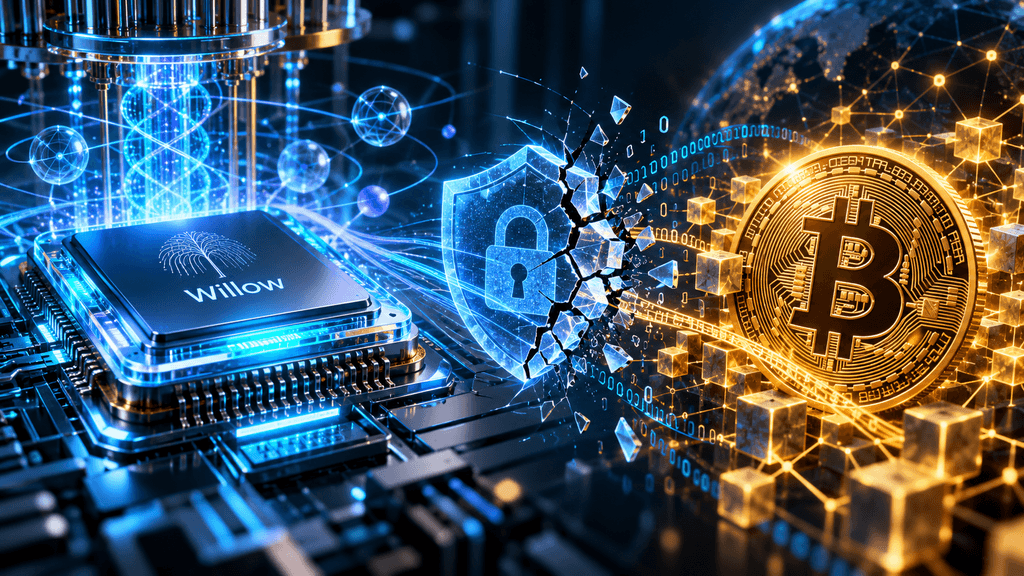
Google’s Willow Chip Cuts Magic-State Preparation Errors by 40-Fold
Google Quantum AI reported on October 15, 2026, that its Willow superconducting processor achieved a roughly 40-fold reduction in errors when preparing magic states, specialized quantum resources required for universal fault-tolerant computation. The result, published in Science, reached a logical fidelity of 99.99 percent on the retained states after quality checks, using at most 54 of the chip’s 105 qubits. Magic states enable non-Clifford operations that classical error-corrected circuits cannot efficiently supply. Traditional distillation methods have long been projected to consume most of a future machine’s capacity, sometimes estimated at 90 to 95 percent. Cultivation filters noisy inputs through coordinated measurements and discards failed attempts, leaving higher-purity states that can be grafted into larger surface-code encodings.
The advance does not create an immediate ability to recover Bitcoin private keys. Current error rates remain orders of magnitude higher than those required for practical cryptanalysis, and the acceptance rate of only about 8 percent of preparation attempts underscores remaining engineering limits. Yet the demonstration validates a technique previously explored mainly in theory and reduces one of the largest resource overheads in blueprints for cryptographically relevant quantum computers. Separate March 2026 modeling by Google researchers indicated that breaking the 256-bit elliptic-curve discrete logarithm problem underlying Bitcoin signatures could require fewer than 1,200 logical qubits and under 500,000 physical qubits on superconducting hardware under stated assumptions, with some attack circuits completing in minutes. The combination of improved state preparation and lowered resource estimates has intensified scrutiny of Bitcoin addresses whose public keys already appear on-chain.
Willow Achieves Record Magic-State Fidelity Through Cultivation Filtering
Google Quantum AI’s experiment demonstrated that magic-state cultivation works on real superconducting hardware. Researchers injected a noisy initial state into a small region of the Willow processor and applied repeated coordinated measurements designed to detect errors. Failed attempts were discarded, producing cultivated T-states with a logical fidelity of at least 0.9999 among the approximately 8 percent of trials that passed every check. The protocol achieved roughly a 40-fold reduction in error relative to uncultivated baseline injection. The work also included a code-switching step that moved the purified state from a distance-3 color code into a distance-5 surface code, showing that cultivated states can survive transfer into encodings more convenient for larger computations. These steps required new metrology techniques to handle laboratory noise sources such as electrical drift and temperature variation that had previously compromised benchmarking validity.
The result addresses a long-recognized bottleneck. Non-Clifford gates essential for algorithms such as Shor’s require high-quality magic states that cannot be produced by standard stabilizer operations alone. Earlier resource analyses treated distillation of these states as the dominant cost center in fault-tolerant architectures. By showing cultivation can deliver usable fidelity on present-day hardware, the Willow experiment provides empirical support for theoretical projections that the overhead of state preparation can be substantially lowered. Google researchers have noted that further reductions in physical noise should improve cultivated-state error rates cubically, amplifying gains from each successive hardware generation. The demonstration remains limited in scale, however, and the authors themselves emphasize that larger-scale cultivation must still be shown before the method becomes practical for full-scale machines.
Magic States Supply the Non-Clifford Resources Shor’s Algorithm Requires
Shor’s algorithm can, in principle, solve the elliptic-curve discrete logarithm problem that protects Bitcoin’s digital signatures. Execution of the algorithm on error-corrected hardware depends on a universal gate set that includes non-Clifford operations. Magic states serve as the consumable resource that enables those operations under standard fault-tolerant constructions. Once a public key is known, a sufficiently powerful quantum computer running an optimized circuit could recover the corresponding private key and produce a valid signature that the Bitcoin network would accept as authentic. The March 2026 Google resource estimates placed one such circuit at fewer than 1,200 logical qubits and roughly 90 million Toffoli gates, translating under their superconducting assumptions to fewer than 500,000 physical qubits and runtimes measured in minutes.
Magic-state quality directly affects the size and speed of the machine required. Lower error rates in the prepared states reduce the amount of physical hardware that must be devoted to generating and purifying them, freeing capacity for the arithmetic operations of the attack itself. Cultivation’s experimental success therefore improves the credibility of the lower resource figures by confirming that one of the most expensive preparation steps can be made more efficient. The current fidelity of roughly 1 error in 10,000 remains far from the approximately 1 error in 10 billion typically cited as necessary for large-scale cryptanalysis, yet the direction of progress is clear. Each verified improvement in state preparation tightens the engineering path between today’s laboratory devices and a cryptographically relevant system.
March 2026 Modeling Lowered Estimated Physical Qubit Counts for ECDLP Attacks
In a paper released at the end of March 2026, Google researchers and collaborators presented updated circuit constructions and resource estimates for solving the 256-bit elliptic-curve discrete logarithm problem. One design used fewer than 1,200 logical qubits and 90 million Toffoli gates; another used fewer than 1,450 logical qubits and 70 million Toffoli gates. Under the superconducting hardware assumptions stated in the work, both are mapped to machines with fewer than 500,000 physical qubits. The estimates represented roughly a 20-fold reduction relative to some earlier projections that had placed requirements in the millions of physical qubits. The shorter runtimes also raised the possibility of “on-spend” attacks that could complete within Bitcoin’s average ten-minute block interval once a public key becomes visible in the mempool.
These figures are model-dependent and rest on assumptions about error rates, connectivity, and magic-state production rates. They do not describe existing hardware. Willow itself contains 105 physical qubits. The modeling nevertheless shifted expert discussion by showing that algorithmic and architectural improvements can shrink the scale of a cryptographically relevant quantum computer more aggressively than previously assumed. When the October cultivation result is read against that backdrop, the combination of lower qubit counts and more efficient state preparation narrows the projected gap between current experimental systems and machines that could threaten exposed Bitcoin keys.
Public-Key Exposure Already Places Millions of Bitcoin in a Vulnerable Category
Bitcoin addresses become quantum-vulnerable once their public keys appear on the blockchain. Early pay-to-public-key outputs reveal the key at the moment of creation. Any address that has ever been spent from likewise places its public key permanently on-chain. Recent on-chain analyses place the total quantity of Bitcoin held in such exposed positions in the range of approximately 6.7 million to more than 7 million BTC, representing roughly one-third of circulating supply depending on the precise snapshot and classification method. Structural exposure from P2PK and certain Taproot outputs accounts for a substantial share, while address reuse contributes the larger remainder.
The exposure is asymmetric. Modern unused BECH32 addresses that have never sent a transaction keep their public keys hidden until the first spend. Once that spend occurs, the key becomes visible, and the address joins the long-exposure category. Holders who reuse addresses or who control early outputs therefore face a longer window of potential risk once a capable quantum machine exists. The absolute numbers fluctuate weekly with transaction activity, yet the overall scale has remained large enough to attract attention from security researchers, custodians, and industry coalitions throughout 2026.
Satoshi-Era Pay-to-Public-Key Outputs Carry Permanent On-Chain Visibility
The earliest Bitcoin outputs, mined under the pay-to-public-key script type, publish the recipient’s public key directly in the output script. Approximately 1.1 million BTC widely associated with the pattern of early mining attributed to Satoshi Nakamoto sit in such outputs. Those keys have been visible on the blockchain since 2009 or shortly thereafter. No further action by the owner is required for the exposure to exist; the information is already public and permanent. Migration of these coins would require a valid signature from the corresponding private keys. If the keys have been lost, the coins cannot be moved under ordinary conditions.
This category of exposure differs from modern address types that reveal the public key only at spending time. For the oldest coins, the “long exposure” clock has been running for more than a decade and a half. Security analyses treat these holdings as among the first that a future cryptographically relevant quantum computer would be able to target without needing to wait for a new transaction. The same permanence applies to other early P2PK outputs that remain unspent. The combination of high visibility and potential dormancy has made the Satoshi-era supply a focal point in discussions of quantum risk even while no practical attack capability exists.
Current Error Rates Still Leave Cryptographic Relevance Distant
The cultivated magic states produced on Willow achieve an error rate on the order of 1 in 10,000 among retained attempts. Cryptanalysis of Bitcoin-scale elliptic-curve keys is generally estimated to require magic-state error rates closer to 1 in 10 billion. The gap remains approximately six orders of magnitude. Only about 8 percent of preparation attempts survived the quality filters in the reported experiment, so the effective production rate of usable states is substantially lower than the raw trial count. Google researchers have indicated that further reductions in physical hardware noise would improve cultivated-state fidelity cubically, yet such improvements have not yet been demonstrated at the necessary scale.
These numerical realities keep the threat theoretical for the present. No existing quantum processor can execute the full sequence of operations required to recover a secp256k1 private key from a public key. The Willow result improves one component of the overall stack; it does not deliver the complete fault-tolerant machine. Analysts who track the field therefore continue to describe cryptographically relevant quantum computers as years away under even optimistic roadmaps, while acknowledging that successive experimental successes can compress earlier timelines.
Acceptance Rates and Scaling Remain Practical Barriers
The 8 percent retention rate observed in the cultivation experiment means that the majority of preparation attempts are discarded. At the volumes required for a full cryptanalytic circuit that consumes hundreds of thousands of high-quality magic states per second, such a low yield would impose a heavy overhead unless the acceptance fraction improves substantially with scale or with better physical error rates. The experiment itself used a maximum of 54 qubits. Extending the same protocol to the hundreds of thousands of physical qubits contemplated in the resource estimates introduces new challenges of calibration, connectivity, and error correlation that have not yet been solved in hardware.
Google’s own commentary on the result stresses that larger-scale demonstrations are still required before cultivation can be considered realistic for practical quantum computing. Until those demonstrations succeed and acceptance rates rise, the resource savings projected from the technique remain provisional. The laboratory milestone is real and important; translating it into a production-capable subsystem for a cryptographically relevant machine constitutes a separate and substantial engineering task.
Bitcoin Protocol Discussions Center on New Address Formats
Bitcoin developers have examined post-quantum address designs, including proposals such as BIP-360 that aim to keep public keys off-chain for longer periods. These designs would change the exposure profile of newly created outputs by delaying the moment at which a public key becomes visible. Implementation would require a soft fork and broad consensus across the network. As of mid-October 2026, the proposals remain at the discussion and draft stage rather than activated code. Wallet software and infrastructure providers would also need to adopt the new formats before the majority of economic activity could benefit.
The deliberate pace of Bitcoin’s consensus process is intentional. Changes to the consensus rules carry systemic risk and are therefore subjected to extensive review. The appearance of successive quantum milestones, including the Willow cultivation result, has increased the perceived urgency of that review without altering the technical and social requirements for activation. Holders who wish to reduce exposure in the meantime can avoid address reuse and move funds to fresh addresses that have never been spent, thereby limiting the window during which a public key is visible.
Industry Groups and Custodians Have Begun Coordinated Planning
A coalition of companies formed in 2026 under the banner of the Quantum Alliance to develop common approaches to post-quantum readiness for Bitcoin and other networks. Custodians, exchanges, and security firms have published analyses of exposed supply and migration pathways. Some have begun internal roadmaps for supporting post-quantum signature schemes once standards and protocol support mature. These efforts treat the threat as long-term yet sufficiently material to justify preparation now, given the time required for soft-fork activation, wallet updates, and user migration.
Coordination across the industry is complicated by differing risk tolerances and by uncertainty over exact timelines. Entities that control large volumes of customer funds face particular pressure to demonstrate readiness, while individual holders retain the ability to manage their own address hygiene. The shared recognition that public-key exposure already exists for a sizable fraction of supply has shifted the conversation from abstract cryptography toward concrete operational planning.
On-Spend Windows Could Become Relevant Once Machines Mature
If a cryptographically relevant quantum computer eventually achieves the speed projected in the March 2026 modeling, an attacker who observes a public key in the mempool could in principle recover the private key and broadcast a competing transaction before the original spend confirms. Bitcoin’s average ten-minute block interval provides a limited window. Faster quantum runtimes would shrink that window and raise the priority of defenses such as shorter confirmation expectations for high-value transfers or protocol changes that further delay key exposure.
Current hardware is nowhere near the required performance, yet the modeling has made the scenario part of formal risk discussions. Defenses against on-spend attacks differ from those required for long-exposed dormant coins. The former can be mitigated by operational practices and by eventual protocol upgrades; the latter depend on the ability of owners to move funds before an attack becomes feasible. Both categories of risk are therefore under examination even while the hardware capability remains aspirational.
Successive Hardware Generations Compound Error-Rate Gains
Google has projected that reductions in the underlying physical noise of devices such as Willow would improve cultivated magic-state error rates with a cubic dependence. Each generation that halves physical error rates could therefore deliver substantially larger improvements in the quality of prepared states. Combined with algorithmic refinements in circuit design and decoding, these compounding effects form the basis for optimistic projections that cryptographically relevant machines could appear within the next decade under continued progress.
Pessimistic projections continue to place the same milestone further in the future, citing the many unsolved engineering problems that remain between laboratory demonstrations and large-scale fault-tolerant systems. The Willow cultivation result itself supplies one data point on that trajectory. It confirms that a previously theoretical technique can function on present hardware and thereby supports the premise that further noise reductions will yield outsized gains in state quality. Whether the observed scaling continues at larger qubit counts will determine how rapidly the remaining gap closes.
Holders Can Reduce Exposure Through Address Hygiene Today
Individual Bitcoin holders can limit the long-exposure surface of their funds by never reusing addresses and by moving coins from early or previously spent outputs to fresh addresses that have never appeared in a spending transaction. Such practices do not eliminate quantum risk entirely, but they shrink the set of public keys that are already visible and thereby reduce the time available to a future attacker. Custodial services and hardware-wallet software increasingly emphasize this hygiene as standard guidance. Large dormant holdings present a more difficult problem if the controlling keys are lost or if the owners are unwilling or unable to move the coins.
Protocol-level migration paths will eventually offer stronger cryptographic protection once post-quantum signature schemes are standardized and activated. Until that occurs, the most immediate practical steps remain those that control the visibility of public keys on the existing blockchain. The Willow result does not change the advice; it simply underscores that the window for proactive measures is finite even if its exact length remains uncertain.
Timeline Uncertainty Makes Preparation the Rational Response
No consensus exists on the precise year in which a cryptographically relevant quantum computer might appear. Optimistic readings of successive experimental milestones, including the March resource estimates and the October cultivation demonstration, place meaningful capability in the early-to-mid 2030s. More conservative assessments emphasize the distance still remaining in qubit count, error rates, connectivity, and systems engineering. The absence of a firm date does not remove the incentive to prepare. Soft-fork activation, wallet upgrades, and the migration of exposed coins all require years of coordinated work.
Starting that work while the hardware threat remains distant is the approach now adopted by a growing set of industry participants. The Willow experiment is one more data point in a multi-year progression rather than a sudden inflection. It validates an important technique, reduces a major resource overhead on paper, and keeps the long-term security of elliptic-curve cryptography under active scrutiny. Bitcoin’s response will be measured by the speed and quality of its eventual protocol upgrades and by the degree to which holders and custodians act on the exposure that already exists.
🔥 Beyond the Headlines: What KuCoin 5.0 Means for You
Market news moves fast — but where you act on it matters just as much. This October, KuCoin launches KuCoin 5.0, transforming KuCoin into a rebuilt platform. Here's what actually changes for you:
-
One account for everything. Older platforms split your money across separate "spot," "margin," and "futures" accounts and expected you to understand why. KuCoin 5.0's unified account removes that entirely — deposit once, and everything is simply there (only available to VIPs for now).
-
Stocks, indices, and commodities. KuCoin 5.0 expands beyond crypto into global markets. When crypto chops sideways and equities rally (or the reverse), you rotate in minutes instead of opening a brokerage account and waiting days for fiat rails.
-
Real-world assets (RWA). Tokenized exposure to traditional assets like commodities, right inside your crypto account. One of the fastest-growing segments in global finance is no longer reserved for institutions — you access it from the same balance you trade with.
-
Earn while you learn. Not ready to trade? KCUSD lets your stablecoins earn daily, auto-compounding interest. The lowest-stress way to put your idle deposit to work for 4% yield.
-
An AI assistant in plain language. Ask questions, get market context, understand what you're looking at — built into the platform, no jargon required.
-
An app that doesn't overwhelm. Faster, cleaner, and consistent — intuitive from the first tap, not after a tutorial.
-
Safety you can check, not just trust. A MiCAR-licensed EU entity, Proof of Reserves you can verify yourself, and internationally certified security (SOC 2 Type II, ISO 27001:2022).
Create your account in minutes — and start on the platform built for where crypto is going, not where it's been.
FAQs
What exactly did Google demonstrate with the Willow processor in October 2026?
Google Quantum AI showed that a technique called magic-state cultivation can be executed on its 105-qubit Willow superconducting chip. The protocol reduced errors in the prepared states by approximately 40 times compared with a baseline without cultivation and produced T-states with 99.99 percent logical fidelity among the roughly 8 percent of attempts that passed all quality checks. The experiment also included a successful transfer of the cultivated state into a larger surface-code encoding. The work was published in the journal Science and constitutes the first hardware demonstration of the cultivation method proposed in theory several years earlier.
Does the result mean Bitcoin private keys can be recovered today?
No. The achieved error rates are still roughly a million times higher than those required for a practical attack on Bitcoin’s elliptic-curve signatures. Willow itself has only 105 physical qubits, far below the hundreds of thousands contemplated in resource estimates. The demonstration advances one component of a future fault-tolerant machine; it does not deliver the complete system capable of running Shor’s algorithm against secp256k1 keys.
How many Bitcoin are currently considered quantum-exposed?
On-chain analyses conducted in 2026 place the total between approximately 6.7 million and more than 7 million BTC, or roughly one-third of circulating supply, depending on the exact snapshot date and classification criteria. The figure includes early pay-to-public-key outputs and any addresses whose public keys became visible through spending or reuse. The number fluctuates with transaction activity but has remained large throughout recent measurements.
Why are the oldest Bitcoin holdings of particular concern?
Early pay-to-public-key outputs publish the recipient public key directly in the output script. Approximately 1.1 million BTC associated with the earliest mining patterns have therefore had their public keys visible on the blockchain for more than fifteen years. These keys cannot be hidden after the fact. Any future machine capable of solving the elliptic-curve discrete logarithm problem could target them without waiting for a new transaction to reveal the key.
What is the difference between long-exposure and short-exposure risk?
Long-exposure risk applies to public keys that are already permanently recorded on the blockchain. Short-exposure risk applies to modern addresses that reveal the public key only when a spend is broadcast and remains vulnerable only until the transaction confirms. Once a cryptographically relevant quantum computer exists, long-exposed keys offer an attacker essentially unlimited time, while short-exposed keys offer only the mempool-to-confirmation window.
Disclaimer: This content is for informational purposes only and does not constitute investment advice. Cryptocurrency investments carry risk. Please do your own research (DYOR).