

Galaxy Digital Swings to $323M Q3 Profit and Announces $200M Share Buyback: What It Means for Crypto and AI
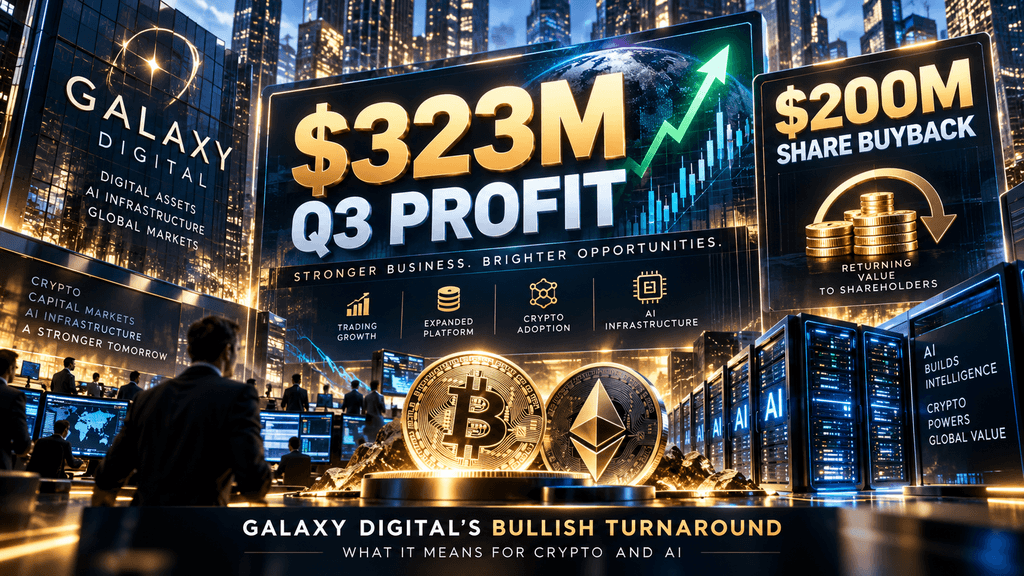
Galaxy Digital (NASDAQ: GLXY) reported $323 million in net income for the third quarter of 2026, reversing an $85 million loss in the previous quarter, while authorizing an additional $200 million share repurchase program. Announced on October 27, the results highlight a company benefiting from stronger cryptocurrency market activity, gains across its investment portfolio, and the growing contribution of its AI data center business. Galaxy also reported $569 million in adjusted gross profit and $455 million in adjusted EBITDA, compared with $43 million and negative $77 million, respectively, in Q2.
Treasury and corporate investments generated the largest share of adjusted gross profit, while the Digital Assets segment continued to report negative adjusted EBITDA. Meanwhile, the Helios data center campus delivered a stronger contribution from long-term leasing operations, giving Galaxy another potential source of recurring revenue. For cryptocurrency investors, the key question is whether the latest results signal sustainable business improvement or primarily reflect favorable market valuations, and how the company's $200 million buyback fits into its longer-term AI infrastructure investment strategy.
-
Galaxy Digital returned to profitability: Q3 net income reached $323 million, compared with a loss of $85 million in Q2 2026.
-
Investment gains drove much of the improvement: Treasury & Corporate generated $419 million in adjusted gross profit, making it the largest contributor to the company's quarterly result.
-
AI infrastructure is becoming a meaningful business: The Data Centers segment produced $79 million in adjusted gross profit and $69 million in adjusted EBITDA during its first full quarter of revenue-generating operations under the Helios I, Phase I lease.
-
A new $200 million buyback adds flexibility: The authorization allows Galaxy to repurchase Class A common shares, but does not require the company to spend the full amount.
-
Crypto operations still face profitability challenges: Digital Assets generated $71 million in adjusted gross profit but reported negative $9 million in adjusted EBITDA.
-
Capital allocation is the central issue: Investors must assess whether Galaxy can balance cryptocurrency market exposure, shareholder returns, and the capital requirements of its expanding data center business.
Galaxy Digital's third-quarter results marked a substantial sequential recovery. Net income rose from a loss of $85 million in Q2 to $323 million in Q3, while adjusted EBITDA improved from negative $77 million to positive $455 million. Adjusted gross profit increased from $43 million to $569 million. The company attributed its performance to stronger Digital Assets operations, significant appreciation across its investment portfolio, and a larger contribution from data centers. These figures suggest that several parts of Galaxy's business benefited from a more favorable operating and market environment, although the contribution of each segment differed considerably.
Net Profit Rebounds to $323 Million
The headline figures show how quickly Galaxy's financial performance can change between quarters. Its $323 million net profit compares with the $85 million loss recorded in Q2, representing a $408 million sequential improvement. Diluted earnings per share reached $0.66, while adjusted earnings per share were $0.83. Investors should distinguish between the two because adjusted EPS is a non-GAAP measure calculated using assumptions about the conversion of outstanding partnership units into Class A common shares. The company also cautioned that its preliminary quarterly figures could change as normal accounting procedures and adjustments were completed.
The balance sheet also expanded significantly. Total assets rose to $16.4 billion from $10.8 billion in Q2, while total equity increased to $3.0 billion from $2.7 billion. Cash, stablecoins, and US Treasury securities totaled $4.9 billion at September 30, up from $2.5 billion at the end of the previous quarter. This liquidity position provides Galaxy with resources to support its businesses and capital allocation plans, but it should not be interpreted as entirely unrestricted cash: the reported total includes several asset categories, and the company has substantial construction commitments and financing obligations associated with its data center expansion.
| Financial metric | Q3 2026 | Q2 2026 |
| Net income / (loss) | $323 million | -$85 million |
| Adjusted gross profit | $569 million | $43 million |
| Adjusted EBITDA | $455 million | -$77 million |
| Total assets | $16.4 billion | $10.8 billion |
| Total equity | $3.0 billion | $2.7 billion |
| Cash, stablecoins, and US Treasuries | $4.9 billion | $2.5 billion |
Source: Galaxy Digital's Q3 2026 financial results. Adjusted gross profit, adjusted EBITDA, and adjusted EPS are non-GAAP measures and should be considered alongside the company's GAAP financial statements.
Galaxy's results become more informative when adjusted gross profit and EBITDA are separated by business segment. Treasury & Corporate contributed $419 million in adjusted gross profit and $395 million in adjusted EBITDA, compared with losses of $42 million and $78 million, respectively, in Q2. Data Centers contributed $79 million in adjusted gross profit and $69 million in adjusted EBITDA, while Digital Assets generated $71 million in adjusted gross profit but recorded negative $9 million in adjusted EBITDA. The breakdown shows that the overall recovery was not evenly distributed: investment gains and data center leasing made substantial contributions, while the core digital asset operating business remained under pressure.
Treasury and Corporate Investments Lead Earnings
Treasury & Corporate was the largest contributor to Galaxy's quarterly profit improvement. The segment holds exposure across digital assets, derivatives, exchange-traded products, publicly traded securities, venture investments, private equity holdings, and funds. Its performance can therefore be influenced by changes in cryptocurrency prices, equity valuations, investment marks, and hedging activity. When those positions appreciate, they can support reported earnings even if fee-based or transaction-based businesses experience more modest growth. Conversely, a market reversal can reduce investment gains or create losses in a later reporting period. The latest result should therefore be understood partly as a reflection of market-sensitive investment exposure, not solely as evidence of improved recurring operating income.
This distinction matters for investors evaluating the quality of Galaxy's earnings. A profitable quarter can demonstrate effective positioning and strong financial performance, but its durability depends on the mix of investment gains and repeatable business revenue. Investors should monitor the segment's future results alongside cryptocurrency prices, realized trading performance, investment valuations, and the company's risk-management disclosures. If investment gains remain strong, they may continue to support earnings; if asset prices weaken, the same exposure can become a source of volatility. Galaxy's Q3 performance is therefore best interpreted as a combination of market-related gains and progress in its operating businesses rather than a guarantee of similarly strong results in future quarters.
Digital Asset Operations Still Face Profitability Challenges
Galaxy's Digital Assets segment generated $71 million in adjusted gross profit, up from $66 million in Q2. Trading volumes rose 12% quarter over quarter, outperforming the broader spot market, where volumes declined. The average loan book increased 27% to $1.8 billion, and the number of trading counterparties rose to 1,763 from 1,741. These indicators point to stronger client activity and demand for trading and financing services. The company also reported $10.4 billion in combined assets under management and assets under stake, up 46% from the previous quarter, although this combined figure includes overlapping assets and is influenced by changes in underlying asset prices.
Despite these improvements, the segment's adjusted EBITDA remained negative at $9 million. That gap between adjusted gross profit and EBITDA indicates that gross profitability alone is not sufficient to demonstrate positive operating earnings after the relevant operating expenses and adjustments. It also makes the segment an important area to watch in subsequent quarters: continued trading growth, financing demand, asset management inflows, and staking adoption would need to translate into stronger operating profitability for the digital asset business to become a more consistent contributor to group earnings. Galaxy's overall net profit should not obscure this distinction.
On October 26, Galaxy's board authorized an additional $200 million share repurchase program. This followed the completion of a previous $200 million program announced in February 2026, under which the company repurchased approximately 9.8 million Class A common shares by October 15. The new authorization gives Galaxy the option to buy additional shares when management considers the timing and price appropriate. It does not mean that the full amount has already been spent, nor does it establish a fixed schedule for future purchases.
How Share Buybacks Affect Shareholders
A share repurchase reduces the number of outstanding shares when the acquired shares are retired or otherwise removed from circulation under the applicable arrangements. This can increase the ownership percentage represented by each remaining share and may support per-share earnings, provided the company's underlying financial performance holds up. A buyback can also communicate management's willingness to allocate capital to its own equity rather than deploy every available dollar into expansion. However, it does not create operating income by itself, and its economic value depends on the price paid, the company's future earnings, and the alternative uses of the funds. If shares are repurchased at an excessive valuation, the transaction may offer limited benefits to continuing shareholders.
Galaxy's new authorization is also discretionary. The company said repurchases may occur through open-market transactions, privately negotiated purchases, or other permitted arrangements. The timing and amount will depend on business conditions, prevailing share prices, market circumstances, and legal and regulatory requirements. The program can be suspended or discontinued, and it does not obligate Galaxy to acquire any specific number of shares. Investors should therefore distinguish the headline $200 million authorization from the actual amount spent and the number of shares repurchased over time.
Capital Returns Versus AI Infrastructure Investment
The buyback raises a broader question about how Galaxy will balance shareholder returns with its capital-intensive expansion. The company has significant construction spending associated with Helios, including a fully financed second phase and additional potential data center capacity. At the same time, it ended Q3 with $4.9 billion in cash, stablecoins, and US Treasuries and reported $3.0 billion in total equity. The existence of substantial liquid assets does not eliminate the need to manage financing carefully, particularly when large infrastructure projects require upfront capital before all future capacity begins generating revenue.
A disciplined capital allocation strategy would evaluate repurchases against expected returns from construction, operating requirements, financing costs, and the potential value of retaining liquidity during market volatility. Galaxy's authorization may offer flexibility to repurchase shares when management sees an attractive opportunity, but the company must also deliver on its infrastructure plans. For investors, the key question is not simply whether Galaxy is buying back shares, but whether it can do so while maintaining adequate financial capacity to complete projects and manage the risks associated with its digital asset exposure.
Galaxy's AI infrastructure business is increasingly important because it offers a different earnings model from cryptocurrency trading and investment gains. The Data Centers segment generated $79 million in adjusted gross profit and $69 million in adjusted EBITDA in Q3, its first full quarter of revenue-generating operations under the Helios I, Phase I lease. All 133 megawatts (MW) of critical IT load covered by the initial lease had been delivered to CoreWeave by the end of Q2. The segment's adjusted EBITDA increased from $11 million in Q2, demonstrating the financial contribution of moving from construction and delivery into revenue-generating operations.
The CoreWeave Contract and Helios Expansion
The Helios project illustrates how Galaxy is seeking to build a longer-term infrastructure business alongside its digital asset franchise. Galaxy CEO Mike Novogratz said during the October 27 earnings call that Phase I was generating approximately $80 million in quarterly leasing revenue. Based on current delivery schedules, management expects the campus to reach an annualized leasing revenue run rate of approximately $800 million to $850 million by the end of 2027 as Phase II capacity comes online. These figures are management expectations, not guaranteed future revenue, and depend on delivery schedules and the terms of the relevant lease arrangements.
Phase II is designed to add 260 MW of critical IT capacity and is fully financed and under construction, with data hall deliveries scheduled to begin in Q2 2027. Galaxy also reported more than 5.7 gigawatts (GW) of potential gross power capacity across its broader development pipeline. In addition, the company is discussing potential leases for 830 MW of approved capacity at Helios II that has not yet been contracted. The distinction between existing leases, capacity under construction, and unleased development capacity is essential: only contracted and delivered capacity can support a more direct assessment of future revenue, while pipeline capacity remains subject to commercial, construction, and power-related milestones.
Can AI Infrastructure Deliver More Predictable Earnings?
Long-term data center leases can provide more visible revenue streams than businesses whose income depends heavily on trading volumes or the prices of digital assets. Once facilities are delivered and operating, contracted payments can help support planning for operating costs and financing. Galaxy's expansion also gives it exposure to growing demand for AI and high-performance computing capacity, potentially diversifying its earnings beyond cryptocurrency-related activities. However, contracted revenue is not the same as risk-free profit: data centers require large upfront investments, ongoing power and maintenance costs, reliable infrastructure, and customers capable of meeting their contractual obligations.
The financial commitment is substantial. Galaxy reported $757 million in quarterly Data Centers capital expenditure in Q3, compared with $448 million in Q2. The segment had approximately $6.8 billion in total assets and $5.3 billion in total liabilities at quarter-end, reflecting continued development and financing activity. Galaxy also completed a $3.5 billion offering of senior secured notes to fund construction of Helios I, Phase II. These figures demonstrate both the scale of the opportunity and the capital requirements involved. Investors should monitor project delivery, customer commitments, financing costs, and cash flow to determine whether the expansion generates attractive returns over time.
Galaxy's results offer a useful example of how a publicly traded company can combine cryptocurrency exposure with AI infrastructure investment. Its Digital Assets business benefits from trading, lending, staking, and institutional demand, while Treasury & Corporate earnings can respond to market valuations. The Data Centers segment, by contrast, depends more directly on construction progress, leased capacity, customer payments, and infrastructure operating costs. These businesses may respond differently to the same macroeconomic environment, giving Galaxy multiple potential sources of growth but also exposing it to several distinct categories of risk.
Bitcoin Prices and Crypto Market Exposure
Cryptocurrency prices remain important because Galaxy maintains exposure to digital assets through spot positions, derivatives, exchange-traded products, and investment vehicles. A broad market rally can improve the value of some portfolio positions and support client trading activity. A sharp downturn can have the opposite effect, although hedges and the mix of holdings may alter the outcome. Q3's investment gains and stronger trading volumes indicate that market conditions helped Galaxy's results, but investors should avoid treating one favorable quarter as proof that the company will remain profitable across every market cycle.
Galaxy is also developing services linked to the wider financial system, including staking, tokenization, custody, and onchain financing. During Q3, it entered a multi-year agreement with BNY to support digital asset infrastructure, including staking for BNY's digital asset custody platform. It also reported more than $160 million in net inflows to asset management during the quarter. These developments matter because fee-based institutional services may offer a different source of income from proprietary investment gains, although their long-term contribution depends on customer adoption, operating costs, and the economics of each service.
GLXY Stock and the AI Infrastructure Investment Trend
Investors evaluating GLXY need to consider both its digital asset business and the valuation of its infrastructure operations. Cryptocurrency-related earnings can be volatile, while data center projects involve long construction timelines, large capital commitments, and expectations about future computing demand. The combination may appeal to investors seeking exposure to both digital assets and AI infrastructure, but it also makes simple comparisons with pure-play cryptocurrency firms or traditional data center operators less straightforward.
The central valuation question is whether the company's infrastructure expansion can produce sufficiently predictable cash flows to complement its more market-sensitive earnings. If Helios deliveries proceed as scheduled and contracted leases generate the expected revenue, data centers could become a more meaningful contributor to the company's financial profile. If construction is delayed, financing costs rise, or future capacity remains unleased, the returns from expansion could be lower than anticipated. The $200 million buyback adds another variable: management must decide how to balance share repurchases against the potential returns from continued infrastructure investment.
The next stage of Galaxy's story will depend on whether the company can sustain its financial recovery while executing its infrastructure plans. Investors should monitor the composition of earnings rather than relying solely on net income, especially because Treasury & Corporate made the largest contribution to Q3 adjusted gross profit. Future results will help show whether investment gains persist, whether the Digital Assets segment can move toward positive adjusted EBITDA, and whether institutional trading, lending, staking, and asset management continue to expand. These operating measures will be important for determining how much of Galaxy's profitability comes from repeatable business activity rather than market-sensitive investment returns.
The second priority is execution at Helios. Phase II deliveries are scheduled to begin in Q2 2027, while the additional 830 MW of approved Helios II capacity remains under discussion with potential tenants. Investors should follow construction milestones, new lease announcements, actual capital expenditure, and management's updates on the timing of future revenue. The third priority is capital allocation: the amount of stock actually repurchased under the new authorization, the company's remaining liquidity, and the cost of financing its infrastructure projects. Together, these indicators can help determine whether Galaxy's diversified business model is translating into sustainable financial strength.
Galaxy Digital's Q3 2026 results show a substantial financial rebound, supported by investment portfolio appreciation, stronger activity in digital asset markets, and a growing contribution from its Helios data center operations. The additional $200 million share repurchase authorization gives management another way to allocate capital, but it does not guarantee future purchases or share-price gains. The more important question is whether Galaxy can maintain sufficient liquidity while funding infrastructure expansion and improving the profitability of its digital asset operations.
For cryptocurrency investors, Galaxy offers a case study in the changing business model of the digital asset industry. Trading and investment exposure remain important, but AI infrastructure, institutional staking, and tokenization may create additional growth opportunities. The next several quarters will show whether these businesses can deliver recurring earnings that complement the company's market-sensitive investment portfolio.
What is Galaxy Digital's stock ticker and where is it listed?
Galaxy Digital trades on Nasdaq under the ticker GLXY. Its business combines digital asset financial services with AI and high-performance computing data center infrastructure.
What is the difference between adjusted gross profit and adjusted EBITDA?
Adjusted gross profit measures profitability after specified direct transaction expenses and other adjustments defined by the company. Adjusted EBITDA goes further by excluding certain items such as interest, taxes, depreciation, amortization, equity-based compensation, and other specified expenses. Both are non-GAAP measures, so they should be reviewed alongside GAAP net income and cash flow rather than treated as replacements for them.
Does Galaxy's CoreWeave partnership mean all planned data center capacity is already leased?
No. The initial 133 MW under the Helios I, Phase I lease had been delivered by the end of Q2 2026, and Phase II is under construction. Galaxy is also discussing potential leases for 830 MW of approved Helios II capacity that has not yet been contracted. Planned or approved capacity should not be confused with delivered, revenue-generating capacity.
Why does Galaxy report both assets under management and assets under stake?
Assets under management generally refer to assets managed through investment products and mandates, while assets under stake represent the notional value of assets bonded to Galaxy's validators. The two measures reflect different services and may overlap. Galaxy's combined figure should therefore not be interpreted as a single pool of distinct assets without considering the company's definitions and overlap disclosures.
What could prevent Galaxy's AI data center business from meeting expectations?
Potential challenges include construction delays, power availability, financing costs, customer concentration, lease execution, and changes in demand for AI and high-performance computing capacity. Even with signed leases, project returns depend on delivery schedules, operating costs, and the company's ability to finance construction on acceptable terms. Galaxy's reported pipeline represents potential capacity, not guaranteed future revenue.
Does the new buyback mean Galaxy expects its stock price to rise?
Not necessarily. A buyback authorization provides management with the option to repurchase shares, but it does not establish a price forecast or guarantee that purchases will occur. The actual outcome depends on execution, the price paid, future business performance, and the company's alternative capital needs.
Disclaimer: This general market information, possibly from third-party, commercial, or sponsored sources, is provided for reference and educational purposes only and does not constitute financial or investment advice, an offer, solicitation, or guarantee. We disclaim liability for its accuracy, completeness, reliability, and any resulting losses. Investments/trading are risky; past performance doesn’t guarantee future results. Users should research, judge prudently, and take full responsibility. For further details, please consult KuCoin’s Terms of Use and Risk Disclosure.