

The Tech Hegemony Shift: How Heatwaves and Power Crunches Forced Crypto Miners to Become Tech Giant Landlords
2026/06/19 09:00:00
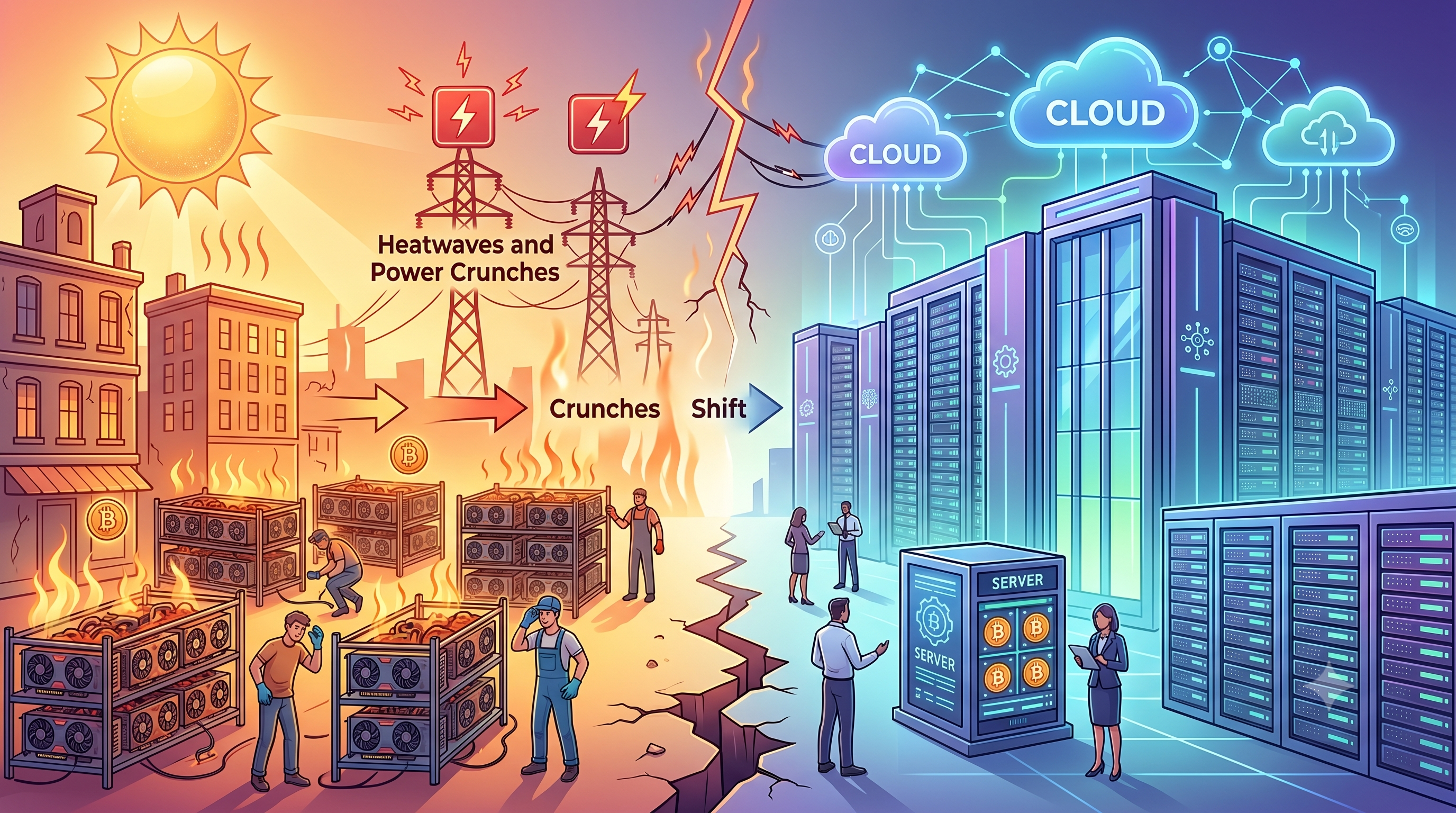
Crypto miners are shifting from Bitcoin production to AI data-center infrastructure as heatwaves, power shortages, and Big Tech demand turn electricity access into one of the most valuable assets in the digital economy.
Crypto mining was once seen mainly as a Bitcoin production business. Miners searched for cheap electricity, installed large numbers of mining machines, and converted energy into BTC. Their success depended on Bitcoin price, electricity costs, mining difficulty, hardware efficiency, and the ability to operate at scale.
That business model is now changing. The rise of artificial intelligence has created a new race for computing power. Big Tech companies, AI startups, cloud providers, and hyperscalers need more data centers, more cooling systems, more land, and above all, more reliable electricity.
As heatwaves and power crunches place more pressure on energy grids, power-ready infrastructure has become one of the most valuable assets in the technology sector. This shift has placed crypto miners in an unexpected position. Many mining companies already control large power contracts, industrial sites, substations, cooling systems, and grid connections.
These assets were originally built for Bitcoin mining. Now, some of them are being repositioned for AI data centers and high-performance computing. The result is a major tech hegemony shift. Crypto miners are no longer only competing to mine Bitcoin. Some are becoming landlords for the AI economy.
The New Power Map Behind the AI Economy
The title of this article points to a bigger change happening across the technology industry. Crypto miners are not becoming AI infrastructure landlords by accident. They are being pulled into this role because the AI boom has made power access one of the most important assets in the digital economy.
For years, tech dominance was shaped by software, platforms, cloud services, and user data. Now, the balance is shifting toward companies that can control physical infrastructure: electricity, land, cooling systems, substations, and grid-ready data-center sites.
This is where crypto miners have become unexpectedly important. Many mining companies spent years building facilities designed to consume large amounts of electricity. These sites were originally built to mine Bitcoin, but in a market where AI companies are competing for power-ready infrastructure, they have taken on a new value.
Heatwaves and power crunches have accelerated this shift. When electricity demand rises and grids become stressed, companies that already control large power capacity gain more leverage. Instead of being seen only as energy-heavy Bitcoin producers, some crypto miners are now being viewed as infrastructure owners that can help Big Tech expand AI capacity faster.
This is the core of the tech hegemony shift: control over the next phase of computing may depend less on digital platforms alone and more on access to the physical systems that keep those platforms running.
How Heatwaves and Power Crunches Changed the Crypto Mining Business
Crypto mining has always been an energy-driven business. For Bitcoin miners, profitability depends not only on the price of Bitcoin, but also on electricity costs, mining machine efficiency, network difficulty, and the ability to keep hardware running at scale. When power is cheap and stable, miners can operate with stronger margins. When electricity becomes expensive or unreliable, the business model quickly comes under pressure.
Heatwaves Made Mining More Expensive and Harder to Operate
Heatwaves have made this challenge more serious. During periods of extreme heat, electricity demand rises as households, offices, factories, and cities rely more heavily on air conditioning. At the same time, mining facilities also need stronger cooling systems to keep machines from overheating.
This creates a difficult situation for miners: electricity becomes more expensive exactly when energy-intensive operations need it most. Higher cooling demand, grid stress, and peak power prices can reduce mining profitability and force some operators to pause machines, limit expansion, or search for more flexible business models.
For mining companies, heat is not only a weather problem. It is a financial pressure point. When machines run hot, efficiency can fall, maintenance costs can rise, and operating schedules may become harder to manage. This makes energy planning and cooling capacity more important than ever.
Power Access Became More Valuable Than Mining Machines
Power crunches have changed how miners think about their assets. In the past, many mining companies focused mainly on expanding hash rate and adding more machines. But as grids become more stressed, the most valuable asset is no longer only the mining equipment. It is access to large amounts of electricity through power contracts, substations, land, cooling systems, and grid connections.
This shift has pushed some miners to rethink their role in the digital economy. Instead of only using electricity to mine Bitcoin, they are now looking for ways to monetize their power infrastructure in more stable ways. AI data centers and high-performance computing have become attractive alternatives because Big Tech companies need fast access to power-ready sites.
The result is a major change in the mining business. Crypto miners are moving from a pure Bitcoin production model toward a broader infrastructure model. Their facilities are no longer just mining farms. In some cases, they are becoming energy-backed campuses that can support AI workloads, cloud computing, and enterprise data-center demand.
Why Big Tech Is Turning Crypto Miners Into AI Infrastructure Landlords
Big Tech companies are racing to expand AI infrastructure, but the biggest obstacle is no longer only access to advanced chips. It also has access to electricity, land, cooling capacity, and grid-ready data-center sites. AI workloads require large amounts of continuous power, and building new data centers from the ground up can take years because of permitting, grid interconnection delays, equipment shortages, and local approval processes.
Crypto miners already have many of the assets that AI companies need. Many mining firms spent years building facilities near cheap electricity, securing power contracts, installing substations, and operating high-density computing sites. These locations were originally designed to run Bitcoin mining machines, but some can be upgraded or converted for AI and high-performance computing workloads.
Big Tech Needs Fast Access to Power-Ready Sites
AI companies and cloud providers cannot wait years for every new data-center project to be built from zero. They need locations that already have large-scale power access and industrial infrastructure in place. This is where crypto miners become useful.
A mining company with land, energy agreements, grid connections, and existing power equipment can offer Big Tech a faster path to capacity. Instead of only selling Bitcoin production to the market, miners can lease their infrastructure to AI companies that need space for GPUs, servers, cooling systems, and cloud workloads.
This turns miners into infrastructure landlords. They may not own the AI models or the cloud platforms, but they can control the physical sites needed to run them. In the AI race, a power-ready location can be as important as the computing hardware itself.
Miners Can Turn Volatile Mining Assets Into Stable Leasing Revenue
Bitcoin mining revenue can be unpredictable because it depends on Bitcoin price, mining difficulty, halving cycles, transaction fees, and electricity costs. When market conditions weaken, mining margins can fall quickly.
AI infrastructure leasing offers a different opportunity. Long-term contracts with hyperscalers, cloud providers, or enterprise AI firms may provide more predictable revenue than mining Bitcoin alone. For public mining companies, this can make the business look less like a pure crypto-cycle bet and more like a digital infrastructure company.
This is why Big Tech is turning miners into AI infrastructure landlords. The AI boom needs power-ready real estate, and crypto miners already control some of the energy-backed sites that can support the next phase of computing.
From Bitcoin Mining to Data-Center Leasing: The New Revenue Model
For years, crypto miners made money by converting electricity into Bitcoin. Their revenue depended on how many coins they could mine, how efficient their machines were, and whether Bitcoin prices stayed high enough to cover electricity and operating costs. This made the business highly sensitive to market cycles.
Now, some miners are shifting toward a different model: leasing energy-backed infrastructure to AI companies, cloud providers, and high-performance computing customers. Instead of relying only on Bitcoin rewards, they can earn revenue by providing power capacity, data-center space, cooling infrastructure, and long-term hosting services.
Leasing Infrastructure Can Create More Predictable Cash Flow
Bitcoin mining income can change quickly because it is tied to Bitcoin price, mining difficulty, transaction fees, and halving cycles. When market conditions weaken, mining margins can shrink even if a company continues running the same machines.
Data-center leasing offers a more stable alternative. If a miner signs long-term agreements with AI or cloud customers, the company may earn recurring revenue from infrastructure access rather than depending only on daily mining economics. This can make the business more attractive to investors looking for predictable cash flow.
This new model also changes how mining companies present themselves. Instead of focusing only on hash rate growth, they may highlight megawatts under development, contracted power capacity, data-center campuses, AI tenants, and high-performance computing revenue.
Miners Are Becoming Hybrid Infrastructure Companies
This shift does not mean every miner will stop mining Bitcoin. Instead, many companies may become hybrid operators. They can continue mining when conditions are profitable while also developing AI data-center capacity on the same or nearby sites.
In this new model, the most valuable assets are not only ASIC miners or hash rate. They are power contracts, grid connections, industrial land, substations, cooling systems, and the ability to deliver large-scale compute infrastructure. That changes how the market values mining companies.
A miner is no longer judged only by how much Bitcoin it can produce. It is also judged by how much power it controls, how quickly it can build data-center capacity, and whether it can attract long-term AI or cloud customers.
What This Tech Hegemony Shift Means for Crypto, AI, and the Power Grid
The shift from Bitcoin mining to AI infrastructure shows how digital power is becoming physical again. In the past, technology dominance was mostly linked to software, platforms, users, data, and cloud services. Now, the AI boom is making electricity, land, cooling systems, and grid access just as important.
For crypto miners, this creates a new identity. They are no longer only Bitcoin producers. Some are becoming energy-backed infrastructure companies that can serve AI firms, cloud providers, and hyperscalers. This may reduce their dependence on Bitcoin market cycles, but it also means investors must analyze them differently. A miner with strong power assets may be valued more like a data-center company than a pure crypto stock.
Crypto Miners May Become Less Dependent on Bitcoin Cycles
Bitcoin mining will still remain important for the crypto industry, but the business model is becoming more diversified. When miners lease infrastructure to AI or cloud customers, they can create revenue streams that are not directly tied to Bitcoin price, mining difficulty, or halving cycles.
This could make some mining companies more stable over time. However, it may also weaken their identity as pure Bitcoin mining firms. A company that earns more from AI data-center leasing than mining may no longer move only with the crypto market. Instead, its value may depend on power contracts, tenant demand, construction timelines, and data-center execution.
For crypto investors, this makes the sector more complex. Mining stocks may no longer act only as leveraged Bitcoin exposure. Some may behave more like infrastructure, energy, or data-center companies.
AI Growth Will Put More Pressure on the Power Grid
For the AI industry, crypto miners offer faster access to power-ready sites. But this also raises bigger questions for the power grid. AI data centers require large amounts of reliable electricity, and rapid expansion can increase pressure on local utilities, transmission systems, and energy prices.
This means the future of AI infrastructure will depend not only on chips and models, but also on energy planning. Regions with strong grids, affordable power, and clear data-center policies may attract more investment. Regions with limited capacity may face delays, local opposition, or stricter regulation.
The tech hegemony shift is therefore not just about crypto miners finding a new business model. It is about a larger change in the digital economy. Power access is becoming a strategic asset, and the companies that control energy-ready infrastructure may play a larger role in shaping the next phase of AI and crypto growth.
Conclusion
Crypto miners built their first major business around turning electricity into Bitcoin. Now, the AI boom is giving some of them a new role in the digital economy.
Heatwaves, power crunches, and grid stress have exposed a key reality: the future of technology depends on physical infrastructure. Electricity, land, cooling capacity, and grid access are becoming as important as algorithms, chips, and software platforms.
This is why some crypto miners are becoming attractive to Big Tech. Their power-ready sites, industrial campuses, and energy-market experience can help AI companies expand faster in a world where grid access is becoming harder to secure.
The shift does not mean Bitcoin mining is over. But it does mean the mining business is changing. In the next phase of digital infrastructure, the companies that control power may become the landlords of artificial intelligence.
Frequently Asked Questions
Why are crypto miners moving into AI data centers?
Crypto miners are moving into AI data centers because many already control large power contracts, industrial land, substations, cooling systems, and grid connections. These assets were originally used for Bitcoin mining, but they are now valuable to AI companies that need fast access to power-ready infrastructure.
How did heatwaves affect the crypto mining business?
Heatwaves increase electricity demand because homes, businesses, and cities use more cooling. At the same time, mining machines also need stronger cooling to operate safely. This can raise power costs, reduce mining margins, and make energy-intensive mining operations harder to manage.
Why does Big Tech need crypto miners?
Big Tech needs crypto miners because AI data centers require huge amounts of reliable electricity. Building new data centers from scratch can take years, while some crypto miners already have power-ready sites that can be upgraded for AI and high-performance computing workloads.
Are crypto miners becoming landlords for AI companies?
Yes, some crypto miners are becoming infrastructure landlords by leasing power capacity, data-center space, cooling systems, and industrial sites to AI companies or cloud providers. Instead of only earning revenue from Bitcoin mining, they can generate income from long-term infrastructure agreements.
Does this mean Bitcoin mining is ending?
No, Bitcoin mining is not ending. Efficient miners with low-cost electricity can still remain competitive. However, some mining companies are diversifying their business models by adding AI data-center leasing and high-performance computing services.
Why is power access becoming so important in the AI economy?
Power access is becoming important because AI models and data centers require large amounts of continuous electricity. As grids become more stressed, companies with reliable power contracts, land, substations, and cooling capacity may gain a strategic advantage.
What does this shift mean for investors?
This shift means investors may need to look at crypto miners differently. In the past, mining companies were often valued mainly as Bitcoin-linked stocks. Now, some may be valued more like digital infrastructure or data-center companies, depending on their power assets, AI customers, and long-term leasing potential.
Disclaimer: This article is for informational purposes only and is not financial advice. Cryptocurrency investments are highly volatile and carry risk. Readers should do their own research before making any investment decisions.