

CoW Protocol (COW) Surges 55% as Trading Volume Spikes: What’s Behind the Rally?
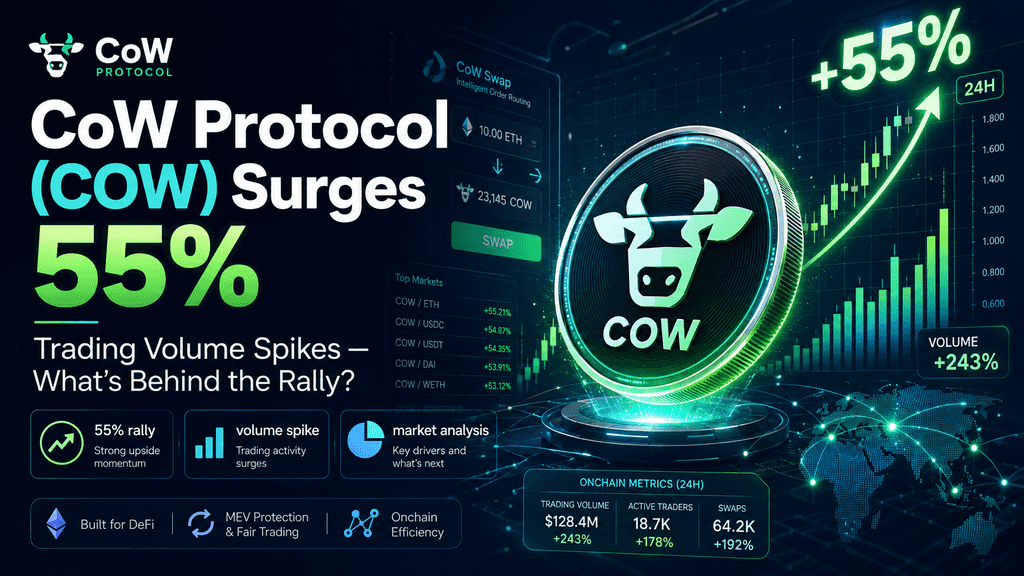
CoW Protocol’s COW token became one of the crypto market’s standout movers after surging roughly 55% within a 24-hour window on August 15, 2026. The rally carried COW from around the $0.10–$0.11 range toward intraday highs near $0.17–$0.19, while trading activity increased dramatically. At one point, market data cited by KuCoin showed COW’s trading volume running about 15.8 times above its recent seven-day average.
Yet the move came with an unusual twist: there was no obvious major exchange listing, airdrop, protocol upgrade, or other headline announcement that could neatly explain a 55% repricing. COW also gave back a substantial portion of its gains shortly afterward, raising an important question for traders. Was this a genuine reassessment of CoW Protocol’s improving fundamentals, or was it primarily a liquidity- and momentum-driven rally? Understanding the answer requires looking beyond the price candle at the trading activity, protocol economics, token buybacks, and the still-evolving relationship between CoW Protocol’s success and the COW token itself.
What Happened to COW Price?
COW entered the August 15 session trading around the low-$0.10 range before accelerating sharply higher. Depending on the exchange and the exact rolling 24-hour window, market trackers showed gains ranging from roughly 35% to more than 50%, with some readings putting the peak increase close to 55%. The token briefly traded in the $0.17–$0.19 area before momentum faded and sellers began taking profits.
Different percentage figures do not necessarily indicate conflicting data. Crypto platforms generally calculate 24-hour performance on a rolling basis, meaning a token could show a 37% gain at one point and a 55% gain several hours later as the comparison price changes. The broader picture was clear regardless of the exact snapshot: COW experienced one of its largest short-term moves in recent trading, accompanied by an unusually large increase in turnover.
| Metric | What Happened |
| Pre-rally range | Around $0.10–$0.11 |
| Intraday peak | Roughly $0.17–$0.19 |
| Peak 24-hour move | Around 55% in some market snapshots |
| Trading activity | Far above recent averages |
| Follow-up move | Significant pullback after the spike |
The price jump attracted attention, but the more revealing signal was the volume behind it. A large green candle can sometimes result from thin liquidity alone. A large green candle combined with a sharp expansion in turnover suggests that market participation changed materially.
Why Did Trading Volume Explode?
Market data cited during the rally showed COW’s 24-hour volume reaching roughly 15.8 times its recent seven-day average. That type of increase suggests substantially more traders were interacting with the token than during a typical session. It does not, however, tell us who those traders were or whether they were building long-term positions.
Trading volume includes both sides of the market. A surge can reflect new buyers entering, existing holders selling into strength, arbitrage activity, leveraged traders opening positions, short sellers closing positions, momentum traders chasing the breakout, or early buyers taking profits. The same tokens can also change hands several times during a highly speculative session, allowing turnover to rise far faster than the amount of capital actually entering the asset.
COW’s market structure makes that especially relevant. Compared with assets such as Bitcoin, Ether, or Solana, COW has a much smaller market capitalization and thinner liquidity. Concentrated demand can therefore have a much larger effect on price. In simple terms, smaller market capitalization + thinner liquidity + sudden speculative demand can produce outsized moves. Volume helps explain how the rally became so large, but it still leaves the harder question: what caused traders to focus on COW in the first place?
Was There a Clear Catalyst Behind the Rally?
No single major catalyst has been clearly identified as the direct cause of the August 15 surge. There was no same-day announcement of a major exchange listing, large airdrop, transformative protocol launch, new financing round, or dramatic token burn that would naturally explain a 55% move. Binance, for example, had already listed COW well before this rally, so the price increase cannot reasonably be attributed to a fresh Binance listing.
That makes a reflexive, market-led explanation more plausible. Once COW broke out of its previous trading range, rising prices may have attracted momentum traders and renewed social attention. That additional demand could then have pushed prices higher, drawing in further speculation. Short sellers covering positions and leveraged traders entering the market may also have added fuel. The sequence can become self-reinforcing: price breakout → attention → higher volume → FOMO → more positioning → further price gains.
This should not be treated as a confirmed explanation from CoW Protocol or CoW DAO. It is a market-structure interpretation based on the absence of an obvious major catalyst and the pattern of price and volume activity. What makes the rally more interesting, however, is that traders were not speculating on an asset with no underlying story. CoW Protocol has been building a comparatively strong DeFi fundamental narrative.
What Is CoW Protocol and Why Does It Matter?
CoW Protocol is an intent-based trading infrastructure designed to improve how users execute onchain swaps. Traditional decentralized exchanges generally require transactions to be routed through available liquidity pools or aggregators. CoW Protocol instead allows users to express the result they want and leaves specialized market participants to compete over how best to achieve that result.
Intent-Based Trading Explained
When a trader submits an order through CoW Protocol, they are effectively expressing an intent: for example, sell a certain amount of ETH for at least a specified amount of USDC. Independent entities known as solvers compete to find the most efficient execution. They can search across available liquidity sources, combine different routes, and attempt to deliver a better outcome than a rigid swap path might provide.
The architecture moves complexity away from the user. Instead of requiring traders to understand every liquidity venue, routing option, or execution path, solvers compete in the background. This approach fits into the broader growth of intent-based infrastructure across DeFi, where protocols increasingly focus on what users want to achieve rather than forcing them to manually specify every transaction step.
Coincidence of Wants and MEV Protection
The “CoW” in CoW Protocol stands for Coincidence of Wants. If one user wants to sell ETH for USDC while another wants to sell USDC for ETH, the protocol can potentially match some or all of those opposing needs directly rather than sending both trades independently through an automated market maker. When suitable matches exist, this can reduce unnecessary interaction with external liquidity.
CoW Protocol also emphasizes protection against harmful forms of maximal extractable value, or MEV, such as front-running and sandwich attacks. Users sign trade intents rather than exposing a predetermined execution path for searchers to exploit. Solvers then compete to execute the order under the user’s stated conditions. Together, solver competition, intent-based execution, and MEV protection give the protocol a differentiated position within decentralized trading infrastructure.
Are CoW Protocol’s Fundamentals Improving?
The fundamental case behind CoW Protocol has strengthened over time. The project’s core team said in 2026 that products within the CoW ecosystem had processed more than $200 billion in cumulative trading volume and more than 12 million transactions. Since the ecosystem began generating meaningful revenue, CoW Swap, MEV Blocker, and related products have also produced tens of millions of dollars in cumulative revenue, according to CoW DAO discussions.
These figures matter because they show that CoW Protocol is not relying only on token speculation. Users are actually trading through the infrastructure, solvers are competing for execution, and the ecosystem is monetizing activity. Expansion across chains and integrations with additional assets can further increase the amount of trading flow addressable by the protocol.
| Fundamental Area | Why It Matters |
| Trading volume | Shows demand for protocol execution |
| Transaction count | Indicates recurring user activity |
| Protocol revenue | Demonstrates monetization |
| Solver competition | Supports efficient execution |
| MEV protection | Provides product differentiation |
| Multi-chain expansion | Expands potential user and liquidity base |
Those fundamentals can help explain why investors might be willing to revisit COW’s valuation when market attention returns. But they should not be confused with a same-day catalyst. Strong protocol metrics accumulated over months or years do not prove that they directly caused a 55% price increase during one trading session.
What Role Do COW Buybacks Play?
One of the more interesting pieces of COW’s tokenomics is the DAO’s use of protocol revenue for token purchases. Since 2024, CoW DAO has used part of its revenue to buy COW from the market, helping offset tokens distributed as incentives to solvers. This creates a relationship between protocol activity and token supply that is more concrete than governance utility alone.
According to a 2026 CoW DAO recap, cumulative buybacks had reached roughly 78.6 million COW, compared with around 66.6 million COW distributed through solver emissions over the measured period. In other words, buybacks had exceeded the corresponding solver emissions, resulting in negative net emissions across that period rather than persistent dilution.
That dynamic is attractive to token investors because growing protocol activity can generate more resources that may be used to offset token issuance. But the distinction remains important: token buybacks are not the same as profit distributions to token holders. They can influence supply dynamics and potentially support demand, but owning COW does not automatically provide a direct contractual claim on CoW Protocol’s revenue.
Does COW Actually Capture the Protocol’s Value?
This is arguably the most important long-term question for the token. CoW Protocol can increase trading volume, attract users, improve execution, and generate revenue without necessarily causing the COW token to appreciate at the same rate. A successful protocol and a successful token are related concepts, but they are not interchangeable.
COW currently plays roles in governance, ecosystem incentives, and the broader economic design of the protocol. Buybacks provide one mechanism through which protocol economics can affect token supply. Yet COW is not equivalent to an equity share that directly entitles its holder to a percentage of corporate profits. That distinction is particularly important when investors compare protocol revenue with COW’s market capitalization and attempt to apply traditional valuation ratios.
CoW DAO has been exploring a broader COW Value Distribution Mechanism, reflecting awareness of this issue. The key question is not whether the protocol can generate economic activity—it already does—but how much of that activity can ultimately accrue to token holders in a sustainable and legally viable way. Clearer value capture could become a far more important long-term catalyst than any single short-term price spike.
Was the Rally Driven by Fundamentals or Speculation?
The most reasonable interpretation is that both played a role, but in different ways. CoW Protocol’s underlying fundamentals provide a credible narrative: real trading activity, protocol revenue, solver competition, MEV protection, token buybacks, and a growing discussion around value distribution. Those factors can make COW more attractive when traders begin searching for underfollowed DeFi assets.
The size and speed of the rally, however, are harder to explain through fundamentals alone. No major new fundamental announcement appeared at the same time as the surge. Meanwhile, COW’s relatively modest market capitalization, thinner liquidity, abrupt volume expansion, and rapid post-rally pullback are all consistent with a move that was heavily amplified by market structure and speculative positioning.
| Factor | Likely Role in the Rally |
| Protocol fundamentals | Supported the broader investment narrative |
| Token buybacks | Added interest around supply dynamics |
| Sudden volume spike | Amplified price discovery |
| Thin liquidity | Increased price sensitivity |
| Momentum and FOMO | Likely accelerated the move |
| Major new catalyst | No clear one was identified |
A useful way to summarize the episode is: fundamentals may have provided the story, while market structure provided the 55% candle. COW was not rallying around an empty narrative, but neither is there evidence that its fundamental value suddenly improved by 55% within one day.
Why Did COW Give Back So Much of the Gain?
The sharp pullback after the rally strengthens the argument that speculative momentum was an important part of the move. After reaching the upper-$0.10 range, COW quickly fell back toward levels much closer to where the rally began. Trading activity also cooled considerably from the extraordinary levels seen during the initial spike.
This pattern is common after a rapid move in a smaller-cap token. Early buyers take profits, late momentum traders face losses, leveraged positions unwind, and buyers become less willing to chase at elevated prices. Once volume begins falling, a market that previously moved sharply higher because of concentrated demand can reverse quickly for the same liquidity-related reasons.
A more durable fundamental repricing usually becomes easier to identify after the initial volatility passes. The key question is not whether COW can print a large green candle, but whether it can establish and defend a sustainably higher trading range while protocol metrics continue improving. The speed of the retracement suggests the August surge alone was not enough to confirm that kind of long-term repricing.
Can the COW Rally Continue?
For COW to turn a short-lived surge into a more durable trend, trading activity would need to remain healthy without depending entirely on sudden speculative bursts. A rally accompanied by gradually improving liquidity, sustained participation, and repeated buying at higher price levels would look very different from a one-day spike followed by collapsing turnover.
Protocol fundamentals would also need to keep developing. Continued growth in CoW Protocol trading volume, revenue, solver participation, multi-chain activity, and user adoption would strengthen the case that increasing token interest is connected to genuine economic expansion. The development of a clearer COW value distribution mechanism could be particularly important because it would help answer how growing protocol success translates into tokenholder value.
The bearish scenario is simpler. If trading volume normalizes quickly, COW fails to hold higher price levels, and no meaningful new protocol or tokenomics catalyst appears, the August move may ultimately be remembered as a liquidity-driven momentum rally rather than the start of a lasting valuation shift. Investors should therefore pay more attention to what happens after the spike than to the size of the spike itself.
What Should COW Traders Watch Next?
Market activity remains the first area to watch. Traders can monitor whether COW’s volume stays meaningfully above its earlier baseline, whether price can rebuild support above pre-rally levels, and whether another increase in derivatives or spot activity accompanies future breakouts. A price rise without renewed volume would generally provide weaker evidence of broad market participation.
Protocol data may ultimately matter more. Continued growth in CoW Protocol trading volume, transaction activity, revenue, solver competition, and chain expansion would provide stronger evidence that the underlying ecosystem is gaining economic importance. These metrics help separate the protocol’s long-term trajectory from the short-term volatility of its token.
Tokenomics is the third area. Investors should watch future COW buyback execution, solver emissions, and progress around value distribution proposals. For COW, the next meaningful fundamental catalyst may come not from another sudden market candle but from a clearer answer to how protocol economics can create lasting demand or reduced net supply for the token.
The Bigger Picture for CoW Protocol
The COW rally also highlights growing interest in the broader intent-based trading narrative. DeFi has traditionally required users to deal with concepts such as routing, slippage, liquidity fragmentation, gas costs, and MEV. Intent systems attempt to abstract much of that complexity by allowing users to state their desired outcome and letting specialized execution networks determine how to achieve it.
That model could become increasingly important as onchain liquidity spreads across more networks and venues. Instead of requiring users to understand every underlying pool or bridge, competing solvers can potentially coordinate execution across a fragmented market. CoW Protocol’s existing trading activity gives it a meaningful position within that emerging architecture.
For investors, this means the more important question is not whether COW can rise another 50% in a day. It is whether CoW Protocol can become a lasting execution layer for onchain markets—and whether the economic value created by that role eventually translates into sustainable value for the COW token. That question will take much longer than a single trading session to answer.
Conclusion
COW’s roughly 55% surge was real, and the accompanying explosion in trading volume showed that the move attracted genuine market participation. What remains less certain is why that participation appeared so suddenly. No single major announcement has emerged as a convincing explanation, making a combination of existing bullish fundamentals, thin liquidity, momentum trading, and speculative demand the more plausible interpretation.
CoW Protocol itself has a stronger fundamental story than many tokens that experience similar short-term rallies. It has meaningful trading activity, protocol revenue, an established solver network, MEV-focused execution, token buybacks, and ongoing work around value distribution. But strong protocol fundamentals do not automatically validate every short-term token move.
For COW to undergo a lasting repricing, the market will need more than another volume spike. Continued protocol growth, clearer token value capture, disciplined supply dynamics, and sustained demand will ultimately matter far more than one 55% candle.
FAQs About CoW Protocol (COW)
Is COW the Same as CoW Swap?
No. CoW Swap is the user-facing trading interface, while CoW Protocol is the underlying trading infrastructure. COW is the ecosystem’s governance and utility token.
What Is the Maximum Supply of COW?
COW has a maximum supply of 1 billion tokens. The circulating supply is lower because not all tokens have entered the market.
Can COW Holders Earn Native Staking Rewards?
COW should not automatically be treated as a conventional proof-of-stake token with protocol-level staking rewards. Third-party platforms may offer yield products involving COW, but those carry separate risks and should not be confused with native protocol staking.
Who Created CoW Protocol?
CoW Protocol grew out of the Gnosis ecosystem and was later developed under CoW DAO. The project evolved from research into batch auctions and Coincidence of Wants into a broader intent-based trading protocol.
Is CoW Protocol Only Available on Ethereum?
No. CoW Protocol has expanded beyond Ethereum as part of its multi-chain strategy. Supported networks can change over time, so traders should check the protocol’s current interface or documentation before trading.
🔥 KuCoin Offers A More Stable Option in A Volatile Market
If you worry about the frequent ups and downs in the market, and pursue a more stable option to earn money passively, KuCoin is the right place to come:
Simple Earn: Deposit and withdraw tokens anytime, earning stable returns.
Kucoin Earn: Earn stable profits with professional asset management.
Hold to Earn: Earn rewards by holding assets in Funding, Trading, Margin, Futures, Mining, and Unified Accounts.
Staking: Unlock the earning potential of on-chain assets.
Advanced Investments: Advanced Investments offer a variety of structured products to help your money grow in any market.
Shark Fin: Principal Protection and Guaranteed Gains
Dual Investment: Buy low and sell high with transparent return calculations.
Snowball: High yields, with price protection.
Discount Buy: Buy crypto at discount prices.
KCS Loyalty: Level up to enjoy exclusive perks by staking ≥ 1 KCS.
KuCoin Wealth: Discover future value and begin your smart investing journey.
KCS Benefits: Hold and stake KCS to access benefits across the platform.
KCS Staking 2.0: Participate in KCS on-chain governance to earn yield.
Disclaimer: This content is for informational purposes only and does not constitute investment advice. Cryptocurrency investments carry risk. Please do your own research (DYOR).