

Why CoreWeave Bonds Collapsed to Record Lows Amid Renewed AI Debt Fears
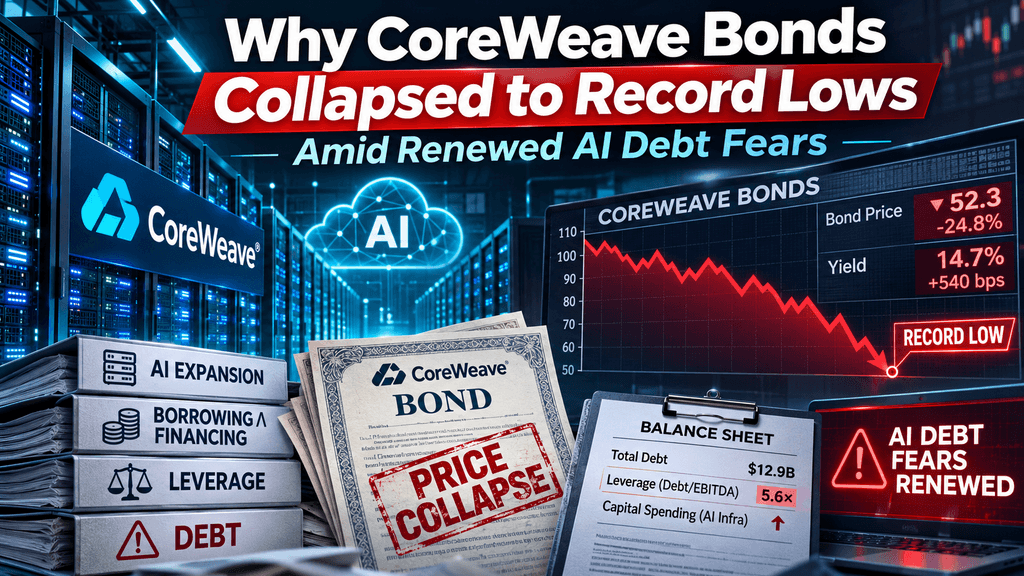
CoreWeave Inc.’s high-yield bonds fell to record lows on November 24, 2026, making the company one of the biggest losers in the corporate credit market that day. The decline showed growing concerns about the financial risks of the AI infrastructure boom, particularly as companies borrow heavily to expand their operations. Several of CoreWeave’s bonds moved deeper into distressed territory, with yields climbing toward or above 17% to 18%.
The sell-off shows the pressure facing AI infrastructure providers as they invest heavily in data centers, advanced chips, and power capacity to meet rising demand. While companies such as CoreWeave have secured major customer commitments, their expansion depends on continued demand and access to financing. As borrowing costs rise and bond prices fall, investors are paying closer attention to whether future revenue can support the debt accumulated during this quick expansion.
Key Takeaways
-
CoreWeave’s major bonds fell 3–4.6 points on Nov. 24 to lifetime lows near 75–81 cents on the dollar.
-
The drop erased Monday gains tied to Nvidia’s reinstatement of Jensen Huang as CEO.
-
Yields climbed toward 17–18%, while five-year CDS spreads implied high default odds.
-
Q3 revenue surged 168% to $3.66 billion with a $132.5 billion backlog, yet net interest expense hit $846 million.
-
High leverage, large capex guidance, and reliance on debt financing remain central investor concerns.
-
A planned Meta-backed loan highlights ongoing access to secured financing at lower spreads.
Why Did CoreWeave Bonds Hit Record Lows on November 24, 2026
Trading data from Trace showed CoreWeave’s 9% notes due 2031 falling as much as 3.6–3.69 points to around 76.4–76.6 cents on the dollar, marking their lowest level since they were issued in July 2025. The company’s 9.625% notes due 2032 also dropped as much as 4.6 points to 74.9 cents, their weakest level since launching in June 2026. Meanwhile, the 9.75% notes due 2031 lost 3.75 points to 76.3 cents, while the 9.25% notes due 2030 declined 3 points to 80.9 cents. Both also touched record lows.
The declines were among the steepest moves in the corporate bond market that day, wiping out the gains recorded during the previous session. That earlier recovery came after news that Nvidia’s board had reinstated Jensen Huang. However, sentiment had changed considerably by the close of Tuesday's trading, with later reports showing yields on some of CoreWeave's bonds approaching or even exceeding 17–18%.
The sharp reversal highlights growing investor concerns about how sustainable AI-related spending will be, particularly for infrastructure providers carrying substantial debt. With borrowing costs remaining high and competition for power and semiconductor supplies intensifying, investors are paying closer attention to whether companies like CoreWeave can generate enough revenue to meet their growing financing obligations.
How Far Did CoreWeave’s Key Bonds Fall, and What Do the Prices Mean
At the reported lows, CoreWeave’s four main dollar-denominated notes, with a combined face value of approximately $7.75 billion, were worth around $6 billion in total. This put their average market value at roughly 77 cents for every dollar of debt issued.
Longer-dated bonds recorded the biggest declines, showing greater investor concerns about the risks associated with holding debt over a longer period and the company's ability to refinance its obligations.
Bond name, maturity date, approx. low price, and point decline below:
|
Bond
|
Maturity
|
Approximate Low Price (cents)
|
Point Decline
|
|
9.25% Senior Notes
|
Due 2030
|
80.9
|
3
|
|
9.00% Senior Notes
|
Due 2031
|
76.4–76.6
|
~3.6
|
|
9.75% Senior Notes
|
Due 2031
|
76.3
|
3.75
|
|
9.625% Senior Notes
|
Due 2032
|
74.9
|
4.6
|
These prices show that the unsecured bonds are now trading well below what investors would normally consider healthy market levels. At this point, investors are less concerned about the interest payments and more focused on how much they could recover if the company runs into financial trouble, what assets are available to support the debt, and whether it can refinance or manage its growing debt. For a company still spending heavily to expand its capacity, these low prices could make future borrowing more expensive and put additional pressure on its stock valuation.
What Role Did Nvidia’s Leadership News Play in the Bond Sell-Off
Monday’s session had delivered gains across CoreWeave’s curve after Nvidia’s board reinstated Jensen Huang as president and CEO following a brief absence. Nvidia is both a significant equity investor in CoreWeave and its primary supplier of GPUs, and it has provided certain capacity-purchase commitments. The market initially interpreted the leadership continuity as supportive for the broader AI ecosystem.
Tuesday’s reversal demonstrated that the positive catalyst proved short-lived in credit markets. Fixed-income investors appeared more focused on fundamental leverage metrics, interest-expense trajectories, and the sheer scale of ongoing capital deployment than on near-term equity sentiment. The episode illustrated a divergence: equity markets can react swiftly to high-profile leadership or partnership news, while credit markets often demand clearer evidence of improving free-cash-flow generation and reduced refinancing risk before sustaining rallies.
How Do CoreWeave’s Recent Financial Results Explain the Credit Pressure
In its third-quarter 2026 results, CoreWeave reported revenue of $3.66 billion, a 168% year-over-year increase that exceeded the company’s prior guidance range. Contracted revenue backlog stood at $132.5 billion at the end of September, up sharply from earlier in the year and providing multi-year visibility. Adjusted operating income improved, and the company raised full-year revenue guidance to $13.0–$13.3 billion.
Offsetting these positives was a net loss of $709 million, driven in large part by net interest expense of $846 million, up 173% from the prior-year period. Management guided fourth-quarter interest expense to $1.05–$1.15 billion and full-year capital expenditures to $37–$39 billion. Total debt approximated $47 billion at quarter-end, with a meaningful portion due in the near term. The combination of rapid top-line growth, substantial contracted demand, and still-elevated cash interest and investment needs has left credit investors focused on the path to sustainable free-cash-flow generation.
Why Are AI Infrastructure Companies Facing Heightened Debt Scrutiny
The AI build-out has required unprecedented capital intensity. Specialized providers such as CoreWeave have financed large GPU fleets and data-center capacity through a mix of secured delayed-draw term loans, high-yield bonds, convertible notes, and customer prepayments. While long-term contracts and residual-value arrangements (including certain Nvidia capacity commitments) provide revenue visibility, the absolute scale of leverage has made the sector sensitive to any perceived slowdown in AI spending or rise in borrowing costs.
Credit markets have repeatedly tested these structures. Earlier in the autumn, CoreWeave bonds had already traded at yields above 15% and CDS spreads near or above 1,000 basis points, levels that historically signal distress. The November 24 move extended that pressure and spilled into related names, with broader hyperscaler CDS baskets also widening. Investors are effectively asking whether contracted backlog will convert into cash flows quickly enough to cover interest, principal amortization, and continued expansion without further equity or high-cost debt issuance.
What Does the Spike in Credit Default Swaps Signal for CoreWeave
Five-year credit-default-swap spreads on CoreWeave widened sharply around the bond sell-off, with reports of levels exceeding 1,200 basis points and, in some sessions, pricing implied default probabilities above 60–70% over five years. Such levels place the name in clear distressed territory and raise the cost of any new unsecured or hybrid capital.
CDS markets often lead cash-bond markets in expressing risk aversion because they allow leveraged positioning and rapid transfer of credit exposure. For CoreWeave, the widening coincided with equity declines of roughly 12% on November 24 (shares closed near $42.61) and continued pressure in subsequent sessions. Elevated CDS pricing can also influence bank lending appetite and the terms of any new secured facilities, even if those facilities benefit from strong collateral packages.
How Does CoreWeave’s Capital Structure Balance Secured and Unsecured Debt
CoreWeave’s funding mix includes parent-level high-yield bonds and convertibles alongside subsidiary-level delayed-draw term loans secured primarily by GPU servers and associated customer contracts. Some facilities carry full parent guarantees; others are structured with more limited recourse. This distinction matters: secured paper has generally held up better than the unsecured bonds, trading closer to par even as the high-yield notes sold off.
The company has continued to access new secured financing. Reports in late November indicated banks were preparing a $4.5 billion Meta-backed loan tied to GPUs for a Georgia data center, with expected yields in the 7–7.5% range, well below the double-digit yields demanded on existing unsecured notes. Such structures demonstrate that collateralized, customer-tied financing remains available, yet they also highlight the growing premium investors attach to unsecured exposure.
What Are the Effects for the AI Trade and Related Markets
The CoreWeave credit move arrived amid renewed questions about the pace and financing of AI infrastructure spending across the technology sector. Hyperscalers continue to guide to elevated capital expenditures, while specialized providers absorb significant leverage to capture share. When credit markets reprice risk aggressively, the effects can transmit to equity valuations, supplier relationships, and even secondary markets for GPUs and related assets.
Companies with stronger balance sheets or investment-grade access face lower friction; those reliant on high-yield and private-credit markets face higher hurdles when sentiment shifts. Related assets, including AI-related cryptocurrencies and tokens, often exhibit correlated volatility during such periods of sector-wide risk reassessment.
How Have Equity Investors Reacted to the Bond Market Pressure
CoreWeave shares fell nearly 12% on November 24, closing around $42.61 after trading as low as the low-$40s, extending a multi-month decline that has left the stock substantially below earlier 2026 peaks. Trading volume was elevated. Some senior executives also sold modest amounts of stock in the period, according to Form 4 filings, though the amounts were small relative to overall market capitalization.
Equity performance has been highly sensitive to both company-specific credit news and broader AI sentiment. Strong earnings prints earlier in November produced sharp rallies, only for subsequent credit stress to reverse gains. Analyst price targets remain widely dispersed, reflecting differing views on the sustainability of backlog conversion versus the drag from leverage and interest costs. Investors seeking exposure to AI infrastructure themes continue to weigh growth potential against balance-sheet risk, often monitoring both equity and credit markets for confirmation of trends.
What Financing Alternatives Is CoreWeave Pursuing Amid Higher Unsecured Yields
Despite elevated unsecured yields, CoreWeave has maintained access to secured and structured financing. The reported $4.5 billion Meta-linked loan, expected to fund specific GPU deployments and amortize over its life, illustrates one path: collateralized facilities tied to identifiable customer demand and hardware. Customer prepayments and advances have also become a meaningful source of liquidity, sometimes exceeding operating cash flow in recent periods.
Management has emphasized the strength of contracted demand and improving adjusted margins. The ability to continue raising capital at the asset level while working to improve overall credit metrics will be critical. Any sustained reduction in interest expense or acceleration of free-cash-flow generation would likely be viewed positively by both bond and equity holders. For market participants, tracking the terms and successful placement of new facilities provides useful real-time signals of lender confidence.
How Does CoreWeave’s Situation Compare with Broader High-Yield and Technology Credit Trends
CoreWeave’s move occurred against a backdrop of selective pressure in technology and AI-related credit rather than a broad high-yield sell-off. Spreads on certain other AI-exposed names also widened, and baskets of hyperscaler CDS reached multi-year or record levels in some reports. Traditional high-yield indexes, by contrast, have generally been more stable, indicating that the stress remains concentrated in names with the highest leverage and capital-intensity profiles.
This differentiation is important. Investors distinguishing between companies with robust free-cash-flow generation and those still in heavy investment mode have driven the divergence. For CoreWeave specifically, the combination of rapid growth, large backlog, and high absolute debt levels has made it a high-beta proxy for AI infrastructure financing risk. Continued differentiation between secured and unsecured paper, and between operators with varying degrees of customer concentration and residual-value support, is likely to persist.
Which Developments Could Shape the Market Outlook Ahead
Key variables include sequential trends in interest expense relative to adjusted EBITDA and operating income, the pace of backlog conversion into revenue and cash, utilization rates on deployed capacity, and the terms of any new debt issuance. Progress toward higher adjusted operating margins and any reduction in the net debt trajectory would ease pressure. Conversely, further widening in CDS or additional bond price declines would signal continued risk aversion.
Investors will also need to consider developments beyond CoreWeave, including spending decisions by major cloud providers, changes in GPU delivery timelines, and the availability of power for new data centers. Movements in Bitcoin and Ethereum prices may offer additional insight into overall market sentiment and investors' willingness to take on risk during periods of technology-sector uncertainty. However, a sustained recovery in CoreWeave's bond prices will likely depend on stronger evidence that its growing revenue can support operating costs, capital commitments, and debt obligations without relying excessively on additional borrowing.
FAQs
What caused CoreWeave bonds to fall to record lows in late November 2026?
The primary catalyst was a quick reassessment of AI infrastructure financing risk. After a brief rally linked to Nvidia’s leadership news, investors focused on CoreWeave’s elevated leverage, rising interest expense, and large ongoing capital needs. Trace data showed multiple issues declining several points to lifetime lows, with yields subsequently reported near 17–18%.
How significant is CoreWeave’s debt load relative to its revenue and backlog?
At the end of the third quarter of 2026, total debt stood near $47 billion against quarterly revenue of $3.66 billion and a contracted backlog of $132.5 billion. Interest expense alone reached $846 million in the quarter and was guided higher for the fourth quarter. While the backlog provides multi-year visibility, the absolute scale of leverage and the cash requirements of continued data-center expansion keep credit metrics under scrutiny.
Did Nvidia’s actions influence the bond market reaction?
Yes, but only temporarily. Nvidia is both an equity investor and the main GPU supplier, and it has provided certain residual-capacity purchase commitments. The reinstatement of Jensen Huang produced a short-lived bond rally on Monday, November 23. By the following day, credit investors had shifted attention back to company-specific leverage and cash-flow metrics, erasing those gains.
Are CoreWeave’s bonds considered distressed?
Prices near 75–81 cents on the dollar and yields in the high teens place the unsecured notes in distressed territory by conventional market thresholds. CDS spreads implying default probabilities above 60% over five years reinforce that assessment. Distressed pricing typically leads investors to focus on recovery analysis, collateral quality, and the issuer’s ability to refinance or restructure rather than on traditional carry and spread income.
What financing options remain available to CoreWeave?
Secured, asset-backed, and customer-tied facilities continue to attract interest. Reports of a planned $4.5 billion Meta-backed loan at expected yields of 7–7.5% demonstrate ongoing access to collateralized capital at more attractive levels than the unsecured market. Customer prepayments have also become an important liquidity source.
Disclaimer: This general market information may come from third-party, commercial, or sponsored sources and is provided for informational and educational purposes only. It does not constitute financial or investment advice, an offer, a solicitation, or a guarantee. We assume no responsibility for the accuracy, completeness, or reliability of this information or for any losses arising from its use.
Investing and trading involve risks. Past performance does not guarantee future results. Users should conduct their own research, exercise sound judgment, and take full responsibility for their decisions. For more information, please refer to KuCoin's Terms of Use and Risk Disclosure.