

Circle Stock Rebounds Nearly 50% From Early August Lows: Is It Time to Buy CRCL Now?
2026/08/24 11:48:00
Introduction
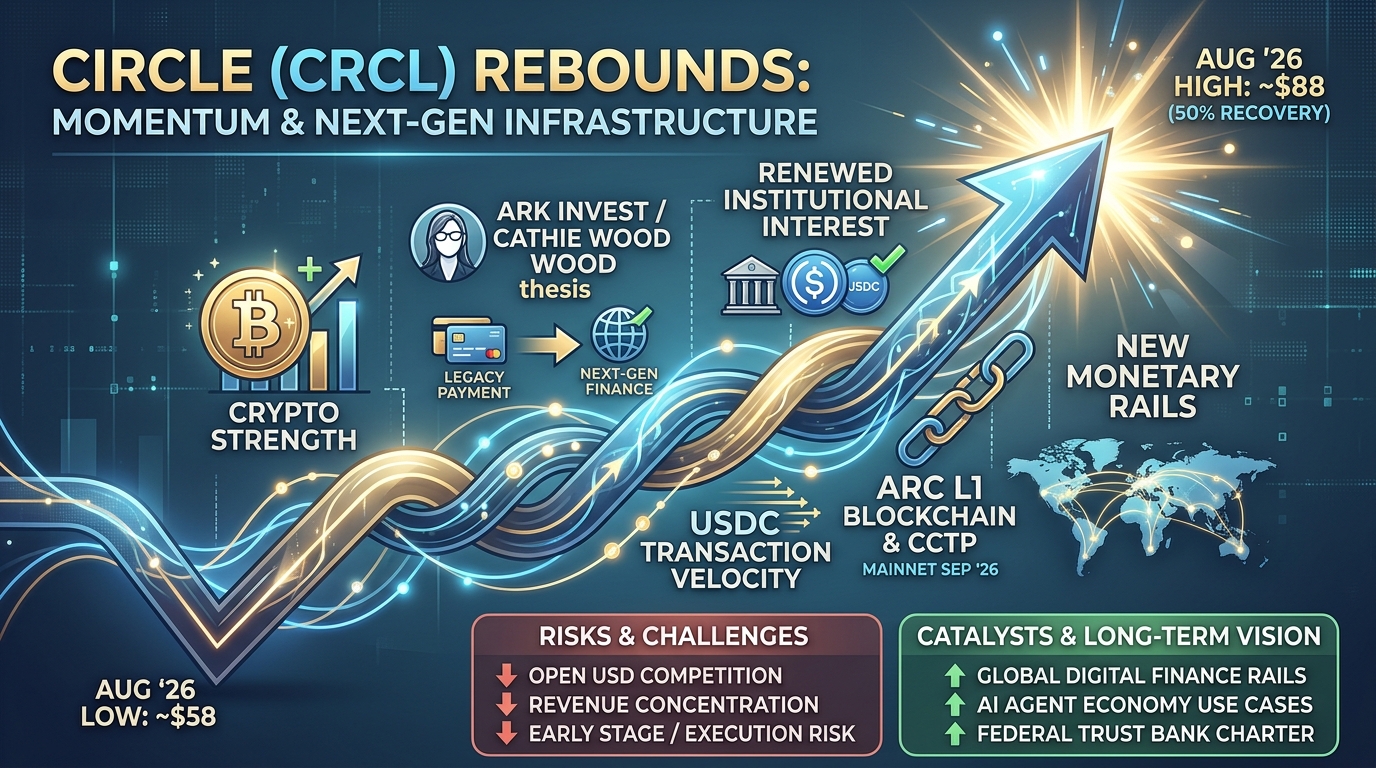
Bitcoin’s surge of more than 20% in the past week has lifted crypto-related equities, and Circle Internet Group (NYSE: CRCL) stands out. After touching a low near $57.84 in early August 2026, the stock climbed to around $87–$88 by late August, delivering a rebound of roughly 50%.
Cathie Wood’s recent comments added fuel, arguing that traditional Visa and Mastercard valuation frameworks undervalue Circle’s role in next-generation payments. The short answer: the rebound reflects genuine momentum from crypto markets and institutional progress, yet the business remains early-stage. Investors should treat any position as a long-term allocation with strict risk controls rather than a short-term buy signal.
What Caused Circle’s Sharp Drop Earlier in 2026?
Circle’s earlier weakness stemmed primarily from intensified competition in the stablecoin market, not from fundamental collapse of USDC demand. In late June 2026, the Open Standard consortium announced Open USD (OUSD), a rival dollar stablecoin backed by more than 140 companies including Visa, Mastercard, Stripe, BlackRock, and Coinbase. The announcement triggered an immediate sell-off, with CRCL falling as much as 17–18% in a single session as investors priced in pressure on Circle’s core economics.
Open USD’s model differs sharply from Circle’s. Traditional issuers such as Circle retain most of the interest earned on reserves held in cash and short-term U.S. Treasuries. OUSD plans to distribute the majority of that yield back to participating partners while charging only a management fee. Because Circle derives the bulk of its revenue from reserve income—historically 94–99% in recent periods—the market viewed the consortium as a direct threat to margins and partner distribution. According to contemporaneous reports from CoinDesk and industry analyses in July 2026, the reaction reflected concerns over margin compression more than an immediate loss of USDC circulation.
The broader context reinforced the pressure. Circle’s business model had been perceived as relatively narrow: issue USDC, hold high-quality reserves, and earn the yield spread. When a well-capitalized group of payment giants and asset managers signaled an alternative structure, the market discounted Circle’s pricing power. USDC still commanded roughly 24% of the stablecoin market with approximately $74–$75 billion in circulation around mid-2026, while Tether held the majority share near 59%. Yet the narrative of a single-purpose company facing powerful new entrants dominated sentiment and drove the stock toward the $57–$60 zone in early August.
Why Has Circle Stock Rebounded About 50% Since Early August?
The rebound is driven by a combination of broader crypto strength, improving company fundamentals, and renewed institutional interest. Bitcoin’s advance above key levels in mid-to-late August 2026 lifted sentiment across crypto equities, including Coinbase and other blockchain-related names. Circle participated fully, rising from the early-August low near $57.84 to closes around $87.98 by August 21, according to market data from multiple sources including Stock Analysis and TradingView. That move represents an approximate 50% recovery and a one-month gain exceeding 40%.
Company-specific catalysts supported the move. Second-quarter 2026 results showed total revenue and reserve income of $701 million, up 7% year-over-year, with adjusted earnings of $0.18 per share beating consensus. Management raised guidance for other revenue and highlighted expanding transaction activity. USDC processed substantial volumes, including reports of $849 billion in a single recent month and multi-trillion-dollar figures for the first half of 2026. Circle also secured a federal trust bank charter and continued deepening partnerships.
Technical factors amplified the price action. After forming a potential bottom near the high-$50s, the stock cleared short-term moving averages and attracted volume on up days. Market observers noted that the longer-term trend remained challenged—the stock was still well below its 52-week high near $159 and its all-time high—but the near-term momentum was clear. Crypto market correlation provided the tailwind; when Bitcoin advanced more than 20% over a short window, related equities followed.
What Is Cathie Wood’s Bullish Thesis on Circle?
Cathie Wood of ARK Invest argues that markets still value Circle through the outdated lens of traditional card networks and therefore miss its potential as infrastructure for the next era of payments and finance. In her August 23, 2026 comments on X, she noted that although CRCL had risen 84% since its June 2025 IPO, the one-year chart still showed underperformance relative to the disruption underway. Analysts who built careers on Visa and Mastercard, she said, “cannot fathom” Circle. Technology is rewriting the world order, and Circle “should be a prime beneficiary.”
ARK has consistently added to its position during weakness. By late August the firm’s flagship fund held millions of shares valued in the hundreds of millions, making Circle one of its larger crypto-related holdings. Wood’s logic centers on the idea that USDC and Circle’s expanding platform are not merely a yield product on Treasuries. Instead, they form part of a broader shift toward digital cash rails for cross-border payments, merchant settlement, enterprise treasury, capital markets, and on-chain finance.
She contrasts the limited growth trajectory of pure reserve-income businesses with the larger total addressable market that opens once stablecoins become programmable, internet-native money. In this framing, short-term competition from Open USD does not erase the network effects already built around USDC liquidity, regulatory positioning, and developer adoption.
How Does USDC’s Strategic Value Extend Beyond Market Cap?
USDC’s importance cannot be judged solely by circulating supply. Transaction volume, liquidity depth, developer adoption, payment penetration, real-world asset settlement share, and network usage frequency ultimately determine whether genuine network effects take hold. According to recent industry data referenced in August 2026 analyses, USDC has captured a leading share of on-chain dollar transaction volume in many periods—sometimes exceeding 60% of certain activity metrics—while maintaining strong institutional integrations.
Stablecoins are evolving from crypto-native trading tools into global digital-finance cash and settlement infrastructure. The addressable market has expanded from pure crypto trading into cross-border payments, merchant acceptance, corporate cash management, capital-markets settlement, and on-chain finance. In this view, stablecoins function as the new monetary rails of the internet era. Circle’s ability to maintain high velocity and deep liquidity across dozens of chains therefore carries strategic weight beyond the headline market capitalization of roughly $22 billion for the equity itself.
What Progress Has Circle Made Toward Next-Generation Payment Infrastructure?
Circle has begun translating narrative into concrete infrastructure through two major initiatives: the Arc Layer-1 blockchain and the Cross-Chain Transfer Protocol (CCTP). Arc is a purpose-built Layer-1 network designed for institutional stablecoin finance. Transaction fees settle in USDC rather than a volatile native token, removing a key friction for traditional firms. The chain incorporates compliance frameworks, KYC capabilities, and deterministic settlement aimed at regulated participants. Public mainnet is scheduled for September 16, 2026. Founding validators announced in early August include BlackRock, Visa, Mastercard, DTCC, Standard Chartered, ICE, and others. Testnet activity has already processed hundreds of millions of transactions across millions of wallets, according to company disclosures.
CCTP enables native USDC to move across dozens of public blockchains via a burn-and-mint mechanism. This approach avoids the liquidity fragmentation and counterparty risks of traditional bridges. Continuous upgrades through 2026 have expanded chain support and added faster-transfer options, reinforcing Circle’s role as a multi-chain settlement layer. Together, Arc and CCTP position Circle less as a pure issuer and more as an internet financial operating system that can host payments, tokenized assets, and programmable money flows.
An additional longer-term catalyst is the potential rise of AI agents. Machines favor low-cost, real-time, global, programmable, and API-native payment methods. Stablecoins align naturally with agent-to-agent and machine-to-machine economic activity. While still largely prospective, this use case expands the demand curve beyond human-driven finance.
What Risks Remain for Circle Investors?
Despite the rebound and infrastructure progress, material risks persist. Open USD remains a structural competitive threat even if its live volume is still limited; partners have financial incentives to route activity toward a shared-yield model. Circle’s revenue concentration in reserve income leaves it sensitive to interest-rate changes and any loss of market share. Execution risk on Arc is real—the mainnet has not yet launched publicly, and institutional adoption of a new chain takes time. Regulatory developments, while recently more constructive in some jurisdictions, can shift quickly. Finally, the stock remains highly correlated with crypto market sentiment and has experienced severe drawdowns from prior highs.
Most of the transformative narrative is still in the early-to-mid stages of realization. Circle has not yet delivered enough commercial proof points to confirm that it has fully constructed the next generation of payment and financial infrastructure. The imagination space is large, yet current results, while improving, remain limited relative to the long-term vision.
KuCoin Offers A More Stable Option in A Volatile Market
If you worry about the frequent ups and downs in the market, and pursue a more stable option to earn money passively, KuCoin is the right place to come:
-
Simple Earn: Deposit and withdraw tokens anytime, earning stable returns.
-
Kucoin Earn: Earn stable profits with professional asset management.
-
Hold to Earn: Earn rewards by holding assets in Funding, Trading, Margin, Futures, Mining, and Unified Accounts.
-
Staking: Unlock the earning potential of on-chain assets.
-
Advanced Investments: Advanced Investments offer a variety of structured products to help your money grow in any market.
-
Shark Fin: Principal Protection and Guaranteed Gains
-
Dual Investment: Buy low and sell high with transparent return calculations.
-
Snowball: High yields, with price protection.
-
Discount Buy: Buy crypto at discount prices.
-
KCS Loyalty: Level up to enjoy exclusive perks by staking ≥ 1 KCS.
-
KuCoin Wealth: Discover future value and begin your smart investing journey.
-
KCS Benefits: Hold and stake KCS to access benefits across the platform.
-
KCS Staking 2.0: Participate in KCS on-chain governance to earn yield.

Conclusion
Circle’s roughly 50% rebound from early-August 2026 lows near $58 to levels around $88 reflects a combination of Bitcoin strength, solid quarterly results, and growing recognition of its infrastructure ambitions. Cathie Wood’s thesis—that markets still price the company with legacy payment frameworks—captures the longer-term opportunity in USDC network effects, Arc, CCTP, and potential AI-agent demand. At the same time, competition from Open USD, revenue concentration, and the early stage of many initiatives mean the stock is not a low-risk, near-term certainty.
Investors who believe stablecoins will become core rails of digital finance can consider measured, long-term exposure while actively managing position size. Short-term traders should respect the volatility and correlation to crypto markets. The narrative is compelling and the recent price recovery is real, yet confirmation will come only through sustained commercial progress on Arc, continued USDC velocity, and resilience against competitive yield-sharing models. Discipline and a multi-year horizon remain essential.
FAQs
Is Circle stock (CRCL) still undervalued after the 50% rebound?
Valuation remains debated. The stock trades well below prior highs, yet any premium depends on successful execution of Arc and expansion beyond reserve income. Independent analysis of current multiples versus growth outlook is required.
How does Open USD specifically threaten Circle’s business model?
Open USD distributes most reserve yield to partners rather than retaining it at the issuer level. This structure can incentivize distribution partners to favor OUSD, pressuring Circle’s margins even if USDC retains liquidity advantages.
When does Circle’s Arc blockchain launch publicly?
Public mainnet is scheduled for September 16, 2026, following extensive testnet activity and the announcement of a founding validator set that includes major financial institutions.
Can retail investors buy Circle stock easily?
Yes, CRCL trades on the NYSE under standard brokerage accounts. Crypto-focused investors can alternatively gain thematic exposure through USDC and related assets on platforms such as KuCoin.
What is the biggest near-term catalyst for Circle?
Successful public launch and early institutional adoption of the Arc Layer-1 network in September 2026, together with any measurable growth in USDC transaction volumes and new use cases, represent the clearest near-term catalysts.