

Circle’s EURC Euro Stablecoin Surpasses €400 Million in Circulation, Up Over 100% in a Year
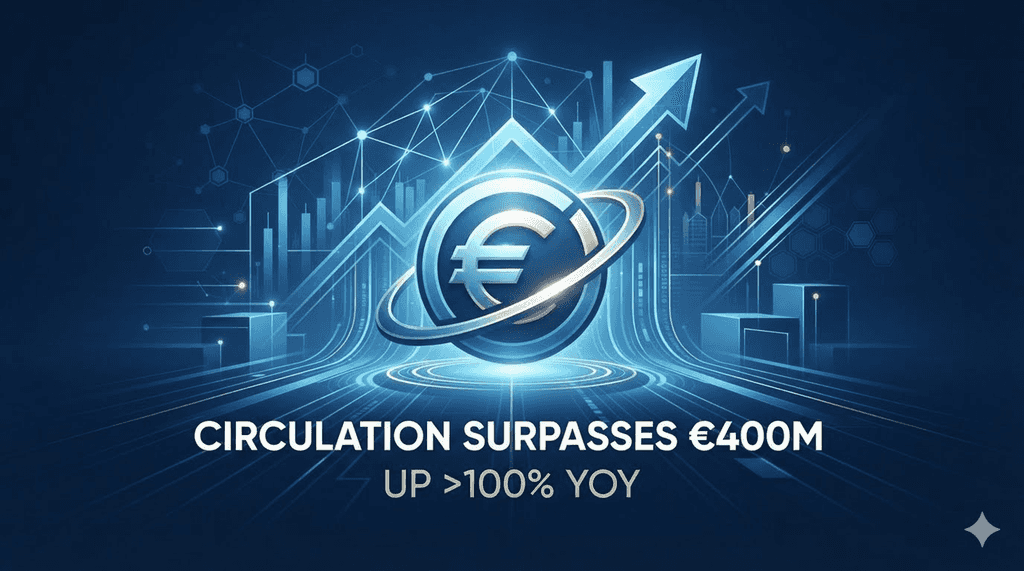
For years, US dollar-pegged stablecoins like USDT and USDC have maintained a near-monopoly, accounting for over 99% of the total stablecoin market capitalization. However, recent regulatory changes in Europe and evolving institutional demands are creating room for alternative fiat-pegged digital assets. At the forefront of this movement is Circle’s euro-pegged stablecoin, EURC.
According to official data from Circle, EURC has officially surpassed the €400 million milestone in circulating supply. This achievement represents an annualized growth rate of over 100%, positioning EURC as a dominant force in the euro-backed digital asset sector. This growth is not merely a statistical anomaly; it is a direct consequence of the implementation of the European Union’s Markets in Crypto-Assets (MiCA) regulation, expanded multi-chain infrastructure, and growing integration with traditional payment rails.
Key Takeaways
-
Circle’s EURC stablecoin has surpassed €400 million in circulating supply, reflecting an annualized growth rate of over 100% and a 61% market share.
-
The EU’s MiCA regulation fueled EURC’s dominance by forcing major exchanges to delist non-compliant competitors, directly benefiting compliant, licensed issuers like Circle.
-
Circle’s French EMI license ensures EURC meets stringent standards, offering 1:1 reserve backing, mandatory audits, and bankruptcy-remote status to protect user funds.
-
EURC is driving real-world adoption by enabling 24/7 on-chain foreign exchange markets, diversified European DeFi yields, and faster, cheaper corporate cross-border settlements.
Breaking Down the Numbers: EURC’s Growth Metrics
To understand the trajectory of EURC, it is necessary to analyze its supply mechanics over the past several quarters. Launched initially as Euro Coin (EUROC) on the Ethereum network in June 2022, the asset was later rebranded to EURC to align with Circle’s product nomenclature.
For the first two years of its existence, EURC experienced slow adoption due to a lack of clear regulatory frameworks in Europe and low liquidity on centralized exchanges. By the end of 2024, the circulating supply hovered around €80 million. The major inflection point occurred throughout 2025 and early 2026, driven by systematic policy shifts.
|
Metric
|
Q4 2024
|
Q4 2025
|
August 2026
|
|
Circulating Supply (EUR)
|
~€80 Million
|
~€310 Million
|
~€402 Million
|
|
YoY Supply Growth (%)
|
Basis Year
|
+287.5%
|
+100%+ (Annualized)
|
|
Euro Stablecoin Market Share
|
~15%
|
~45%
|
~61%
|
This data shows a steady compounding effect. As the total market value of all euro-denominated stablecoins hovers around €650 million, EURC now commands a decisive majority of the market share. Following the announcement of this milestone, financial markets showed positive sentiment toward the issuer, with Circle’s public equity tracking indicators (CRCL) reflecting steady institutional interest.
How European Regulation Cleared the Battlefield
The primary driver behind EURC’s aggressive expansion is the formal implementation of the EU’s Markets in Crypto-Assets (MiCA) regulatory framework. Rather than restricting stablecoin growth, MiCA has acted as a filtering mechanism, separating compliant issuers from non-compliant entities.
The "EMT" Standard and the Fall of Non-Compliant Competitors
Under MiCA guidelines, stablecoins tied to the value of a fiat currency are classified as Electronic Money Tokens (EMTs). To legally issue and market an EMT within the European Economic Area (EEA), issuers must hold an Electronic Money Institution (EMI) or credit institution license. Furthermore, they are required to maintain strict 1:1 liquid reserve backing, segregating user funds from corporate capital, and hosting at least 30% of reserves in independent bank deposits (rising to 60% for significant tokens).
Many legacy euro stablecoins failed to meet these stringent requirements before the implementation deadlines. As a result, major centralized exchanges operating within Europe—including Binance, Bitstamp, and OKX—were legally mandated to delist or restrict trading pairs involving non-compliant euro stablecoins. This structural shift removed a large portion of EURC's market competition overnight.
Circle’s First-Mover Advantage in France
Circle anticipated these regulatory barriers. The company secured an Electronic Money Institution (EMI) license from the Autorité de Contrôle Prudentiel et de Résolution (ACPR) in France. This early compliance status allowed EURC to become one of the first mainstream euro stablecoins to achieve full conformity with MiCA’s EMT standards. When European exchanges began restructuring their listings to avoid regulatory penalties, EURC became the default choice for compliant euro liquidity.
Key Structural Protections Offered by MiCA Compliance:
-
Bankruptcy Remote Status: Reserves are isolated from the issuer's balance sheet, ensuring users can redeem tokens even if the parent company faces insolvency.
-
Prudential Oversight: Regular mandatory state audits prevent the fractional reserve practices that previously caused stablecoin failures.
-
Systemic Risk Mitigants: Guardrails on transaction volumes prevent unregulated capital flight, offering a predictable environment for corporate treasuries.
Multi-Chain Ecosystem & Infrastructure Integration
A stablecoin’s utility is tied directly to its availability across multiple blockchain protocols. Circle has pursued an aggressive multi-chain strategy to distribute EURC liquidity across distinct architectural ecosystems, each serving a specific market niche.
Expanding Native Blockchain Footprint
EURC is natively minted across seven major blockchain networks: Ethereum, Solana, Avalanche, Stellar, Base, World Chain, and Cronos. This broad diversification allows the asset to capture different sectors of the on-chain economy:
-
Ethereum & Base (Layer 2): These chains house the majority of institutional DeFi activity. Base, in particular, offers low-cost transactions that have driven retail adoption of EURC in decentralized lending pools and automated market makers (AMMs).
-
Solana & Cronos: Utilized primarily for high-frequency trading, retail commerce, and algorithmic execution due to their sub-second finality, robust exchange ecosystems, and minimal transaction overhead.
-
Stellar, Avalanche, & World Chain: Positioned as foundational infrastructure rails for enterprise payment processing, identity-verified digital finance, commercial remittance networks, and business-to-business (B2B) liquidity settlement.
CCTP (Cross-Chain Transfer Protocol) Integration
To resolve the liquidity fragmentation common across multi-chain assets, Circle integrated EURC into its Cross-Chain Transfer Protocol (CCTP). Unlike traditional third-party blockchain bridges, which require locking tokens in a smart contract (creating a single point of failure for hackers), CCTP operates via a native burn-and-mint mechanism. When a user transfers EURC between supported networks, the protocol burns the tokens on the source chain, verifies the transaction, and mints an equivalent amount of native EURC on the destination chain.
Real-World Use Cases: Why the Crypto Market Needs EURC
The growth of EURC indicates a shift from purely speculative trading toward practical, utility-driven use cases. The asset serves several functional purposes across both Web3 and traditional commerce.
On-Chain Foreign Exchange (FX) Markets
The traditional foreign exchange market moves over $7 trillion daily but operates on legacy infrastructure with T+2 settlement cycles and high intermediary banking fees. EURC, when paired with dollar stablecoins like USDC, enables the creation of 24/7 on-chain FX markets. Automated market makers allow institutions and retail traders to execute EUR/USD trades instantly, with settlement occurring in seconds at a fraction of traditional banking costs.
Diversified DeFi Yield Opportunities
Before the rise of compliant euro stablecoins, DeFi yields were denominated almost exclusively in US dollars or volatile crypto assets. EURC allows European investors to participate in decentralized lending, borrowing, and liquidity provisioning without exposing themselves to euro-to-dollar foreign exchange volatility. This is particularly valuable during periods of macroeconomic uncertainty or fluctuating interest rate differentials between the Federal Reserve and the European Central Bank (ECB).
Corporate Treasury and Global Remittances
Global merchant settlement has historically been delayed by geographic boundaries and banking holidays. By partnering with payment netwoks like Visa and Mastercard, Circle has enabled businesses to accept EURC and settle transactions over public ledger networks. This architecture allows multinational corporations to optimize liquidity management, route capital across borders instantaneously, and pay global contractors without relying on traditional wire transfer corridors like SWIFT.
Can Euro Stablecoins Challenge Dollar Dominance?
Despite reaching the €400 million milestone, euro stablecoins face structural hurdles that prevent them from matching the scale of their dollar-denominated counterparts.
First, the scale disparity remains vast. The aggregate dollar stablecoin market capitalization exceeds $160 billion, whereas the total euro stablecoin market sits under $1 billion. The US dollar remains the undisputed reserve currency of the global digital asset economy, as the vast majority of crypto trading pairs, derivatives, and perpetual contracts are denominated in USD.
Second, strict regulatory caps under MiCA could inadvertently stifle exponential growth. MiCA imposes daily transaction volume limits on non-USD or non-domestic fiat tokens if they reach certain systemic thresholds (e.g., 1 million transactions or €200 million in daily transaction value as a medium of exchange). While designed to protect sovereign monetary policy, these limits could restrict the upper boundaries of EURC adoption for large-scale commercial retail payments within the Eurozone.
Conclusion
The expansion of Circle’s EURC past €400 million is a clear signal that regulatory clarity accelerates institutional adoption. By aligning early with Europe’s MiCA guidelines, Circle has transformed a regulatory hurdle into a competitive advantage, securing the majority of the euro-denominated on-chain market.
As the infrastructure for on-chain FX, multi-chain liquidity, and corporate settlements matures, assets like EURC will play an essential role in bridging the gap between legacy European banking systems and public blockchain networks. For global platforms, the growth of compliant euro liquidity offers traders and institutional clients new opportunities to diversify portfolios, hedge macro risks, and participate in a legally secure digital economy.
KuCoin Offers A More Stable Option in A Volatile Market
If you worry about the frequent ups and downs in the market, and pursue a more stable option to earn money passively, KuCoin is the right place to come:
Simple Earn: Deposit and withdraw tokens anytime, earning stable returns.
Kucoin Earn: Earn stable profits with professional asset management.
Hold to Earn: Earn rewards by holding assets in Funding, Trading, Margin, Futures, Mining, and Unified Accounts.
Staking: Unlock the earning potential of on-chain assets.
Advanced Investments: Advanced Investments offer a variety of structured products to help your money grow in any market.
Shark Fin: Principal Protection and Guaranteed Gains
Dual Investment: Buy low and sell high with transparent return calculations.
Snowball: High yields, with price protection.
Discount Buy: Buy crypto at discount prices.
KCS Loyalty: Level up to enjoy exclusive perks by staking ≥ 1 KCS.
KuCoin Wealth: Discover future value and begin your smart investing journey.
KCS Benefits: Hold and stake KCS to access benefits across the platform.
KCS Staking 2.0: Participate in KCS on-chain governance to earn yield.
FAQs
What is Circle’s EURC?
EURC is a euro-pegged stablecoin issued by Circle. It is backed 1:1 by euro reserves held in regulated financial institutions, ensuring that one EURC can always be redeemed for one euro.
Why did EURC's circulation grow over 100% in a year?
Growth was primarily driven by the EU’s MiCA regulations. As non-compliant competitors were delisted from European exchanges, EURC’s early compliance allowed it to capture the vast majority of the euro stablecoin market share.
Is EURC compliant with the EU’s MiCA regulations?
Yes. Circle secured an Electronic Money Institution (EMI) license from the ACPR in France. This status makes EURC fully compliant with MiCA’s strict Electronic Money Token (EMT) standards across the European Economic Area.
How does Circle secure the assets backing EURC?
EURC reserves are maintained in segregated, bankruptcy-remote bank accounts. They consist entirely of cash euros and low-risk European government bonds, which are audited monthly by independent accounting firms.
What is Circle’s CCTP and how does it help EURC?
The Cross-Chain Transfer Protocol (CCTP) allows users to move EURC between blockchains safely. It burns tokens on the source chain and mints native tokens on the destination chain, eliminating traditional smart-contract bridging risks.
What are the main use cases for EURC today?
EURC is used for 24/7 on-chain foreign exchange (FX) trading, cross-border corporate remittances, low-fee global merchant card settlements, and diversifying yield strategies in decentralized finance (DeFi) without dollar exposure.
Disclaimer
The information provided on this page may originate from third-party sources and does not necessarily represent the views or opinions of KuCoin. This content is intended solely for general informational purposes and should not be considered financial, investment, or professional advice. KuCoin does not guarantee the accuracy, completeness, or reliability of the information, and is not responsible for any errors, omissions, or outcomes resulting from its use. Investing in digital assets carries inherent risks. Please carefully evaluate your risk tolerance and financial situation before making any investment decisions. For further details, please consult KuCoin’s Terms of Use and Risk Disclosure.