

Circle Arc Mainnet Launch: Can It Become the Next Robinhood Chain?
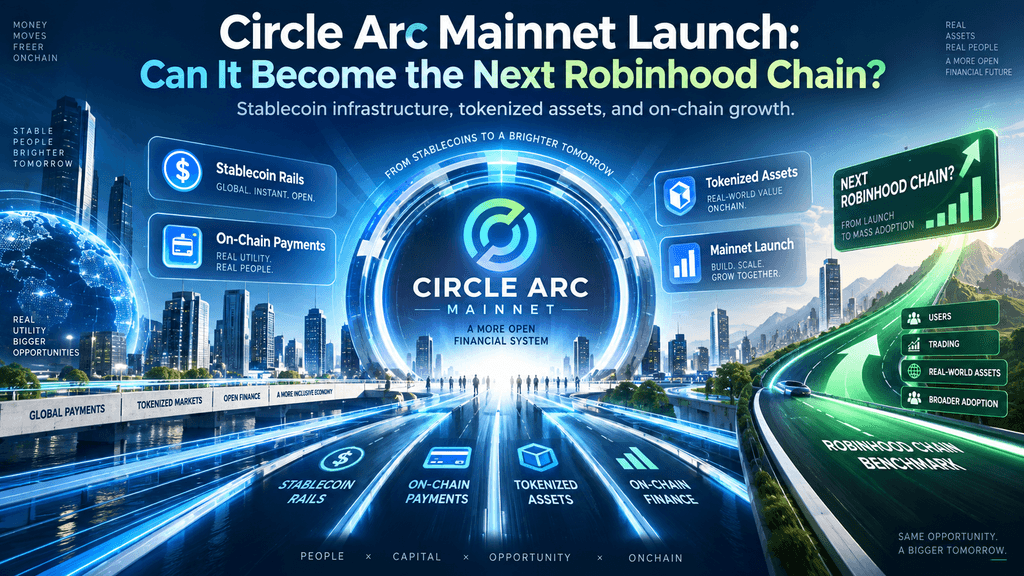
Circle officially launched the public mainnet of Arc on September 16, 2026, bringing a new Layer 1 into an already crowded blockchain market. Yet Arc did not arrive like a typical new network. More than 100 applications and over 100 institutional and ecosystem builders were involved from day one, while BlackRock, Visa, Mastercard, DTCC and other major financial institutions joined its founding validator cohort. Crypto-native infrastructure including Uniswap, Aave, Morpho, Chainlink, MetaMask and Alchemy was also ready around launch.
That unusually mature starting point is why Arc is already drawing comparisons with Robinhood Chain, which turned an existing financial distribution network into one of 2026’s fastest-growing new onchain ecosystems. But the comparison has limits. Robinhood brought millions of retail users to a new Layer 2; Circle is bringing USDC liquidity, financial institutions and a ready-made infrastructure stack to an independent Layer 1. The real question is therefore not whether Arc can simply copy Robinhood Chain, but whether Circle can convert those advantages into sustained users, liquidity and economic activity.
What Happened at the Arc Mainnet Launch?
Arc became publicly accessible on September 16 as an EVM-compatible Layer 1 designed specifically for financial markets, real-time money movement and what Circle calls “agentic economic activity.” Circle said the network launched with more than 100 applications and more than 100 institutional and ecosystem builders. Its testnet had processed more than 700 million transactions, while its developer community had produced more than 1,200 projects before public mainnet went live.
The launch is notable because Arc appears to have tackled part of the traditional blockchain cold-start problem before opening to the public. A new network normally launches first and then attempts to attract wallets, exchanges, developers, liquidity providers, lending protocols and institutional users. Arc arrived with much of that stack already assembled.
| Part of the Ecosystem | Examples at Arc Launch |
| Trading and liquidity | Uniswap, Aero, 1inch |
| Lending and credit | Aave, Morpho |
| Infrastructure | Chainlink, Alchemy, QuickNode, Figment |
| Wallets | MetaMask, Phantom, Ledger, Trust Wallet |
| Institutional validators | BlackRock, DTCC, Visa, Mastercard, ICE |
| Exchanges and access | Binance, Coinbase, Kraken, KuCoin, OKX |
Circle’s launch announcement also named tokenized funds, payment companies, custodians and AI-focused projects. The importance is not that every integration will necessarily generate large usage, but that users and developers do not have to wait for basic infrastructure to arrive after launch.
Why Is Arc Different From Other Blockchains?
Arc is not trying to differentiate itself primarily through another token incentive program or a theoretical transactions-per-second figure. Its architecture is designed around a specific assumption: if blockchain networks are going to support banks, payments, foreign exchange, tokenized securities and autonomous software agents, their economics and settlement characteristics need to look more familiar to financial institutions.
USDC Pays the Gas
The most obvious difference is that Arc uses USDC to pay transaction fees. Ethereum uses ETH and Solana uses SOL, meaning users need a separate volatile asset simply to interact with those networks. On Arc, a company already holding dollars or USDC can pay network fees with a dollar-denominated asset. Circle argues that this makes transaction costs easier for companies to forecast and removes an additional source of price volatility from operational budgets.
Settlement Is Designed for Finance
Arc also offers deterministic sub-second finality. For many financial applications, knowing exactly when a transaction becomes irreversible can matter more than an eye-catching maximum throughput figure. Payments, foreign-exchange settlement, collateral movements and trading systems all benefit from predictable settlement, particularly when institutions are trying to reconcile blockchain activity with traditional financial operations.
Open Apps, Curated Validators
Arc combines permissionless application deployment with a permissioned validator set. Developers can build Solidity-based applications because the network is EVM compatible, while validation initially relies on selected institutions including BlackRock, DTCC, ICE, Visa and Mastercard. That model deliberately trades some of the permissionless validator structure associated with networks such as Ethereum for a governance perimeter that Circle believes financial institutions will find easier to use.
Why Is Crypto Infrastructure Moving Into Arc?
No single partnership explains Arc’s launch advantage. What matters is the combination. Aave and Morpho provide lending infrastructure, Uniswap and other trading applications provide liquidity venues, Chainlink and Alchemy support developers, major wallets provide user access, centralized exchanges create fiat and crypto entry points, and custody firms give institutions ways to hold assets. Circle has effectively tried to assemble an entire onchain financial stack at once.
That can reduce a common coordination problem for new blockchains. Developers often avoid networks without users, users avoid networks without applications, liquidity providers avoid networks without volume, and exchanges wait until demand exists. A network backed by Circle can approach this cycle differently because USDC already has more than $74 billion in circulation and is supported across dozens of blockchain networks. Arc does not have to create awareness of its core settlement asset from zero.
Still, integrations should not be confused with adoption. A company appearing in an ecosystem announcement does not tell investors how much capital, transaction volume or user activity it will eventually bring. Arc’s early advantage is therefore best understood as infrastructure readiness, not proof of product-market fit.
Why Is Arc Being Compared With Robinhood Chain?
Robinhood Chain provides one of 2026’s clearest examples of a company-backed blockchain starting with advantages a typical crypto startup does not possess. Its public mainnet launched on July 1 as an Ethereum Layer 2 built using Arbitrum technology, with direct connections to Robinhood’s existing user ecosystem and integrations from firms such as Uniswap, Chainlink and Alchemy. Robinhood positioned the network around tokenized assets, DeFi and broader access to financial markets.
What happened next was less predictable. Within roughly two weeks, Robinhood Chain had around $312 million in total value locked and 3.6 million daily transactions, but tokenized real-world assets represented only about $12.8 million of onchain value. Memecoins and stablecoins had become major drivers of activity instead. By August 30, the chain processed a record 5.52 million transactions, decentralized exchange volume approached $875 million and memecoin-related applications accounted for a large share of application revenue.
The lesson was broader than “memecoins are popular.” Robinhood showed how a financial company with existing distribution, integrated infrastructure and developer access could accelerate the early growth of a blockchain. Arc is generating comparisons because Circle enters with a different but similarly powerful set of assets: USDC liquidity, institutional relationships, exchange integrations and established developer infrastructure. Both represent what could be called the company-backed blockchain model — build a network around an existing financial ecosystem instead of launching a chain first and searching for distribution afterward.
Arc vs Robinhood Chain: What’s Actually Different?
Calling Arc “the next Robinhood Chain” is useful as a question, but misleading as a description. The networks are built differently and start with different competitive advantages. Robinhood Chain is an Ethereum Layer 2 using Arbitrum technology and ETH for gas, while Arc is an independent Layer 1 using USDC for network fees.
| Circle Arc | Robinhood Chain | |
| Network type | Layer 1 | Ethereum Layer 2 |
| Main corporate backer | Circle | Robinhood |
| Core starting advantage | USDC liquidity + institutions | Retail brokerage distribution |
| Gas asset | USDC | ETH |
| Initial narrative | Payments, FX, RWA, finance, AI agents | Tokenized assets, trading, DeFi |
| Natural initial audience | Institutions, developers, crypto finance | Retail traders and brokerage users |
| Main growth challenge | Turning infrastructure into users | Turning users into lasting onchain markets |
Their growth problems are almost opposites. Robinhood already had consumers and needed to build deeper liquidity and onchain applications around them. Circle already has a widely used stablecoin, financial counterparties and infrastructure partners, but must prove that those connections will result in recurring Arc-native activity.
Put simply, Robinhood Chain starts with distribution; Arc starts with financial infrastructure. Whether Arc can produce comparable growth depends on whether infrastructure can create its own distribution flywheel.
Can Arc Repeat Robinhood Chain’s Growth?
Arc already possesses several ingredients that helped Robinhood Chain gain traction: a recognizable financial brand, mature infrastructure, permissionless application development and connections to existing pools of capital. The network also benefits from EVM compatibility, which lowers the cost for Ethereum developers to deploy existing Solidity applications. Those conditions give Arc a stronger starting position than an entirely new L1 attempting to build every component from scratch.
But Robinhood Chain also offers a warning against assuming that a chain’s intended use case will determine its actual behavior. Robinhood emphasized stock tokens and tokenized assets, yet speculative token trading generated much of its early activity. Arc could experience a similar divergence. Circle lists Pump.fun among its onchain trading ecosystem participants, while decentralized exchanges and wallets needed for speculative markets were present at launch.
The critical distinction is that infrastructure is not the same as usage. One hundred integrations do not automatically produce one hundred successful applications, and validator participation from major financial firms does not guarantee large transaction volumes. Arc can plausibly create a strong initial growth loop, but the thesis will need to be validated by sustained liquidity, repeat users and economic activity that remains after launch enthusiasm fades.
Where Could Arc Find Its Killer App?
Arc does not necessarily need the same type of speculative boom that propelled Robinhood Chain. Circle has designed the network around several markets where its existing USDC business may provide a more natural advantage.
Stablecoin Payments and FX
Payments and foreign exchange are the most obvious starting points. Arc integrates Circle Payments Network and StableFX, while USDC itself is both a major settlement asset and the network’s gas currency. Circle is trying to create a system in which companies can move stablecoins, exchange currencies and settle transactions continuously without maintaining an additional volatile token for fees. If Arc succeeds here, its core activity could look more like financial infrastructure than a conventional DeFi chain.
Tokenized Real-World Assets
Tokenized assets may be the more important long-term opportunity. Circle says BlackRock’s BUIDL and Circle’s USYC are among the productive assets available in Arc markets for trading, lending and collateral. Asset managers and RWA issuers including BlackRock, Bitwise, Janus Henderson and others are also participating in the broader ecosystem.
The larger question is whether Arc can become a common settlement layer connecting stablecoins with tokenized funds, Treasuries, private credit and eventually other regulated securities. If meaningful institutional assets begin moving onchain, that would create a substantially different growth engine from the retail speculation that initially powered Robinhood Chain.
AI Agents and Machine Payments
Circle is also making a large bet on software agents as future financial participants. The company says USDC accounts for 98.8% of agent-driven transaction volume within the activity it tracks through its agent infrastructure and x402-based payments. Arc is being designed around small programmable payments, delegated wallets and machine-to-machine transactions.
The opportunity is still emerging rather than proven. If autonomous agents eventually pay for APIs, compute, data, trading services or other agents, a network with dollar-denominated gas and rapid finality may be useful. But Arc’s AI thesis should be treated as a future market to validate, not current evidence of large-scale adoption.
What Could Stop Arc From Succeeding?
The first challenge is competition. Ethereum, Solana, Base and other major networks already have deep USDC liquidity, established users and large developer communities. Circle confirms that USDC is natively supported across 38 blockchain networks as of Arc’s launch. Arc therefore needs to answer a difficult question: why should users move activity onto a new Circle-controlled network when they can already use USDC elsewhere?
The second challenge is Arc’s institutional validator model. It may make the network more acceptable to banks and enterprises, but crypto-native users may view a curated validator set as less decentralized than established permissionless alternatives. Arc therefore sits directly in the long-running trade-off between institutional control and crypto decentralization. Whether this becomes an advantage or a limitation may depend on who ultimately creates most of its economic activity.
Finally, launch partnerships need to turn into measurable usage. BlackRock as a validator, Uniswap as a trading venue and Aave as a credit layer are meaningful signals, but the success of Arc will eventually be judged by harder metrics: transaction value, active users, stablecoin settlement, TVL, trading volume, tokenized asset value and developer retention. A launch announcement can create credibility; it cannot manufacture durable demand.
What Should Users Watch Next?
The most useful way to evaluate Arc over the coming months will be to separate headline partnerships from actual network economics. Rising transaction counts are more meaningful when accompanied by growing stablecoin settlement, repeat addresses, deeper DEX liquidity and expanding lending activity. Tokenized real-world asset value may be even more important because institutional finance is one of Arc’s principal differentiators.
Investors should also watch the evolution of ARC, the proposed network token. Circle completed a genesis mint of 10 billion ARC tokens around the mainnet launch, but explicitly stated that the mint does not constitute a commitment to launch the token publicly. Network transaction fees continue to be paid in USDC. Circle says ARC is intended as a future coordination mechanism for security, utility and governance as Arc explores a transition from its current Proof-of-Authority structure toward Proof of Stake in 2027.
That distinction is important: ARC token speculation and Arc network adoption are not the same thesis. The strongest evidence for the network will come from applications and financial activity that would exist even without a publicly traded ARC token.
🔥 Beyond the Headlines: What KuCoin 5.0 Means for You
Market news moves fast — but where you act on it matters just as much. This October, KuCoin launches KuCoin 5.0, transforming KuCoin into a rebuilt platform. Here's what actually changes for you:
-
One account for everything. Older platforms split your money across separate "spot," "margin," and "futures" accounts and expected you to understand why. KuCoin 5.0's unified account removes that entirely — deposit once, and everything is simply there.
-
Stocks, indices, and commodities. KuCoin 5.0 expands beyond crypto into global markets. When crypto chops sideways and equities rally (or the reverse), you rotate in minutes instead of opening a brokerage account and waiting days for fiat rails.
-
Real-world assets (RWA). Tokenized exposure to traditional assets like commodities, right inside your crypto account. One of the fastest-growing segments in global finance is no longer reserved for institutions — you access it from the same balance you trade with.
-
Earn while you learn. Not ready to trade? KCUSD lets your stablecoins earn daily, auto-compounding interest. The lowest-stress way to put your idle deposit to work for 4% yield.
-
An AI assistant in plain language. Ask questions, get market context, understand what you're looking at — built into the platform, no jargon required.
-
An app that doesn't overwhelm. Faster, cleaner, and consistent — intuitive from the first tap, not after a tutorial.
-
Safety you can check, not just trust. A MiCAR-licensed EU entity, Proof of Reserves you can verify yourself, and internationally certified security (SOC 2 Type II, ISO 27001:2022).
Create your account in minutes — and start on the platform built for where crypto is going, not where it's been.
Conclusion
Arc has several characteristics that made Robinhood Chain’s launch compelling: a powerful corporate sponsor, strong distribution advantages, established infrastructure and permissionless access for developers. But the comparison only goes so far. Robinhood Chain began with a huge retail audience and discovered that speculative trading could rapidly create onchain activity. Arc begins with something different — USDC liquidity, institutional validators and an unusually complete financial infrastructure stack.
That means Arc does not have to become Robinhood Chain 2.0 to succeed. Its larger opportunity may be turning Circle’s existing stablecoin network into a settlement layer for payments, FX, tokenized assets, credit and eventually machine-driven commerce.
The next phase will determine whether those advantages translate into durable economic activity. If they do, Arc may represent something larger than another successful new blockchain: a shift toward financial networks built directly by companies that already own the liquidity, distribution or infrastructure needed to overcome crypto’s traditional cold-start problem.
FAQs
Is Circle Arc the Same Thing as USDC?
No. USDC is a dollar-backed stablecoin issued by Circle, while Arc is a Layer 1 blockchain. USDC is used as Arc’s gas and is central to its financial design, but it continues to exist on many other networks. Circle listed native USDC support across 38 blockchains at the time Arc launched.
Do Users Need a Circle Account to Use Arc?
Arc is designed as an open blockchain rather than a closed service limited to Circle account holders. Users can access applications through compatible wallets and infrastructure providers, although specific financial products built on Arc may apply their own eligibility, identity or compliance requirements.
Can Ethereum Developers Build on Arc?
Yes. Arc is fully EVM compatible, which means developers can use Solidity contracts and many of the tools already used across the Ethereum ecosystem. That compatibility lowers the technical barrier for existing Ethereum applications interested in deploying on Arc.
Will USDC Leave Ethereum or Solana Because Arc Exists?
There is no indication that Circle intends to replace its multichain USDC strategy with Arc. USDC remains natively available on Ethereum, Solana, Base and dozens of other networks. Arc instead adds another settlement environment designed specifically around Circle’s stablecoin and institutional financial infrastructure.
Does Arc Compete With Ethereum and Traditional Payment Networks?
Potentially both, but the relationship is not purely competitive. Arc competes with other blockchains for developers, liquidity and financial applications, while its payments and settlement features could overlap with services offered by traditional financial networks. At the same time, companies such as Visa and Mastercard are participating in Arc’s validator ecosystem, suggesting that established payment firms may also view blockchain infrastructure as complementary to parts of their existing businesses.
Disclaimer: This article is for informational and educational purposes only. It does not constitute financial or investment advice.