

China Opposes Proposed 7.5% U.S. Tariff as Trade Tensions Rise Ahead of Trump-Xi Talks
2026/08/28 17:54:00
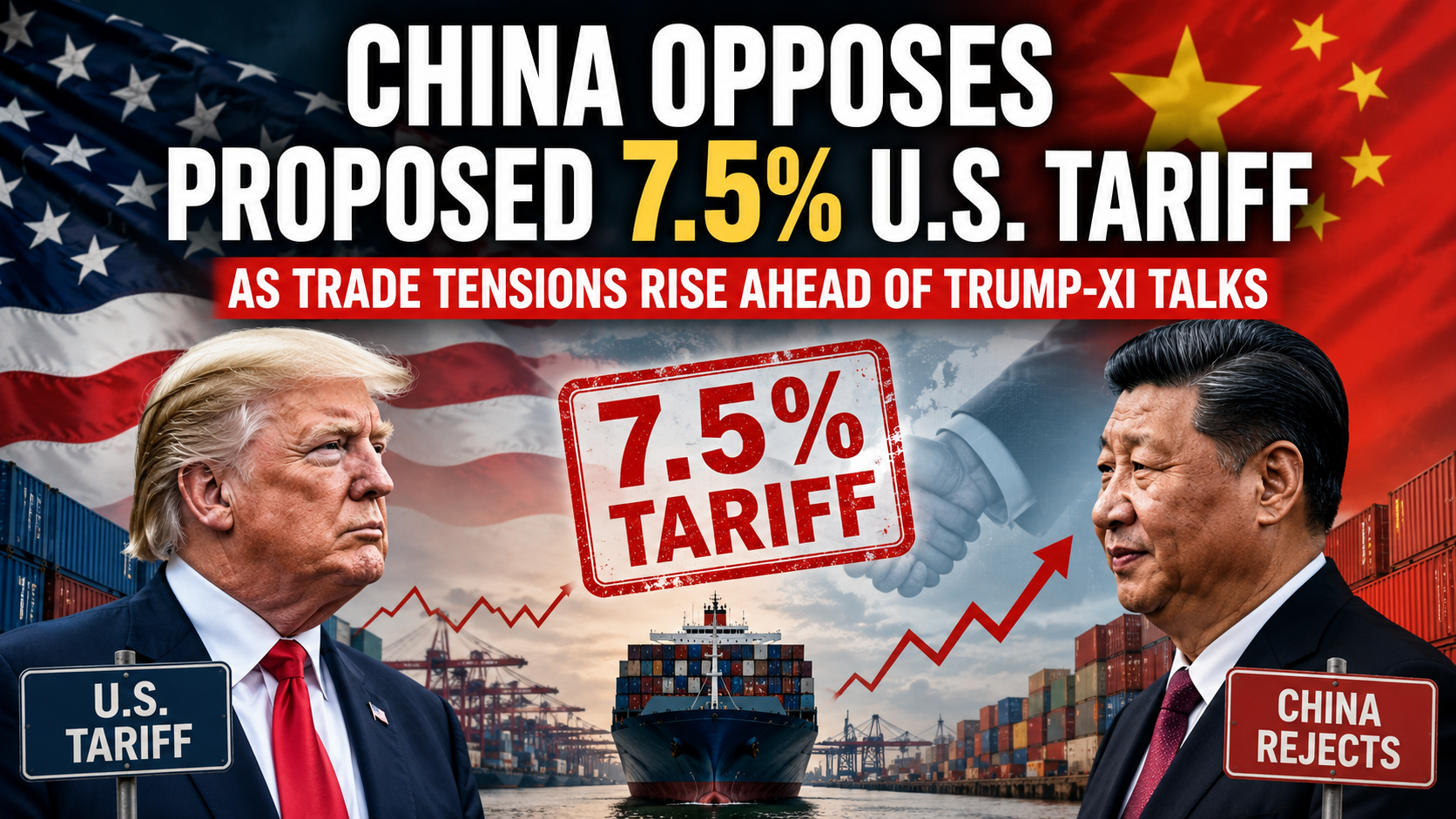
The United States is considering an additional 7.5% tariff on Chinese imports over concerns about what Washington describes as structural excess manufacturing capacity, adding a new source of uncertainty to already complicated U.S.-China trade relations. China has strongly opposed the proposal, accusing Washington of using “overcapacity” as a justification for protectionism and warning that it reserves the right to take necessary measures in response.
The timing makes the dispute particularly significant. President Donald Trump and Chinese President Xi Jinping reached a series of trade agreements during their May meeting in Beijing, while Xi is expected to visit Washington this fall. A new tariff before the next Trump-Xi talks could therefore become either additional U.S. negotiating leverage or the beginning of another escalation cycle. For businesses and financial markets, the bigger question is not simply whether the tariff rate is 7.5%, but how broadly it would apply, how China might respond, and whether the recent trade détente can survive.
What Is the Proposed 7.5% U.S. Tariff?
The reported measure would impose an additional 7.5% tariff on Chinese imports in response to concerns about China's manufacturing capacity. Bloomberg first reported that the Trump administration was preparing the measure, and Reuters subsequently reported the development while noting that it had not independently verified Bloomberg's information. As of August 28, the United States has not formally announced a final product list, implementation date, or detailed tariff schedule associated with the proposal.
China responded publicly on August 27. The Ministry of Commerce said Beijing firmly opposes the U.S. Section 301 investigation into what Washington calls structural excess capacity, describing the approach as unilateral and protectionist. The ministry said China would closely monitor and comprehensively assess subsequent U.S. actions and reserved the right to take all necessary measures to defend its legitimate interests.
One important distinction is that the proposed 7.5% should not be interpreted as meaning Chinese imports would face only a 7.5% U.S. tariff. It would be an additional tariff, potentially layered on top of existing Section 301 duties, product-specific measures, and other trade restrictions. The economic significance therefore depends on cumulative tariff exposure rather than the headline 7.5% rate alone.
Why Is the U.S. Using Section 301 Again?
The proposed tariff is connected to a broader Section 301 investigation launched by the U.S. Trade Representative on March 11, 2026. Section 301 of the Trade Act of 1974 gives the U.S. government a mechanism to investigate foreign acts, policies, or practices that it considers unreasonable or discriminatory and that burden or restrict U.S. commerce. The latest investigations cover China and 15 other economies, including the European Union, Japan, South Korea, India, Vietnam, Mexico, Taiwan, and several Southeast Asian countries.
USTR opened a public comment period in March and conducted four days of hearings from May 5 through May 8. That timeline is important because it shows that the 7.5% proposal did not emerge from a sudden shift in policy. Washington has spent months building a case around what it sees as structural imbalances in global manufacturing, while increasingly using more targeted trade instruments to support domestic production and reshape critical supply chains.
The investigation also fits a wider U.S. policy emphasis on industrial resilience. Washington has increasingly connected tariffs and trade rules with efforts to reshore semiconductor manufacturing, strengthen strategic supply chains, and reduce dependence on foreign producers in sectors considered economically or technologically important.
What Does Washington Mean by “Excess Capacity”?
The U.S. argument centers on the idea that government support can push manufacturing output beyond levels justified by sustainable market demand. Subsidies, favorable financing, preferential industrial policies, state-owned enterprises, and other forms of support can theoretically encourage companies to continue expanding production even when domestic consumption cannot absorb all of their output. The excess products then move into export markets, putting downward pressure on global prices and making it harder for manufacturers in other economies to compete.
Washington's broader investigation covers manufacturing industries in which it believes these dynamics could weaken the U.S. industrial base. The policy debate has touched sectors such as metals, machinery, electronics, batteries, clean-energy equipment, vehicles, semiconductors, chemicals, robotics, and shipbuilding. However, these sectors should not be confused with a confirmed tariff list. The United States has not yet disclosed exactly which Chinese products would face the reported additional 7.5% levy.
The basic U.S. policy argument can be summarized as industrial support → expanding production → stronger exports → pressure on global prices → weaker incentives for U.S. manufacturing investment. Whether this sequence represents unfair distortion or normal international competition is precisely where Washington and Beijing fundamentally disagree.
Why China Rejects the “Overcapacity” Argument
China argues that production exceeding domestic consumption should not automatically be labeled excess capacity. From Beijing's perspective, international trade exists precisely because countries produce goods for customers beyond their own borders. A country with a comparative advantage in certain industries may naturally manufacture far more than its domestic market consumes, just as major agricultural, energy, and technology exporters around the world routinely sell substantial shares of their production overseas.
The disagreement therefore goes well beyond tariff rates. Washington emphasizes the role of state support, industrial imbalances, and the effect of large export volumes on competing manufacturers. China emphasizes productivity, economies of scale, technological progress, global demand, and the principle that export competitiveness should not automatically be considered evidence of market distortion. The Chinese Commerce Ministry has said Washington's use of the “overcapacity” argument politicizes economic and trade issues and amounts to protectionism.
| U.S. View | China’s View |
| State-backed excess production can distort global markets | Export capacity can reflect legitimate global demand |
| Low-priced imports can weaken domestic manufacturing | Competitive pricing is not automatically unfair |
| Section 301 can defend U.S. industry | Section 301 is being used as unilateral protectionism |
| Domestic demand helps assess sustainable capacity | Global rather than domestic demand should also be considered |
This disagreement is likely to remain even if Washington and Beijing reach a compromise over the immediate tariff proposal. It reflects a much broader clash over the role of industrial policy, state support, and national manufacturing strategies in the global economy.
Why the Timing Before Trump-Xi Talks Matters
The timing of the tariff discussion makes the story considerably more important than a routine Section 301 dispute. Trump traveled to China in May, where he and Xi agreed to establish a U.S.-China Board of Trade and a U.S.-China Board of Investment. The White House also said Xi would visit Washington in the fall, creating an additional diplomatic channel for addressing trade and investment disputes. China committed to several commercial measures as part of the May agreements, including at least $17 billion per year of U.S. agricultural purchases through 2028.
A new tariff ahead of Xi's expected visit can therefore be interpreted in two different ways. It could represent negotiating leverage, with Washington increasing pressure in an attempt to obtain concessions on manufacturing, trade balances, or market access before high-level talks. Alternatively, it could indicate that U.S. trade policy is becoming structurally more restrictive regardless of the diplomatic dialogue.
Reuters reported that the proposed 7.5% measure was being considered ahead of the planned Xi-Trump talks. The distinction between leverage and long-term escalation will become clearer only once the United States publishes a formal policy and the two governments begin negotiating over its implementation.
Why a 7.5% Tariff Could Matter More Than It Looks
A 7.5% tariff appears modest compared with the much larger duties that have characterized previous rounds of global trade conflict. But companies rarely experience tariffs in isolation. A new levy can sit on top of existing Section 301 duties, earlier China-specific tariffs, industry-specific restrictions, anti-dumping measures, and technology controls. The relevant cost for businesses is therefore the combined burden associated with entering the U.S. market.
That cumulative effect can matter even when an additional tariff appears small. A manufacturer operating with a thin profit margin may have to decide whether to absorb the extra cost, raise prices charged to U.S. customers, renegotiate contracts, shift production to another jurisdiction, or redirect goods toward other markets. Importers may respond by diversifying suppliers, while multinational companies could reconsider future investment decisions if they believe tariff uncertainty will persist.
The result is that the most important number may not be 7.5% itself. The bigger issue is cumulative trade friction and the uncertainty it creates for long-term supply-chain planning.
Which Industries Could Face the Most Pressure?
The precise industry impact cannot be determined until Washington publishes a product list. Nevertheless, sectors examined in the broader Section 301 process provide a useful indication of where U.S. concerns are concentrated. Advanced manufacturing is particularly sensitive because U.S. trade policy increasingly overlaps with industrial strategy, national security, energy policy, and the competition for leadership in artificial intelligence.
Electric vehicles, batteries, solar equipment, semiconductors, electronics, machinery, metals, chemicals, robotics, and other manufacturing sectors could attract close policy attention. Semiconductors are especially important because Washington is separately considering additional tariffs involving chips and potentially technology products containing semiconductors, such as laptops, servers, and gaming consoles. The White House has stressed that reshoring strategically important manufacturing remains a priority, although officials have also cautioned that tariff plans are speculative until formally announced.
That makes product-level details crucial. A narrowly targeted tariff focused on a few strategic industries would have a very different economic effect from a broadly applied levy covering a large share of Chinese imports. Investors and companies should therefore pay more attention to the eventual tariff codes and exemptions than to broad industry speculation.
What Could the Tariff Mean for China’s Export Economy?
The dispute arrives while exports remain one of the strongest parts of China's economy. China's dollar-denominated exports increased 23.9% year over year in July, supported by strong global demand for high-tech and AI-related products. Semiconductor exports in the first seven months of the year nearly doubled in value, while overall high-tech exports increased 40.7%. Exports to the United States rose 17% year over year, while shipments to the European Union increased 16%.
That strength is particularly important because China's domestic economy remains uneven. A Reuters poll published on August 28 projected that the official manufacturing PMI would remain in contraction territory at 49.6 in August, while China's second-quarter economic growth slowed to 4.3%. Weak domestic demand and continued property-sector problems mean exports and manufacturing are helping offset softness elsewhere in the economy.
However, China is less dependent on the U.S. market than it was during the first major U.S.-China trade war. Exporters have expanded into Europe, ASEAN, the Middle East, and other markets. Economists cited by Reuters said recent U.S. trade measures could hurt individual sectors but may have a more limited effect on total exports because of that diversification. This means a new tariff could put significant pressure on certain companies without producing an equivalent decline in China's aggregate exports.
Could New Tariffs Raise U.S. Inflation?
Tariffs are collected from importers at the U.S. border, which means an additional levy initially increases costs for the companies bringing affected products into the country. What happens next depends on market conditions. Importers can absorb the cost through lower margins, convince Chinese suppliers to reduce prices, pass some or all of it to U.S. customers, or pursue alternative sources. In practice, the burden can be distributed across several parts of the supply chain.
That creates a difficult policy trade-off for Washington. Tariffs can make imported goods relatively more expensive and potentially support domestic producers, but broad duties can also increase consumer prices and manufacturing input costs. The issue is particularly sensitive because U.S. inflation remains elevated. The PCE price index was up 3.7% year over year in July, while core PCE stood at 3.3%, both above the Federal Reserve's 2% target. Reuters noted that existing tariffs have already contributed to goods-price pressures.
The U.S. goods trade deficit also widened to $118.8 billion in July, its largest since March 2025, as imports rose and exports declined. Washington is therefore trying to pursue several objectives at the same time: reduce trade imbalances, strengthen domestic manufacturing, maintain supply-chain resilience, and avoid intensifying inflation. These goals do not always point in the same direction.
How Could China Respond?
China has not announced a specific retaliation package because the United States itself has not formally implemented the reported 7.5% tariff. The Commerce Ministry's language is deliberately broad: Beijing will evaluate subsequent U.S. measures and reserves the right to take all necessary actions. Any attempt to predict the exact response now would therefore be premature.
China nevertheless has several potential trade-policy tools. Past disputes demonstrate that governments can respond through reciprocal tariffs, trade investigations, export restrictions, procurement decisions, regulatory actions, or challenges through international trade mechanisms. Agricultural purchases could also become politically sensitive because the May U.S.-China agreement includes significant Chinese commitments to buy American farm products.
The scale of Beijing's response would provide an important signal. A largely diplomatic objection would suggest both governments still want to contain the dispute. Substantial retaliatory measures would increase the risk that the tariff issue develops into another cycle in which one side's restrictions trigger increasingly broad countermeasures from the other.
Is Another U.S.-China Trade War Starting?
It is too early to conclude that a full-scale U.S.-China trade war has restarted. The proposed tariff has not yet been formally announced, the product coverage is unknown, bilateral trade institutions established in May remain in place, and an expected Xi visit to Washington provides another opportunity for negotiation. All of those factors create room for compromise.
There are nevertheless several plausible paths from here:
| Scenario | What It Could Mean |
| Negotiated compromise | The tariff becomes leverage in broader Trump-Xi negotiations and is modified, delayed, or paired with concessions |
| Limited escalation | Washington imposes targeted duties on selected manufacturing sectors while broader trade ties remain stable |
| Broader trade conflict | The U.S. adopts wide-ranging tariffs and China responds with significant countermeasures |
At present, the second scenario may best describe the policy risk that markets are being asked to price: additional trade pressure without clear evidence of a return to unrestricted tariff escalation. That assessment could change quickly if the United States publishes a broad product list or Beijing announces substantial retaliation.
What Markets Should Watch Next
The next major development should come from official U.S. policy rather than additional speculation. A USTR or White House announcement would answer several questions that currently remain unresolved: whether the tariff will actually be 7.5%, which products it will cover, when it will take effect, whether companies can seek exclusions, and how the new duties will interact with existing China-related tariffs.
China's response will then determine whether the event remains a limited trade dispute or develops into a broader escalation. The expected Trump-Xi meeting will also be critical because it could provide a mechanism for incorporating tariffs into a larger negotiation involving market access, agricultural trade, strategic manufacturing, critical minerals, and investment.
Financial markets may watch Chinese and U.S. equities, semiconductor and industrial stocks, the yuan, Treasury yields, gold, and broader risk sentiment. The immediate market effect is likely to depend less on the 7.5% headline than on whether investors believe the measure changes the longer-term direction of U.S.-China economic relations.
Will the 7.5% Tariff Disrupt the Trade Truce?
The proposed additional tariff arrives at a sensitive moment. Washington is increasingly using industrial and trade policy to address concerns about foreign manufacturing capacity, while Beijing rejects the premise that strong export competitiveness should be treated as evidence of unfair overproduction. Those positions are unlikely to disappear even if the two countries reach another short-term agreement.
For now, however, the proposal remains exactly that—a proposal. Its economic impact will depend on its scope, implementation date, cumulative interaction with existing tariffs, and China's eventual response. The expected Trump-Xi talks add another layer of uncertainty because the measure could become part of a broader negotiation rather than a permanent standalone tariff.
Ultimately, the future of the trade détente may depend less on whether the headline rate is 7.5% than on how both governments choose to use it. If it serves as leverage for a negotiated compromise, the broader relationship could remain manageable. If it triggers reciprocal restrictions and an expanding list of targeted industries, it could instead mark the beginning of another U.S.-China trade escalation cycle.
FAQs
What Is the Difference Between a Tariff and a Trade Sanction?
A tariff is a tax imposed on imported goods and is typically collected from the importer when products enter a country. Trade sanctions are a broader category of restrictions that can include export bans, restrictions on financial transactions, limits on investment, asset freezes, or prohibitions involving specific companies and technologies. A government can use tariffs and sanctions simultaneously, but they operate through different legal and economic mechanisms.
Who Actually Pays U.S. Tariffs on Chinese Imports?
The U.S. importer of record generally pays the tariff to U.S. Customs and Border Protection. That does not necessarily mean the importer bears the entire economic cost. Companies can try to negotiate lower prices from suppliers, reduce their own margins, raise retail prices, or change suppliers. As a result, the final cost can be shared among Chinese exporters, U.S. businesses, and American consumers depending on market conditions.
Can U.S. Companies Apply for Tariff Exemptions?
Previous Section 301 tariff programs have sometimes included exclusion processes allowing companies to request relief for certain products. Whether a similar mechanism would accompany the proposed 7.5% tariff is currently unknown because the measure has not been formally issued. Businesses would need to examine the final USTR rules before determining whether individual products can qualify for exclusions.
What Are HS Codes and Why Do They Matter for Tariffs?
Harmonized System, or HS, codes are standardized numerical classifications used by customs authorities to identify traded products. Tariff policies are generally implemented through specific product classifications rather than broad descriptions such as “electronics” or “machinery.” That is why the eventual tariff schedule will matter greatly: two products within the same general industry can face completely different tariff treatment depending on their classification.
Could Companies Avoid Tariffs by Moving Production to Another Country?
Companies can restructure supply chains and establish manufacturing operations in other countries, but simply shipping Chinese-made goods through a third country does not legally change their origin. U.S. authorities use rules of origin and anti-circumvention enforcement to determine where products were actually manufactured. The White House recently estimated that transshipment, much of it involving goods originating in China, costs the United States billions of dollars in lost tariff revenue annually, underscoring Washington's focus on enforcement.
How Long Can a Section 301 Tariff Remain in Place?
Section 301 tariffs can remain in effect for years rather than months and may be reviewed, modified, expanded, or removed as trade conditions and government policies change. The first major U.S. Section 301 investigation into China's technology-transfer practices began in 2017, and China-related Section 301 measures have remained an important part of U.S. trade policy across multiple administrations.
🔥 KuCoin Offers A More Stable Option in A Volatile Market
If you worry about the frequent ups and downs in the market, and pursue a more stable option to earn money passively, KuCoin is the right place to come:

Simple Earn: Deposit and withdraw tokens anytime, earning stable returns.
Kucoin Earn: Earn stable profits with professional asset management.
Hold to Earn: Earn rewards by holding assets in Funding, Trading, Margin, Futures, Mining, and Unified Accounts.
Staking: Unlock the earning potential of on-chain assets.
Advanced Investments: Advanced Investments offer a variety of structured products to help your money grow in any market.
Shark Fin: Principal Protection and Guaranteed Gains
Dual Investment: Buy low and sell high with transparent return calculations.
Snowball: High yields, with price protection.
Discount Buy: Buy crypto at discount prices.
KCS Loyalty: Level up to enjoy exclusive perks by staking ≥ 1 KCS.
KuCoin Wealth: Discover future value and begin your smart investing journey.
KCS Benefits: Hold and stake KCS to access benefits across the platform.
KCS Staking 2.0: Participate in KCS on-chain governance to earn yield.
Disclaimer: This content is for informational purposes only and does not constitute investment advice. Cryptocurrency investments carry risk. Please do your own research (DYOR).