

What Is the Canary Staked TRX ETF (TRXS)? How the New U.S. TRON ETF Works
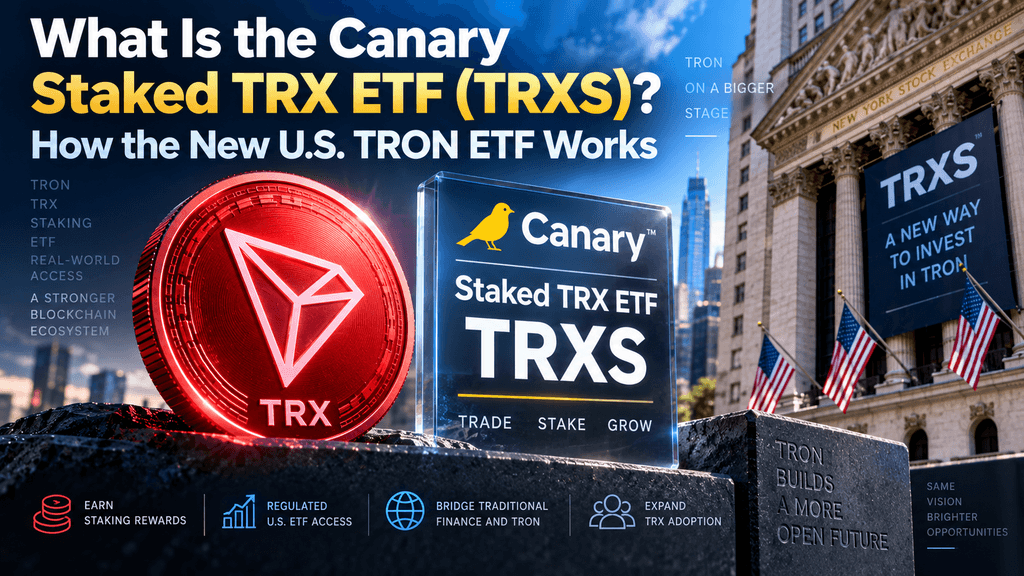
The U.S. crypto ETF market is expanding beyond simple price exposure. Canary Capital's new Canary Staked TRX ETF, trading under the ticker TRXS, is designed to give traditional investors access to TRON's native token while also capturing part of the staking rewards generated by the network. The product is scheduled to debut on Cboe BZX on September 9, 2026, making it the first U.S. staked exchange-traded product tied to TRON.
That structure makes TRXS more interesting than a conventional altcoin ETF. Instead of simply holding TRX in custody and tracking its price, the trust plans to stake substantially all of its eligible TRX and retain part of the resulting rewards. For crypto investors, that raises important questions about yield, liquidity, fees and potential demand for TRX.
This guide explains how TRXS works, why staking matters, how the fund differs from holding TRX directly, and what its launch could mean for the broader TRON ecosystem.
What Is the Canary Staked TRX ETF?
The Canary Staked TRX ETF is an exchange-traded product sponsored by Canary Capital Group LLC that seeks to provide direct exposure to the price of TRX held by the trust. Its shares are expected to trade under the ticker TRXS on Cboe BZX. According to its SEC registration statement, the primary investment objective is to reflect the value of TRX held by the trust after expenses and liabilities. A secondary objective is to earn additional TRX through participation in the TRON network's proof-of-stake system. Unlike a futures-based or leveraged product, TRXS is designed to hold actual TRX rather than derivatives that merely reference its price.
That distinction is important for crypto investors. A futures ETF can behave differently from the underlying asset because of contract rollover costs, leverage or derivatives-market conditions. TRXS instead seeks direct exposure to TRX held by an institutional custodian. BitGo Bank & Trust serves as the custodian responsible for safeguarding the trust's TRX, while Canary manages the fund structure and staking program. The filing also identifies firms including Flowdesk, Crypto.com, Wincent, Wintermute and BitGo as TRX trading counterparties.
Although the product is marketed as an ETF, its legal structure differs from a traditional mutual-fund-style ETF. The trust is registered under the Securities Act of 1933 but is not registered as an investment company under the Investment Company Act of 1940. That is similar to the structure used by many commodity and digital-asset exchange-traded products. For most investors, however, the practical idea is straightforward: TRXS packages TRX price exposure and staking economics into a security that can be bought and sold through a traditional brokerage account.
How Does TRXS Actually Work?
The mechanics begin with the trust acquiring TRX and holding it through BitGo. The fund calculates its net asset value using a TRX pricing benchmark produced by CoinDesk Indices. Rather than leaving all of those tokens idle, Canary intends to allocate substantially all of the trust's TRX to its staking program, except for amounts reserved for redemptions, expenses and liquidity management. TRON uses a delegated proof-of-stake system in which users freeze TRX, obtain voting rights and support Super Representatives that participate in network consensus. Those activities can generate staking rewards in TRX.
The rewards do not work like a conventional cash dividend automatically deposited into a shareholder's brokerage account. Instead, the trust receives TRX generated through the staking program. After staking-related fees are deducted, the remaining TRX generally stays inside the trust and can be restaked, used for redemptions or sold to cover permitted expenses. The SEC filing says aggregate staking fees paid to the custodian, staking provider and sponsor cannot exceed 20% of staking rewards, and the prospectus currently expects the trust to retain approximately 80% of the rewards generated by the program.
Investors therefore need to distinguish between the network's gross staking yield and the economic return that eventually benefits TRXS shareholders. The trust also charges an annual 1.10% Sponsor Fee, calculated on its TRX holdings and accrued daily. That means the relevant economics are not simply “TRX staking yield plus TRX price appreciation.” Staking-related costs and the sponsor fee reduce returns, while the TRX price itself remains the dominant driver of the fund's value. If TRX falls sharply, staking rewards are unlikely to offset a large decline in the underlying token.
Why Staking Makes TRXS Different
Staking is what separates TRXS from a basic spot crypto product. A Bitcoin ETF can hold BTC and provide price exposure, but Bitcoin does not have a proof-of-stake yield that a fund can capture. TRX does. By putting the underlying asset to work in the TRON network, TRXS attempts to preserve part of the native economic benefit that direct TRX holders can receive. In theory, that can improve the long-term economics of the fund relative to a product that simply keeps all of its TRX idle in custody.
The trade-off is liquidity. Staked TRX cannot become immediately liquid the moment the fund wants to sell it. TRON's current unstaking process imposes a 14-day waiting period before frozen TRX becomes transferable again. The trust therefore needs to keep enough liquid TRX available to manage foreseeable redemptions, fees and normal operations. Its sponsor is responsible for managing the resulting liquidity risk. TRON's delegated proof-of-stake system does not impose conventional slashing of staked principal, according to the prospectus, although validators can lose rewards for misconduct.
This creates a fundamental design challenge for staked crypto ETFs. The more assets a fund stakes, the more network rewards it may capture, but the less underlying liquidity it has available at any given moment. That balance becomes especially important during periods of extreme volatility or heavy ETF redemptions. TRXS therefore represents more than another altcoin listing: it is an example of how traditional fund structures are beginning to incorporate native onchain yield while still trying to preserve the creation, redemption and liquidity mechanisms investors expect from exchange-traded products.
Why TRON Fits a Staked ETF
TRON's investment case today is increasingly tied to stablecoins rather than simply to speculative activity around TRX. The network has become one of the largest settlement layers for USDT and other dollar-linked assets. CoinDesk Research reported that USDT supply on TRON reached approximately $89 billion in the second quarter of 2026, giving the chain around 47% of total USDT supply at the time. TRON also accounted for roughly 28.7% of stablecoin market capitalization across tracked chains and averaged around 3.5 million daily active users during the quarter.
Recent network activity reinforces that role. TRONSCAN shows more than 15.39 billion cumulative transactions on the network by early September 2026, while USDT transfers represented more than 3.5 billion of those transactions. Its separate USDT statistics show average daily USDT transfer volume of roughly $23 billion over the latest 30-day period, with more than one million accounts transferring USDT on an average day. These numbers help explain why TRON is often viewed less as a general-purpose smart-contract competitor and more as global infrastructure for stablecoin payments, remittances and value transfer.
That matters for TRXS because TRX plays an operational role inside this network. Staking TRX provides voting rights and network resources such as Bandwidth and Energy, while TRX remains central to TRON's governance and transaction-resource model. Canary itself describes TRON as a high-throughput, low-cost network that has evolved into a major stablecoin settlement layer, particularly in markets where inexpensive transfers are important. The stronger this real-world network activity becomes, the easier it is for investors to analyze TRXS as exposure to an operating blockchain economy rather than simply as a wrapper around another altcoin.
What Could TRXS Mean for TRX Price?
An ETF listing does not automatically make the underlying cryptocurrency rise. The important variable is capital inflow. If investors buy newly created TRXS shares and the fund needs additional TRX to back those shares, the trust becomes a new source of spot demand. If much of that acquired TRX is subsequently staked, some of the newly accumulated supply also becomes temporarily unavailable to the liquid market. In theory, the process creates a combination of new demand and supply lock-up that is somewhat different from a fund that simply purchases tokens and leaves them fully liquid.
The scale of that effect will depend entirely on TRXS assets under management. TRX has a market capitalization above $30 billion, so an ETF attracting only a few million or tens of millions of dollars would probably have little influence on the broader market. The potential impact becomes more meaningful if the fund eventually reaches hundreds of millions or billions of dollars in assets. That is why first-day trading volume should not be confused with ETF inflows. Shares can trade heavily between buyers and sellers without requiring an equivalent amount of new TRX purchases. Net creations, fund holdings and AUM provide better evidence of whether TRXS is actually generating incremental spot demand.
Short-term price action can also differ from the long-term supply story. TRX had already appreciated ahead of the scheduled TRXS debut, suggesting that at least part of the launch was known and potentially priced in before trading began. That creates the possibility of a classic buy-the-rumor, sell-the-news reaction even if the product is positive for TRON over a longer horizon. The stronger signal will come after launch: whether TRXS attracts sustained net inflows, how much TRX the trust accumulates and whether those holdings become large enough to matter relative to the circulating market.
TRXS vs. Buying TRX Directly
TRXS and direct TRX ownership provide exposure to the same underlying asset, but the investor experience is very different. With TRXS, an investor can gain TRX-linked exposure through a traditional brokerage account without opening a crypto exchange account, managing a wallet or protecting private keys. Custody and staking are handled inside the fund structure. This can be attractive for investors who already operate within regulated securities accounts or institutions that face operational restrictions around directly holding digital assets.
Direct TRX ownership offers more control. A user holding actual TRX can trade it around the clock, move it between wallets, participate directly in TRON applications, choose how and where to stake, use network resources and control the private keys if the assets are self-custodied. TRXS shareholders cannot withdraw TRX from the trust or use their ETF shares inside the TRON ecosystem. They own shares representing an economic interest in the trust, not transferable TRX tokens sitting in their own wallets. The fund also trades during U.S. securities-market hours, while TRX itself trades continuously.
The choice therefore depends on what an investor values. TRXS prioritizes brokerage access, professional custody and managed staking, but investors pay fund expenses and surrender direct onchain utility. Direct TRX provides 24/7 liquidity and full blockchain functionality but requires the investor to manage exchange, custody and staking risks independently. For crypto-native investors, direct ownership may remain more flexible. For traditional investors who want TRX exposure without managing crypto infrastructure, TRXS offers a very different access route.
What Are the Main Risks of TRXS?
The largest risk remains TRX itself. TRXS does not hedge the price of the underlying cryptocurrency and is not actively managed to protect investors during a downturn. If TRX loses 30%, 50% or more of its value, staking rewards would not prevent a substantial decline in the fund. The SEC prospectus explicitly warns that extreme volatility could cause shares to lose all or substantially all of their value. Investors are therefore still taking crypto market risk even though the asset is packaged inside a traditional security.
Staking creates an additional layer of operational and liquidity risk. Because unstaking currently requires 14 days, some of the trust's TRX cannot be immediately sold or used to meet redemptions. Staking rewards themselves can also change as TRON governance, validator economics or network participation evolves. The fund relies on service providers to manage staking and custody, and while BitGo uses institutional custody controls and insurance coverage, the prospectus notes that digital assets are not covered by FDIC insurance and that available private insurance may not fully cover every possible loss.
There are also fund-structure and tracking risks. Sponsor and staking fees create a drag on returns, so TRXS will not perfectly match the performance of directly held TRX over long periods. Shares can also temporarily trade above or below NAV, particularly during volatile conditions. Because TRX trades 24/7 while TRXS follows U.S. market hours, a major weekend move in TRX could produce a large opening gap when TRXS resumes trading. Finally, digital-asset regulation continues to evolve, meaning future changes to U.S. rules governing staking, crypto ETPs, custody or TRX itself could affect the product even if the underlying TRON network continues operating normally.
What Should Investors Watch After Launch?
The most important number after launch will not be TRXS's share price. It will be net fund flows. First-day trading volume can reveal whether traders are interested in the new product, but sustained net creations show whether additional capital is actually entering the fund and forcing it to acquire more TRX. Assets under management will provide the next level of evidence. A steadily growing AUM would suggest that TRXS is becoming a meaningful investment channel rather than simply benefiting from initial launch publicity.
Investors should also monitor the amount of TRX held by the trust, the portion participating in staking and the rewards ultimately retained after fees. Over time, comparing TRXS performance with spot TRX will reveal whether staking income materially offsets the fund's 1.10% sponsor fee and other expenses. Tracking error will be especially interesting during periods of high market volatility, large creations or redemptions and major weekend price moves in TRX.
Ultimately, the most important question is whether TRXS develops into a genuine institutional accumulation channel. If the fund remains small, its effect on TRX supply and price may be limited even if the listing itself is historically significant. If assets grow substantially, however, the structure could gradually convert traditional brokerage demand into sustained purchases of TRX and place a meaningful portion of those holdings into staking. That would make TRXS relevant not only as a U.S. ETF milestone, but also as a new component of TRX's market structure.
🔥 Beyond the Headlines: What KuCoin 5.0 Means for You
Market news moves fast — but where you act on it matters just as much. This October, KuCoin launches KuCoin 5.0, transforming KuCoin into a rebuilt platform. Here's what actually changes for you:
-
One account for everything. Older platforms split your money across separate "spot," "margin," and "futures" accounts and expected you to understand why. KuCoin 5.0's unified account removes that entirely — deposit once, and everything is simply there.
-
Stocks, indices, and commodities. KuCoin 5.0 expands beyond crypto into global markets. When crypto chops sideways and equities rally (or the reverse), you rotate in minutes instead of opening a brokerage account and waiting days for fiat rails.
-
Real-world assets (RWA). Tokenized exposure to traditional assets like commodities, right inside your crypto account. One of the fastest-growing segments in global finance is no longer reserved for institutions — you access it from the same balance you trade with.
-
Earn while you learn. Not ready to trade? KCUSD lets your stablecoins earn daily, auto-compounding interest. The lowest-stress way to put your idle deposit to work for 4% yield.
-
An AI assistant in plain language. Ask questions, get market context, understand what you're looking at — built into the platform, no jargon required.
-
An app that doesn't overwhelm. Faster, cleaner, and consistent — intuitive from the first tap, not after a tutorial.
-
Safety you can check, not just trust. A MiCAR-licensed EU entity, Proof of Reserves you can verify yourself, and internationally certified security (SOC 2 Type II, ISO 27001:2022).
Create your account in minutes — and start on the platform built for where crypto is going, not where it's been.
Conclusion
The Canary Staked TRX ETF represents a new stage in the evolution of crypto exchange-traded products. Instead of simply packaging cryptocurrency price exposure for traditional investors, TRXS attempts to preserve part of the underlying blockchain's native staking economics.
For TRON, the product provides another bridge between a network heavily used for stablecoin settlement and the regulated U.S. securities market. Its structure could create new spot demand for TRX while placing part of the fund's holdings into staking, but the size of that effect will depend on actual investor inflows rather than the ETF launch alone.
TRXS therefore should not be judged only by TRX's immediate price reaction. Its longer-term significance will depend on how much capital it attracts, how effectively staking rewards offset fund costs and whether traditional investors develop sustained demand for regulated TRON exposure.
FAQs
Can TRXS be held in an IRA or other retirement account?
Availability depends on the brokerage and account rules. Because TRXS is an exchange-traded security rather than directly held crypto, some U.S. brokerage retirement accounts may support it if the broker allows the product.
Does TRXS pay staking rewards as cash dividends?
Not necessarily. The trust receives staking rewards in TRX, and the retained portion generally remains within the fund rather than being automatically distributed as a cash dividend to shareholders.
Can TRXS trade above or below its NAV?
Yes. Like other exchange-traded products, its market price can temporarily differ from the value of the underlying assets. Creation and redemption mechanisms are intended to help limit large or persistent gaps.
What happens if TRX moves sharply over a weekend?
TRX trades continuously, while TRXS follows U.S. securities-market hours. A major weekend move could therefore cause TRXS to open substantially higher or lower when the market reopens.
Could more staked crypto ETFs launch in the U.S.?
TRXS may strengthen the case for products that combine spot exposure with native proof-of-stake rewards. Whether similar structures expand to other assets will depend on each network's staking design, liquidity, custody infrastructure and U.S. regulatory requirements.
Disclaimer: This content is for informational purposes only and does not constitute investment advice. Cryptocurrency investments carry risk. Please do your own research (DYOR).