

Bought Bitcoin at $100K? Here's Your 2026 Recovery Strategy
2026/06/12 16:49:00
Introduction
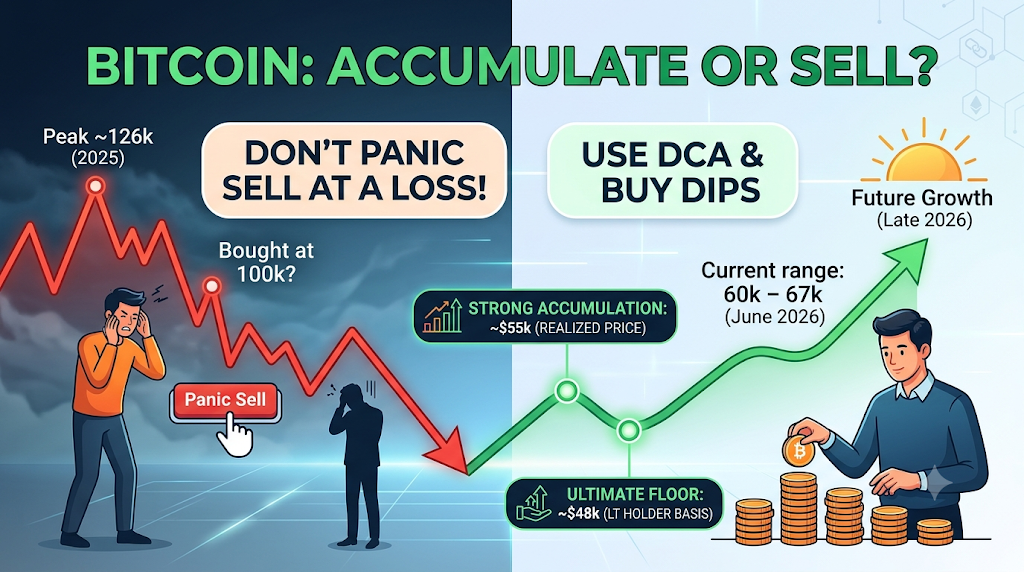
Bitcoin's journey from its $126,000 all-time high in October 2025 to today's $60,000-$67,000 range has tested every investor who entered near the peak.
If you bought Bitcoin near $100,000, do not sell your spot holdings at a loss. Instead, use dollar-cost averaging (DCA) or targeted dip-buying to lower your average entry price. Based on Bitcoin's four-year cycle and current on-chain data, the strongest accumulation zones sit near the realized price of approximately $55,000 and the long-term holder cost basis around $48,000. With BTC trading in the $60,000 range as of June 2026, patient accumulation now positions you for the next leg up.
Why Is Bitcoin Down Nearly 50% From Its All-Time High?
Bitcoin's nearly 50% drawdown from its $126k peak reflects a convergence of macroeconomic pressures, institutional profit-taking, and shifting risk sentiment across global markets.
The primary driver has been persistent macro headwinds. U.S. inflation data surprised to the upside in April 2026, with the Consumer Price Index rising to 3.8% — the highest reading since September 2023. The Producer Price Index jumped to 6%, forcing bond yields higher and pushing back expectations for Federal Reserve rate cuts. When risk-free rates climb, risk assets like Bitcoin face immediate pressure as institutional capital rotates toward safer fixed-income instruments.
ETF outflows have amplified the selling pressure. U.S. spot Bitcoin ETFs recorded five consecutive weeks of outflows totaling approximately $4.3 billion through mid-February 2026, with the streak extending into June. On May 27 alone, total outflows reached $733 million — the strongest single-day result in months, with BlackRock's IBIT losing $528 million in a single session, as reported by Bitcoin Foundation. These redemptions force authorized participants to sell actual BTC on spot exchanges, creating direct supply pressure that spot markets struggle to absorb in thin liquidity.
Geopolitical uncertainty has compounded the weakness. The U.S.-Israel-Iran conflict escalation in late February triggered a sharp risk-off move that pushed Bitcoin below $64,000. While geopolitical shocks are typically temporary, they catalyze leveraged liquidations that cascade through derivatives markets, amplifying downside moves beyond what fundamentals would suggest.
Finally, corporate buying slowed dramatically. After Strategy's aggressive accumulation pace in early 2026, corporate Bitcoin purchases dropped roughly 80% month-over-month in May, removing a key demand floor that had supported prices above $80,000.
Should You Sell Bitcoin Bought at $100K?
No — selling spot Bitcoin purchased at $100,000 today would lock in a permanent loss and forfeit your exposure to the asymmetric upside that defines Bitcoin's long-term investment thesis.
Bitcoin has experienced six drawdowns exceeding 40% throughout its history, and every single one has eventually resolved to new all-time highs. The average recovery time from 40%+ drawdowns sits at approximately 8-14 months. Based on historical cycle, investors who held through the 2018, 2020, and 2022 crashes notably outperformed those who panic-sold or attempted to time re-entries.
The behavioral math of selling at a loss works against you. If you sell today at $65,000, you crystallize a 35% loss. To recover that capital in traditional markets, you would need to generate 54% returns elsewhere just to break even — a challenging proposition in the current environment. Meanwhile, Bitcoin's structural supply dynamics remain overwhelmingly bullish. The April 2024 halving reduced daily issuance to approximately 450 BTC per day, while ETF holdings collectively sit near 1.29 million BTC, representing roughly 7% of circulating supply in institutional custody.
Selling now means betting against the same four-year cycle that has governed Bitcoin's price action since 2009. It means exiting when institutional infrastructure has never been more developed, when ETF access has never been broader, and when the post-halving supply squeeze has only begun to take effect.
How Can You Lower Your Bitcoin Average Cost?
The two most effective strategies for lowering your cost basis are dollar-cost averaging (DCA) through regular fixed purchases, and targeted accumulation during extreme fear when Bitcoin approaches key on-chain support levels.
Dollar-cost averaging removes emotion from the equation. By committing to a fixed dollar amount at regular intervals — weekly or monthly — you automatically purchase more Bitcoin when prices are low and less when prices are high.
The hybrid approach combines the discipline of DCA with opportunistic additional purchases during extreme fear events. When Bitcoin approaches historically significant support levels — such as the realized price or long-term holder cost basis — adding capital beyond your regular DCA schedule can accelerate your cost basis reduction. The key constraint: only deploy capital you can afford to lose and continue deploying through an extended downturn.
For investors with available capital, the current $60,000-$65,000 range represents a compelling entry zone. Bitcoin has already declined 46%-50% from its all-time high. A purchase at current levels immediately lowers your blended cost basis if your original entry was near $100,000. If you originally allocated $10,000 at $100,000 and add $10,000 at $65,000, your new average cost drops to approximately $78,850 — a 21% improvement that requires only a 22% price recovery to break even rather than the 54% recovery needed from the original entry alone.
What Price Levels Matter Most for Bitcoin Accumulation?
The two most critical on-chain price floors are Bitcoin's overall realized price at approximately $55,000 and the long-term holder realized price at roughly $48,000. When spot price falls below these levels, historical data indicates cycle bottoms are forming.
When Bitcoin trades below its realized price, the entire market enters unrealized loss territory. Historically, such periods have coincided with major cycle bottoms in 2015, 2018, and 2022. The long-term holder realized price acts as an even stronger floor because these investors have demonstrated conviction through multiple volatility cycles. When price approaches this level, long-term holders historically shift from passive holding to active accumulation, creating natural demand that stabilizes price action.
The current market structure supports this analysis. As of June 2026, Bitcoin has been trading in a consolidation range between $60,000 and $70,000, unable to sustain a breakout above $70,000 but finding consistent bids on dips toward $60,000. This range-bound action following a major correction is historically characteristic of accumulation phases that precede recovery moves.
|
Price Level
|
On-Chain Significance
|
Historical Behavior When Tested
|
|
~$74,000
|
Short-term holder cost basis
|
Resistance in bear markets, support in bull markets
|
|
~$55,000
|
Overall realized price
|
Cycle bottom indicator; strong accumulation zone
|
|
~$48,000
|
Long-term holder realized price
|
Ultimate cycle floor; maximum conviction buy zone
|
For investors who bought at $100,000, these levels define your strategic roadmap. If Bitcoin breaks below $55k, that signals a potential cycle-bottoming process. A decline toward $48k would represent a generational accumulation opportunity based on historical patterns.
Should You Buy More Bitcoin on KuCoin?
If you are looking to lower your cost basis through DCA or make targeted purchases near key support levels, KuCoin provides the infrastructure to execute either strategy efficiently. The platform offers spot trading with competitive fees, recurring buy functionality for automated DCA strategies, and deep liquidity across BTC trading pairs.
For investors implementing the hybrid approach of regular DCA plus opportunistic dip accumulation, KuCoin's recurring buy feature automates your fixed-interval purchases while the spot trading interface enables manual execution when Bitcoin approaches critical levels like the $55,000 realized price or $48,000 long-term holder cost basis. The platform supports over 700 cryptocurrencies, allowing you to diversify beyond Bitcoin if your strategy includes altcoin allocation.
New users can now register at KuCoin and Get Up to 11,000 USDT in New User Rewards.

Conclusion
Buying Bitcoin at $100,000 and watching it decline to $60,000 is painful, but it is not unprecedented. Bitcoin has survived six drawdowns exceeding 40% throughout its history, and each one has ultimately resolved to new all-time highs. The data supports patience over panic.
Do not sell your spot Bitcoin at a loss. Realized losses are permanent; unrealized losses are temporary. Instead, implement a systematic DCA strategy or make targeted purchases during extreme fear to lower your average cost basis. The on-chain data points to $55,000 and $48,000 as the highest-conviction accumulation zones if Bitcoin continues lower. Current price action in the $60,000-$65,000 range already represents a significant discount to your original entry.
Bitcoin's four-year cycle, post-halving supply dynamics, and institutional adoption through ETFs all point toward recovery potential in late 2026. Nine AI models consensus projects $100,000 by Q4. The long-term holder realized price near $48,000 provides a historically validated floor. Your job is not to time the exact bottom — it is to survive until the cycle turns and ensure you still hold Bitcoin when it does.
FAQs
How low can Bitcoin go in 2026?
Based on prediction market data from Polymarket and AI model consensus from TradingNews, the most likely floor sits in the $55,000-$57,000 range. Nine AI models surveyed in June 2026 projected no structural collapse below $40,000 as a base case. The long-term holder realized price at approximately $48,900 represents the ultimate historical floor.
Is dollar-cost averaging better than waiting for the bottom?
Yes. Timing market bottoms is statistically nearly impossible. DCA removes emotion, enforces discipline, and ensures you accumulate through the full downturn. According to case studies from Invity, investors who continued DCA through the 2025-2026 correction significantly lowered their average cost basis compared to those who attempted to time entries.
Should I sell other crypto to buy more Bitcoin?
This depends on your portfolio construction and risk tolerance. Bitcoin's market dominance and institutional adoption make it the lowest-risk cryptocurrency allocation. However, concentrating too heavily in any single asset increases vulnerability. A balanced approach maintains core Bitcoin exposure while keeping diversified positions.