

BofA’s Michael Hartnett: Best AI Bubble Play Is Long Tech Giants + Laggards, Short AI Bonds
According to Bank of America Securities Chief Strategist Michael Hartnett, private client equity allocations surged to an all-time high of 66.4% while tech stocks logged their largest weekly capital outflows in seven weeks. Bank of America’s proprietary Bull & Bear Indicator sits deep in extreme bullish territory at 9.3, maintaining an outright "sell" signal for broader risk assets. Despite these macro warning flags, global equity markets continue to climb under a widespread investor belief that monetary policymakers regard equity markets as too big to fail.
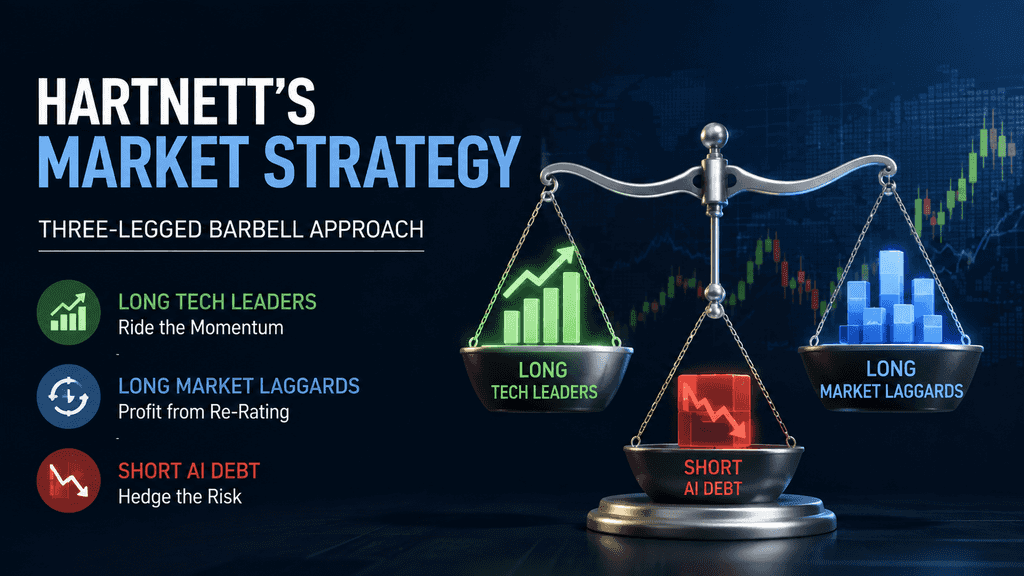
Hartnett argues that market participants are navigating a late-stage speculative cycle fueled by massive nominal GDP expansion, expanding government debt, and aggressive enterprise capital allocation. Rather than executing a premature short position on tech equities that retain dominant price momentum, Hartnett advocates a sophisticated three-legged barbell framework: remain long dominant technology megacaps, long deeply out-of-favor cyclical laggards, and aggressively short corporate bonds tied to artificial intelligence debt issuance.
This approach addresses the underlying realities of modern market microstructure—where corporate liquidity, fixed-income supply dynamics, and retail momentum converge. Traders on KuCoin can leverage this strategy across both crypto and traditional asset classes by carefully managing market exposure, debt risks, and asset class correlations.
What Is the "Pride and Prejudice" Bubble Framework?
The fundamental driver of Hartnett’s portfolio architecture is the simultaneous exploitation of market euphoria and deep valuation disconnects during a speculative peak. Historical market bubbles—from the 1999 internet boom to late-1980s Japanese real estate—demonstrate that capital spills into underpriced cyclical corners of the economy right before a final market top.
Hartnett classifies AI market leaders as "Pride" (or "Hubris") and out-of-favor laggards as "Prejudice" (or "Humiliation"). Under this barbell playbook, long tech leaders provide momentum exposure driven by balance sheet cash flows, while long laggards target the re-rating of deeply discounted cyclicals. Simultaneously, shorting AI corporate debt hedges against supply strain and widening credit spreads. The core mechanism relies on dual-exposure benefits:
-
Capturing Late-Stage Momentum: Dominant tech leaders possess massive balance sheet cash reserves, monopolistic pricing power, and direct monetization capabilities that allow them to absorb late-cycle capital inflows.
-
Exploiting Overflow Liquidity: As mega-cap valuations reach historically stretched multiples, speculative capital flows into neglected value sectors that offer asymmetric upside as nominal growth surges.
-
Mitigating Market Top Risks: Diversifying long equity exposure across mega-cap tech and discounted real-economy assets limits vulnerability to sudden narrative shifts or single-sector drawdowns.
Why Short AI-Related Corporate Bonds and Debt?
The primary structural risk in the current technology ecosystem is located in fixed-income debt markets rather than equity order books. Enterprise infrastructure expansion across artificial intelligence, high-performance computing, and hyperscale data centers requires over $1 trillion in capital expenditures, forcing mega-cap tech and energy providers to flood debt markets with corporate bond issuances.
Based on recent market research from Bank of America, the cash flows generated by AI operations are currently insufficient to cover aggressive capital expenditure budgets, forcing heavy reliance on corporate bond markets.
The Debt Supply Crisis
Hyperscaler corporate debt issuance reached over $120 billion across recent months. This massive supply surge strains fixed-income liquidity, driving corporate credit spreads wider relative to benchmark government debt.
Spreading Credit Vulnerability
Credit spreads for major technology issuers expanded from historical lows of 50 basis points to nearly 80 basis points over benchmark Treasuries. Widening credit spreads indicate deteriorating credit conditions and rising default risk premiums long before equity indices register a pull-back.
The Dot-Com Parallel
During the 12 months preceding the March 2000 dot-com peak, corporate tech bonds fell by 8% as debt markets priced in over-leverage, even while technology equity indices reached record highs. Shorting corporate AI debt serves as a direct, lower-risk hedge against over-leveraged infrastructure spending.
How to Trade Market Laggards: The Rotation Play
When speculative bubbles approach maturity, capital naturally searches for under-owned, low-valuation market segments that stand to benefit from broader economic spillover. Hartnett emphasizes that historical market tops are multi-month processes rather than sudden single-day events, making sector rotation a prime generator of relative alpha.
Data from BofA Securities indicates that while technology equities experienced major capital outflows, broad commodities notched strong year-to-date returns of 58.9%, and gold recorded its largest single-week capital inflows since January. Capital allocation strategies targeting laggards focus on key assets:
-
Small-Caps & Regional Banks: Beneficiaries of sustained nominal GDP growth that trade at deep relative valuation discounts compared to large-cap technology benchmarks.
-
Real Estate Investment Trusts (REITs) & Distressed Property: Assets characterized by depressed valuations, such as Hong Kong real estate trading at approximately 12x earnings multiples matching 30-year valuation lows.
-
Biotech & Consumer Cyclicals: High-beta sectors that have lagged overall index returns but offer operational leverage if broader liquidity conditions remain supportive.
What Macro Indicators Signal the Peak of the AI Bubble?
Navigating late-stage equity rallies requires tracking quantitative risk thresholds across debt, monetary policy, and fiscal metrics. According to BofA Securities, three primary macro constraints threaten to suppress further equity upside and trigger a broader market correction.
Crucial risk metrics include 10-Year Treasury Yields, where surging past 5.0% forces systemic debt repricing; U.S. National Debt approaching $40 Trillion with debt service hitting $1.4 Trillion; the BofA Bull & Bear Index reading at 9.3 signaling extreme bullish crowding ("Sell"); and Private Client Equity allocation hitting a record 66.4%, leaving virtually zero cash sidelined.
Soaring Government Debt & Interest Costs
U.S. national debt is rapidly approaching the $40 trillion threshold, pushing annualized national debt service costs to over $1.4 trillion. High interest expenses maintain upward pressure on long-duration Treasury yields, restricting monetary flexibility.
Extreme Retail Positioning
With private client equity holdings at a record 66.4% and cash balances at historic lows, marginal buying power in retail equity accounts is fully exhausted. Highly crowded positioning leaves markets exceptionally vulnerable to unexpected macroeconomic shocks.
Bond Yield Spikes
Fixed-income markets face severe pressure as 30-year Treasury yields reach multi-decade highs. Japanese and U.S. currency and yield interventions indicate that fiscal authorities view a 10-year Treasury yield above 5.0% as a critical threshold for financial stability.
What Macro Hedges Protect Portfolios Against Dollar Debasement?
In an economic regime defined by massive government fiscal deficits, soaring debt servicing costs, and persistent inflation pressures between 3% and 5%, holding unhedged fiat currency reserves introduces substantial purchasing power risks. Hartnett’s macroeconomic matrix centers on three explicit rules: avoid fixed-income bonds, avoid the U.S. dollar, and remain allocated to high-conviction real assets.
Gold serves as the primary structural hedge against sovereign debt expansion and currency debasement. Capital flows into precious metals continue to accelerate as institutional asset managers seek zero-counterparty-risk reserves to offset expanding public sector debt burdens.
Simultaneously, hard-capped digital assets like Bitcoin continue to function as sovereign-debt hedges over extended macro cycles. Although digital assets experience short-term volatility, their strict supply limits appeal to institutional investors seeking alternatives to depreciating fiat currencies.
How Does the AI Bubble Dynamic Impact Crypto Markets?
The structural spillover from traditional technology infrastructure into decentralized digital asset markets is highly pronounced. Decentralized physical infrastructure networks (DePIN), AI compute protocols, and cryptographic verification layer projects maintain high operational correlations with traditional technology capital expenditure cycles.
According to a report by 1kx, total crypto industry revenues totaled $47 billion in the first half of the year, representing a 23% year-over-year decline driven by lower centralized exchange and derivatives trading volumes. However, crypto infrastructure sectors directly linked to artificial intelligence compute saw expanding revenue footprints:
-
Public Bitcoin Miner Pivot: Publicly traded Bitcoin mining entities trimmed hash-rate capacity by 13.4% to pivot operational infrastructure toward AI enterprise compute and data hosting, diversifying revenue streams.
-
Infrastructure Token Volatility: DePIN and AI-related crypto tokens exhibit amplified beta relative to traditional technology stocks like Nvidia, Microsoft, and Alphabet.
-
Stablecoin Liquidity Flows: Record non-fiat asset allocations push capital into yield-bearing stablecoins and tokenized real-world assets (RWAs), bridging decentralized finance with traditional credit markets.
Should You Trade AI Tokens and Crypto Assets on KuCoin?
Trading AI-related digital assets and macro hedges on KuCoin offers crypto investors direct exposure to late-stage technology momentum and structural inflation hedges. KuCoin maps BofA strategic categories across key product lines: Long Tech Leaders map to Spot & Futures exposure on High-Beta AI Tokens; Long Hard Asset Hedges map to Spot Bitcoin (BTC) & Tokenized Gold (XAUT/PAXG); Capital Efficiency maps to KuCoin Futures leverage & Auto-Invest Trading Bots; and Yield Generation maps to KuCoin Earn stablecoin flexible deposit programs.
KuCoin provides a robust ecosystem for executing macro-themed crypto strategies across multiple specialized trading tools:
Exposure to AI & Compute Networks
KuCoin features deep liquidity across leading decentralized AI, compute, and data protocols—including Near Protocol (NEAR), Render (RENDER), Fetch.ai (FET), and Bittensor (TAO)—allowing traders to participate in the artificial intelligence technology cycle.
Access to Hard-Asset Hedges
Investors seeking protection against fiat debasement can execute long spot and derivatives positions in Bitcoin (BTC) as well as tokenized gold assets like Tether Gold (XAUT) directly through KuCoin's spot market.
Latest KuCoin Promotional Campaigns & Events
To lower trading costs and maximize user yields during volatile macro shifts, KuCoin currently offers several high-reward promotional campaigns:
-
Copy Trading Task Campaign: Running from August 12 to September 11, new copy traders can claim a 100 USDT Copy Trading Trial Fund and complete tasks to unlock up to 300 USDT in rewards, alongside competing for a 1,000 USDT top-trader reward pool.
-
KuCoin Square Creator Campaign: Running from August 4 to September 1, content creators and community builders can participate to win share from 10,000 AEON in total rewards by publishing trading insights and market analysis.
-
New User GemSlot & Welcome Rewards: Newly registered users can unlock newcomer bonuses of up to 11,000 USDT by completing daily tasks on KuCoin GemSlot and participating in initial deposit programs.
Professional Trading Automation
Utilize KuCoin Trading Bots—such as Spot Grid, Infinity Grid, and DCA (Dollar-Cost Averaging)—to automatically capture market volatility, systematically rebalance asset allocations, and execute long-laggard rotation strategies without emotional bias.
Yield Optimization & Futures Risk Management
Hedge directional downside using KuCoin Futures contracts or deposit idle USDT/USDC stablecoins into KuCoin Earn to generate competitive yields while maintaining liquidity to deploy during market pullbacks.
How to Execute Michael Hartnett’s Playbook on KuCoin
Implementing a macro-hedged AI strategy requires a systematic, step-by-step approach to balance capital growth with strict risk management.
-
Establish Core Capital Reserves: Transfer funds into your KuCoin account via bank transfer, credit card, or P2P trading to secure USDT or USDC base balances.
-
Allocate to Core Hard-Asset Hedges: Allocate a baseline percentage of your portfolio to Bitcoin (BTC) or Tokenized Gold (XAUT) on KuCoin Spot to build a defensive hedge against dollar debasement and bond market volatility.
-
Deploy Capital into High-Conviction AI Protocols: Select top-tier decentralized AI and infrastructure projects with strong revenue generation and active developer ecosystems. Use KuCoin Spot Grid bots to accumulate positions during localized market dips.
-
Hedge Downside Exposure via Futures: Manage portfolio risk by utilizing KuCoin Futures to open selective short positions on overextended, high-valuation altcoins or high-leverage tokens showing credit-style fatigue.
-
Automate Portfolio Rebalancing: Set up KuCoin DCA or Rebalancing Bots to systematically take profits from surging AI tokens and automatically rotate gains into underperforming, high-value market laggards.
Conclusion
Michael Hartnett’s "Long Tech Giants + Laggards, Short AI Bonds" framework offers a comprehensive roadmap for navigating the complexities of a late-stage technology bubble. By capitalizing on equity momentum, hedging against excessive corporate debt issuance, and accumulating hard-asset hedges like gold and Bitcoin, investors can effectively balance risk and return in an volatile macro environment.
As technology spend and macroeconomic policy continue to evolve, maintaining strict risk discipline, monitoring fixed-income credit spreads, and utilizing advanced trading tools are essential for long-term capital preservation. Position your portfolio for the next phase of the market cycle by exploring high-beta AI tokens, sovereign debt hedges, and active campaigns available on KuCoin.
Frequently Asked Questions (FAQs)
What is Michael Hartnett’s main advice for trading the AI bubble?
Hartnett advises going long on leading technology giants and deeply discounted market laggards while shorting corporate AI bonds to hedge against massive capital expenditure debt supply.
Why is shorting AI bonds safer than shorting tech stocks?
Shorting AI bonds targets corporate over-leveraging and credit spread expansion directly without fighting strong equity momentum and retail capital inflows driving stock prices higher.
What macro signals indicate that the AI equity market is near a top?
Key indicators include 10-year U.S. Treasury yields surging past 5.0%, widening technology corporate credit spreads, extreme retail equity allocations above 66%, and BofA's Bull & Bear Indicator issuing a sell signal.
How does gold fit into Bank of America’s macro strategy?
Gold acts as a primary hedge against massive U.S. national debt expansion, escalating debt servicing costs, and sovereign fiat currency debasement.
How can crypto traders apply BofA's playbook on KuCoin?
Crypto traders can go long on top-tier AI protocols, hold Bitcoin and tokenized gold as debasement hedges, use futures to short overextended assets, and participate in active KuCoin campaigns like the Copy Trading Task Campaign to earn trial funds.