

Bitcoin Stalls Under $87,200 Ahead of FOMC Minutes and October 14 CPI
Introduction
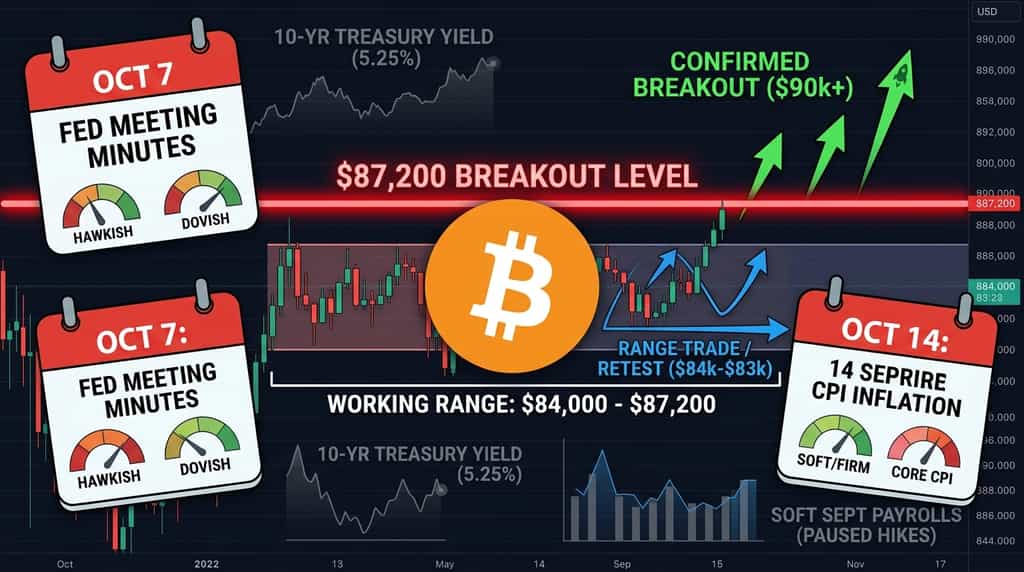
Bitcoin is still roughly 32 percent below its October 6, 2025 peak near $126,200, and the latest push has stalled just under $87,200. As of October 6, 2026, spot Bitcoin is trading in the mid-$85,000s to high-$86,000s after sellers rejected a move through $87,100 to $87,220 on October 2, based on exchange price histories and the CoinDesk Bitcoin Price Index. The stall is a pause, not a breakdown. Traders are waiting for the Federal Reserve’s September meeting minutes on October 7 and the September Consumer Price Index on October 14 before they pay up for a breakout. A daily close that holds above $87,200 is the level that would confirm the next leg. Until that print arrives, $84,000 to $87,200 is the working range.
Why Is Bitcoin Stalling Under $87,200?
Bitcoin price is stalling under $87,200 because buyers have failed to convert a multi-week rebound into a confirmed breakout. According to QCP Capital’s October 5 market note, Bitcoin recovered to about $86,700 after Friday’s rejection near $87,100, and acceptance above $87,200 is the level required to confirm the next leg higher. Dip demand is present. Follow-through is not.
The rejection is the fourth serious test of the high-$86,000s to low-$87,000s since September 21. Price histories from specialized market data show an October 2 high near $87,177 to $87,220, a weekly close in the mid-$86,000s, and an October 5 session that opened near $86,500 before fading toward $85,700. Early October 6 trade sat near $85,500 to $86,000. That pattern is a failed expansion, not a trend reversal.
Two forces explain the stall. Soft labor data pulled October rate-hike odds down, which is supportive for risk assets. At the same time, the 10-year U.S. Treasury yield has held near 5.25 percent, according to QCP Capital, because Treasury supply and term premium have outweighed the growth signal. Bitcoin can rally on a pause in the funds rate and still fail to trend if long-end yields stay punitive.
Positioning is cleaner than it looks. QCP Capital reported weekend liquidations of about $62.7 million, with short positions accounting for roughly 68 percent of that total. The flush was small. It removed some late shorts without forcing a cascade of long liquidations. That leaves the market able to move in either direction once the minutes and CPI land.
What Did the September Jobs Report Change for Bitcoin?
The September jobs report weakened the case for an October rate hike, and that is why Bitcoin found buyers under $87,000. According to the U.S. Bureau of Labor Statistics Employment Situation for September 2026, released October 2, nonfarm payrolls rose by 29,000 and the unemployment rate was 4.2 percent. Both changed little on the month. Average hourly earnings rose 5 cents to $37.81, a 3.0 percent gain over the past 12 months.
That payroll print was far below the roughly 84,000 figure markets had expected, based on consensus tracked by QCP Capital. The same note put the three-month payroll average near 50,700, about one-third of the pace a year earlier. Health care still added jobs, but the broad private-sector impulse cooled. A labor market that is no longer re-accelerating gives the Federal Open Market Committee room to pause.
Rate pricing moved with the data. According to the CME FedWatch Tool as cited in market pricing on October 5, the probability of an October hike had fallen to about 22 percent, with roughly 78 percent priced for a hold. A week earlier, hike odds had been far higher. December still carries a larger chance of another increase. The jobs report delayed tightening. It did not end the cycle.
For Bitcoin, the transmission is straightforward. A lower chance of an immediate hike reduces the near-term carry advantage of cash and can support spot demand. It does not guarantee a break of $87,200. Bitcoin still has to absorb a 10-year yield near multi-decade highs and a CPI print that could put a December hike back in play.
What Will the October 7 FOMC Minutes Tell Traders?
The October 7 minutes will tell traders whether September’s hawkish dissent was conviction or compromise. Based on the Federal Reserve’s published calendar, the minutes of the September 15–16, 2026 meeting are due at 2:00 p.m. Eastern Time on Wednesday, October 7. The next policy decision is not until the October 27–28 meeting. Minutes are the bridge.
The September meeting matters because the Committee raised the target range for the federal funds rate by 25 basis points to 3.75 to 4.00 percent, its first increase in three years. Markets now want the internal debate. If the minutes show a narrow hike and a committee already open to a pause after the soft payrolls, Bitcoin’s hold above the mid-$84,000s becomes easier to defend. If the minutes show a broad desire to keep tightening despite slower hiring, yields can push higher and the $87,200 cap can hold.
Three lines inside the document will matter more than the headline tone.
-
The balance of risks. A shift toward labor-market downside would support a pause. A focus on still-elevated inflation would not.
-
The neutral-rate discussion. Higher estimates of the long-run funds rate keep term premium supported and limit how far Bitcoin can re-rate on a single soft data print.
-
The treatment of dissent. QCP Capital framed the week’s core question as whether hawkish dissents reflected genuine conviction or a negotiated compromise under the current leadership.
Minutes rarely reverse a trend by themselves. They reprice the path. A dovish read can squeeze remaining shorts toward $87,200. A hawkish read can send price back toward $84,000 without breaking the broader rebound from September’s lows near $75,000.
Why Does the October 14 CPI Release Matter for Bitcoin?
The October 14 CPI release is the first clean test of whether disinflation is reasserting before the late-October Fed meeting. According to the Bureau of Labor Statistics release schedule, the Consumer Price Index for September 2026 is due at 8:30 a.m. Eastern Time on Wednesday, October 14, alongside real earnings. The Producer Price Index follows on October 15. The Fed’s October 27–28 meeting comes after both prints. September personal consumption expenditures inflation is scheduled later in the month.
The latest completed CPI is a high bar to clear. According to the Bureau of Labor Statistics, the Consumer Price Index for all urban consumers rose 0.4 percent in August 2026 and 3.4 percent over the prior 12 months. The index for all items less food and energy rose 0.3 percent on the month and 2.4 percent over the year. Headline inflation is still well above the Fed’s 2 percent goal. Core is closer, but not there.
Bitcoin traders should split the print into two questions. Did headline CPI cool because energy eased, or did core services slow? A softer core reading would weaken the case for a December hike and improve the odds of a close above $87,200. A firm core reading, especially if shelter or other services re-accelerate, would validate the yield backup and favor range trade or a retest of $83,000 to $84,000.
CPI also interacts with oil and the long bond. Elevated energy prices can lift headline inflation even when the labor market is soft. That mix — weak jobs, firm prices, high term premium — is the scenario that has capped Bitcoin despite the drop in October hike odds. October 14 is the date that either breaks that mix or extends it into the October 27–28 decision.
How Are Treasury Yields Limiting Bitcoin’s Breakout?
Treasury yields are limiting the breakout because the long end has not confirmed the dovish repricing in the funds rate. According to QCP Capital, the 10-year yield stood near 5.25 percent even after the soft payrolls, held up by Treasury supply and the extra compensation investors demand to hold longer-dated bonds. A pause in the policy rate does not automatically pull the 10-year yield down.
That split matters for Bitcoin more than a single FedWatch probability. Spot Bitcoin often trades as a duration-sensitive risk asset when real yields rise. If the 10-year stays above 5 percent into the minutes, rallies toward $87,200 can keep failing even if October hike odds stay near 22 percent. If the minutes or a soft CPI pull the 10-year lower, the same spot bid that defended $86,000 can extend.
The dollar and oil sit on the same side of the ledger. A firm dollar tightens global financial conditions and can drain incremental demand for dollar-priced Bitcoin. Firm oil feeds headline CPI and gives hawks a reason to keep December live. Neither has to collapse for Bitcoin to break $87,200. Both have to stop rising.
ETF flow is the offset. QCP Capital cited spot Bitcoin ETF flows and short covering as part of the positioning reset after the labor data. Resumed inflows would help a break of $87,400 in the constructive case. Renewed outflows would reinforce the challenging case below $83,000. Flow data this week should be read next to the minutes, not instead of them.
How to Trade Bitcoin on KuCoin Ahead of the FOMC Minutes and CPI
KuCoin is a practical venue for trading the $87,200 decision because it lists spot Bitcoin and perpetual contracts in one account. A spot buy of BTC/USDT fits traders who want exposure to a hold above $87,200 without funding rates. A USDT-margined perpetual fits traders who want to express a range view — long near $84,000 to $85,000, or a tactical short only after a failed retest of $87,200 — with explicit leverage limits.
The sequence is simple. Create a KuCoin account, complete identity verification, and fund with USDT or another supported asset. For spot, place a limit order near support rather than chasing a wick into $87,200. For futures, set leverage low into October 7 and October 14, because macro releases gap through stops. Attach a stop below the level that invalidates the trade, such as a daily close under $83,000 for a long taken inside the current range.
Event weeks reward planned orders over reactive clicks. KuCoin’s order book and charting tools let traders stage bids at $85,000 and $84,000 and stage a breakout plan only after a daily close above $87,200. None of that removes macro risk. It does put the execution next to the levels this article has already defined.
Beyond the Headlines: What KuCoin 5.0 Means for You
Market news moves fast — but where you act on it matters just as much. This October, KuCoin launches KuCoin 5.0, transforming KuCoin into a rebuilt platform. Here's what actually changes for you:
-
One account for everything. Older platforms split your money across separate "spot," "margin," and "futures" accounts and expected you to understand why. KuCoin 5.0's unified account removes that entirely — deposit once, and everything is simply there (only available to VIPs for now).
-
Stocks, indices, and commodities. KuCoin 5.0 expands beyond crypto into global markets. When crypto chops sideways and equities rally (or the reverse), you rotate in minutes instead of opening a brokerage account and waiting days for fiat rails.
-
Real-world assets (RWA). Tokenized exposure to traditional assets like commodities, right inside your crypto account. One of the fastest-growing segments in global finance is no longer reserved for institutions — you access it from the same balance you trade with.
-
Earn while you learn. Not ready to trade? KCUSD lets your stablecoins earn daily, auto-compounding interest. The lowest-stress way to put your idle deposit to work for 4% yield.
-
An AI assistant in plain language. Ask questions, get market context, understand what you're looking at — built into the platform, no jargon required.
-
An app that doesn't overwhelm. Faster, cleaner, and consistent — intuitive from the first tap, not after a tutorial.
-
Safety you can check, not just trust. A MiCAR-licensed EU entity, Proof of Reserves you can verify yourself, and internationally certified security (SOC 2 Type II, ISO 27001:2022).
Create your account in minutes — and start on the platform built for where crypto is going, not where it's been.
Conclusion
Bitcoin’s stall under $87,200 is a macro waiting room. Soft September payrolls of 29,000 and a 4.2 percent unemployment rate, according to the Bureau of Labor Statistics, knocked October hike odds to about 22 percent on CME FedWatch pricing. That bid is real. It has not been strong enough to clear $87,200 while the 10-year yield holds near 5.25 percent.
October 7 minutes will show whether September’s hike was a reluctant step or the start of a longer tightening bias. October 14 CPI, scheduled by the Bureau of Labor Statistics for 8:30 a.m. Eastern Time, will test whether August’s 3.4 percent headline and 2.4 percent core readings are cooling. A daily close above $87,200 opens $90,000. A loss of $83,000 reopens $80,000. Between those prints, the working range is $84,000 to $87,200.
The practical takeaway is conditional, not directional. Dip demand near $86,000 has survived a small short liquidation, and dominance near 59 percent says Bitcoin is still leading. The breakout is not confirmed until price holds above $87,200 after the data, not before it. Traders who size for both the minutes and the CPI, and who use defined levels on a venue such as KuCoin, are matching the event risk instead of guessing it.
FAQs
Does a Fed pause in October guarantee a Bitcoin rally?
No. A pause lowers the near-term funds rate path, but Bitcoin still has to clear $87,200 against a 10-year yield near 5.25 percent. December hike odds can stay elevated even if October is a hold.
How are FOMC minutes different from the policy statement?
The statement is the decision released on meeting day. The minutes, due three weeks later, record the debate behind that decision, including dissent and the balance of risks. October 7 minutes cover the September 15–16 meeting, not a new vote.
Why should crypto traders watch core CPI as well as headline CPI?
Headline CPI includes food and energy, which oil can swing. Core CPI strips those out and is closer to the inflation trend the Fed uses when it judges whether another hike is needed. August core rose 2.4 percent over the year, according to the Bureau of Labor Statistics.
Can spot Bitcoin ETF flows override the minutes and CPI?
They can amplify a move, not replace the data. QCP Capital treats resumed inflows as part of the constructive case above $87,400 and outflows as part of the case below $83,000. Flow is a confirmation tool beside the macro prints.
What happens to Ethereum if Bitcoin stays under $87,200?
Ether is likely to stay inside its $2,650 to $2,800 range. QCP Capital said acceptance above $2,800 is required for continuation. A Bitcoin range usually keeps large-cap altcoins range-bound until CPI resets the macro bid.
Disclaimer: This article is for informational purposes only and does not constitute financial, legal, or investment advice. Always conduct your own research before interacting with digital assets.