

Bitcoin Open Interest Falls to Two-Month Low: What Declining Leverage Means for BTC’s Next Move?
2026/08/25 15:12:00
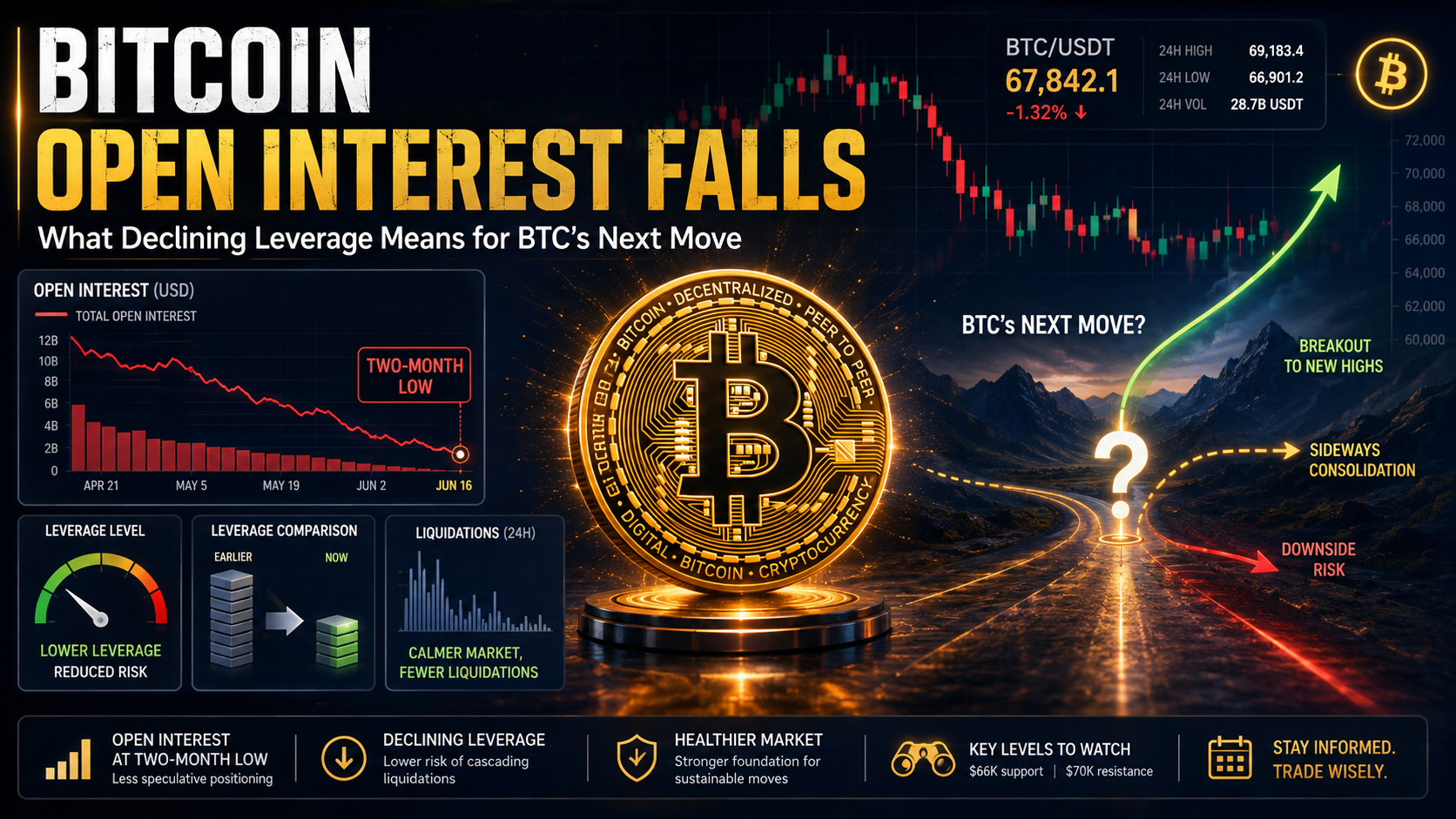
Bitcoin’s latest market movement has created an unusual situation that has attracted attention from traders, analysts, and investors: BTC prices have recovered strongly while leverage in the derivatives market has continued to decline. In previous market rallies, rising Bitcoin prices were often accompanied by increasing futures positions as traders used leverage to amplify potential returns. However, the recent decline in Bitcoin Open Interest suggests that market participants are taking a more cautious approach rather than aggressively increasing their exposure.
This divergence between Bitcoin’s price performance and derivatives positioning has raised an important question: does falling leverage represent a healthier market structure, or does it indicate weaker confidence among traders? To understand what this shift means for Bitcoin’s next move, it is necessary to examine the role of Open Interest, the reasons behind declining leverage, and how changing market behavior could influence the future direction of BTC.
Understanding Bitcoin Open Interest and Why It Matters
Bitcoin Open Interest refers to the total value of active futures contracts that remain open and have not yet been closed, settled, or liquidated. Unlike trading volume, which measures the amount of buying and selling activity during a specific period, Open Interest reflects the amount of capital currently committed to derivatives positions. Because futures markets allow traders to use leverage, changes in Open Interest often provide insight into market risk appetite, trader positioning, and potential volatility.
When Open Interest increases alongside Bitcoin’s price, it usually indicates that more traders are entering the derivatives market and increasing their exposure. During strong bullish periods, rising Open Interest can accelerate price movements because leveraged traders are willing to take larger positions. However, this situation can also create additional risks because excessive leverage makes the market more vulnerable to liquidation cascades when prices move against crowded positions.
| Metric | What It Measures | Why It Matters |
| Bitcoin Open Interest | Outstanding futures contracts | Shows leverage and market positioning |
| Trading Volume | Total buying and selling activity | Measures participation and liquidity |
| Funding Rate | Cost of holding perpetual contracts | Indicates long and short market sentiment |
The reason this indicator has become especially important is that Bitcoin’s recent price movement does not follow the traditional pattern of a leverage-driven rally. Instead of rising prices attracting increasingly aggressive futures speculation, Bitcoin has advanced while derivatives exposure has declined. This has led market participants to question whether the current rally is being supported by stronger underlying demand rather than short-term leverage.
Why Bitcoin Open Interest Is Falling While BTC Price Rises?
The most notable feature of the current Bitcoin market is the disconnect between price appreciation and derivatives positioning. According to market data, Bitcoin-denominated Open Interest declined while BTC moved higher, creating a situation where traders are reducing leverage even as the asset gains momentum. This pattern differs from previous rallies where rising prices were often accompanied by increasing speculative activity in futures markets.
One explanation is that traders are actively reducing risk after a period of market uncertainty. Instead of opening new leveraged positions, some participants are closing existing contracts, securing profits, or waiting for clearer signals before increasing exposure. This process, known as deleveraging, removes excess risk from the market and can occur even when the underlying asset remains strong. In this environment, falling Open Interest does not necessarily mean investors are abandoning Bitcoin; it may simply indicate that traders are becoming more selective.
Another important factor is the impact of liquidation events and changing market positioning. When Bitcoin rises sharply, traders holding short positions may be forced to close their trades as losses increase. These forced buybacks can contribute to upward price movements, but after these positions disappear, total Open Interest may decline because fewer contracts remain active. As a result, Bitcoin can experience price appreciation while the derivatives market simultaneously becomes less leveraged.
The difference between a leverage-driven rally and a deleveraging rally is significant. A leverage-driven move depends heavily on traders continuously adding new positions, while a deleveraging rally occurs when prices rise despite declining speculative exposure. The current market behavior suggests that Bitcoin’s momentum may be increasingly influenced by factors such as spot demand, institutional participation, and broader market conditions rather than simply by futures leverage expansion.
Is Declining Leverage Bullish or Bearish for Bitcoin?
The market’s interpretation of declining leverage depends on the reason behind the reduction in Open Interest. From one perspective, lower leverage can be viewed as a positive development because it reduces the risk of excessive speculation and sudden liquidation events. Historically, Bitcoin has experienced some of its sharpest corrections when large amounts of leveraged positions accumulated during periods of strong optimism. When prices reversed, forced liquidations created additional selling pressure and intensified market declines.
A lower-leverage environment can therefore provide Bitcoin with a more stable foundation if price growth is supported by genuine demand rather than aggressive futures positioning. If investors are buying Bitcoin through spot markets, institutional products, or long-term accumulation strategies, the market may become less vulnerable to sudden liquidation cascades. This type of growth is generally considered healthier because it reflects direct demand for the asset rather than temporary amplification from borrowed capital.
However, declining leverage is not automatically a bullish signal. A continuous decline in Open Interest could also indicate that traders are losing confidence or reducing their participation because they expect uncertainty ahead. The key difference lies in whether leverage is falling while demand remains strong or whether both derivatives activity and spot demand are weakening. A healthy deleveraging phase removes excessive risk from the market, while a weak market environment usually shows declining participation across multiple areas.
The current Bitcoin market appears to reflect a balance between these two possibilities. On one hand, reduced leverage lowers the probability of large-scale liquidation events and may create a more sustainable market structure. On the other hand, Bitcoin will need continued demand from investors and institutions to maintain momentum because reduced speculative activity can also limit short-term price acceleration.
How Lower Leverage Is Changing Bitcoin’s Market Structure
The decline in Bitcoin Open Interest highlights a broader transformation in the way market participants approach Bitcoin trading. In previous cycles, Bitcoin rallies were often closely associated with expanding derivatives activity. As prices moved higher, traders frequently opened more leveraged positions, creating additional momentum but also increasing the risk of sharp reversals. This cycle often ended when excessive leverage triggered large liquidation events that forced traders out of their positions.
The current environment shows a different pattern. Bitcoin is gaining strength while leveraged exposure is declining, suggesting that market growth may be becoming less dependent on speculative futures activity. Instead, the market may be moving toward a structure where spot demand, institutional participation, and long-term investment decisions play a larger role. This transition reflects the broader maturation of Bitcoin as an asset class, where price movements are increasingly influenced by participants with different investment horizons.
| Market Phase | Main Characteristics | Potential Impact on BTC |
| High-leverage rally | Rapid growth in futures positions and speculative activity | Strong short-term gains but higher liquidation risk |
| Deleveraging period | Traders reduce exposure and excessive positions disappear | Lower market fragility but potentially slower momentum |
| Demand-driven growth | Price supported by spot buyers and institutional capital | More sustainable long-term expansion |
Despite this shift, derivatives markets remain an important part of Bitcoin’s ecosystem. Futures and perpetual contracts provide liquidity, improve price discovery, and allow traders to manage risk. The issue is not whether leverage exists, but whether leverage grows in line with genuine market demand. A gradual increase in Open Interest supported by strong spot activity could indicate healthy confidence, while rapid leverage expansion without fundamental support could recreate previous market vulnerabilities.
What Could Drive Bitcoin’s Next Move?
Although declining leverage provides valuable information about market positioning, it does not determine Bitcoin’s future direction by itself. The next major move for BTC will likely depend on a combination of institutional demand, macroeconomic conditions, liquidity trends, and developments in both spot and derivatives markets.
Institutional participation has become one of the most important factors influencing Bitcoin’s long-term trajectory. Unlike short-term traders who often rely on leverage, institutional investors typically focus on portfolio allocation, risk management, and long-term exposure. The continued growth of Bitcoin investment products and broader institutional adoption could provide a source of demand that is less sensitive to short-term fluctuations in futures positioning.
Macroeconomic conditions will also remain a major driver. Bitcoin continues to respond to changes in global liquidity, interest rate expectations, and investor risk appetite. A more supportive monetary environment could encourage capital flows into risk assets, while tighter financial conditions may limit Bitcoin’s upside potential. At the same time, traders will continue monitoring derivatives data to determine whether leverage returns in a controlled way or whether speculative excess begins building again.
The most important question for Bitcoin’s next phase is whether demand can continue expanding without creating unhealthy leverage. A sustainable market environment does not require the absence of derivatives activity; instead, it requires a balance where leverage supports liquidity without becoming the primary force driving prices.
Key Indicators to Watch After Bitcoin’s Leverage Reset
Following the recent decline in Bitcoin Open Interest, traders are paying closer attention to several market indicators that can help determine whether the current adjustment represents a healthy reset or a sign of weakening activity. While Open Interest remains an important metric, it should be analyzed together with other indicators to form a complete view of market conditions.
One important factor is whether Bitcoin can maintain price strength while leverage remains controlled. If BTC continues to rise without a sharp increase in Open Interest, it may suggest that the market is supported by stronger underlying demand. However, if prices begin declining while Open Interest continues falling, it could indicate that traders are reducing exposure because of weaker confidence rather than simply removing excessive risk.
Funding rates, liquidation levels, and spot trading activity will also provide important signals. Moderate funding rates may indicate balanced market sentiment, while extremely high funding costs could suggest that traders are becoming overly optimistic and rebuilding risky positions. Similarly, strong spot volume can confirm genuine buying interest, while price increases driven mainly by derivatives activity may create additional risks.
For investors and traders, the recent decline in Bitcoin leverage reinforces the importance of looking beyond price alone. The relationship between derivatives positioning, spot demand, and macroeconomic conditions will likely determine whether Bitcoin can establish a stronger market foundation or whether another period of volatility is approaching.
Conclusion
Bitcoin’s decline in Open Interest during a period of price recovery represents a meaningful shift in market behavior. Rather than relying on expanding leverage, the latest rally has developed alongside reduced speculative exposure, suggesting that traders are becoming more cautious and that some excess risk has been removed from the market.
Lower leverage does not guarantee further Bitcoin gains, but it may create a healthier environment by reducing liquidation risks and encouraging a more sustainable market structure. The next stage of Bitcoin’s movement will depend on whether institutional demand, spot market activity, and broader economic conditions can continue supporting growth. As Bitcoin evolves into a more mature financial asset, understanding the relationship between price movements and leverage will become increasingly important for evaluating future market trends.
FAQs
Why does Bitcoin Open Interest matter for market analysis?
Bitcoin Open Interest helps traders understand how much capital is currently committed to futures markets. It provides insight into market participation and leverage levels, but it should not be used alone to predict price movements because it does not reveal whether traders are positioned correctly.
Can Bitcoin reach new highs with low leverage?
Yes. Bitcoin can achieve significant price growth even when leverage remains relatively low if demand comes from spot buyers, institutional investors, or long-term holders. Strong price performance does not always require increasing futures exposure.
How does Bitcoin leverage affect market volatility?
Higher leverage can increase volatility because large numbers of forced liquidations may occur when prices move sharply. Lower leverage generally reduces liquidation risks, although it may also reduce the speed of short-term price movements.
What is a leverage reset in crypto markets?
A leverage reset refers to a period when excessive speculative positions are removed from the market. During this process, traders reduce exposure, liquidation risks decline, and the market may transition toward a more balanced positioning structure.
Should investors rely on Open Interest when making Bitcoin decisions?
Open Interest can provide useful information about market conditions, but investors should consider multiple factors, including price trends, liquidity conditions, institutional demand, and macroeconomic developments, before evaluating Bitcoin’s outlook.
🔥 KuCoin Offers A More Stable Option in A Volatile Market
If you worry about the frequent ups and downs in the market, and pursue a more stable option to earn money passively, KuCoin is the right place to come:
Simple Earn: Deposit and withdraw tokens anytime, earning stable returns.
Kucoin Earn: Earn stable profits with professional asset management.
Hold to Earn: Earn rewards by holding assets in Funding, Trading, Margin, Futures, Mining, and Unified Accounts.
Staking: Unlock the earning potential of on-chain assets.
Advanced Investments: Advanced Investments offer a variety of structured products to help your money grow in any market.
Shark Fin: Principal Protection and Guaranteed Gains
Dual Investment: Buy low and sell high with transparent return calculations.
Snowball: High yields, with price protection.
Discount Buy: Buy crypto at discount prices.
KCS Loyalty: Level up to enjoy exclusive perks by staking ≥ 1 KCS.
KuCoin Wealth: Discover future value and begin your smart investing journey.
KCS Benefits: Hold and stake KCS to access benefits across the platform.
KCS Staking 2.0: Participate in KCS on-chain governance to earn yield.
Disclaimer: This content is for informational purposes only and does not constitute investment advice. Cryptocurrency investments carry risk. Please do your own research (DYOR).