

Bitcoin Breaks Above $80,000 on August 25: Can It Rally Toward $90,000?
2026/08/25 15:44:00
Introduction
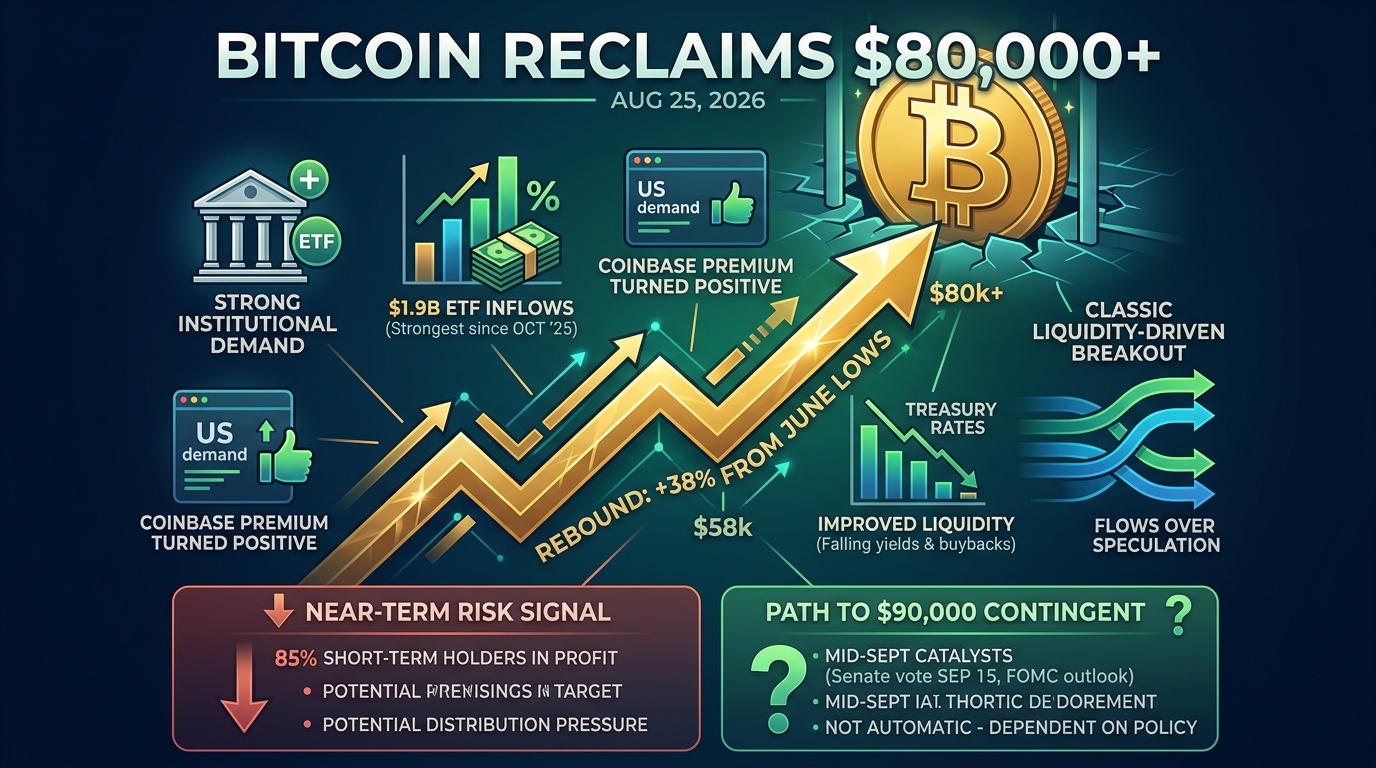
Bitcoin reclaimed the $80,000 level on August 25, 2026, for the first time since May 15, briefly touching around $81,000. This marks a roughly 38% rebound from levels below $58,000 in late June and nearly 29% gains over seven days. Strong institutional demand, improving liquidity conditions, and shifting U.S. market signals are driving the move rather than pure retail enthusiasm.
Whether Bitcoin can push straight to $90,000 remains open and hinges on mid-September catalysts, including a key Senate procedural vote and broader macro developments.
What Triggered Bitcoin’s Return Above $80,000?
Bitcoin’s reclaim of $80,000 on August 25 stems from genuine capital inflows and improving macro liquidity rather than short-term speculation alone. According to recent market data, the cryptocurrency had last held this level in mid-May before a multi-month period of pressure that saw it trade below $58,000 near the end of June. The subsequent recovery delivered approximately 38% gains from those lows and close to 29% in just seven days, with prices testing the $81,000 area.
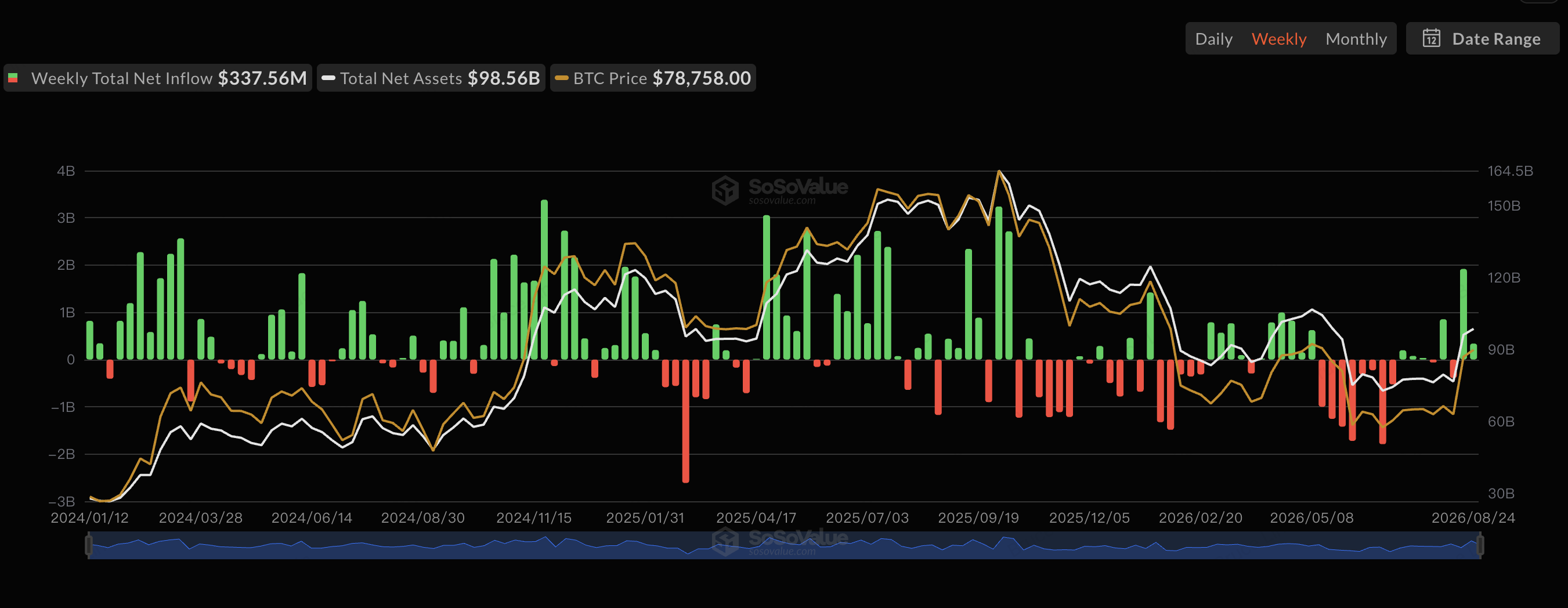
Three concrete factors stand out. First, U.S. spot Bitcoin ETFs recorded roughly $1.9 billion in net inflows during the prior week—the strongest weekly total since October 2025, based on SoSoValue and related tracking data. BlackRock’s IBIT accounted for a large share of the activity, reflecting renewed institutional participation.
Second, the Coinbase Premium Index turned positive for the first time in 98 days, signaling stronger buying interest from U.S.-based participants compared with global platforms. Third, falling U.S. Treasury yields combined with expanded long-bond buybacks by the Treasury improved overall liquidity expectations. These moves weakened the dollar and supported risk assets across equities, bonds, gold, and Bitcoin simultaneously.
The rally therefore reflects a broader liquidity-driven environment more than an isolated crypto narrative. Short liquidations added fuel during the breakout, yet the underlying flows into spot products and the shift in U.S. demand provide a more durable foundation than pure leverage dynamics.
Why Are Short-Term Holders’ Profit Levels a Near-Term Risk Signal?
Approximately 85% of short-term Bitcoin holders now sit in profit, creating a classic setup where profit-taking can emerge if momentum slows. On-chain analysis divides holders into two groups: long-term holders who have kept coins for more than 155 days and short-term holders (STH) who have held for less than 155 days. The 155-day threshold is not arbitrary. Statistical patterns show that the probability of selling drops sharply once coins remain unmoved beyond this period, so STH represent newer entrants, swing traders, and participants more sensitive to short-term volatility.
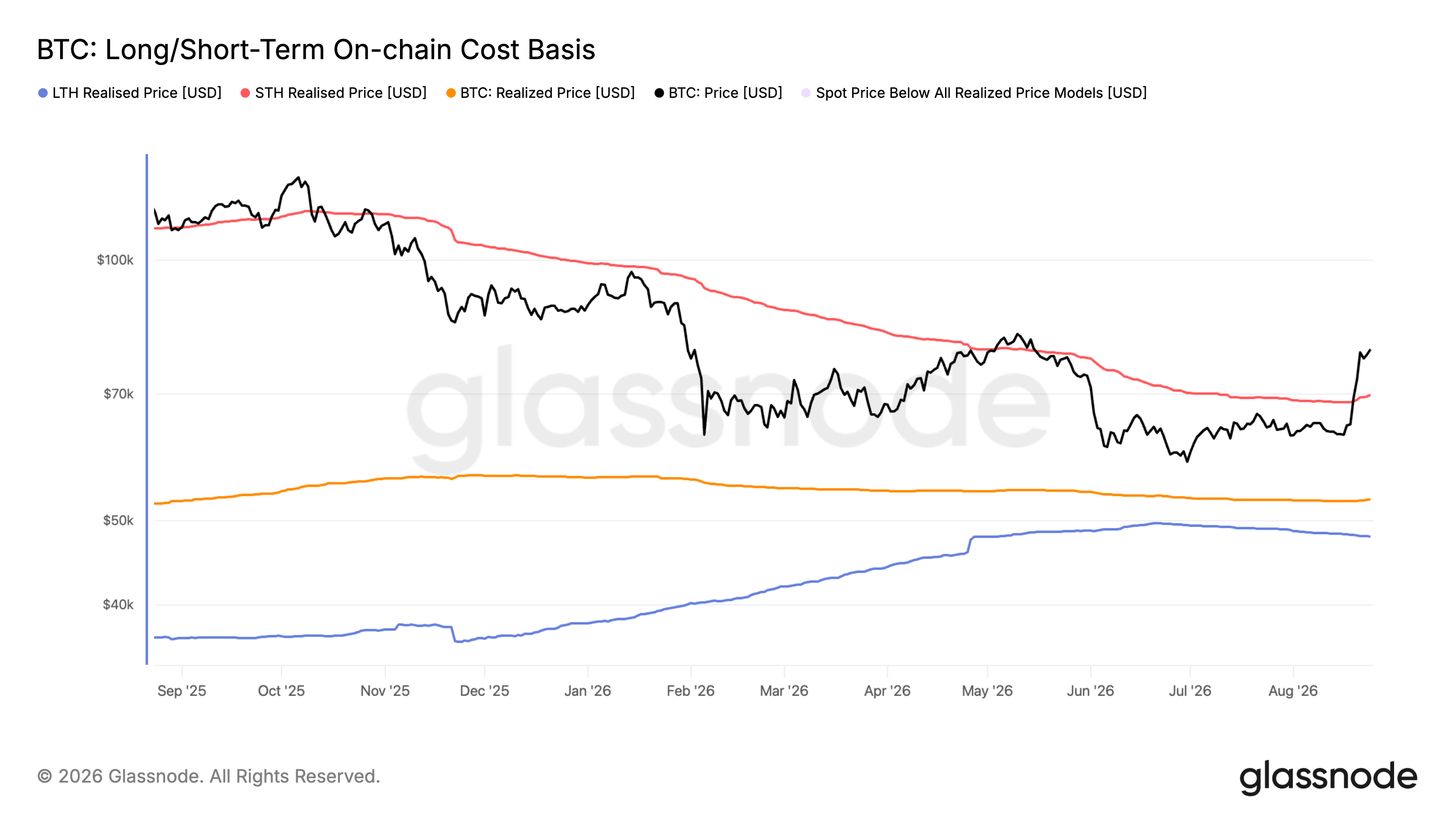
When a large majority of STH supply moves into profit—as currently observed—the risk of distribution rises. These holders often entered during the recent recovery and may look to lock in gains if price stalls or faces resistance. Recent data showed STH profitability climbing rapidly as Bitcoin moved from the low $60,000s into the high $70,000s and beyond $80,000. Elevated profitability does not guarantee an immediate sell-off, yet it historically coincides with periods of heightened volatility once upward momentum pauses. Monitoring exchange inflows from this cohort and the short-term holder spent-output profit ratio remains useful for assessing whether distribution pressure is building.
Can Bitcoin Reach $90,000 Before Mid-September Catalysts?
Bitcoin is unlikely to deliver a clean, uninterrupted run to $90,000 without navigating two high-impact events centered around mid-September. The first is the Senate procedural vote on the Clarity Act (Digital Asset Market Clarity Act) scheduled for September 15. The Senate returns on September 14, and the cloture vote that day will determine whether the chamber can formally take up the bill. This vote requires 60 votes and represents a critical early test rather than final passage.
Much of the recent price strength has priced in expectations of legislative progress. On August 19, President Trump hosted crypto industry executives, including representatives from Coinbase and Gemini, at the White House and publicly urged Congress to advance clearer digital-asset rules. Markets responded positively in the days that followed. This dynamic is classic “buy the rumor” behavior. If the September 15 procedural step stalls or fails to advance, profit-taking and position reduction could follow quickly as the anticipated catalyst is removed.
The second focus is the concurrent FOMC meeting and the broader monetary-policy outlook. Market participants remain divided on the scope for additional rate cuts later in the year. Importantly, the current Bitcoin advance has tracked broader liquidity improvements more closely than crypto-specific narratives alone. Treasury expansion of longer-dated bond buybacks, the resulting decline in long-end yields, and dollar softness have lifted equities, bonds, gold, and Bitcoin together. A shift in FOMC guidance that alters liquidity expectations could therefore influence Bitcoin independently of regulatory developments.
Until these mid-September events resolve, the path to $90,000 is best viewed as contingent rather than automatic. Sustained closes above $80,000–$83,000 would keep higher targets viable, while failure at the Clarity Act step or tighter liquidity messaging could prompt a retest of lower support zones.
How to Buy and Trade Bitcoin on KuCoin?
KuCoin offers a straightforward platform for acquiring and trading Bitcoin with competitive fees, deep liquidity, and multiple order types suited to both beginners and experienced traders. Users can deposit fiat or crypto, convert to BTC via the spot market, or use futures and other products for more advanced strategies. The exchange supports real-time price tracking, stop-limit orders, and portfolio tools that help manage positions around key levels such as $80,000.
After completing registration and identity verification, traders can fund accounts and execute buys during periods of heightened volatility or around scheduled catalysts. Always size positions according to personal risk tolerance and use available risk-management features.
Conclusion
Bitcoin’s return above $80,000 on August 25, 2026, represents its first sustained reclaim of the level since mid-May and caps a roughly 38% recovery from June lows near $58,000, including nearly 29% gains in seven days. The advance has been underpinned by approximately $1.9 billion in weekly spot ETF inflows—the strongest since October 2025—renewed U.S. demand shown by the Coinbase Premium Index turning positive after 98 days, and improved liquidity from falling Treasury yields plus expanded bond buybacks. These factors point to genuine capital commitment rather than pure retail speculation.
At the same time, roughly 85% of short-term holders now sit in profit, elevating the risk of distribution if momentum pauses. Progress toward $90,000 depends heavily on mid-September events: the Clarity Act procedural vote on September 15 and the surrounding FOMC backdrop. The recent move has largely traded the expectation of regulatory clarity following the August 19 White House meeting, while also riding broader liquidity conditions that lifted multiple asset classes. Until those catalysts resolve, caution around position sizing and profit-taking risk remains warranted. Bitcoin has reclaimed an important psychological threshold with institutional support, yet the next leg higher is not guaranteed without confirmation from policy and macro developments.
FAQs
What is the current Bitcoin price level after the August 25 breakout?
Bitcoin traded above $80,000 on August 25, 2026, for the first time since May 15 and briefly reached the $81,000 area before consolidating.
How significant were the recent Bitcoin ETF inflows?
U.S. spot Bitcoin ETFs recorded roughly $1.9 billion in net inflows in the prior week, marking the largest weekly total since October 2025 according to available flow data.
What does the Coinbase Premium Index turning positive indicate?
It signals that Bitcoin traded at a premium on Coinbase relative to global platforms for the first time in 98 days, pointing to stronger U.S. buying interest.
Why does the 155-day holding period matter for Bitcoin holders?
Coins held longer than 155 days show a sharply lower statistical probability of being sold, which is why holders beyond that window are classified as long-term and those under it as short-term.
Disclaimer: This article is for informational purposes only and does not constitute financial, legal, or investment advice. Always conduct your own research before interacting with digital assets.