

“Big Short” Investor Michael Burry Warns of AI Bubble Burst After Boosting Nebius and Micron Shorts
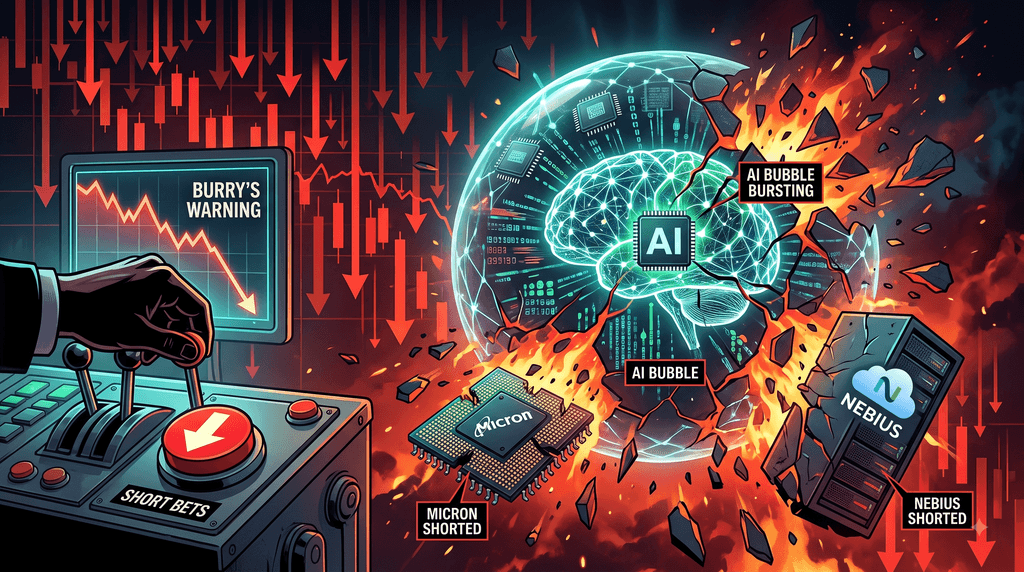
Michael Burry Bets Against the AI Boom: Why He Sees Signs of a Market Top
Michael Burry, the investor portrayed in “The Big Short” for his successful bet against the U.S. housing market before the 2008 crisis, has expanded short positions in several high-profile artificial intelligence and semiconductor names. In a recent Substack update, Burry disclosed additions to his shorts in Nebius Group at approximately $247 per share, Micron Technology at about $924, Oracle at $152, and the iShares Semiconductor ETF. He described Nebius specifically as “what the top of a boom looks like,” pointing to pricing dynamics in AI compute contracts and broader questions about hardware depreciation and demand sustainability.
The thesis is that Burry’s intensified bearish stance reflects structural concerns about the AI infrastructure build-out, including elevated valuations, potential overstatement of asset lives, circular financing arrangements, and signs of peak-boom behavior in certain contracts and stock performances. While companies continue to report strong revenue growth driven by AI demand, the investor’s focus remains on whether current spending levels and accounting treatments will prove durable once the initial wave of capital deployment matures.
Burry’s Latest Position Updates Center on Nebius and Micron
Burry’s most recent disclosure revealed that he has strategically added to his short position on Nebius at a price point of $247 per share, a level that was reached following the stock’s significant and substantial gains throughout the year to date. In addition to this, he simultaneously increased his short position on Micron, which is now near $924, and also raised his short on Oracle, which is currently around $152. Furthermore, he has expanded his put positions on the semiconductor ETF, with options set to expire in March 2027 and strikes positioned in the low $400s. These recent moves build upon earlier short positions that were established across the artificial intelligence and semiconductor complex in the preceding months.
The timing of these actions coincides with the continued strength and resilience observed in many of the targeted names within this sector. Nebius has posted impressive and large percentage gains in the year 2026, while Micron has experienced a powerful rally earlier in the year, which was tied to the increasing memory demand stemming from AI data centers. Burry’s willingness to add to his positions at these elevated levels signals a strong conviction that the risk-reward dynamic has tilted further against the bulls, even as the fundamental reports coming from these companies remain robust and strong on the surface.
Nebius Earns the Label of Peak-Boom Behavior
Burry specifically highlighted Nebius, stating, “Nebius is what the top of a boom looks like.” This insightful comment came after the company engaged in a detailed discussion regarding the pricing of AI compute capacity during its recent earnings call. During this call, Nebius revealed that it has the potential to sell its entire capacity for the year 2027 through contracts that span one to three years. However, the company is also strategically retaining a portion of its capacity to address shorter-term needs that may arise. Burry took note of the significant pricing differential, emphasizing that the rates for short-term capacity were being described as exhibiting extreme urgency. He characterized this pricing structure as a form of backwardation, which is a critical economic concept.
This observation is a fundamental component of his overall investment thesis. In a market that is experiencing a boom, customers who are willing to pay substantially higher rates for access to capacity in the nearer term can often signal frothiness in the market. Burry interprets this sense of urgency, when combined with the overall valuation of the equity in question, as indicative of characteristics typical of a late-stage market rather than reflecting a sustainable demand that one would expect during a mid-cycle phase. The stock’s substantial advance year-to-date provides a significant market backdrop against which he critically views these contract details as cautionary indicators that investors should consider carefully.
Strong Nebius Earnings Have Not Dissuaded the Short Thesis
Nebius has reported an impressive second-quarter revenue growth of 454 percent compared to the same period last year, showcasing the remarkable performance of its AI cloud business, which has exhibited even higher percentage gains. The company has achieved an annualized run rate that is reaching a significant scale, indicating a strong trajectory for future growth. Furthermore, management has reaffirmed its full-year guidance, which reflects confidence in the ongoing demand for AI infrastructure capacity. However, it is important to note that depreciation and amortization expenses have remained elevated in relation to revenue, as the company continues to depreciate its servers and related equipment over multi-year periods, which is a standard practice in the industry.
Burry’s critique of Nebius has focused less on the current absence of demand and more on the sustainability and durability of returns on the substantial capital that has been deployed. He has raised concerns regarding the accounting treatment of hardware that is subject to rapid technological obsolescence, which could impact long-term profitability. Even in light of a strong earnings report that initially caused the stock to rise, the investor has chosen to maintain and even add to his short position. This decision indicates that he believes near-term operational strength does not adequately address the longer-term questions he is raising about the cyclical nature of the market and the potential risks associated with it.
Micron Short Reflects Cyclical and Valuation Concerns
Micron has consistently emerged as a focal point in Burry’s strategy of shorting semiconductor stocks. This memory specialist has experienced a remarkable surge in its share price throughout the year 2026, driven primarily by the escalating demand for high-bandwidth memory and associated products that are integral to artificial intelligence applications. Burry has previously highlighted that the stock has traded at significantly elevated levels, far exceeding its 200-day moving average, and he has also pointed out its long-standing history of experiencing sharp cyclical downturns. The most recent addition to his short position, occurring around the $924 mark, continues to align with this overarching theme of caution.
The memory markets, by their very nature, are cyclical and subject to fluctuations. Periods characterized by tight supply and elevated pricing often give way to subsequent capacity expansions, which in turn lead to price pressures that can affect profitability. Burry’s current positioning indicates that he perceives the ongoing upswing driven by artificial intelligence as following a well-established pattern, one that has been observed in previous cycles. The magnitude of the recent advance in share prices leaves little room for a margin of safety, particularly if there is a moderation in demand growth or if supply responds aggressively to the changing market conditions.
Oracle Position Targets Data-Center Spending and Leverage
Oracle has prominently appeared in Burry’s shorts related to artificial intelligence as well. The company has made a significant commitment of substantial capital towards the expansion of its cloud services and data center infrastructure, aiming to effectively capture the growing workloads associated with AI technologies. Burry has previously characterized certain spending decisions made by the company as carrying an elevated level of financial risk, which raises concerns among investors. The recent addition to his short position, occurring near the $152 mark, follows earlier put positions and reflects ongoing apprehension regarding the balance-sheet implications of large, multi-year commitments to infrastructure investments.
Enterprise software and cloud service providers that heavily invest in AI infrastructure face the dual challenge of not only funding the extensive build-out of these capabilities but also demonstrating adequate returns on their investments. Burry’s repeated focus on Oracle indicates that he perceives leverage, lease obligations, and the pace of capital deployment as potential pressure points that could arise if the anticipated revenue ramp from AI services fails to meet the expectations that are currently embedded in the company’s valuations. This ongoing scrutiny suggests a cautious outlook on the sustainability of Oracle's financial commitments in this growing AI ecosystem.
Broader Semiconductor ETF Exposure Amplifies the Bearish Stance
Burry has notably expanded his put exposure on the iShares Semiconductor ETF, in addition to his focus on individual stock names. This strategic move offers a more diversified approach to expressing a bearish outlook on the semiconductor sector, which has seen significant benefits from the surge in AI-related capital expenditures. By extending the puts into March 2027 with strike prices in the low $400s, Burry indicates a longer-term perspective, suggesting that he anticipates a multi-quarter timeframe for his investment thesis to unfold and materialize.
This sector-level exposure is particularly advantageous, as it enables the position to effectively capture potential weaknesses across various segments, including design, manufacturing, and equipment companies. This approach does not necessitate precise timing on any single equity, thereby reducing the risk associated with individual stock volatility. Furthermore, it shows the interconnected nature of the AI supply chain, where fluctuations in strength or weakness within one segment can often have ripple effects that impact other segments as well.
Depreciation Accounting Forms a Recurring Theme in the Critique
A recurring theme in Burry’s comprehensive analysis of companies involved in AI infrastructure is the critical examination of the useful life that is assigned to GPUs and other related hardware components. He has put forth the argument that many firms are depreciating their chips over timeframes that are significantly longer than what the rapid product cycle would suggest, which could lead to an overstatement of their current profitability levels. The hardware that is replaced or turned over on a typical two-to-three-year cadence may not adequately justify the longer accounting lives that are currently being applied in financial statements.
Should these depreciation schedules prove to be overly optimistic, there could be considerable pressure on future earnings as assets are written down or replaced at a pace that is more rapid than what has been modeled. This particular accounting dimension serves to distinguish Burry’s critique from more traditional valuation arguments and places a strong emphasis on the quality of the reported profits during the critical build-out phase of these companies.
Circular Financing and Off-Balance-Sheet Concerns
Burry has brought attention to findings from the Bank for International Settlements that pertain to the financing of the growing demand for AI infrastructure. He has put forth the idea that a significant portion of both current and anticipated demand is underpinned by financial arrangements that lack full transparency on balance sheets and may even involve circular financial elements. From this perspective, the influence of end-customer demand is less significant than what the prevailing market narrative suggests.
These financial structures have the potential to support elevated levels of spending for a certain period; however, they also introduce a degree of vulnerability. This vulnerability becomes particularly pronounced if financing conditions become more stringent or if the anticipated revenue streams do not materialize at the scale that was initially projected. This line of reasoning elevates the discussion from merely focusing on simple capacity growth to a more nuanced examination of the sustainability of the funding mechanisms that are essential for supporting that growth.
Market Context of Narrow Leadership and Extended Calm
Burry has provided insights regarding the current broader market environment, highlighting the occurrence of extended periods that lack significant corrections and the notable concentration of gains within a relatively small group of mega-cap companies that are closely linked to artificial intelligence. He has expressed concerns that this narrow leadership, when combined with a prevailing low-volatility environment, can create conditions that encourage the use of leverage. This situation may ultimately set the stage for more pronounced market reversals when investor sentiment shifts unexpectedly. This macroeconomic backdrop plays a crucial role in shaping the individual short positions that Burry has taken.
If the artificial intelligence trade has indeed emerged as the primary driving force behind recent market advances, any disappointment or negative developments within this sector could potentially have spillover effects that impact the broader market. Burry’s strategic approach to portfolio construction, which involves pairing short positions in high-momentum artificial intelligence and semiconductor stocks with carefully selected long positions in other areas, reflects his attempt to isolate and manage the specific risks that he has identified in the current market landscape.
Historical Parallels and Investor Reception
Burry has made notable comparisons between the current market conditions and previous periods characterized by significant market excess, particularly drawing parallels with the late-1990s technology boom that captivated investors and analysts alike. His impressive track record from the financial crisis of 2008 lends considerable weight to his warnings, ensuring that they receive heightened visibility, even in instances where short-term price movements may seem to contradict his positions. Some participants in the market regard his commentary as a valuable counterbalance to the prevailing optimism that often permeates investor sentiment; however, others argue that the robust current demand and strong earnings can endure for a longer duration than skeptics might expect or anticipate.
Furthermore, the investor’s choice to publicly disclose specific entry prices and the rationale behind his decisions on Substack not only enhances transparency but also subjects his investment thesis to rigorous real-time market tests. As subsequent earnings reports are released and stock reactions unfold, these events serve as immediate referenda, allowing market participants to assess whether Burry's concerns are indeed premature or if they are, in fact, well-timed and prescient.
Effect for AI Infrastructure Valuations and Capital Allocation
The current positions reflect a significant tension at the very core of the ongoing economic cycle. Companies are making substantial investments to secure both capacity and market share in the rapidly evolving field of AI compute, which is generating remarkable growth in the near term. However, this aggressive investment strategy raises important questions regarding the scale of capital required, the swift pace of technological advancements, and the complex accounting and financing structures that are being utilized. These factors collectively create legitimate concerns about the sustainability of longer-term returns. Burry’s short positions represent a calculated bet that these pressing questions will ultimately take precedence in determining valuations.
Investors are faced with the challenging task of weighing the compelling evidence of current demand against the potential risks associated with overcapacity, the possibility of faster-than-expected obsolescence, and the likelihood of compression in returns once the initial phase of build-out reaches maturity. The outcome of this evaluation will not only impact the specific equities that are being targeted but will also have broader implications for the allocation of capital across the entire technology sector in the years to come.
FAQs
What specific short positions did Michael Burry recently increase?
Burry added to shorts in Nebius at approximately $247, Micron at about $924, and Oracle at $152, and expanded March 2027 puts on the iShares Semiconductor ETF with strikes in the low $400s, according to his latest Substack disclosure.
Why did Burry single out Nebius as showing peak-boom characteristics?
He pointed to the company’s ability to sell 2027 capacity under longer-term contracts while short-term capacity commanded significantly higher rates, describing the urgency and pricing gap as indicative of late-cycle behavior.
How did Nebius’s recent earnings affect the short thesis?
The company reported 454 percent year-over-year revenue growth and strong AI cloud metrics, yet Burry maintained and added to the position, focusing on depreciation practices and the sustainability of returns rather than the absence of current demand.
What is Burry’s primary concern regarding AI hardware depreciation?
He has argued that companies are applying accounting lives to GPUs and related equipment that may exceed the rapid product-cycle realities, potentially overstating near-term profitability.
Has Burry shorted other semiconductor and AI-related names previously?
Yes. Earlier disclosures included positions in Nvidia, Applied Materials, Caterpillar, Tesla, Palantir, and the semiconductor ETF, establishing a pattern of skepticism toward the broader AI infrastructure complex.
What role does the Bank for International Settlements report play in the thesis?
Burry has cited the 2026 BIS annual report in support of the view that a substantial portion of AI infrastructure demand is financed through arrangements that are not fully transparent and may involve circular elements.
🔥 KuCoin Offers A More Stable Option in A Volatile Market
If you worry about the frequent ups and downs in the market, and pursue a more stable option to earn money passively, KuCoin is the right place to come:

Simple Earn: Deposit and withdraw tokens anytime, earning stable returns.
Kucoin Earn: Earn stable profits with professional asset management.
Hold to Earn: Earn rewards by holding assets in Funding, Trading, Margin, Futures, Mining, and Unified Accounts.
Staking: Unlock the earning potential of on-chain assets.
Advanced Investments: Advanced Investments offer a variety of structured products to help your money grow in any market.
Shark Fin: Principal Protection and Guaranteed Gains
Dual Investment: Buy low and sell high with transparent return calculations.
Snowball: High yields, with price protection.
Discount Buy: Buy crypto at discount prices.
KCS Loyalty: Level up to enjoy exclusive perks by staking ≥ 1 KCS.
KuCoin Wealth: Discover future value and begin your smart investing journey.
KCS Benefits: Hold and stake KCS to access benefits across the platform.
KCS Staking 2.0: Participate in KCS on-chain governance to earn yield.
Disclaimer: This content is for informational purposes only and does not constitute investment advice. Cryptocurrency investments carry risk. Please do your own research (DYOR).