

Beyond Pseudonymity: Why Vitalik is Banking on ZK Payments for the AI Agent Era
2026/05/14 16:00:00
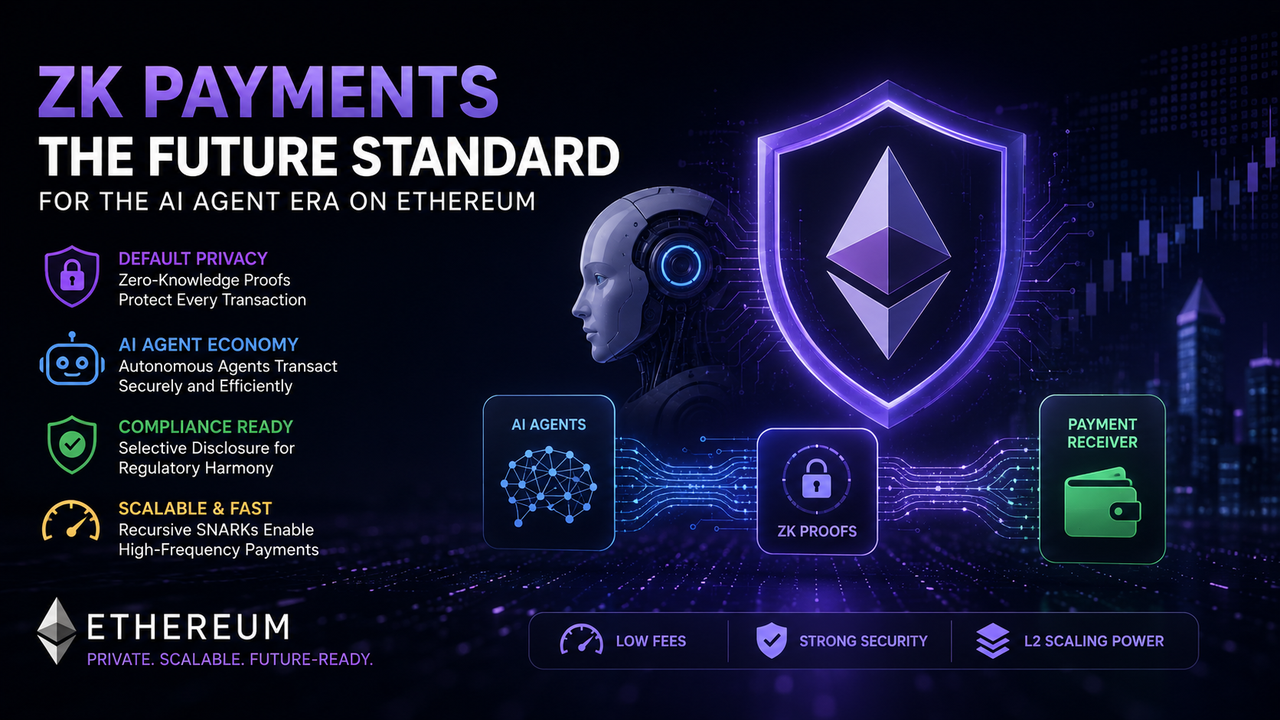
As we navigate through 2026, the convergence of blockchain and artificial intelligence has moved from theoretical speculation to a foundational economic shift. Ethereum co-founder Vitalik Buterin recently unveiled a transformative vision, asserting that Zero-Knowledge (ZK) payments are no longer just a privacy feature but a mandatory global standard required to sustain the rapidly expanding digital landscape.
In this deep dive, we explore how ZK Payments serve as the critical infrastructure for the AI Agent Era, ensuring that autonomous entities can transact securely, privately, and efficiently within the decentralized ecosystem.
Key Takeaways
Before delving into the technicalities, it is essential to understand the primary shifts occurring in the Ethereum ecosystem as of mid-2026:
-
Privacy Shift: Ethereum is transitioning from "pseudonymity" (visible addresses) to "default privacy" using ZK-proofs.
-
AI Integration: The rise of autonomous AI agents requires a payment standard that supports high-frequency, low-cost, and private transactions.
-
Regulatory Balance: New ZK tools allow for "selective disclosure," satisfying global AML/KYC requirements while protecting individual data.
-
Exchange Readiness: Platforms like KuCoin are already leading this trend by integrating ZK-rollup assets and privacy-preserving compliance tools.
-
Infrastructure Evolution: Layer 2 networks are becoming the primary execution environment for private AI-driven commerce.
The Strategic Pivot: ZK Payments as Ethereum’s 2026 Core Standard
For years, the "glass house" nature of the blockchain was seen as a feature—a transparent ledger that guaranteed trust. However, as institutional money and AI workloads have flooded the network in 2026, this transparency has become a liability. Vitalik Buterin’s latest research indicates that for crypto payments to replace legacy fiat systems, they must mirror the privacy of physical cash.
The pivot toward ZK Payments as a core standard stems from the realization that mass adoption is impossible if every coffee purchase or salary payment is visible to the entire world. By utilizing Zero-Knowledge proofs, the network can verify that a transaction is valid without revealing the sender’s identity or specific amount. Exchanges like KuCoin have responded to this shift by providing specialized categories for ZK-proof tokens and Layer 2 infrastructure, allowing users to tap into the most liquid privacy-centric assets early.
Solving the AI Privacy Paradox in the New "Agentic Era"
The "Agentic Era" refers to a shift where the majority of on-chain transactions are no longer initiated by humans, but by AI agents performing autonomous tasks. These agents operate in a paradox: they need to be fully integrated into the blockchain to access liquidity, yet their competitive advantage often relies on keeping their strategies and data usage private.
From Bots to Economic Actors: The Rise of Autonomous AI Agents
In 2026, AI agents have evolved beyond simple chatbots into sophisticated economic actors. They are now capable of automatically buying GPU compute power on decentralized clouds or executing complex DeFi strategies. Without ZK Payments, an agent’s every move would be public data, allowing rival bots to reverse-engineer its logic and front-run its transactions. To support these actors, KuCoin Pay has been developing decentralized frameworks for direct crypto payments that emphasize speed and security without intermediaries.
Breaking the Pattern: How ZK Technology Prevents AI Behavioral Tracking
Even if an AI agent uses a new wallet address for every transaction, metadata analysis can link activities together. Patterns in timing and transaction size create a "digital fingerprint." ZK technology breaks this link by decoupling the identity from the action. By utilizing "Recursive SNARKs," agents can prove they have the right to perform an action without revealing the historical chain of events, effectively neutralizing behavioral tracking.
Technical Pillars: Powering the High-Frequency AI Economy
The transition to a ZK-dominated landscape is supported by three major technical pillars that ensure the Ethereum network can handle the volume of AI-driven activity.
Recursive SNARKs: Achieving Near-Zero Latency for Private Micro-transactions
The primary challenge for ZK-proofs has always been the computational "overhead." In 2026, the implementation of recursive SNARKs has solved this, allowing an AI agent to bundle thousands of micro-transactions into a single, compact proof. This means an agent can pay negligible amounts for API calls a million times while the network only verifies one small proof, keeping gas fees near zero.
EIP-8141 & Account Abstraction: Enabling AI Wallets to Pay Gas in Stablecoins
A major friction point for AI agents was the need to hold ETH for gas. With EIP-8141 and advanced Account Abstraction, AI agents now operate as native smart contract wallets. This allows them to pay for gas in stablecoins like USDC or USDT and use automated "session keys" to operate independently without constant human oversight.
ZK API Usage Credits: Private Resource Acquisition for Large Models
Vitalik has proposed a system of "ZK API Credits." In this model, an AI agent buys a batch of credits for a service using a ZK-proof. When the agent uses those credits, the service provider can verify the credit is valid but cannot track which specific user or agent is making the call. This ensures proprietary data remains confidential and unlinked to a financial identity.
The Compliance Bridge: Balancing Default Privacy with Global Regulations
A common criticism of ZK technology is that it facilitates illicit activity. However, the 2026 standard for ZK Payments includes sophisticated "viewing key" mechanisms that satisfy global regulators while maintaining user sovereignty.
Selective Disclosure: Providing "Proof of Innocence" to Financial Regulators
Modern ZK payments on Ethereum utilize Selective Disclosure. This allows a user or an AI agent to generate a specific proof for an auditor. Platforms like KuCoin Wallet are already implementing this "Privacy-Preserving Compliance" model, which uses biometric facial scans and digital IDs to verify a user's eligibility (like age or residency) without actually storing sensitive personal data on centralized servers.
-
Proof of Solvency: Proving the wallet holds enough funds without revealing the total balance.
-
Proof of Innocence: Proving that a specific transaction did not originate from a sanctioned address.
Impact Analysis: How ZK-Based Infrastructure Redefines Exchange Liquidity
For crypto exchange platforms like KuCoin, the move toward ZK Payments and the AI Agent Era represents a fundamental change in how liquidity is managed. As transactions become private by default, exchanges are evolving into "ZK-Gateways." Instead of just matching buy and sell orders, exchanges now provide the infrastructure for AI agents to enter and exit private liquidity pools securely.
The integration of ZK-proofs reduces the risk of "MEV" (Maximal Extractable Value). Since the details of an agent’s trade are shielded until the moment of execution, predatory bots cannot front-run large orders. This creates a more stable, "dark pool" style environment highly attractive to professional traders and automated AI systems, leading to deeper order books and tighter spreads across major pairs.
Future Roadmap: Ethereum’s Path to a Native ZK-EVM by 2028
While the current focus is on Layer 2 solutions, the ultimate goal in Vitalik’s roadmap is the "Native ZK-EVM" slated for 2028. This upgrade will bring ZK-verification directly to the Ethereum Mainnet (Layer 1). Every block produced will come with its own ZK-proof, making the entire chain instantly verifiable. For the AI Agent Era, this means that the underlying security of their financial transactions will be mathematically guaranteed by the protocol itself, creating a "World Computer" that is both infinitely scalable and perfectly private.
Conclusion
The push for ZK Payments marks the end of the experimental phase of blockchain transparency and the beginning of a mature, private, and AI-compatible financial system. By addressing the privacy paradox of the AI Agent Era, Vitalik Buterin is ensuring that Ethereum remains the dominant layer for the future of digital commerce. As we move closer to a native ZK-EVM, the integration of privacy-by-default, low-cost micro-transactions, and regulatory-friendly disclosure tools—already being pioneered by exchanges like KuCoin—will solidify crypto as the global standard for both human and machine-led economies.
FAQ
What are ZK Payments and why do they matter in 2026?
ZK Payments use Zero-Knowledge proofs to verify transactions without revealing sensitive data. In 2026, they are the vital standard for protecting user privacy and enabling high-frequency micro-transactions required by autonomous AI agents. You can find many leading ZK-infrastructure tokens listed on KuCoin.
How does the AI Agent Era change the way we use Ethereum?
The AI Agent Era shifts activity from human-centric manual trades to autonomous bot-led commerce. AI agents now manage portfolios and buy resources 24/7, necessitating infrastructure like ZK Payments to prevent tracking and front-running by competitors.
Is EIP-8141 related to ZK Payments?
Yes, EIP-8141 enhances Account Abstraction, allowing AI agents to act as smart contract wallets. This works alongside ZK Payments to let agents pay gas fees in stablecoins and execute private, pre-authorized transactions without human intervention.
How do ZK Payments stay compliant with government regulations?
ZK Payments utilize "Selective Disclosure" and "Proof of Innocence." This allows users to prove their transactions follow laws to regulators using private keys, while keeping their data hidden from the public. Platforms like KuCoin Wallet are leaders in this "Privacy-Preserving Compliance" shift.
What are Recursive SNARKs in the context of AI payments?
Recursive SNARKs are a scaling technology that condenses thousands of ZK-proofs into one. This is essential for AI agents performing massive volumes of micro-transactions, as it keeps costs low and verification speeds high.