

Best Dogecoin Exchange in 2026: Where to Buy, Trade, and Store DOGE Safely
2026/05/08 10:42:01
Introduction
Dogecoin remains one of the top 10 cryptocurrencies by market capitalization, with daily trading volumes regularly exceeding $1.5 billion across major exchanges, according to CoinGecko data from April 2026. That liquidity makes choosing the right platform critical — the difference between a great Dogecoin exchange and a mediocre one can cost you 1-2% per trade in fees, slippage, and spread.
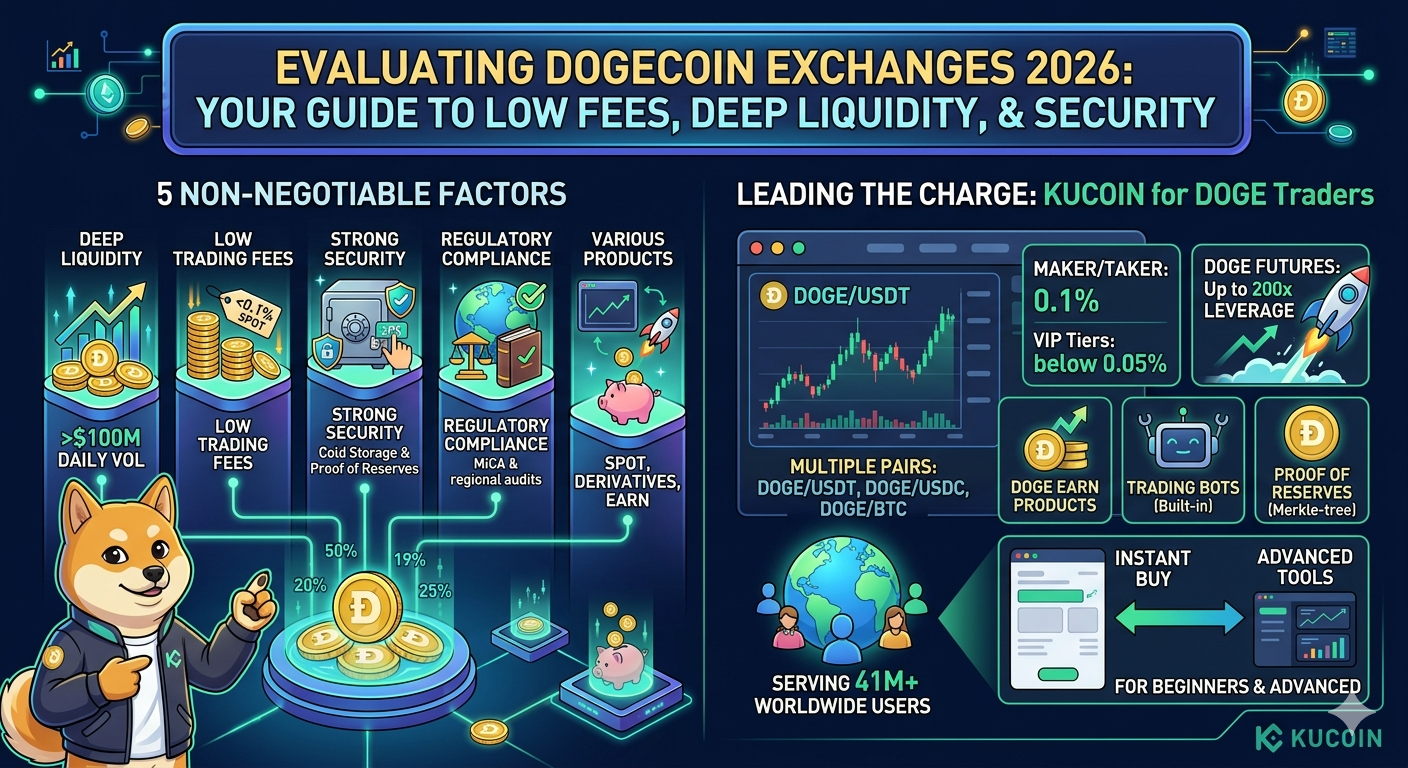
The best Dogecoin exchange in 2026 is one that combines deep DOGE liquidity, low trading fees (under 0.1% spot), strong security infrastructure, multiple DOGE trading pairs (DOGE/USDT, DOGE/USDC, DOGE/BTC), and access to both spot and derivatives markets. KuCoin consistently ranks among the top platforms for Dogecoin traders thanks to its competitive 0.1% maker/taker fee, 200x DOGE futures leverage, and listing of DOGE since 2019.
This guide breaks down how to evaluate Dogecoin exchanges, compares leading platforms, and shows you exactly how to buy DOGE in minutes.
What Makes the Best Dogecoin Exchange?
The best Dogecoin exchange combines five non-negotiable factors: liquidity, low fees, security, regulatory compliance, and product variety. Skip any one of these and you risk poor execution, lost funds, or limited trading flexibility.
Liquidity and Trading Volume
High DOGE liquidity is the single most important criterion. Exchanges with daily DOGE volume above $100 million produce tighter bid-ask spreads — typically under 0.05% — which directly reduces your cost per trade. Thin order books, by contrast, can cause 1-3% slippage on a single $10,000 market order.
Binance, KuCoin, Coinbase, OKX, and Bybit currently dominate DOGE liquidity, with Binance and KuCoin accounting for a significant share of global DOGE/USDT trading volume as of Q1 2026, based on aggregated CoinMarketCap data.
Trading Fees
Trading fees on Dogecoin should not exceed 0.1% per side for spot trades. Anything higher — particularly the 1.49% retail fee charged by some U.S.-focused brokers — eats meaningfully into returns for active traders. Tiered VIP programs, maker rebates, and fee discounts via native exchange tokens (like KCS on KuCoin or BNB on Binance) can drop effective rates below 0.05%.
Security Track Record
A reliable Dogecoin exchange must demonstrate cold storage practices, proof-of-reserves audits, two-factor authentication, withdrawal whitelisting, and a clean history with no unresolved security incidents. Platforms that publish Merkle-tree proof-of-reserves quarterly offer the strongest transparency.
Product Range
Top DOGE exchanges offer spot trading, perpetual futures, margin, staking or lending products, and convert/instant-buy features. Limiting yourself to a spot-only platform means missing hedging tools, leverage, and yield opportunities.
Which Exchange Has the Lowest Dogecoin Trading Fees?
KuCoin, Binance, and Bybit offer the lowest standard Dogecoin trading fees among major global exchanges, all starting at 0.1% maker/taker for spot trades. After fee discounts and VIP tiers, effective rates can fall as low as 0.02-0.06%.
Here is how the leading exchanges compare on standard published fees as of early 2026:
|
Exchange
|
Spot Fee (Maker/Taker)
|
DOGE Futures Fee
|
|
KuCoin
|
0.1% / 0.1%
|
0.02% / 0.06%
|
|
Binance
|
0.1% / 0.1%
|
0.02% / 0.05%
|
|
Coinbase Advanced
|
0.4% / 0.6%
|
0.02% / 0.05%
|
|
Bybit
|
0.1% / 0.1%
|
0.02% / 0.055%
|
|
Kraken
|
0.25% / 0.40%
|
0.02% / 0.05%
|
For high-frequency traders, the gap between Coinbase's 0.6% taker fee and KuCoin's 0.1% taker fee is substantial — on $50,000 of monthly DOGE volume, that's $250 versus $50.
Is KuCoin a Good Exchange for Dogecoin?
KuCoin is one of the best Dogecoin exchanges globally for traders who want low fees, deep liquidity, and access to advanced products. The platform listed DOGE in 2019 and serves over 41 million registered users worldwide as of its February 2026 platform update.
KuCoin's Dogecoin Advantages
-
Competitive fees: 0.1% spot fee, reducible through KCS holdings and VIP tiers.
-
DOGE earn products: Flexible savings and promotional yield campaigns let holders earn passive income on idle DOGE.
-
Trading bots: Built-in spot grid, futures grid, and DCA bots can be deployed on DOGE pairs without coding.
-
Proof of Reserves: KuCoin publishes monthly Merkle-tree PoR reports covering BTC, ETH, USDT, USDC, and DOGE among other major assets.
Considerations
KuCoin does not currently serve U.S. customers with full functionality, and users should always verify regional availability before signing up. KYC verification is required to unlock higher withdrawal limits and fiat on-ramps.
How Do I Choose the Best Dogecoin Exchange for Beginners?
Beginners should prioritize an exchange with a simple interface, fiat on-ramps, strong customer support, and educational resources over one with the absolute lowest fees. The goal in your first six months is learning safely, not optimizing for basis points.
Key Beginner Criteria
-
Fiat purchase options — Credit card, bank transfer, Apple Pay, and P2P trading let you fund accounts without first acquiring USDT elsewhere.
-
Mobile app quality — A 4.5+ star App Store and Google Play rating suggests a polished user experience.
-
Customer support — 24/7 live chat in your language matters when you have a frozen withdrawal at 2 AM.
-
Educational content — Glossaries, video tutorials, and demo trading help you avoid expensive mistakes.
-
Instant Buy / Convert features — One-click DOGE purchases without navigating an order book are essential for new users.
KuCoin, Coinbase, and Binance all score well on beginner-friendliness, with KuCoin offering particularly strong P2P fiat access in over 130 countries.
What Are the Risks of Trading Dogecoin on Exchanges?
The main risks of trading Dogecoin on any exchange fall into four categories: market volatility, exchange counterparty risk, regulatory risk, and security risk. Understanding each lets you size positions appropriately and protect funds.
Market Volatility
Dogecoin is among the most volatile top-20 cryptocurrencies. Daily moves of 5-10% are routine, and event-driven spikes — such as social media catalysts or payments integration news — can trigger 20%+ single-day swings. Use stop-losses and avoid over-leveraging futures positions.
Counterparty Risk
Funds held on any centralized exchange carry counterparty risk. The collapses of FTX in 2022 and other smaller venues demonstrated that even large platforms can fail. Mitigation: use exchanges that publish proof-of-reserves, withdraw long-term holdings to self-custody wallets, and never store more than your active trading capital on any single platform.
Regulatory Risk
Dogecoin's regulatory classification varies by jurisdiction. The U.S., EU (under MiCA), UK, and Singapore each apply different frameworks. Choose exchanges licensed or registered in your region to reduce the risk of sudden access restrictions.
Security Risk
Phishing, SIM-swap attacks, and credential stuffing remain the leading causes of retail account breaches. Always enable hardware-key 2FA (such as YubiKey), set withdrawal address whitelists, use a unique strong password, and bookmark the exchange URL to avoid fake login pages.
Should You Use a Centralized or Decentralized Exchange for DOGE?
Centralized exchanges (CEXs) remain the better choice for trading Dogecoin in 2026 due to native chain liquidity, lower friction, and higher volume. Decentralized exchanges (DEXs) host wrapped DOGE on Ethereum or BNB Chain, but liquidity is fragmented and the bridging process introduces additional smart-contract risk.
CEXs like KuCoin offer:
-
Native Dogecoin deposits and withdrawals
-
Order books with millions in depth
-
Fiat on-ramps and customer support
-
Advanced order types (limit, stop-limit, OCO, trailing stop)
DEXs are useful for privacy-focused users comfortable with self-custody and willing to accept thinner liquidity, but for the vast majority of DOGE traders, a regulated CEX is the right answer.
How to Buy Dogecoin on KuCoin
You can buy Dogecoin on KuCoin in under five minutes using credit card, bank transfer, or P2P trading. The process is identical for spot purchases of any size.
Step-by-Step
-
Create an account at kucoin.com using your email or phone number, then enable 2FA.
-
Complete KYC verification by uploading a government ID and a selfie. Verification typically completes in under 30 minutes.
-
Deposit funds via Fast Buy (credit/debit card), SEPA/wire transfer, or P2P trading with local payment methods.
-
Navigate to the DOGE/USDT spot market under the Trade menu.
-
Place your order — use a market order for instant fills or a limit order to set your target buy price.
-
Withdraw to a personal wallet for long-term storage, or keep DOGE on the exchange to trade or earn yield.
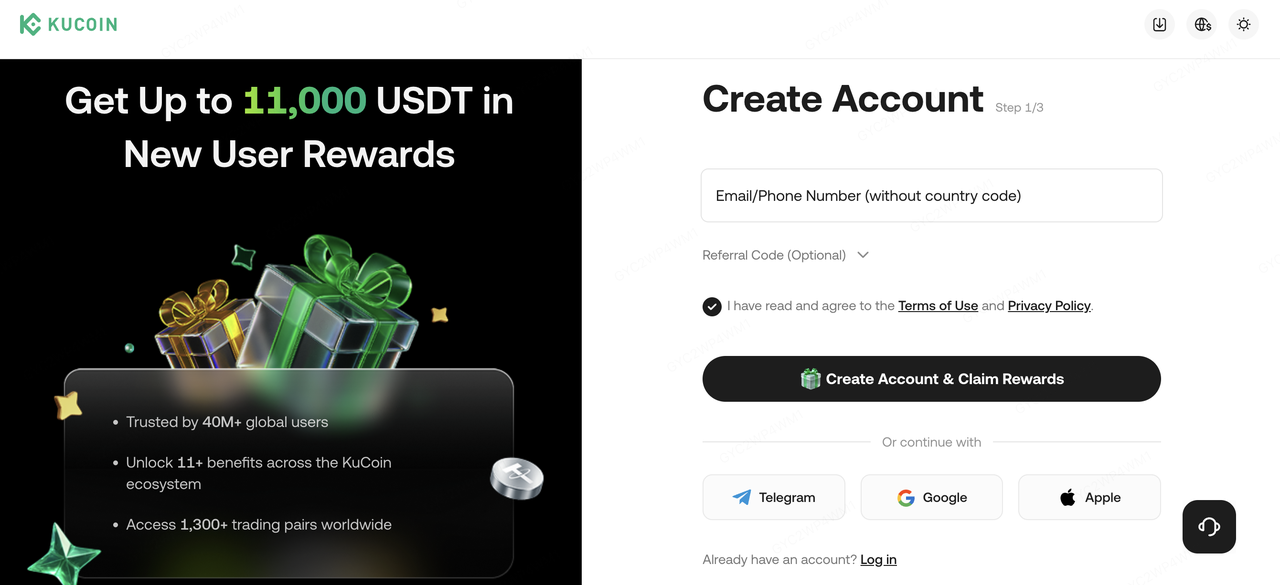
New users can now register at KuCoin and Get Up to 11,000 USDT in New User Rewards.
Should You Trade Dogecoin on KuCoin?
KuCoin is a strong choice for traders seeking a feature-rich, low-fee Dogecoin exchange with global reach. With 0.1% spot fees, up to 200x leverage on DOGE futures, monthly proof-of-reserves reports, and built-in trading bots, KuCoin covers the needs of beginners and advanced traders alike.
New users can sign up at kucoin.com, complete identity verification, and start trading DOGE within minutes. Active traders benefit from VIP fee tiers, while passive holders can deploy DOGE into Earn products to generate yield. Whether you want to dollar-cost-average into Dogecoin, short-term swing trade, or hedge with perpetual futures, KuCoin provides the tools — combined with 24/7 multilingual customer support — to execute your strategy efficiently.
If you are evaluating where to buy your first DOGE or looking to migrate from a higher-fee platform, KuCoin's combination of liquidity, security infrastructure, and product breadth makes it one of the best Dogecoin exchanges available in 2026.
Conclusion
The best Dogecoin exchange depends on your priorities, but the strongest platforms all share the same DNA: deep DOGE liquidity, fees at or below 0.1%, transparent security practices, and a full product suite covering spot, futures, and earn products. KuCoin, Binance, Bybit, OKX, and Coinbase consistently rank at the top of these criteria, with KuCoin standing out for its low fees, 200x DOGE futures leverage, and global accessibility through P2P fiat on-ramps in over 130 countries.
Beginners should prioritize ease of use, fiat on-ramps, and customer support, while experienced traders should weigh fee tiers, leverage, API quality, and advanced order types. Regardless of which exchange you choose, protect yourself with hardware-key 2FA, withdrawal whitelists, and self-custody for long-term holdings.
Dogecoin's strong liquidity profile means you have real choice — use that leverage to pick a platform that matches your strategy, region, and risk tolerance, and you will save meaningfully on costs over time.
FAQs
What is the minimum amount of Dogecoin I can buy on most exchanges?
Most major exchanges, including KuCoin, allow Dogecoin purchases starting from approximately $1 to $10 worth of DOGE. Specific minimums depend on the trading pair and payment method — credit card buys typically require a $10-15 minimum, while spot order book trades can be as small as a few dollars.
Do I need to complete KYC to trade Dogecoin?
Yes, on virtually all reputable centralized exchanges in 2026. Global anti-money-laundering rules and the EU's MiCA framework, which took full effect in late 2024, require KYC verification for fiat deposits and most withdrawal tiers. Verification usually involves submitting a government ID and a selfie and completes within an hour.
Can I earn passive income on my Dogecoin?
Yes. Although Dogecoin itself uses proof-of-work and cannot be staked natively, exchanges offer flexible savings, lending, and promotional yield products on DOGE. KuCoin Earn and similar products on other exchanges typically offer variable APYs that change with market demand for borrowing.
How long does a Dogecoin withdrawal take?
Dogecoin withdrawals typically confirm within 5 to 15 minutes once broadcast to the network. Most exchanges require 6 network confirmations before crediting an incoming deposit, which usually takes around 6 minutes given Dogecoin's 1-minute block time.
What is the safest way to store Dogecoin long-term?
A hardware wallet such as Ledger or Trezor is the safest long-term storage option for Dogecoin. Hardware wallets keep your private keys offline, making them immune to exchange hacks and online phishing. For active trading capital, keeping funds on a reputable exchange with proof-of-reserves and strong account security is acceptable, but long-term holdings should be self-custodied.