

AI Bubble or Agentic Economy? Why Arthur Hayes Is Betting on AI Crypto
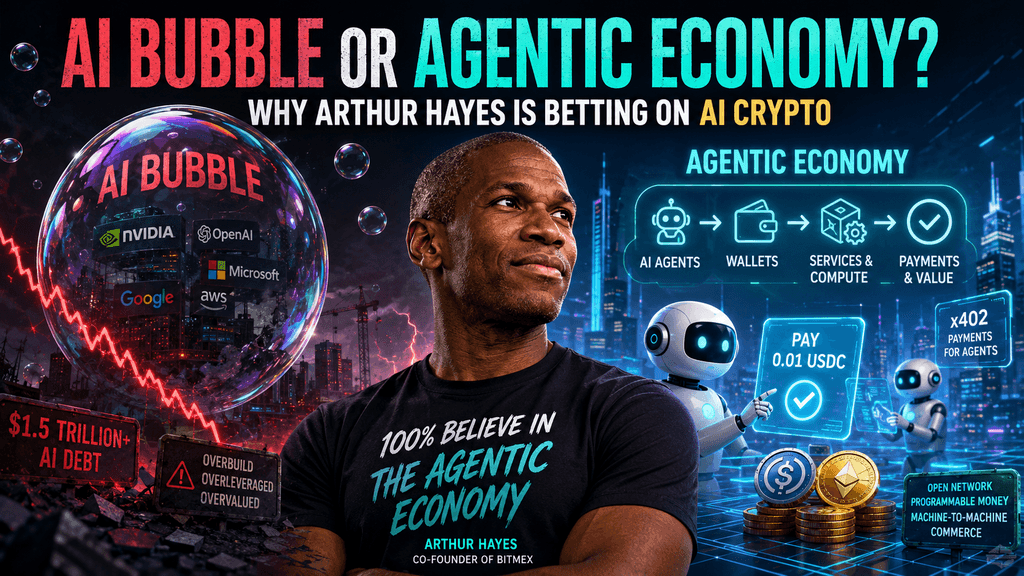
Arthur Hayes has spent months warning that the artificial intelligence boom could become one of the biggest credit bubbles of the current market cycle. Yet on August 18, 2026, the BitMEX co-founder announced that he was stepping back into an operating role to lead Flop Labs, a crypto project built around AI agents, compute and a planned FLOP token. A day later, responding to questions about the apparent contradiction, Hayes said he still believes there is an AI bubble—but also that he “100%” believes in the agentic economy.
The two positions are less contradictory than they first appear. Hayes is primarily skeptical of the debt, capital spending and valuations supporting the AI infrastructure boom, not of artificial intelligence itself. In fact, his thesis suggests that overbuilding data centers could eventually make computing dramatically cheaper. If that happens, autonomous AI agents may become much more economical to operate—and crypto could become one of the payment, settlement and resource-allocation layers those agents use. Flop Labs is Hayes’ attempt to turn that macro thesis into a real crypto network.
Why Hayes Thinks AI Is in a Bubble
Hayes’ AI bubble argument starts with infrastructure rather than chatbots. The explosion in generative AI has triggered enormous demand for GPUs, data centers, electricity, networking equipment and cloud capacity. Companies have responded with aggressive capital expenditure, while credit markets have increasingly helped finance the buildout. In Hayes’ own analysis, roughly $1.5 trillion of AI-related debt had been issued since the emergence of the current AI boom, with about $1.3 trillion of that issuance occurring from 2025 onward. That figure is Hayes’ estimate rather than an official industry statistic, but it illustrates the scale of leverage he believes is accumulating around AI infrastructure.
The risk appears if future AI revenue does not justify the amount of capital invested. Data centers can be built under assumptions of permanently rising compute demand, high utilization and attractive pricing. But GPUs depreciate, newer chips improve efficiency, competitors add capacity and inference prices can fall. If too much infrastructure is financed with debt, weaker returns can become a balance-sheet problem rather than merely a disappointing technology investment. Hayes has therefore framed the AI boom as a potential credit event in which the economics of debt-funded infrastructure become more important than whether AI itself remains useful.
The distinction matters. A speculative technology stock can fall sharply without threatening its creditors. A heavily financed infrastructure project, by contrast, must continue generating enough cash to service debt. Hayes’ concern can be summarized as a chain: AI enthusiasm → massive capital spending → debt expansion → excess compute capacity → weaker returns → potential credit stress. That is much closer to an infrastructure and financing bubble than a claim that artificial intelligence is worthless.
The Key Distinction: AI Is Not the Bubble
This is the most important part of Hayes’ argument. An industry can overinvest in infrastructure while the underlying technology continues to grow. History offers several versions of this pattern: investors may lose money financing too much capacity, yet customers later benefit from the abundant infrastructure left behind. The economic value created by a technology and the financial returns earned by those funding its early buildout are not the same thing.
For AI, that means an oversupplied data center market could hurt lenders, cloud providers or infrastructure investors while simultaneously helping developers. More GPUs and more competing compute capacity can push inference costs lower. The price paid to build AI infrastructure could therefore prove excessive even if demand for AI applications keeps expanding. Hayes’ latest comments make this distinction explicit: he argues that the bubble sits in data center debt and certain loss-making cloud and AI companies, while excess compute capacity strengthens rather than weakens his conviction in the agentic economy.
The thesis is therefore not “AI will collapse.” It is closer to the economics of building AI may deteriorate faster than the economics of using AI. That difference explains why Hayes can warn about an AI bubble while simultaneously launching a project designed for a world in which AI agents become far more common.
Why an AI Bust Could Help AI Agents
AI agents are unusually sensitive to the price of computation because an autonomous system does much more than generate one answer. A sophisticated agent may reason through a task, call external tools, search databases, invoke multiple models, write and execute code, retrieve memories, compare results and repeat the process until a goal is completed. Every step consumes resources. An agent that costs too much to operate may be technically impressive but economically useless.
From Compute Scarcity to Compute Abundance
The current infrastructure boom is attempting to solve exactly that problem by expanding the supply of AI compute. Hayes’ contrarian point is that the industry might solve it too aggressively. If data centers, accelerators and cloud capacity eventually become abundant relative to demand, providers could compete more aggressively on price. Capacity financed at optimistic assumptions may disappoint investors, but lower market prices for compute would make AI applications cheaper to run. That is the mechanism behind Hayes’ comment that debt-funded compute overcapacity can support the Flop Labs thesis.
Cheap Compute Changes Agent Economics
Consider the difference between an AI agent that costs $50 a day to operate and one that costs $5. At the higher cost, it may only make sense for high-value enterprise workflows. At the lower cost, many more use cases become viable: research agents that continuously monitor information, trading agents that analyze markets, commerce agents that compare products, coding agents that maintain software, and machine-to-machine services that perform small tasks thousands of times per day.
The important relationship is not simply more AI capacity = more AI hype. It is more capacity → lower marginal compute cost → more tasks become economically rational to automate. If that transition occurs, an infrastructure bust could paradoxically help create an application boom. The losers might be the investors who financed expensive capacity; the winners could be the developers and agents able to consume that capacity cheaply.
What Is the Agentic Economy?
Most consumers still interact with AI through a relatively simple loop: human → prompt → AI response. The AI may recommend a hotel, draft an email or explain an investment concept, but the person generally remains responsible for executing the next step. Agentic systems move closer to human → goal → AI agent → actions. The distinction is important because the agent is no longer just producing information; it begins coordinating tools and resources to achieve an outcome.
Imagine asking an agent to organize an overseas conference trip. Instead of only suggesting flights and hotels, a sufficiently capable agent could search live availability, compare prices, inspect a calendar, communicate with service providers, purchase access to travel data, make a reservation under predefined permissions and adjust the itinerary if conditions change. Google’s Agent2Agent initiative already reflects a broader industry push toward software agents that can collaborate across platforms, while OpenAI’s Agentic Commerce Protocol provides infrastructure connecting AI-driven product discovery and merchant systems.
Once agents begin consuming services, selling services and requesting paid resources, they start behaving more like economic participants. An agent might need compute from one provider, proprietary data from another, storage from a third and payment infrastructure to settle everything. That network of autonomous or semi-autonomous transactions is what the phrase agentic economy is trying to capture. The financial question then becomes unavoidable: if software increasingly acts on behalf of humans and businesses, what payment rails are best suited to software?
Why AI Agents May Need Crypto
This is where the AI thesis becomes directly relevant to crypto investors. Traditional payments were designed around people and registered businesses. They typically rely on bank accounts, cards, merchant accounts, billing relationships and identity processes. APIs can automate part of that experience, but the underlying system still usually assumes that a human or company owns the account and grants software permission to use it.
Crypto introduces a different model. Software can interact with a programmable wallet, transfer stablecoins, call smart contracts and settle transactions around the clock. Coinbase’s AgentKit, for example, is specifically designed to let AI agents interact with blockchain networks and manage onchain actions, while its Agentic Wallet tools allow agents to hold and spend stablecoins. Coinbase’s x402 standard goes further by enabling APIs, applications and AI agents to make stablecoin payments directly through HTTP requests. These are already functional examples of the broader thesis that blockchain infrastructure can support machine-native financial activity.
| What an AI Agent Needs | Conventional Approach | Crypto-Native Approach |
| Hold spending power | Bank or platform account | Programmable wallet |
| Pay for digital services | Card or account billing | Stablecoin transfer |
| Buy API access | Subscription / API key | Pay-per-request settlement |
| Make micropayments | Often uneconomical | Low-cost onchain payments |
| Execute conditional payments | Platform-specific logic | Smart contracts |
| Pay another agent | Custom platform integration | Wallet-to-wallet settlement |
| Acquire digital assets | Platform-controlled ownership | Onchain ownership |
The most compelling use case may be small, automated payments. An AI research agent could pay a few cents for premium data; a coding agent could purchase an API call; a commercial agent could buy compute only when it needs additional capacity. Coinbase describes x402 as allowing agents to pay for APIs, software and services directly with stablecoins, and by 2026 it had expanded integrations intended to let websites accept agents as customers.
This does not prove that crypto will dominate agent payments. OpenAI’s Agentic Commerce Protocol demonstrates the opposite possibility: agents can transact through existing payment processors using delegated, permissioned payment credentials without requiring a public blockchain or a new token. The real competition is therefore not “AI agents versus banks.” It is between different architectures for programmable commerce. Crypto’s potential advantage lies in open settlement, stablecoins, machine-readable ownership and cross-platform interoperability. Its biggest challenge is proving those features are sufficiently useful to outweigh the complexity of blockchain infrastructure.
Flop Labs Turns Hayes’ Thesis Into a Real Bet
Hayes moved from commentator to operator on August 18 when he announced that he was coming “out of retirement” to lead Flop Labs. He described FLOP as “food” for AI agents and said the project would have no presale or venture-capital allocation, promoting what he called a 100% fair launch. A large airdrop is targeted for the fourth quarter of 2026, while the Flop Network genesis block is planned for the first quarter of 2027. Those dates and mechanics remain preliminary.
The project is not positioning itself as another foundation-model developer. Its stated ambition is to create an economic and compute layer in which AI agents use FLOP to purchase resources such as inference and memory, while GPU providers supply computation and validators help verify that services were delivered. Reporting on the project describes the planned architecture as a Proof-of-Useful-Inference protocol: instead of rewarding computation devoted only to conventional proof-of-work hashing, the network aims to link incentives to useful AI inference.
Proof-of-Useful-Inference
The concept is attractive because it attempts to connect three markets at once: agents that demand computation, GPU owners that want to monetize capacity, and a crypto network that can coordinate payments and rewards. In simplified form, the proposed flow looks like agent requests compute → provider executes AI workload → network verifies delivery → payment and rewards settle in FLOP. The network also proposes a role for memory storage, potentially giving agents a persistent resource layer rather than treating every interaction as a standalone model call.
However, this remains a design thesis, not a proven protocol. As of August 19, detailed public documentation is still limited. No full whitepaper, final token supply schedule or comprehensive technical specification has been released publicly, and important questions remain around how nondeterministic AI inference would be verified, how incorrect computation would be detected and how agent data would be protected. Even reporting supportive of the project stresses that Proof-of-Useful-Inference should currently be viewed as a proposed mechanism rather than a deployed system.
| Flop Network Participant | Proposed Role |
| AI Agents | Purchase inference, memory and other resources |
| GPU / Compute Providers | Execute AI workloads and earn compensation |
| Validators | Verify services and participate in network operation |
| FLOP Token | Proposed payment and incentive asset for the ecosystem |
That distinction is crucial for investors. Flop Labs is interesting because it expresses Hayes’ thesis in product form: cheap compute, autonomous agents and crypto settlement brought into a single network. But a compelling narrative is not evidence of product-market fit. The real test will come only when agents, compute providers and developers begin using the system for economic activity that would exist even without token speculation.
Why This AI-Crypto Bet Could Fail
The first risk is that a successful agentic economy may not need thousands of specialized AI tokens. If autonomous agents mainly require stable, programmable money, they could simply use USDC, USDT or other established assets on existing networks. Coinbase’s own agent infrastructure already emphasizes stablecoin payments rather than requiring every agent application to introduce a new native currency. This creates an important distinction for crypto investors: AI agent adoption can be bullish for blockchain activity without being bullish for every AI token.
The second risk is that centralized infrastructure may remain more convenient. OpenAI and established payment processors are already building agentic commerce around existing merchant and payment relationships, while Google and other technology companies are developing standards for agents to interact across systems. A developer deciding between a decentralized compute marketplace and a hyperscale cloud provider will probably care more about reliability, latency, security and pricing than ideological decentralization. If centralized providers deliver those characteristics better, blockchain-based alternatives may remain niche.
Flop Labs also carries project-specific execution risk. A useful inference network must solve difficult problems around verification, latency, compute quality, pricing, privacy and incentives. Token economics must attract GPU suppliers without creating unsustainable inflation, while agent users must see a reason to hold or acquire FLOP rather than simply paying with stablecoins. The project’s currently limited documentation makes those questions impossible to answer conclusively. A strong macro thesis can explain why a market might emerge; it cannot guarantee that one particular protocol will capture it.
What This Means for Crypto Investors
For crypto investors, Hayes’ return matters less as an immediate FLOP trade than as a signal of where the AI-crypto narrative may be heading. The first wave of AI crypto focused heavily on decentralized GPU networks, model tokens and speculative AI-themed assets. The agentic economy introduces a different possibility: the biggest crypto opportunity could come from machines becoming users of financial infrastructure.
If that happens, the value stack could extend across agent wallets, stablecoin settlement, micropayments, verifiable compute, decentralized inference, identity and machine-to-machine commerce. Coinbase’s AgentKit, Agentic Wallet and x402 initiatives already show that significant crypto companies are building for this scenario rather than treating it purely as a future narrative.The central investment question therefore shifts from “Which AI token has the best story?” to “Which blockchain rails will autonomous software actually use?”
That framework also encourages investors to distinguish infrastructure usage from token speculation. A protocol can process millions of agent transactions while its native token captures little value; alternatively, stablecoins and base-layer blockchains may benefit more directly. What matters is measurable activity: agents holding assets, buying services, paying for compute and generating repeat transactions. The transition from narrative to usage will ultimately determine whether AI x crypto becomes a durable sector or another short-lived thematic trade.
What to Watch Next
The first thing to watch is Flop Labs itself. A whitepaper, protocol specification, testnet, tokenomics framework and more detailed explanation of Proof-of-Useful-Inference would allow the market to evaluate whether the network has a credible technical path rather than only an attractive economic story. The planned Q4 2026 airdrop and Q1 2027 genesis block provide initial milestones, although the project has already made clear that more details are still to come.
The second signal sits outside Flop entirely: the price and availability of AI compute. Hayes’ thesis becomes much more persuasive if inference costs fall as new data center capacity enters the market. Investors should also watch whether autonomous payment systems generate real volumes. x402, agent wallets and agentic commerce protocols provide useful early infrastructure, but the decisive evidence would be sustained demand from software agents paying for resources without continuous human intervention.
Finally, stablecoin adoption may be one of the cleanest indicators. If AI agents increasingly need programmable money, the simplest solution may not be a new AI token at all. Growth in stablecoin-based machine payments could validate Hayes’ broader agentic-economy thesis even if FLOP itself ultimately fails.
The AI Bubble and Agentic Economy Can Both Be Right
The question in the title does not necessarily require choosing one side. An AI infrastructure bubble and a thriving agentic economy can exist at the same time. Hayes’ argument is that excessive debt and capital spending may create too much compute, damage returns for the companies that financed it and eventually cause financial stress. But the infrastructure left behind could make AI cheaper, more accessible and economically viable for a much wider range of autonomous applications.
Crypto enters the story because autonomous software needs a way to pay for resources, hold value and interact economically. Blockchains and stablecoins offer one possible answer, while conventional payment systems are rapidly adapting as well. Flop Labs is therefore best viewed not as proof that AI agents will use FLOP, but as a high-profile experiment built around a much larger question: what financial infrastructure will machines use when they begin acting as economic participants?
The real question may not be whether the AI bubble bursts. It may be who captures the value of the cheap compute and new forms of commerce that remain after it does.
FAQs
What Is Flop Labs?
Flop Labs is the AI-crypto project Arthur Hayes announced he would lead in August 2026. It is developing the Flop Network, a proposed system intended to connect AI agents with compute, memory and payment resources. The project plans to use FLOP as its native economic asset, but the network remains at an early development stage.
When Will the FLOP Token Launch?
Hayes has said the project expects a large FLOP airdrop in Q4 2026, while the Flop Network genesis block is targeted for Q1 2027. The unusual sequencing means token distribution could precede the live blockchain. Both dates remain project targets rather than guaranteed launch dates.
Is FLOP Already Tradable?
The announced roadmap centers on a future airdrop and network launch rather than an already mature live token ecosystem. Investors should be cautious about assets claiming to be official FLOP before Flop Labs publishes definitive contract addresses and launch details. Current public documentation remains limited.
Are AI Agents Already Using Crypto Today?
Yes, at an early infrastructure level. Coinbase offers AgentKit and Agentic Wallet tools that allow agents to interact onchain and hold or spend stablecoins, while x402 allows agents to pay for APIs and digital services using stablecoins over HTTP. This demonstrates technical feasibility, although mass autonomous-agent adoption is still developing.
Could Stablecoins Benefit More Than AI Tokens From the Agentic Economy?
Possibly. Agents primarily need reliable, programmable and liquid money. Stablecoins already provide those characteristics without forcing an agent to take price risk in a specialized token. Native AI tokens may still have roles in incentives or network security, but growing agentic commerce could potentially benefit stablecoins and underlying blockchain infrastructure more broadly than individual AI tokens.
🔥 KuCoin Offers A More Stable Option in A Volatile Market
If you worry about the frequent ups and downs in the market, and pursue a more stable option to earn money passively, KuCoin is the right place to come:

Simple Earn: Deposit and withdraw tokens anytime, earning stable returns.
Kucoin Earn: Earn stable profits with professional asset management.
Hold to Earn: Earn rewards by holding assets in Funding, Trading, Margin, Futures, Mining, and Unified Accounts.
Staking: Unlock the earning potential of on-chain assets.
Advanced Investments: Advanced Investments offer a variety of structured products to help your money grow in any market.
Shark Fin: Principal Protection and Guaranteed Gains
Dual Investment: Buy low and sell high with transparent return calculations.
Snowball: High yields, with price protection.
Discount Buy: Buy crypto at discount prices.
KCS Loyalty: Level up to enjoy exclusive perks by staking ≥ 1 KCS.
KuCoin Wealth: Discover future value and begin your smart investing journey.
KCS Benefits: Hold and stake KCS to access benefits across the platform.
KCS Staking 2.0: Participate in KCS on-chain governance to earn yield.
Disclaimer: This content is for informational purposes only and does not constitute investment advice. Cryptocurrency investments carry risk. Please do your own research (DYOR).