

Anthropic Warns of Rising AI Energy Costs in October 2026 IPO Filing: Can Power Shortages Slow AI Growth?
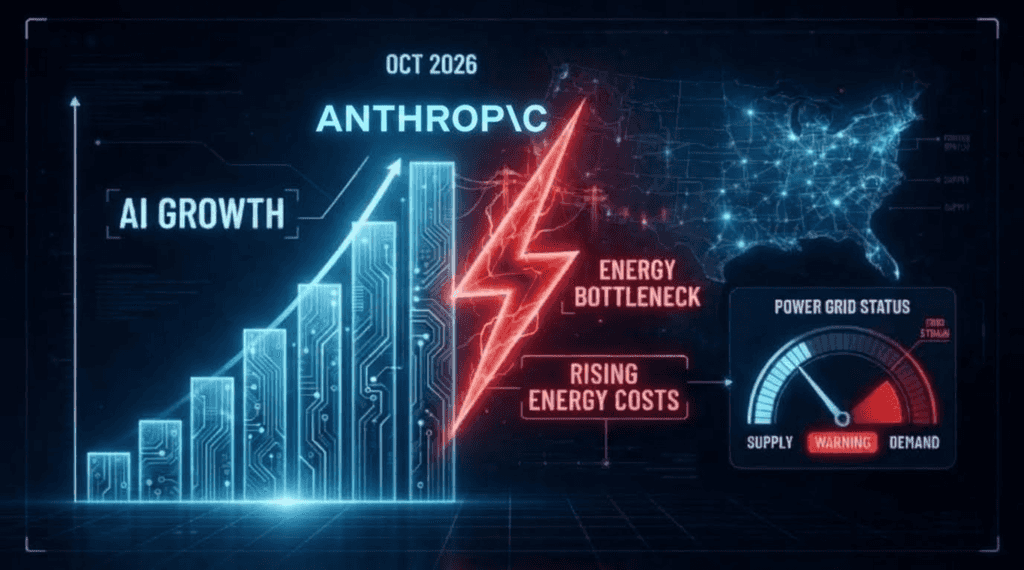
When Anthropic, PBC officially filed its public Form S-1 registration statement with the U.S. Securities and Exchange Commission on October 26, 2026, institutional attention focused heavily on its headline financials: first-half 2026 revenue of $16.3 billion and an annualized revenue run rate exceeding $65 billion, set against $417 billion in confirmed long-term compute and data center payment obligations stretching over the next two decades. Yet within the filing’s 93 pages of mandatory "Risk Factors" disclosures, the company delivered a candid assessment of physical constraints that could challenge that trajectory. In one of the most detailed physical infrastructure warnings from a frontier artificial intelligence laboratory, Anthropic identified electrical grid bottlenecks, rising electricity and water costs, climate change impacts, and municipal moratoriums on data centers as material threats to its operations and reputation.
This regulatory disclosure underscores a broader structural shift across the generative AI industry. The primary bottleneck governing the scaling of foundation models is shifting from algorithmic design and silicon wafer allocation to the physical realities of electrical power delivery. Training and operating frontier neural networks require hundreds of megawatts to multiple gigawatts of continuous power, yet public utility transmission networks cannot expand at the speed of software deployment.
Inside the S-1 Risk Disclosures: Power Access, Cooling Burdens, and On-Site Generation
In its Form S-1 submission, Anthropic outlined several operational vulnerabilities directly tied to data center electricity and resource constraints. Because the commercial expansion of its Claude model family relies on uninterrupted access to high-density compute clusters across AWS, Google Cloud, Microsoft Azure, and leased facilities, any disruption, curtailment, or price spike in power delivery directly affects model training timelines and inference margins.
Thermal Dissipation, Water Scarcity, and Climate Realities
Unlike SpaceX’s initial S-1 filing earlier in 2026, which originally omitted climate change before later adding water scarcity in an amendment, Anthropic’s S-1 directly identifies climate change and environmental pressures as core business risks. High-density AI server racks generate substantial thermal output. Anthropic noted that rising average global temperatures can directly increase both the electrical power and water volumes required to cool the specialized data centers operated by its infrastructure partners.
As ambient temperatures rise during peak summer months, traditional evaporative cooling systems consume larger volumes of municipal water, while mechanical chillers draw a higher share of facility electricity simply to prevent GPU thermal throttling. This cooling overhead, reflected in elevated Power Usage Effectiveness (PUE) ratios, diverts electrical capacity away from active AI computation and increases baseline operating costs.
The Industry Turn to Behind-the-Meter Fossil Generation
The filing’s warnings regarding environmental scrutiny and regulatory charges also reflect the stopgap measures data center operators use to navigate utility grid delays. To energize massive GPU clusters without waiting years for utility substation upgrades, infrastructure developers have increasingly turned to "behind-the-meter" power generation, deploying on-site aeroderivative natural gas turbines and localized gas generators.
While behind-the-meter gas generation allows AI campuses to come online faster than regional transmission lines permit, it exposes operators to natural gas price volatility, local air-permitting challenges, and heightened environmental criticism. In its S-1, Anthropic explicitly acknowledged that public concern over the energy-intensive nature of AI, water usage, and reliance on critical minerals could expose the company to reputational harm, stricter ESG regulation, or new government charges.
The Public Grid Bottleneck: Transmission Backlogs and Substation Lead Times
To understand whether power constraints can slow AI growth, it is necessary to compare the rapid iteration cycle of AI silicon (typically 18 to 24 months) against the multi-year construction timelines of electrical grid infrastructure.
Interconnection Queues Across Major Regional Grids
Modern frontier AI training campuses demand between 100 megawatts (MW) and over 1 gigawatt (GW) of continuous baseload power. Across the United States, major Regional Transmission Organizations (RTOs) face substantial interconnection backlogs:
-
Queue Duration: The regulatory process for completing system impact studies, engineering assessments, and grid upgrade allocations routinely spans four to seven years.
-
Equipment Supply Chain Lead Times: Procuring Large Power Transformers (LPTs) and high-voltage switchgear frequently requires two to four years from order to delivery due to tight global supply in grain-oriented electrical steel and specialized manufacturing capacity.
-
Transmission Capacity Limits: Regional utility grids were historically engineered around gradual load growth of 0.5% to 1.5% per year. Concentrated gigawatt-scale data center requests strain existing transmission corridors, requiring new 345kV and 765kV lines that face lengthy permitting and right-of-way approvals.
Geographic Concentration Risks
Anthropic specifically warned in its S-1 that because the bedrock of its AI infrastructure is heavily concentrated in the United States, its operations remain vulnerable to regional power grid constraints, natural disasters, and local regulatory shifts. In established hubs such as Northern Virginia’s "Data Center Alley," utility provider Dominion Energy has had to pace new high-load connections as regional transmission lines approach thermal limits. To mitigate this concentration risk, Anthropic noted in the filing that it is actively expanding its data center capacity internationally to diversify its infrastructure footprint.
Community Backlash, Water Allocation, and Municipal Moratoriums
Beyond physical hardware and transmission bottlenecks, AI data center expansion is encountering organized local and legislative pushback. In its S-1, Anthropic stated plainly that data center development "has prompted public controversy and regulatory scrutiny regarding environmental impact, land and water use, and the allocation of limited power resources".
$198 Billion in Delayed or Blocked Data Center Projects
Local municipalities no longer view hyperscale data centers as automatic economic wins. According to industry tracking by Data Center Watch cited in October 2026, at least 106 data center projects in the United States, representing approximately $198 billion in planned capital investment, have been delayed, blocked, or forced into renegotiation due to local opposition, zoning rejections, or environmental litigation.
Community opposition generally centers on four recurring issues:
Ratepayer Electricity Costs: When utilities build multi-billion-dollar substations and transmission upgrades for data center campuses, consumer advocates worry those capital costs will be socialized across residential electricity bills.
Municipal Water Competition: High-density facilities using evaporative cooling can draw millions of gallons of water daily, sparking friction in drought-sensitive regions.
Acoustic and Land-Use Impacts: Continuous low-frequency noise from cooling fans and periodic testing of backup diesel generators has led neighborhoods to oppose rezoning near residential areas.
Grid Reliability Concerns: Grid operators warn that rapid data center load additions without matching dispatchable generation could heighten the risk of brownouts during extreme summer or winter weather peaks.
The Rise of Moratoriums and Force Majeure Setbacks
Anthropic highlighted this legislative trend directly in its prospectus: "Certain state, local, and municipal jurisdictions in the United States are also considering or have approved moratoriums on new data center construction, citing public health, safety, and environmental concerns".
Across states including Virginia, Georgia, Indiana, and Pennsylvania, local boards have debated or enacted temporary pauses and stricter zoning rules on data center permits. Meanwhile, commercial disputes over delayed sites are mounting: in late September 2026, for example, Oracle issued a force majeure notice to financing partner Blue Owl Capital following a series of construction and permitting setbacks at its "Project Jupiter" data center campus in New Mexico. For AI labs like Anthropic that have committed $417 billion in long-term lease obligations, municipal delays directly affect how quickly contracted compute capacity can be brought online.
Comparative Matrix: Power Sourcing Architectures and the Crypto Mining Pivot
To navigate multi-year utility queues, AI hyperscalers and infrastructure providers are pursuing four distinct power procurement strategies, including acquiring energized capacity from the cryptocurrency mining sector.
| Power Sourcing Model | Typical Time to Online | Scalability (MW / GW) | Carbon & ESG Profile | Primary Operational & Regulatory Trade-Offs |
| Standard Utility Grid Interconnect | 4 to 7 Years | High (100 MW – 1 GW+) | Mixed (Grid-dependent) | Severe RTO interconnection backlogs; local ratepayer pushback and zoning moratoriums. |
| Behind-the-Meter Natural Gas Turbines | 12 to 24 Months | Medium–High (50 MW – 500 MW+) | High Emissions (Fossil) | Eliminates utility queue wait times, but faces EPA air-permitting hurdles, fuel price volatility, and ESG scrutiny. |
| Nuclear Colocation & SMRs | 2 to 5 Years (Restarts) 2030+ (New SMRs) |
Very High (500 MW – 1 GW+) | Zero-Carbon Baseload | High regulatory complexity (NRC/FERC approvals) and long engineering lead times. |
| Converted Crypto Mining Sites & DePIN | 6 to 18 Months (Retrofits) | Modular (50 MW – 500 MW) | Often Renewable / Stranded Hydro | Immediate access to energized substations and PPAs; requires data center shell and fiber upgrades. |
How Crypto Miners and DePIN Networks Fit into the AI Energy Crunch
As highlighted in the table above, Anthropic’s warning about grid bottlenecks explains one of the most important trends in the digital asset sector: the convergence of Bitcoin mining infrastructure and AI high-performance computing (HPC).
The Value of Energized Megawatts: During previous crypto market cycles, industrial Bitcoin miners secured multi-hundred-megawatt utility interconnections, high-voltage substations, and long-term Power Purchase Agreements (PPAs) across Texas, New York, and the Pacific Northwest. Because an energized substation saves three to five years of grid queue waiting time, AI cloud providers and hyperscalers have signed multi-billion-dollar hosting leases with Bitcoin miners to retrofit mining facilities into liquid-cooled AI data centers.
Grid Load Balancing vs. Continuous AI Loads: While AI data centers typically demand flat, 24/7 uninterrupted power, Bitcoin miners have historically operated as flexible, interruptible loads, powering down within seconds during peak residential demand to stabilize the grid. Increasingly, hybrid campuses pair continuous AI inference clusters with flexible Bitcoin mining units to meet utility demand-response requirements.
Decentralized Compute (DePIN) for Edge Workloads: While frontier training requires massive centralized campuses, decentralized physical infrastructure networks, such as Render, Akash, and Flop Labs, aggregate globally distributed, already-energized GPUs. By routing smaller inference and fine-tuning tasks to existing hardware worldwide, decentralized networks avoid localized municipal grid bottlenecks altogether.
Can Power Shortages Structurally Slow AI Growth?
The central strategic question raised by Anthropic’s Form S-1 is whether electrical and environmental constraints will slow the pace of AI advancement.
Historically, AI progress has followed empirical scaling laws: increasing model parameters, dataset size, and training compute has yielded predictable gains in reasoning and coding capabilities. However, those scaling laws assumed that physical inputs, electricity, water, and permitted land, could scale effortlessly alongside venture capital.
Rather than halting AI progress, grid bottlenecks are forcing three structural adaptations across the industry:
-
Geographically Distributed Training: Because securing 2+ gigawatts of power in a single municipal substation is increasingly difficult, frontier labs are engineering distributed training protocols that split a single model training run across multiple regional data centers linked by high-speed optical fiber.
-
Algorithmic and Silicon Efficiency: Rising electricity costs create strong economic incentives to reduce watt-hours per token. Labs are heavily prioritizing model distillation, sparse mixture-of-experts (MoE) architectures, and specialized inference ASICs (such as Google TPUs and AWS Trainium) that deliver higher compute throughput per megawatt.
-
Infrastructure Consolidation: Because securing long-term nuclear agreements, building private substations, or committing $417 billion in multi-decade leases requires immense capital, power constraints act as a competitive moat that consolidates frontier model training among a handful of mega-cap labs and hyperscalers.
Conclusion
Anthropic’s October 26, 2026 Form S-1 filing makes official what energy analysts and crypto infrastructure operators have observed on the ground: electrical power delivery, water availability, and local permitting have become binding constraints on artificial intelligence scaling. With $417 billion in confirmed infrastructure commitments on its books and $198 billion in US data center projects facing local delays industry-wide, Anthropic’s path to justifying a multi-trillion-dollar public valuation will depend not only on Claude’s software capabilities, but on how effectively its cloud and energy partners navigate the physical limits of the power grid.
FAQs
What did Anthropic disclose regarding energy and environmental risks in its October 2026 S-1 filing?
In its public Form S-1 filed on October 26, 2026, Anthropic warned that power grid constraints, rising electricity and water demand, climate change, and local community opposition could increase its operating costs, delay compute expansion, and harm its reputation.
How much has Anthropic committed to future data center and compute infrastructure?
According to its Form S-1 prospectus, Anthropic has entered into approximately $417 billion in confirmed future minimum payment obligations for cloud computing and data center leases over contracts running up to two decades (with additional pending commitments that could lift total infrastructure spend even higher).
Why are local communities pushing back against AI data centers?
Municipal opposition is driven by concerns over higher household electricity bills, heavy daily water consumption for evaporative cooling, noise pollution from cooling chillers and backup generators, and land use. Industry tracker Data Center Watch estimates that at least 106 US data center projects worth roughly $198 billion have been delayed or blocked by local opposition.
How do Bitcoin miners and crypto infrastructure relate to the AI power shortage?
Because connecting a new data center to the electrical grid can take four to seven years, AI cloud providers are increasingly leasing or acquiring industrial Bitcoin mining sites. Publicly traded crypto miners already hold energized high-voltage substations and multi-hundred-megawatt power contracts, allowing them to retrofit facilities for AI hosting years faster than building new data centers from scratch.
Disclaimer
This general market information, possibly from third-party, commercial, or sponsored sources, is provided for reference and educational purposes only and does not constitute financial or investment advice, an offer, solicitation, or guarantee. We disclaim liability for its accuracy, completeness, reliability, and any resulting losses. Investments/trading are risky; past performance doesn’t guarantee future results. Users should research, judge prudently, and take full responsibility. For further details, please consult KuCoin’s Terms of Use and Risk Disclosure.