

AI Investment Returns Under Scrutiny in November 2026: Rising Debt and Big Tech's Cash Flow Concerns
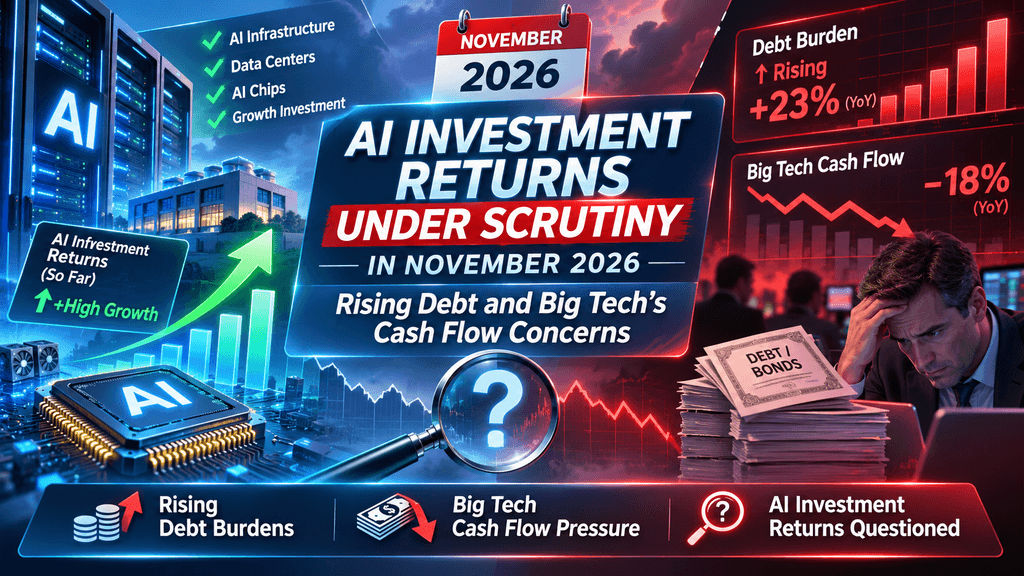
Artificial intelligence investment is entering a new financial reality. Microsoft, Alphabet, Amazon, Meta, and Oracle generated a combined $542.9 billion in operating cash flow during the first nine months of 2026, yet their capital expenditures reached $556.9 billion, leaving a combined free cash flow deficit of approximately $14 billion. The figures highlight a growing concern on Wall Street: whether the enormous cost of building AI infrastructure can translate into sustainable revenue, profitability, and shareholder returns.
The financing side is becoming equally important. Big Tech companies are increasingly turning to debt and equity markets to fund data centers, GPUs, and cloud infrastructure, while the International Monetary Fund (IMF) has warned about interconnected financing arrangements across the AI industry. As investors reassess valuations, borrowing costs, and future earnings potential, the central question is no longer simply how much companies are investing in AI, but whether those investments can generate sufficient financial returns.
Key Takeaways
-
Capital spending exceeds cash generation: Five major technology companies recorded $556.9 billion in capital expenditures against $542.9 billion in operating cash flow during the first nine months of 2026.
-
Free cash flow turns negative: Their combined free cash flow shifted from a $143.5 billion surplus in the comparable period of 2025 to a $14 billion deficit.
-
Debt financing is expanding: AI infrastructure projects are increasingly supported by corporate bonds, bank loans, and equity issuance.
-
IMF highlights financial risks: Its October 2026 analysis identified approximately $650 billion in debt and $1.4 trillion in future revenue commitments across 14 disclosed AI-related financing transactions.
-
Big Tech performance is diverging: Strong cloud demand is supporting AI infrastructure investment, but companies face different challenges involving depreciation, financing costs, and monetization.
-
Market focus is shifting: Investors are paying greater attention to free cash flow, return on invested capital, and the sustainability of AI-related revenue growth.
Why Are AI Investment Returns Under Scrutiny in November 2026?
The AI investment boom is entering a more demanding financial phase because infrastructure spending is growing faster than the cash generated by some of the world's largest technology companies. During the first nine months of 2026, Microsoft, Alphabet, Amazon, Meta, and Oracle generated $542.9 billion in operating cash flow, up 29% year over year. However, their combined capital expenditures doubled to $556.9 billion, producing a $14 billion free cash flow deficit. A year earlier, the same companies had generated a combined $143.5 billion surplus. The figures indicate that even highly profitable technology businesses are committing an increasing proportion of their financial resources to AI infrastructure.
From AI Growth to Financial Accountability
For much of the previous AI investment cycle, companies received favorable market reactions when they announced larger infrastructure budgets, expanded GPU procurement, or increased data center capacity. Investors generally viewed these expenditures as necessary to capture future demand for AI computing and cloud services. However, the financial requirements of the industry are now becoming more visible. Data centers require substantial upfront investment in land, construction, servers, networking equipment, electricity, and cooling systems. These assets also generate ongoing depreciation and maintenance expenses after deployment.
Consequently, investors are increasingly evaluating whether AI-related revenue can grow quickly enough to justify the capital committed. A company may report strong cloud revenue growth while simultaneously experiencing weaker free cash flow because infrastructure spending occurs before the corresponding customer revenue is fully realized. The market is therefore shifting from rewarding investment announcements toward examining capital efficiency, operating margins, and the time required to recover infrastructure costs.
Why Free Cash Flow Matters
Free cash flow (FCF) measures the cash remaining after a company covers its operating activities and capital expenditures. It provides an important indication of how much financial flexibility a business retains for debt repayment, acquisitions, dividends, and share repurchases.
When capital expenditures exceed operating cash flow, companies may need to rely more heavily on existing cash reserves or external financing. This does not automatically indicate financial distress, particularly for businesses with substantial cash balances and recurring revenue. Nevertheless, prolonged negative free cash flow can make investment returns more sensitive to interest rates, borrowing conditions, and changes in customer demand.
Big Tech Raises Capital to Fund the AI Expansion
External financing is becoming an increasingly important part of the AI infrastructure investment cycle. Large technology companies are using corporate bonds, equity offerings, and other financing arrangements to support projects that require substantial upfront capital. According to an October 29 Axios report citing S&P Global Market Intelligence, Alphabet, Amazon, Meta, Microsoft, and Oracle had raised approximately $326 billion through stock and bond financing in 2026, more than three times the previous year's amount. This figure combines different financing instruments and should not be interpreted as debt alone.
Why Are Technology Companies Borrowing More?
AI infrastructure investment requires capital before the full commercial benefits become available. A hyperscale data center may take years to plan, construct, connect to the electricity grid, and bring into operation. Meanwhile, companies must purchase computing equipment and secure long-term power and networking arrangements.
Debt financing allows companies to distribute these costs over time rather than relying exclusively on current operating cash flow. For businesses with strong credit ratings and predictable cloud revenue, issuing bonds can also be an efficient way to fund expansion while retaining financial flexibility.
However, borrowing introduces additional obligations. Interest expenses reduce the cash available for other purposes, while refinancing requirements can become more expensive if market rates rise. Companies must therefore ensure that the expected returns from AI infrastructure exceed the total cost of financing and operating those assets.
Meta and Oracle Take Different Financing Approaches
Meta has indicated that it may raise as much as approximately $95 billion through equity issuance to support its AI infrastructure ambitions, according to October reporting. Equity financing can reduce the immediate pressure associated with interest payments, but it may dilute existing shareholders if additional shares are issued.
Oracle, meanwhile, has emphasized managing the timing of its capital expenditure cycle and future financing requirements. The company indicated that capital spending would reach a peak over the coming fiscal years and communicated a more controlled approach to additional financing. These different strategies illustrate how companies are balancing infrastructure expansion against shareholder dilution, debt obligations, and future cash flow.
The key issue is not whether debt or equity financing is inherently preferable. It is whether the capital structure matches the expected revenue-generating life of the assets being financed.
IMF Warns of Circular Financing Risks in the AI Industry
The IMF's October 2026 Global Financial Stability Report identified interconnected financing arrangements as a potential source of financial risk in the AI sector. Its analysis examined 14 publicly disclosed transactions since 2023, involving approximately $300 billion in equity investments, $650 billion in debt financing, and $1.4 trillion in future revenue commitments. These figures describe the transactions examined by the IMF rather than the total financing of the entire AI industry.
Understanding Circular Financing
Circular financing occurs when investments and commercial agreements create interconnected financial relationships between companies within the same industry. In the AI ecosystem, a technology company may invest in an AI developer, which subsequently commits to purchasing cloud computing services or infrastructure from that investor or its commercial partners.
This structure can support ecosystem development by giving emerging AI businesses access to funding and computing resources while creating demand for infrastructure providers. However, it can also make financial exposures more interconnected.
If an AI company fails to generate sufficient revenue, it may struggle to meet its cloud spending commitments. The infrastructure provider could then experience weaker expected revenue, while the original investor faces a decline in the value of its equity investment. If debt financing is also involved, lenders may face additional credit exposure.
Why Future Revenue Commitments Require Attention
Future revenue commitments are not equivalent to recognized revenue or cash already received. They represent expected commercial activity over a future period, subject to contractual conditions, customer performance, and business developments.
The IMF's analysis highlights why investors should distinguish between signed commercial commitments and realized financial performance. Large future revenue figures can indicate strong demand visibility, but they do not necessarily establish that an AI business model is profitable or financially sustainable.
The broader concern is concentration risk. When investment capital, computing purchases, and financing arrangements depend on a relatively small group of interconnected companies, financial stress at one participant may affect several others. The IMF does not predict an inevitable AI market collapse; rather, it emphasizes the importance of monitoring leverage, transparency, and concentrated exposures.
Microsoft vs. Amazon vs. Alphabet: Who Is Generating Better AI Investment Returns?
The latest financial results reveal that the major hyperscalers are experiencing different combinations of AI demand, infrastructure spending, and cash flow pressure. Strong cloud growth is supporting continued investment, but companies are not converting that demand into financial returns at the same pace. Comparing their business models provides a clearer picture of why investors are becoming more selective.
Microsoft: Strong Azure Growth and Infrastructure Demand
Microsoft has benefited from the integration of AI services into its established cloud business. Azure revenue increased approximately 48% year over year in its latest reported quarter, demonstrating continued enterprise demand for cloud computing and AI-related services. Its financial position has also provided a degree of flexibility to support infrastructure investment.
However, Microsoft's capital expenditure remains substantial. The company has also accessed the corporate bond market, demonstrating that even highly cash-generative hyperscalers are considering external financing as infrastructure requirements expand. Investors will increasingly examine whether Azure's revenue growth and operating profitability can support the depreciation and operating costs associated with its expanding data center network.
Amazon: AWS Growth Comes With Significant Capital Requirements
Amazon provides a particularly clear example of the tension between infrastructure investment and free cash flow. AWS revenue reached approximately $46 billion in the third quarter of 2026, increasing 39.3% year over year. This represented its fastest growth in several years and demonstrated continued demand for cloud and AI computing capacity.
At the same time, Amazon reported approximately $75.9 billion in third-quarter cash capital expenditures, primarily supporting AWS and AI infrastructure. Its trailing 12-month free cash flow declined to approximately negative $42.4 billion. CEO Andy Jassy also indicated that capital spending in 2027 could exceed the company's already substantial 2026 investment plan.
The challenge is converting infrastructure spending into billable computing capacity. Electricity availability, data center construction schedules, and equipment deployment can delay revenue generation even when customer demand is strong. Amazon's investment case therefore depends on whether AWS can continue expanding revenue while improving the utilization and profitability of its infrastructure.
Alphabet: Google Cloud Growth Versus Search Monetization
Alphabet's third-quarter results illustrate a different challenge. Google Cloud revenue reached approximately $30.7 billion, more than doubling year over year, demonstrating strong demand for enterprise cloud services and AI infrastructure.
Nevertheless, the company's capital expenditure intensity has increased substantially. Investors are also evaluating whether AI-powered search products can maintain the profitability of Google's traditional advertising business. Search remains an important source of cash generation, and any meaningful change in user behavior or advertising monetization could influence Alphabet's ability to fund long-term AI expansion.
The company's investment challenge is therefore twofold: expanding its position in the AI market while protecting the established businesses that finance its infrastructure development.
AI Infrastructure Spending Is Reshaping the Semiconductor and Data Center Market
The financial consequences of the AI investment boom extend beyond hyperscalers to semiconductor manufacturers, memory suppliers, server companies, and data center operators. Rising demand for GPUs, high-bandwidth memory, advanced networking equipment, and power infrastructure is creating opportunities across the supply chain. However, the latest market movements indicate that investors are becoming more selective about which companies can convert AI demand into sustainable earnings.
GPU and Memory Demand
AI model training and inference require substantial computing resources, supporting demand for advanced accelerators and high-bandwidth memory. Companies supplying these components can benefit from hyperscaler investment, but their performance still depends on production capacity, delivery schedules, pricing, and customer concentration.
The recent weakness in some semiconductor shares demonstrates that strong industry demand does not guarantee that every supplier will meet market expectations. Investors are paying closer attention to quarterly guidance, inventory levels, gross margins, and the timing of customer orders.
Electricity and Data Center Constraints
Power availability is another major factor affecting AI investment returns. Large data centers require reliable electricity, advanced cooling systems, and suitable grid connections. Even when companies have secured GPUs and financing, infrastructure deployment may be delayed by electricity supply constraints, construction timelines, or equipment availability.
These bottlenecks can extend the period between initial capital investment and revenue generation. As a result, evaluating AI companies increasingly requires examining physical infrastructure capacity alongside financial statements and customer demand.
Rising Debt and Interest Rates Add Pressure to AI Investment
The expansion of AI-related borrowing has made interest rates and credit market conditions more important to the technology sector. A Financial Times analysis published in November 2026 argued that higher borrowing costs could challenge the assumption that strong AI demand will automatically justify increasingly expensive infrastructure projects. Other market coverage has also highlighted growing corporate debt issuance and pressure on riskier AI infrastructure borrowers.
The Cost of Financing
When interest rates increase, newly issued corporate bonds generally require higher yields to attract investors. Companies with strong credit ratings may retain access to relatively favorable financing, but less established infrastructure providers can face significantly higher borrowing costs.
This difference matters because AI infrastructure investments often involve large upfront expenses and long payback periods. Higher financing costs can reduce project returns, particularly when data center utilization takes longer than expected to reach target levels.
Depreciation and Return on Invested Capital
Financing is only one part of the investment equation. Servers, GPUs, and data center equipment depreciate over time, creating accounting expenses that can affect reported operating profits. Rapid technological development may also shorten the period during which certain hardware remains economically competitive.
Investors therefore need to evaluate return on invested capital (ROIC), operating margins, and asset utilization rather than relying exclusively on revenue growth. If infrastructure spending expands faster than the profits generated by those assets, additional investment may eventually create weaker incremental returns.
What Does the AI Investment Cycle Mean for Cryptocurrency Markets?
AI infrastructure investment and cryptocurrency markets are connected primarily through broader financial conditions, technology demand, and investor risk appetite. Although there is no established direct causal relationship between Big Tech's cash flow pressure and Bitcoin or Ethereum prices, changes in technology valuations and financing conditions can influence the wider market environment.
Bitcoin, Ethereum, and Risk Appetite
When investors become more cautious about high-growth technology companies, they may also reassess exposure to other volatile assets. Bitcoin and Ethereum can experience similar changes in risk appetite, although their prices are also influenced by ETF flows, monetary policy expectations, regulatory developments, and cryptocurrency-specific market activity.
Traders can monitor the relationship between Bitcoin and the Nasdaq 100, US Treasury yields, spot ETF flows, and derivatives positioning to understand whether broader financial conditions are affecting digital asset demand.
AI Infrastructure and DePIN Opportunities
The growing demand for computing resources may also create opportunities for decentralized physical infrastructure networks (DePIN). Projects such as Render Network and Akash Network are developing decentralized markets for computing resources and GPU capacity.
However, traditional data center investment should not be treated as direct evidence of future demand for DePIN tokens. These networks must demonstrate reliable computing performance, competitive pricing, sufficient customer demand, and sustainable revenue before their business models can be considered commercially competitive.
The broader takeaway is that AI infrastructure expansion may support interest in decentralized computing, but actual adoption and financial performance remain more important than sector narratives.
What's Next for Big Tech's AI Investment Strategy?
The next stage of the AI investment cycle will be determined by how effectively major technology companies convert infrastructure spending into recurring revenue, stronger margins, and sustainable free cash flow. Investors will pay particular attention to 2027 capital expenditure guidance, cloud business growth, data center utilization, financing costs, and the depreciation of newly deployed equipment. These indicators will help determine whether the current investment cycle is producing sufficient economic returns.
Shareholder distributions will also remain important. During the first nine months of 2026, the five major technology companies returned only 9.3% of operating cash flow to shareholders through dividends and buybacks, compared with 27.4% a year earlier. Their combined share repurchases declined 83% to $13.6 billion, highlighting how infrastructure investment is changing capital allocation priorities.
Ultimately, the AI investment story is moving beyond infrastructure expansion toward financial accountability. Companies that demonstrate strong customer demand, disciplined financing, high asset utilization, and improving free cash flow may maintain investor confidence. Those unable to translate spending into sustainable returns could face greater scrutiny over valuations and borrowing requirements. The distinction between AI adoption and AI profitability will become increasingly important as the industry moves into 2027.
FAQs
What Is the Difference Between Capital Expenditure and Operating Expenditure?
Capital expenditure (CapEx) refers to spending on long-term assets such as buildings, servers, GPUs, and data center equipment. Operating expenditure (OpEx) covers recurring business costs such as electricity, employee salaries, maintenance, and software services. The distinction matters because capital expenditures are generally recorded as assets and depreciated over time, while operating expenses are usually recognized during the period in which they occur.
What Is Return on Invested Capital (ROIC)?
ROIC measures how efficiently a company generates operating profit from the capital invested in its business. It helps investors evaluate whether infrastructure expansion creates economic value. A company can report substantial revenue growth while experiencing declining ROIC if new investments generate returns below the company's cost of capital.
Why Does Data Center Depreciation Matter to Technology Companies?
Data center equipment and servers have limited useful lives. Their purchase costs are allocated across accounting periods through depreciation, reducing reported operating income. As companies deploy more infrastructure, depreciation expenses can increase, potentially affecting margins even when revenue continues to grow.
What Is an AI Hyperscaler?
An AI hyperscaler is a large technology company capable of operating extensive cloud computing and data center infrastructure at scale. These businesses provide computing capacity, storage, networking, and AI services to enterprises and developers. Microsoft Azure, Amazon Web Services, and Google Cloud are major examples.
How Can Investors Evaluate Whether an AI Business Model Is Sustainable?
Investors can examine recurring revenue, gross margins, operating cash flow, free cash flow, customer retention, capital expenditure efficiency, debt levels, and return on invested capital. The relationship between infrastructure spending and actual customer demand is particularly important because high AI investment alone does not establish long-term profitability.
Disclaimer: This general market information, possibly from third-party, commercial, or sponsored sources, is provided for reference and educational purposes only and does not constitute financial or investment advice, an offer, solicitation, or guarantee. We disclaim liability for its accuracy, completeness, reliability, and any resulting losses. Investments/trading are risky; past performance doesn’t guarantee future results. Users should research, judge prudently, and take full responsibility. For further details, please consult KuCoin’s Terms of Use and Risk Disclosure.