

AI Bubble Warning from BIS: Why High Valuations and Circular Financing Could Trigger Market Repricing
2026/08/23 10:11:00
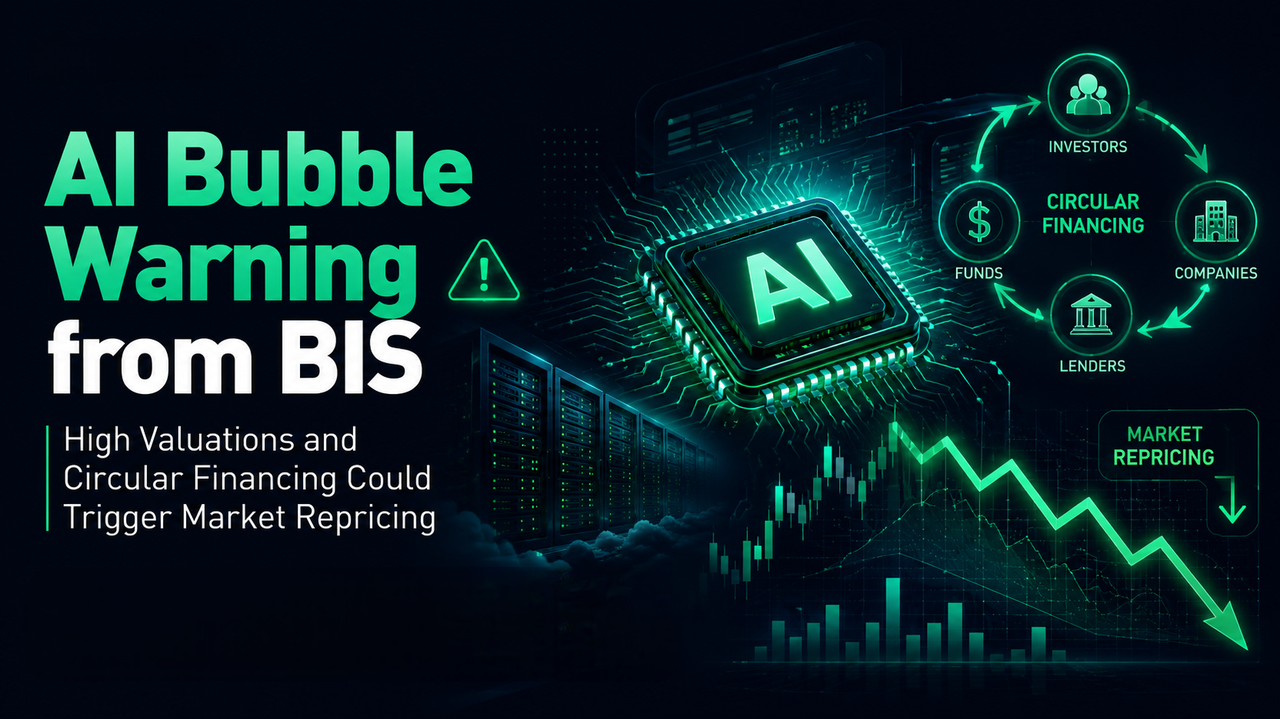
Artificial intelligence remains one of the biggest investment themes of 2026, but the rapid growth in AI valuations, infrastructure spending and debt-financed expansion is attracting greater scrutiny from the Bank for International Settlements (BIS). The concern is not that AI will fail, but that market expectations for revenue, productivity and investment returns may be running ahead of what companies can ultimately deliver. With AI-linked firms holding significant weight in global equity markets and data-center investment increasingly connecting technology companies with banks, private credit and infrastructure providers, weaker AI profitability could affect stocks, credit conditions and broader crypto market conditions. Understanding the BIS AI bubble warning therefore requires looking beyond valuations to the financial networks supporting the current AI investment boom.
Why the BIS Is Warning About an AI Bubble as Valuations and Spending Surge
The Bank for International Settlements (BIS) is drawing attention to growing financial risks around the AI investment boom, as technology companies commit unprecedented amounts of capital to artificial intelligence infrastructure while valuations across parts of the technology sector remain historically elevated. The concern is not that AI lacks long-term economic value or that today's investment cycle will necessarily end in a crash. Instead, the BIS is focused on whether spending, market expectations and valuations are advancing faster than the revenues and productivity improvements needed to justify them. Transformative technologies can create enormous economic value while still experiencing periods of excessive investment, unrealistic expectations and sharp market repricing.
-
Record AI Spending Is Raising the Bar for Future Returns
The scale of current AI investment is one of the main reasons the BIS sees increased vulnerability. According to its 2026 analysis, the five largest US hyperscalers are expected to spend more than $1 trillion on AI-related capital expenditure across 2025 and 2026, while separate BIS research estimates that major hyperscaler capex could exceed $700 billion in 2026 alone. Much of that money is flowing into advanced semiconductors, data centres, cloud infrastructure, networking equipment and electricity capacity required to train and operate increasingly sophisticated AI models. These projects may eventually support substantial revenue growth, but their size means companies will need to generate equally significant economic returns over time to preserve attractive returns on invested capital.
The challenge is that infrastructure is being built before the eventual size, structure and profitability of AI demand are fully known. Large technology companies also face strategic pressure to keep investing because slowing expansion could allow rivals to secure scarce chips, cloud customers, technical talent or data-center capacity. That competitive dynamic can make continued spending rational for an individual company even when the industry as a whole risks creating excess capacity. The key question is therefore whether AI monetisation and enterprise adoption can grow quickly enough to support the pace of capital deployment.
Several additional factors could influence whether today's infrastructure commitments ultimately generate sufficient returns:
-
Rapid hardware innovation may shorten the economic life of expensive processors and computing systems.
-
Energy availability and grid connections could delay the deployment of new data centers even after capital has been committed.
-
Falling prices for AI computing services may help customers while putting pressure on infrastructure-provider margins.
-
Some AI applications may improve productivity without generating enough incremental revenue to justify aggressive infrastructure expansion.
-
High AI Stock Valuations Increase Sensitivity to Earnings Disappointment
The BIS is also concerned about the relationship between AI stock valuations and future earnings expectations. Companies positioned at the centre of the AI ecosystem, including semiconductor producers, cloud providers and major technology platforms, have attracted substantial investor interest as markets attempt to price the long-term economic potential of artificial intelligence. Strong earnings and expanding AI demand can support premium valuations, but high multiples also mean investors are paying today for profits expected many years into the future. When those expectations become particularly optimistic, share prices can react sharply to relatively small changes in revenue growth, margins, capital expenditure or management guidance.
This creates an important distinction between business performance and market performance. A technology company can continue increasing revenue and profits while its shares decline if the results do not meet expectations already embedded in its valuation. The BIS warning therefore does not depend on widespread corporate failure. Slower AI adoption, weaker pricing power, persistently high infrastructure costs or disappointing returns from new projects could be enough for investors to reduce long-term earnings assumptions. Because large technology companies account for a significant share of major indexes, such revisions could also have broader effects on equity-market performance.
For investors assessing whether valuations remain sustainable, several indicators may provide additional context:
-
The relationship between earnings growth and valuation multiples, particularly when stock prices rise much faster than profits.
-
Changes in corporate guidance for AI revenue, cloud demand and capital spending.
-
Profit-margin trends as competition increases across AI products and services.
-
Market concentration, which can amplify the effect of weakness among a relatively small group of large AI-linked companies.
-
AI Productivity Gains May Take Longer to Justify Today's Expectations
Another central issue is the gap between visible improvements from individual AI applications and the broader economy-wide productivity gains required to support ambitious investment assumptions. Generative AI is already helping companies automate parts of software development, customer service, research, marketing and administrative work, but converting those task-level improvements into sustained profitability is more difficult. Businesses often need to redesign workflows, integrate new systems, retrain employees and determine which applications genuinely reduce costs or produce additional revenue. That process can take years, meaning the economic benefits of a major technology may emerge more slowly than financial markets initially anticipate.
Historical technology cycles provide a useful comparison. Railways, electrification and the internet ultimately transformed economies, yet each was associated with periods when investment expanded faster than commercially viable demand. The BIS sees a similar possibility with AI: the technology could prove highly valuable over the long term while some infrastructure projects or investors still experience disappointing returns. For investors, the critical issue is therefore not whether artificial intelligence will remain important, but whether current AI valuations and spending assumptions already reflect an unusually optimistic path for future growth.
How Circular Financing, Debt and AI Data Center Commitments Could Amplify Market Risk
Beyond valuations and capital spending, a more complex risk comes from how the AI infrastructure boom is being financed. The BIS has highlighted a growing web of equity investments, long-term purchase agreements, data-center leases, private credit and special-purpose financing structures connecting chipmakers, hyperscalers, AI laboratories and infrastructure providers. These arrangements can make large projects easier to fund, but they can also create financial dependencies between companies that might otherwise appear separate. If expected cash flows weaken, losses could therefore spread through several parts of the AI financing ecosystem rather than remaining confined to one business.
How Circular Financing Creates Interdependence Across the AI Supply Chain
AI circular financing broadly describes arrangements in which companies funding the AI ecosystem are also customers, suppliers or investors in one another. A semiconductor company or hyperscaler may invest capital in an AI developer or cloud-infrastructure provider, while that recipient simultaneously signs multi-year agreements to purchase chips, computing capacity or related services. BIS research has mapped financing relationships involving roughly $46 billion of equity investment alongside about $879 billion in multi-year purchase commitments, illustrating how relatively modest upfront investments can be associated with much larger future commercial obligations. These arrangements can accelerate growth when demand remains strong, but they can also complicate assessments of how much revenue is generated by independent end-user demand versus business relationships embedded within the same financing network.
AI Data Center Lease Commitments Are Creating Long-Term Financial Obligations
Another important development is the rapid growth of AI data center lease commitments. Reuters reported in August 2026 that Microsoft, Meta, Oracle, Amazon and Alphabet collectively had about $1.09 trillion in uncommenced lease payments, much of it associated with future data-center capacity, compared with around $285 billion of already recognised lease liabilities. These figures should not be treated as $1.09 trillion of conventional debt because many represent undiscounted future payments for leases that have not yet begun and may not yet qualify for recognition as accounting liabilities. Even so, the scale of these commitments matters economically because companies can lock themselves into years of infrastructure payments before facilities become operational, potentially reducing flexibility if future demand or pricing changes.
Private Credit and Special-Purpose Vehicles Are Moving Risk Beyond Big Tech Balance Sheets
AI infrastructure financing is increasingly extending beyond traditional corporate bond markets. Data centers can be funded through special-purpose vehicles, private-credit funds, infrastructure investors, banks and insurers, with the completed facilities subsequently leased to technology companies under long-duration agreements. The BIS has described some of these structures as forms of shadow borrowing because economically significant obligations can sit outside a hyperscaler's reported debt even when that company remains responsible for contractual payments. Private-credit exposure is becoming particularly relevant as direct lenders increase their exposure to AI and information-technology companies, expanding the number of financial institutions potentially affected if infrastructure values, refinancing conditions or borrower cash flows deteriorate.
Why an AI Financing Shock Could Spread Into Corporate Credit Markets
The broader risk is not simply whether one AI developer struggles or one data center proves uneconomic, but how interconnected obligations could behave during a downturn. If a major AI company reduces expansion, a cloud provider may lose expected demand; weaker demand could pressure data-center operators; lower asset values could affect lenders; and tighter financing conditions could make new infrastructure projects more expensive to fund. At the same time, falling technology equity prices could lead investors and lenders to reassess credit risk more broadly. This is why the BIS has raised concerns that an AI market repricing could spill into corporate credit and private lending markets, particularly if multiple financing channels weaken at the same time.
What an AI Market Repricing Could Mean for Stocks, Credit and Global Markets
An AI market repricing would matter far beyond a decline in a handful of technology stocks. Because AI-linked companies occupy an unusually large position in major equity benchmarks and global portfolios, a meaningful change in investor expectations could affect household wealth, institutional portfolios, corporate borrowing conditions and risk appetite across international markets.
The first effects would probably appear in equity valuations as investors reassessed how much future AI growth should be reflected in today's prices, but the economic impact could become broader if the correction were large enough. The BIS has highlighted the concentration of global markets in US equities, which account for roughly 64% of the MSCI global equity index, while the European Central Bank has estimated that euro-area households have around €440 billion of exposure to US technology equities, much of it indirectly through investment funds and ETFs. This means an AI-led correction could transmit internationally even where investors do not directly own individual AI stocks. Falling portfolio values could weaken risk appetite and household wealth effects, while greater uncertainty could push investors toward safer assets and make companies more cautious about investment. For crypto investors, the transmission channel is also relevant because Bitcoin price and market activity can become sensitive to changes in global liquidity and risk sentiment during periods of broad market stress, although its reaction would depend on the cause, severity and duration of any repricing.
Key market effects investors could watch include:
-
Technology and growth stocks: Companies priced on aggressive long-term growth assumptions could experience larger valuation adjustments if earnings forecasts are revised lower.
-
Major stock indexes: Heavy exposure to large technology companies means weakness in a relatively small group of firms could have an outsized impact on benchmark performance.
-
Corporate bonds: A sustained risk-off move could widen credit spreads and increase borrowing costs, particularly for highly leveraged or capital-intensive businesses.
-
Global investment portfolios: International funds, pensions and households with significant US technology exposure could experience losses without directly owning individual AI companies.
-
Safe-haven demand: Severe market uncertainty could increase demand for cash, high-quality government bonds or other defensive assets.
-
Crypto markets: Bitcoin and altcoins could face higher volatility if an AI-led equity correction develops into a broader liquidity shock, although crypto performance would not necessarily mirror technology stocks throughout the cycle.
The key question is therefore not simply whether AI stocks could fall, but whether a valuation adjustment would remain concentrated in technology equities or develop into a broader tightening of global financial conditions. A moderate correction could remove some speculative excess without significantly disrupting economic activity, while a deeper repricing accompanied by deteriorating credit conditions could have wider consequences for stocks, bonds, private markets and crypto.
Conclusion
The BIS AI bubble warning highlights the financial risks surrounding the current artificial intelligence investment boom, particularly high valuations, rising data-center commitments, debt exposure and increasingly complex financing structures. While an AI market correction is not inevitable, weaker-than-expected monetisation or slower productivity gains could pressure technology stocks and broader risk assets. For investors, the key issue is whether future cash flows and returns can justify today’s level of spending, while shifts in crypto market sentiment may also help show how wider market stress is affecting digital assets.
FAQs
What does the BIS mean by an AI bubble?
An AI bubble would describe a situation in which valuations, investment commitments or financing grow faster than the profits and economic benefits ultimately generated by artificial intelligence. The BIS is not saying AI has no value. Its concern is that investors and companies could correctly identify AI as transformative while still paying too much for assets or building more capacity than near-term demand can support.
How is an AI market repricing different from an AI bubble bursting?
A market repricing simply means investors change the value they assign to future earnings and risks. It does not necessarily involve a crash. AI stocks could reprice through slower share-price growth, declining valuation multiples or a moderate correction even while company revenues continue increasing. A bubble bursting generally describes a much faster and more disruptive decline.
Why are AI data centers important to financial markets?
Modern AI requires enormous computing, electricity, cooling and networking capacity, making data centers a major part of the investment cycle. Their importance extends beyond technology because projects can involve utilities, real estate developers, banks, infrastructure funds and private lenders. Changes in AI data center demand could therefore affect several industries rather than technology companies alone.
What indicators could show that AI investment is becoming more sustainable?
Investors can compare growth in AI-related revenue with capital expenditure, monitor data-center utilisation, track enterprise adoption and examine whether AI products are improving margins rather than simply increasing costs. Rising free cash flow from AI businesses, stronger returns on invested capital and broader profitable adoption would provide evidence that spending is being supported by economic demand. During periods of wider market uncertainty, disciplined crypto risk management can also become more relevant for investors exposed to volatile digital assets.
What could weaken the AI bubble argument?
The risk case would become less convincing if AI monetisation grows fast enough to justify current investment, businesses demonstrate durable productivity improvements, data-center capacity remains heavily utilised and technology companies generate rising cash returns from infrastructure spending. Stronger-than-expected earnings could allow valuations to normalise through profit growth rather than falling prices, which is why an AI market correction should be treated as a risk scenario rather than an inevitable outcome.
KuCoin Offers A More Stable Option in A Volatile Market
If you worry about the frequent ups and downs in the market, and pursue a more stable option to earn money passively, KuCoin is the right place to come:
Simple Earn: Deposit and withdraw tokens anytime, earning stable returns.
Kucoin Earn: Earn stable profits with professional asset management.
Hold to Earn: Earn rewards by holding assets in Funding, Trading, Margin, Futures, Mining, and Unified Accounts.
Staking: Unlock the earning potential of on-chain assets.
Advanced Investments: Advanced Investments offer a variety of structured products to help your money grow in any market.
Shark Fin: Principal Protection and Guaranteed Gains
Dual Investment: Buy low and sell high with transparent return calculations.
Snowball: High yields, with price protection.
Discount Buy: Buy crypto at discount prices.
KCS Loyalty: Level up to enjoy exclusive perks by staking ≥ 1 KCS.
KuCoin Wealth: Discover future value and begin your smart investing journey.
KCS Benefits: Hold and stake KCS to access benefits across the platform.
KCS Staking 2.0: Participate in KCS on-chain governance to earn yield.

Disclaimer
The information provided on this page may originate from third-party sources and does not necessarily represent the views or opinions of KuCoin. This content is intended solely for general informational purposes and should not be considered financial, investment, or professional advice. KuCoin does not guarantee the accuracy, completeness, or reliability of the information, and is not responsible for any errors, omissions, or outcomes resulting from its use. Investing in digital assets carries inherent risks. Please carefully evaluate your risk tolerance and financial situation before making any investment decisions. For further details, please consult KuCoin’s Terms of Use and Risk Disclosure.