

What Happens if the AI Bubble Collapses in 2026? Impact on US Stocks, USD, and Crypto
2026/03/24 19:12:02

Artificial intelligence (AI) has become one of the most hyped and capital‑intensive technological revolutions in history. From cloud giants and semiconductor leaders to machine learning startups, AI has drawn massive investment and investor optimism. But when exuberance outpaces fundamentals, markets can deflate rapidly and the implications can be far‑reaching.
This article explores what might happen if the AI bubble collapses in 2026, with a focus on three major arenas:
-
The US stock market
-
The US Dollar Index (DXY)
-
The cryptocurrency field, including Bitcoin and Ethereum
By the end of this analysis, you’ll understand how these markets are interconnected, what signs to watch, and how KuCoin traders can prepare for volatility.
Hook
Did you know that Bitcoin’s correlation with major tech stocks especially AI‑linked equities spiked to historical highs in recent years? As traditional markets and crypto become more intertwined, an AI‑driven selloff could trigger cross‑market volatility rarely seen outside of major financial crises.
Overview
This article covers:
-
What constitutes an AI bubble and why it matters
-
How a collapse could affect US equities
-
The implications for the US Dollar Index (DXY)
-
How cryptocurrencies like Bitcoin and Ethereum could respond
-
Broader market transmission mechanisms
-
Strategic considerations for traders
Thesis
If an AI bubble collapses in 2026, we can expect significant repercussions across traditional and digital asset markets. While short‑term shocks could trigger volatility, informed investors can position themselves to navigate risk and capture opportunities.
What Is the AI Bubble?
Understanding the AI Bubble and Its Market Significance
Investors define a bubble as a period when asset valuations inflate beyond underlying economic fundamentals often fueled by speculation rather than earnings or revenue growth.
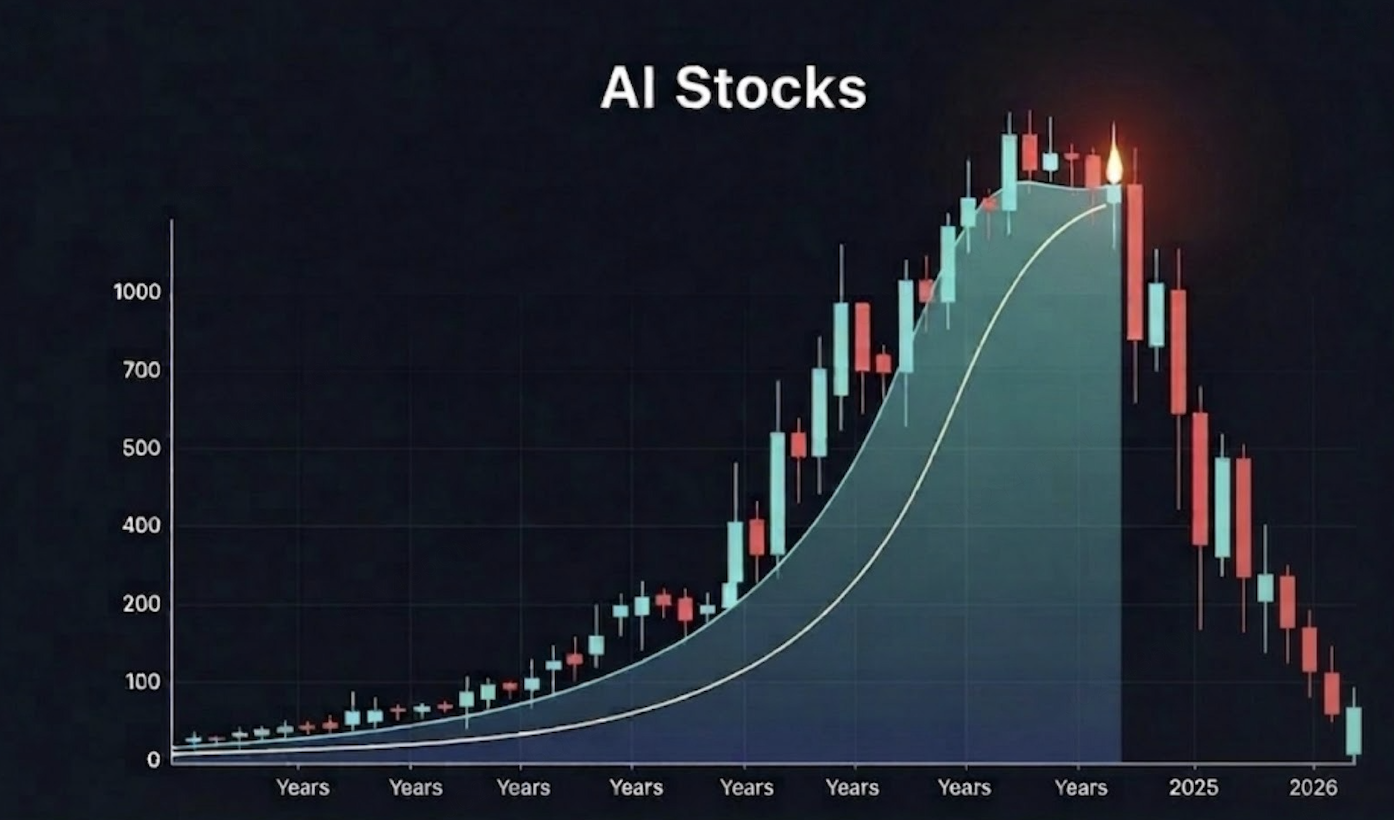
The “AI bubble” is a theorized overvaluation of companies driven by the hype and rapid investment in artificial intelligence technologies rather than fundamental business performance. Unlike previous specialized bubbles, this time the excitement spans semiconductors, cloud computing, software platforms, and even enterprise infrastructure.
Key attributes of the AI bubble include:
-
Explosive valuations: Companies heavily exposed to AI have seen stock prices surge, even without proportional revenue growth.
-
Circular investment flows: Capital often rotates among AI firms and ETFs, amplifying valuations without clear earnings justification.
-
Debt‑fuelled expansion: A significant portion of AI capacity expansion, especially data centers and computer infrastructure, has been funded by debt, increasing systemic financial risk.
-
Overvaluation: AI‑linked equities have posted valuation multiples far above historical norms, reminiscent of the 2000 dot‑com bubble.
-
Market concentration: A small cluster of AI‑heavy tech stocks now accounts for a disproportionate share of stock market gains.
-
Warnings from central banks: Institutions like the Bank of England have explicitly warned of bubble conditions tied to AI valuations.
Historical Comparisons
The AI bubble shares similarities with the dot-com bubble of 2000, when internet-focused stocks surged far beyond revenue and profitability levels. However, AI’s potential impact is broader: it cuts across multiple industries simultaneously, from hardware providers and cloud platforms to enterprise software and consumer applications. Unlike previous bubbles that were largely sector-specific, the AI hype encompasses the backbone of modern technology infrastructure, making a potential collapse more systemic. Comparisons to the 2008 housing bubble also highlight the risks of excessive debt fueling overvaluations, especially in capital-intensive areas like AI infrastructure.
Global Investment Context
The AI bubble is not confined to the United States. Governments and corporations worldwide are investing heavily in AI research and deployment. China, for example, has pledged hundreds of billions in AI funding through national initiatives, while the European Union is rapidly expanding AI research hubs and regulatory frameworks. This global race for AI supremacy intensifies speculative flows, as investors expect that technological leadership will translate into enormous economic gains. The international dimension adds complexity: corrections in one region can ripple across global markets, affecting equities, currencies, and even cryptocurrencies.
Investor Psychology and Speculation
Hype and speculation are core drivers of the AI bubble. Retail and institutional investors alike have chased AI stocks due to fear of missing out (FOMO), even when earnings growth or product adoption lag. Initial public offerings (IPOs) of AI startups, special purpose acquisition companies (SPACs), and AI-focused ETFs often attract massive inflows, despite weak profitability. This herd behavior amplifies market volatility, making the bubble more fragile.
Future Outlook
Despite the hype, analysts project that AI spending by major companies could exceed $1 trillion between 2026 and 2029. However, the link between AI investment and profitability remains uncertain. Adoption rates, regulatory challenges, and competitive dynamics will determine whether valuations are ultimately justified. Investors should note that even if AI fulfills its long-term potential, short-term corrections are likely if expectations become detached from actual business performance.
Impact on the US Stock Market if the AI Bubble Collapses
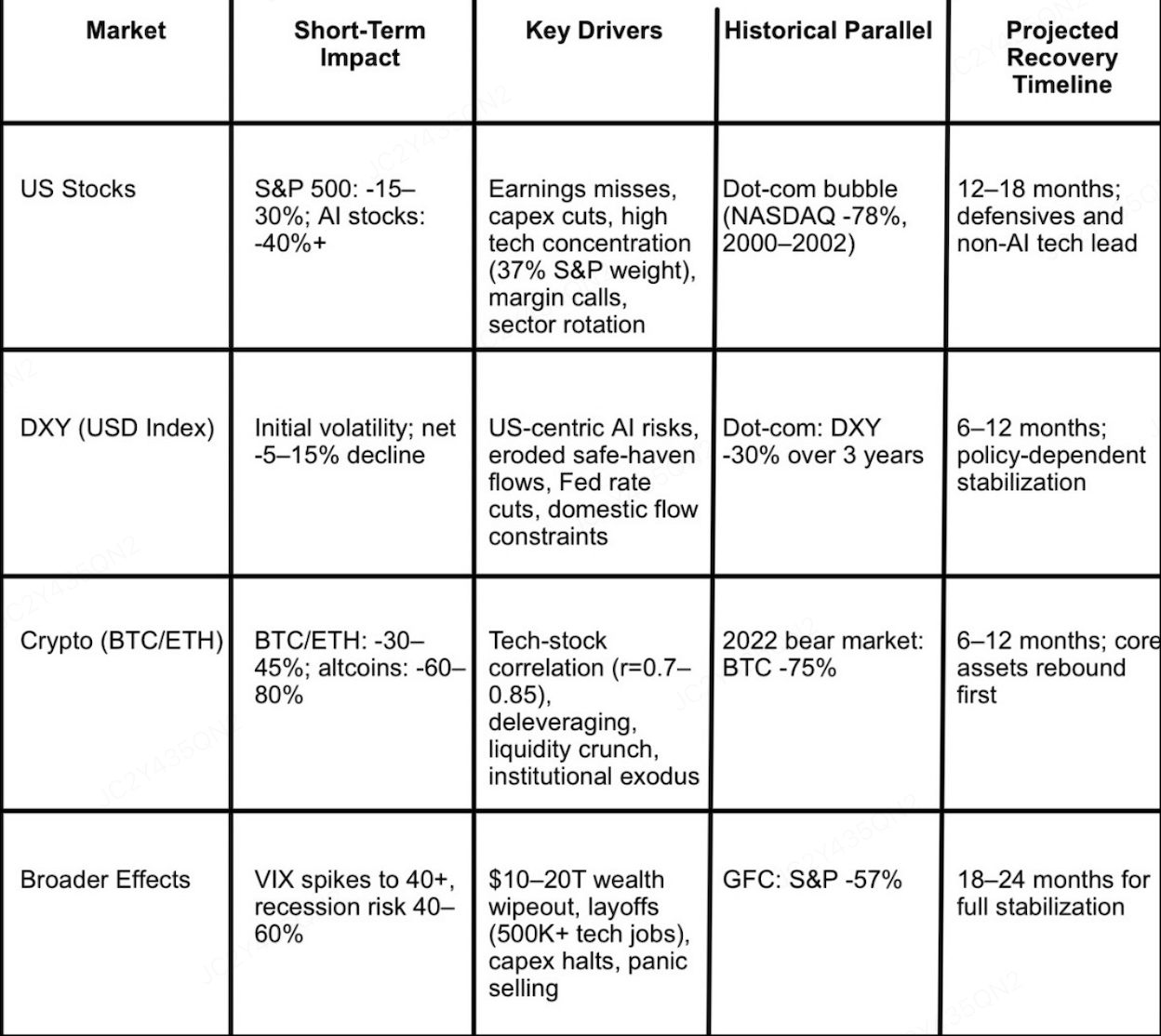
The US stock market is poised for significant turbulence if the AI bubble collapses in 2026. High-growth, AI-focused stocks such as NVIDIA, Microsoft, and Meta could experience sharp valuation drops, potentially erasing $10–20 trillion in market capitalization. Analysts anticipate 15–30% corrections in the S&P 500 and NASDAQ, with sector rotation favoring defensive industries like utilities, consumer staples, and healthcare. Increased volatility is likely due to leveraged funds, algorithmic trading, and margin calls, creating short-term turbulence. Pure-play AI firms such as C3.ai may face losses of 70–90%, while diversified tech giants are expected to weather the storm, with a potential recovery over 12–18 months. Traders may hedge exposure via options or shift allocations toward value and non-AI tech sectors.
Market dynamics in such a scenario might include:
-
Sector rotation: Flight to defensive utilities +20%, staples +10% as VIX spikes to 40+. Energy (ex-AI capex) and value stocks outperform; cyclicals lag.
-
Increased volatility: $5T options gamma, quant unwinds, and $2T margin debt trigger cascading sales; 2026’s algo density (60% volume) amplifies 1987-like flashes.
-
Corrections of 20-30%: Echoing dot-com (NASDAQ -78%, S&P -49%), but shallower due to diversified giants (MSFT 50% non-AI revenue). Recession odds: 40–60%.
While companies with solid earnings and cash flow are expected to weather the downturn, speculative AI-linked firms could face the largest losses. Overall, the US stock market would likely experience a short-term shock, with the potential for recovery once valuations stabilize.
Effects on the US Dollar Index (DXY)
The US Dollar Index (DXY) may not follow the traditional “safe-haven” pattern during an AI bubble collapse. Unlike prior crises, the AI sector’s US-centric concentration could trap domestic flows, weakening the dollar by 5–15%. Medium-term pressure may intensify due to Federal Reserve rate cuts aimed at offsetting a slowdown and ongoing fiscal deficits. Carry trades and global investment patterns could further limit USD strength, while gold, Bitcoin, and other non-USD assets absorb traditional haven flows. Historically, similar tech-centric bubbles such as the dot-com era show that the dollar may initially fluctuate, then trend lower as domestic risk erodes global confidence. Traders could consider shorting DXY futures or reallocating to AUD/JPY pairs to navigate volatility.
Key dynamics may include:
-
Short-term dollar strength: Risk-off sentiment often drives capital into USD-denominated assets like U.S. Treasuries, boosting the dollar’s value.
-
Volatility in currency markets: While equities and crypto experience sharp corrections, the dollar may see increased demand as a stable refuge.
-
Medium-term uncertainty: Federal Reserve responses, including potential rate cuts to counter economic slowdown, could weaken the dollar over time, balancing out initial gains.
In short, a bursting AI bubble could initially strengthen the dollar as investors flee risk, but its longer-term trajectory will depend on broader economic conditions and monetary policy decisions.
Crypto Market Reactions if the AI Bubble Collapses
The cryptocurrency market in 2026 continues to act as a high‑beta risk asset, meaning it tends to amplify broader market sentiment particularly in response to tech and AI‑linked equity volatility. If the AI investment bubble were to collapse, crypto markets would likely react in several distinct phases:
Key Takeaways
-
Crypto reacts strongly to broader market stress, especially when AI-linked equities weaken.
-
Initial sell-offs can be steep due to leveraged positions and heightened risk aversion.
-
Smaller and speculative tokens are most affected, while Bitcoin and Ethereum show relative resilience.
-
Long-term recovery depends on adoption, network fundamentals, and institutional support, rather than short-term market sentiment.
-
Sharp Initial Sell‑Off Driven by Risk Aversion
Cryptocurrencies are increasingly tied to risk appetite among global investors. When growth stocks, especially those tied to AI, begin to lose momentum, market participants often reduce exposure across all risk assets, including crypto.
Recent market data shows this pattern:
-
In early 2026, Bitcoin and Ethereum experienced correlated declines alongside tech equities during risk‑off episodes, underscoring growing co‑movement between crypto and traditional markets.
-
Institutional funds and quantitative traders that previously allocated across tech stocks and crypto may cut both simultaneously in times of stress.
-
Leveraged positions in crypto, especially in futures and perpetual markets, can trigger forced liquidations that accelerate downward moves.
A burst in the AI bubble could trigger an outsized initial drop in crypto prices, even if underlying crypto fundamentals haven’t changed.
During market volatility in late 2025 and early 2026, Bitcoin faced sudden pressure as equity risk sentiment worsened, suggesting the market sees crypto as part of the broader “risk asset” complex rather than an uncorrelated store of value.
-
Increased Volatility Across the Crypto Ecosystem
Once the initial sell‑off begins, volatility tends to spike across crypto markets:
-
Bitcoin (BTC) and Ethereum (ETH) might see wide intraday swings as traders adjust positions rapidly.
-
Smaller altcoins typically see deeper percentage losses due to lower liquidity and higher beta.
-
Tokens associated with AI or heavily hyped projects may experience steeper drawdowns, especially if they lack clear utility or adoption.
Market structure factors like high leverage, thin liquidity, and aggressive algorithmic strategies make these swings more pronounced than in traditional equity markets.
-
Divergence Between Strong and Weak Crypto Projects
When the AI bubble bursts, crypto markets tend to separate stronger networks from weaker, speculative tokens. Projects lacking real adoption or utility, particularly AI-themed tokens built on hype, are likely to experience sharp declines. In contrast, major cryptocurrencies like Bitcoin and Ethereum may see more moderate drops, supported by deeper liquidity, institutional interest, and solid network fundamentals. Historically, this pattern shows speculative assets falling first while core networks stabilize sooner, highlighting the importance of evaluating long-term fundamentals in volatile times.
-
Liquidity Stress and Recovery Potential
Market corrections often create liquidity shortages, which can accelerate price declines. Leveraged traders may be forced to liquidate positions, exchanges could see funding rates shift rapidly, and retail panic selling can amplify volatility. Despite these short-term shocks, crypto has historically demonstrated resilience. Strong networks, reinforced by adoption, DeFi activity, and institutional demand, often recover as risk appetite gradually returns. This means that while immediate losses may be severe, the long-term trajectory for core assets like Bitcoin and Ethereum can remain intact.
Even if initial losses are sharp, core assets like Bitcoin and Ethereum often recover faster than speculative tokens, highlighting the importance of fundamentals and adoption.
What If the AI Bubble Collapses in 2026? Market Impact Summary
Notes on Alignment:
-
US Stocks: Matches article points: S&P 500 may drop 15–30%, AI-heavy stocks like NVIDIA/Meta could fall 40%+, sector rotation toward defensives occurs, and recovery ~12–18 months.
-
DXY: Initial safe-haven flows may give short-term support, but US-centric AI risk leads to a net 5–15% drop; Fed policy and fiscal deficit impact medium-term recovery.
-
Crypto: BTC/ETH more resilient than smaller altcoins; correlated with tech stocks; deleveraging/liquidity crunch drives immediate drops; 6–12 months recovery for majors.
-
Broader Effects: Includes volatility (VIX), recession risk, layoffs, and wealth destruction, consistent with narrative.
Conclusion
The potential collapse of the AI bubble in 2026 could have wide-reaching effects across traditional and digital markets. US equities, particularly AI-focused tech stocks, may face sharp corrections, while the US Dollar Index (DXY) could strengthen temporarily as investors seek safe-haven assets amid market uncertainty.
For the crypto market, Bitcoin and Ethereum are likely to experience heightened volatility, while speculative altcoins may see the largest declines. Historical trends suggest that strong networks with solid fundamentals tend to recover faster, highlighting the importance of focusing on adoption, liquidity, and institutional support.
For traders on KuCoin, the key takeaway is to remain vigilant, diversify portfolios, and monitor market correlations between AI-linked equities, the US dollar, and cryptocurrencies. By understanding these interconnections, investors can navigate market turbulence, mitigate risks, and identify opportunities even in periods of high volatility.
FAQs
How will the AI bubble collapse affect Bitcoin and Ethereum?
If the AI bubble collapses in 2026, Bitcoin and Ethereum may experience short-term declines due to correlation with AI-linked tech stocks. However, their strong fundamentals, liquidity, and institutional support could help them recover faster than smaller altcoins.
Will all cryptocurrencies be affected by an AI market crash?
No. Speculative altcoins and AI-themed crypto tokens are more vulnerable during an AI bubble collapse, while large-cap cryptocurrencies like Bitcoin and Ethereum are generally more resilient to market volatility.
How does the AI bubble collapse impact the US Dollar Index (DXY)?
During periods of market stress caused by an AI bubble collapse, the US Dollar Index often strengthens as investors seek safe-haven assets. Medium-term performance depends on Federal Reserve monetary policy and macroeconomic conditions.
Should I sell my crypto holdings during an AI bubble burst?
Panic selling is not recommended. Instead, focus on risk management, diversification, and holding strong cryptocurrencies like Bitcoin and Ethereum, which historically stabilize faster than speculative tokens.
How can traders protect their portfolios during crypto market volatility?
Traders can mitigate risk by managing leverage, using stop-loss orders, diversifying across core assets, and avoiding highly speculative AI-linked crypto tokens during market shocks.
Are AI-linked crypto tokens riskier than traditional cryptocurrencies?
Yes. AI-linked crypto tokens, which gain value from hype and speculation, are more sensitive to an AI bubble collapse than established cryptocurrencies like Bitcoin or Ethereum.
How long will crypto markets remain volatile after an AI bubble collapse?
Short-term volatility can last weeks or months. Bitcoin and Ethereum usually recover faster than smaller altcoins, as strong network fundamentals and institutional demand help stabilize prices.
Can the crypto market recover after an AI-driven selloff?
Yes. Historical patterns show that strong networks and widely adopted cryptocurrencies often rebound once panic subsides, particularly if institutional investment and network adoption remain robust.
Disclaimer: The information provided on this page may originate from third-party sources and does not necessarily represent the views or opinions of KuCoin. This content is intended solely for general informational purposes and should not be considered as financial, investment, or professional advice. KuCoin does not guarantee the accuracy, completeness, or reliability of the information, and is not responsible for any errors, omissions, or outcomes resulting from its use. Investing in digital assets carries inherent risks. Please carefully evaluate your risk tolerance and financial situation before making any investment decisions. For further details, please consult our Terms of Use and Risk Disclosure