

'AI trade never died': Traders see room for market recovery, but bitcoin's participation is another story
The AI trade rebounded after Jensen Huang's return, but Bitcoin slipped below $60,000. ETF outflows and inflation explain the November 2026 divide.
The AI trade recovery gained momentum on November 23, 2026, when Nvidia reinstated Jensen Huang as CEO and technology shares rallied. Bitcoin initially followed the move but could not sustain its gains, falling below $60,000 the next day. The split exposed two different market stories: AI companies continued reporting substantial demand for computing infrastructure, while cryptocurrency funds faced persistent withdrawals and weak spot buying. By November 25, Nvidia had surrendered part of its rebound, and fresh U.S. inflation figures added pressure to interest-rate expectations. A durable recovery now depends on stronger demand, sounder financing conditions, and more than a brief improvement in sentiment.
Key Takeaways
-
Nvidia shares jumped 31.48% on November 23 after Jensen Huang's reinstatement, although the stock gave back some gains over the next two sessions.
-
Bitcoin fell below $60,000 after briefly approaching $64,500, revealing weaker follow-through than the initial technology-stock rebound suggested.
-
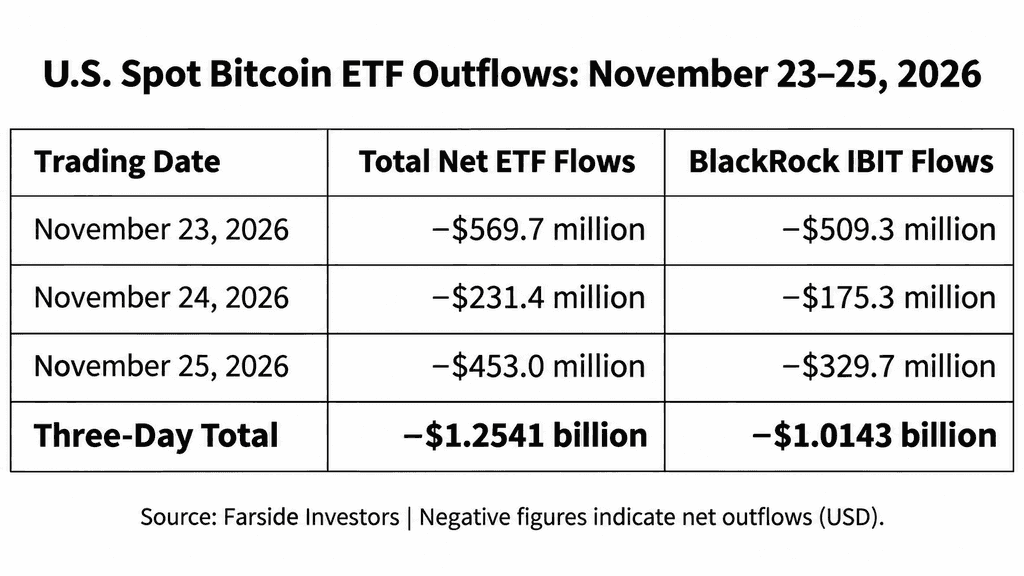
U.S. spot Bitcoin ETFs lost $1.25 billion in net flows over November 23–25, with BlackRock's IBIT accounting for most withdrawals.
-
Core U.S. PCE inflation rose to 3.3% year over year in October, reinforcing concerns about future borrowing costs.
-
AI revenue growth remains strong, but infrastructure financing, valuations, and the timing of customer returns create separate risks for technology companies.
-
Sustained spot demand and cash-flow performance will matter more to the recovery outlook than one-day market rallies.
Why Did AI Stocks Rebound After Jensen Huang's Return to Nvidia?
AI stocks rebounded on November 23, 2026, after Nvidia reinstated Jensen Huang as president and CEO, easing a leadership concern that had unsettled technology shares. Nvidia advanced 31.48% to $165.05 at the close, while the Nasdaq Composite gained approximately 6.5% and the S&P 500 rose 4.7%. The move demonstrated Nvidia's influence on wider market sentiment.
Huang's return mattered because Nvidia supplies critical AI infrastructure. Its processors and computing systems underpin many large development plans, making leadership continuity relevant to product delivery and customer relationships. Nvidia's board said its independent investigation would continue, so the announcement settled the immediate leadership question without resolving every concern surrounding the company.
The timing of the response showed how rapidly expectations shifted. Talos recorded a sharp move in Nvidia-linked perpetual derivatives around 8:55 a.m. Eastern on November 23, before the U.S. stock market opened. Those instruments reacted to the leadership news while regular shares were not yet trading. By the opening bell, part of the initial adjustment in sentiment had already appeared in related markets, helping explain the unusually forceful start to the session.
The rebound also reflected the scale of the previous sell-off. Nvidia had closed at $125.53 on November 20, down 14.01% that day. The leadership news attracted buyers after steep losses, but a large percentage gain from a depressed share price does not erase an earlier decline. The market was responding to both fresh information and recent positioning.
Strong AI Revenue Provided a Business Foundation
Nvidia's financial results provided evidence of commercial demand beyond the leadership news. For its fiscal third quarter of 2027, ended October 25, revenue reached $115.8 billion, up roughly 103% year over year. The Data Center division contributed $107.6 billion, about 93% of quarterly revenue. Those figures show the scale of spending on AI hardware, even as customers' eventual returns attract scrutiny.
Hardware sales and computing services have different economics. Chip suppliers can earn revenue as products ship, while data-center operators carry construction and financing costs before facilities generate income. Palo Alto Networks' proposed $4.5 billion all-stock acquisition of Applied Compute, announced November 18, also indicated corporate interest in AI capabilities. The deal remains subject to closing conditions and says little about the profitability of individual projects.
Different companies therefore face different financial tests. A chip supplier benefits from hardware orders; a cloud operator must keep its equipment occupied at prices covering capital and operating costs. Talos observed particularly sharp relief moves among debt-funded computing providers on November 23. Their financing exposure helps explain uneven investor confidence across the AI sector.
The rebound soon weakened. Nvidia fell 5.86% on November 24 and 3.91% on November 25, closing at $149.30. Although still above its November 20 close, the stock had given back part of the relief rally. Investors continued weighing valuations, financing costs, and future earnings against the positive leadership news.
Why Did Bitcoin Fall Below $60,000 Despite the AI Stock Rally?
Bitcoin briefly joined the November 23 rally, approaching $64,500 as sentiment improved. It then reversed and fell below $60,000 on November 24. The roughly $4,500 retreat from its intraday high stood out because technology shares initially retained more of their gains. Bitcoin's rise appeared tied to the wider market reaction rather than a lasting improvement in cryptocurrency demand.
Glassnode documented a short-lived response in its November 24 research. Bitcoin gained about 5% within half an hour of the news but surrendered the full move in less than six hours. Such speed suggests that the initial orders may have reflected hurried position adjustments rather than patient accumulation across several sessions.
Short Covering and Weak Spot Demand
Short covering can lift prices without signaling lasting conviction. Traders with bearish positions acquire Bitcoin to close them, sometimes producing a sudden rally. This buying can fade when positions are closed and does not necessarily represent new long-term investment. The swift reversal was consistent with that mechanism, although prices alone cannot reveal every participant's motive.
Talos measured persistent net selling during November 19–24. Across monitored venues, net taker flow was approximately negative $660 million in spot markets and negative $1.7 billion in perpetual futures. These figures compare aggressive buying and selling, rather than measuring money permanently leaving the market. They nevertheless indicate that sell orders continued to absorb bids.
Bitcoin's 30-day correlation with the Nasdaq-100 reached 0.77, according to Talos, indicating frequent movement in the same direction. Yet Bitcoin lost 25.3% over that period, compared with 9.8% for the index. Correlation measures how returns move together, not how large the losses are. Bitcoin remained far more volatile despite that close relationship.
Talos also put Bitcoin's market-value-to-realized-value ratio near 1.03. The measure compares market valuation with an estimated aggregate cost basis derived from on-chain transactions. A reading near one indicates that those values are close, but it does not establish a reliable price floor. Holders can continue selling even when average unrealized gains narrow.
Bitcoin ETF Outflows and Weak Institutional Demand in November 2026
U.S. spot Bitcoin exchange-traded funds showed sustained withdrawals during the late-November decline. Farside Investors recorded seven consecutive trading sessions of aggregate net outflows through November 25. Over November 23–25, the group lost $1.2541 billion. Those flows reveal weaker demand through a major institutional access route, although they do not measure every institution's Bitcoin activity.
U.S. Spot Bitcoin ETF Outflows: November 23–25, 2026

BlackRock's iShares Bitcoin Trust accounted for about 81% of the group's three-day net withdrawals. Large funds can dominate aggregate results even when smaller products attract money. Fidelity's FBTC, for example, received $13.3 million on November 23. The inflow was insufficient to offset broader redemptions, but it shows why describing every institution as a seller would be inaccurate.
Aggregate net outflows reached approximately $5.39 billion from November 2–25, according to Farside's daily figures. The period ends before the Thanksgiving market closure and is not a completed monthly total. Fund-flow figures may be updated, so comparisons should use matching reporting cut-offs.
An ETF provides Bitcoin exposure through conventional exchange-listed shares. The Bitcoin exchange-traded fund explanation describes this structure. Spot-fund creations and redemptions connect investor demand with the underlying asset, but intermediaries and settlement timing make reported daily flows different from immediate Bitcoin trading volume.
ETF outflows signal caution without explaining every price change. Redemptions can reflect portfolio rebalancing or a preference for cash, while buyers elsewhere may still support Bitcoin. Evidence of a broader recovery would include improving fund flows alongside steadier spot demand, rather than one isolated positive session.
How Inflation and Federal Reserve Rate Expectations Affect AI Stocks and Bitcoin
Inflation affects both markets through interest rates and liquidity. Higher borrowing costs can squeeze companies, while bond yields may attract capital away from riskier assets. AI shares and Bitcoin respond differently, however, and need not move together on each announcement. The relationship between cryptocurrency prices and the S&P 500 illustrates this changing connection.
October 2026 Inflation Data Raises Market Concerns
The U.S. Bureau of Economic Analysis reported stronger inflation on November 25. October headline Personal Consumption Expenditures inflation reached 3.8% year over year, up from 3.6% in September. Core PCE, excluding food and energy, rose to 3.3% from 3.1%. Both measures increased 0.3% month over month. These figures describe price changes, not total consumer spending.
Core PCE helps policymakers assess persistent inflation. The October reading exceeded the Federal Reserve's 2% objective and reinforced expectations of cautious monetary policy. Yet one report cannot settle the next decision: employment, consumer activity, and the delayed effects of earlier rate changes also matter.
Federal Reserve December 2026 Interest Rate Outlook
The Federal Reserve held its benchmark rate at 3.75%–4.00% during the October 27–28 meeting. Minutes released November 18 described concern about persistent inflation and debate over further tightening. The next policy meeting is scheduled for December 8–9, 2026. Market expectations ahead of that date are not official decisions.
Higher discount rates can reduce valuations for growth companies because future profits become less valuable in today's terms. This may pressure share prices despite rising revenue. The impact depends on profitability, debt levels, and how much expected growth is already reflected in the stock price.
Bitcoin faces a different calculation. It pays no contractual yield, so higher returns on relatively low-risk assets can influence investors' preferences. Tighter policy may also reduce speculative liquidity. Still, Bitcoin's global trading and distinct ownership patterns mean U.S. rates alone cannot explain its movements.
Rising Financing Costs Add Pressure to AI Infrastructure
AI infrastructure requires substantial upfront spending. Developers must secure processors, electricity, buildings, and cooling systems before facilities generate revenue. Borrowing and long-term leases can finance construction, but delays leave businesses paying interest and operating costs while expected customer income is postponed.
The Federal Reserve's October minutes identified AI financing risks. Staff pointed to expanding debt, lease obligations, and complex arrangements among related companies. Their concern was that disappointing AI investment returns could transmit financial stress through firms dependent on continued growth and successful project completion.
Strong chip sales do not guarantee strong returns for every customer. Confirmed hardware demand should be separated from the economics of operating large computing facilities. Interest rates influence both AI shares and Bitcoin, but their distinct sources of demand ultimately shape how each responds.
AI Stock and Bitcoin Recovery Outlook: Key Market Catalysts and Risks
The next stage of an AI stock recovery depends on execution. Companies must turn orders, computing contracts, and construction plans into sustainable earnings and cash flow. Revenue growth matters, but timely delivery, profitable capacity use, and balance-sheet strength will determine how businesses handle expansion.
Bitcoin's recovery depends on steadier market participation. Spot demand, available liquidity, and long-term holder behavior can show whether buyers are consistently absorbing supply. Together, these indicators help distinguish broader improvement from rallies driven mainly by leveraged positions or reactions to technology news.
AI Earnings and Data Center Expansion
Corporate earnings will reveal whether AI expansion produces returns. Relevant measures include operating margins, free cash flow, equipment utilization, contract delivery, and debt. Nvidia's next-generation computing systems may sustain hardware demand, but customers still need to earn enough from those systems to justify the spending.
Project delays pose particular risks for indebted computing providers. A facility awaiting electricity, equipment, or customers may miss expected revenue while financing expenses continue. Businesses with stronger cash generation can handle delays more easily than highly leveraged operators, producing uneven outcomes across the industry.
Bitcoin Liquidity and Near-Term Market Risks
Talos identified a $6.2 billion contraction in stablecoin supply during November 19–24. Stablecoins provide settlement liquidity across cryptocurrency markets, so shrinking supply may indicate fewer readily available funds. It is not a direct measure of withdrawals from Bitcoin: balances also change through redemptions, network transfers, and shifts in market activity.
Options positioning showed caution. Bitcoin's put-to-call open-interest ratio reached 0.82, its highest reading in more than a year, according to Talos. Greater demand for puts may reflect downside protection, although hedging strategies complicate the signal. The ratio alone cannot forecast prices.
Market depth will also influence the quality of any rebound. Bitcoin can rise quickly when order books are thin, but a larger sell order may then reverse the move. Deeper spot liquidity and narrower spreads would indicate a market better able to absorb transactions without large price changes. Those conditions offer a more meaningful test of resilience than a sharp move produced by a small number of trades. Holiday hours could amplify short-term volatility. U.S. stock exchanges are closed November 26 for Thanksgiving and close early November 27, while Bitcoin keeps trading. Reduced participation can magnify large orders. Whether demand holds when regular U.S. market hours resume will offer a better test than holiday price moves alone.
Conclusion
The late-November divide between AI shares and Bitcoin reflects different pressures beneath a shared market rebound. Jensen Huang's return helped restore confidence in Nvidia's leadership, and the company's revenue demonstrated continuing demand for advanced computing. Bitcoin, meanwhile, struggled with persistent fund withdrawals, weak spot buying, and a sharper response to changes in market sentiment. Inflation and borrowing costs complicate both outlooks, but they affect each industry in different ways. A lasting recovery would require more than a favorable announcement: technology companies must turn expansion into durable cash flow, while Bitcoin needs broader and steadier participation. Until those conditions improve, sudden rallies may remain vulnerable to reversals.
FAQs
1. What Is the AI Trade in Financial Markets?
The AI trade describes market exposure to businesses expected to benefit from artificial intelligence. It includes chip designers, cloud providers, data-center operators, and software firms. Their shares respond differently to revenue growth, valuations, and financing needs.
2. Why Do AI Chipmakers and Cloud Infrastructure Stocks Perform Differently?
Chipmakers earn revenue by supplying hardware, while cloud operators charge for computing capacity. Cloud companies also face construction, electricity, maintenance, and financing costs. Strong chip demand therefore does not guarantee higher cloud-service profit margins.
3. Can Bitcoin Prices Change When U.S. Stock Markets and Bitcoin ETFs Are Closed?
Yes. Bitcoin trades around the clock, including holidays. U.S.-listed spot ETFs follow stock-exchange schedules, however. Price changes while exchanges are closed may appear in ETF share prices when trading resumes.
4. Can Bitcoin Prices Rise Even When Spot Bitcoin ETFs Record Net Outflows?
Yes. ETF flows capture only part of Bitcoin demand. Buying elsewhere can outweigh redemptions from U.S.-listed funds. Net fund withdrawals also do not prove what caused a particular market-price movement.
5. What Does Bitcoin's Put-to-Call Options Ratio Reveal About Market Sentiment?
The put-to-call ratio compares outstanding put and call positions. Higher readings can suggest more interest in downside protection. Because options also support hedging strategies, the ratio should be assessed alongside liquidity and other market indicators.
6. How Can Investors Assess Whether AI Infrastructure Spending Is Generating Profits?
Useful measures include utilization, operating margins, free cash flow, and contract delivery. Comparing those results with equipment, electricity, and financing costs shows whether computing capacity is profitable. Revenue growth alone is insufficient.