

Aave to Launch Dedicated RWA Lending Market on Avalanche, With Tether USAT as Core Liquidity
Aave Targets Institutional RWA Lending With New Avalanche Credit Market
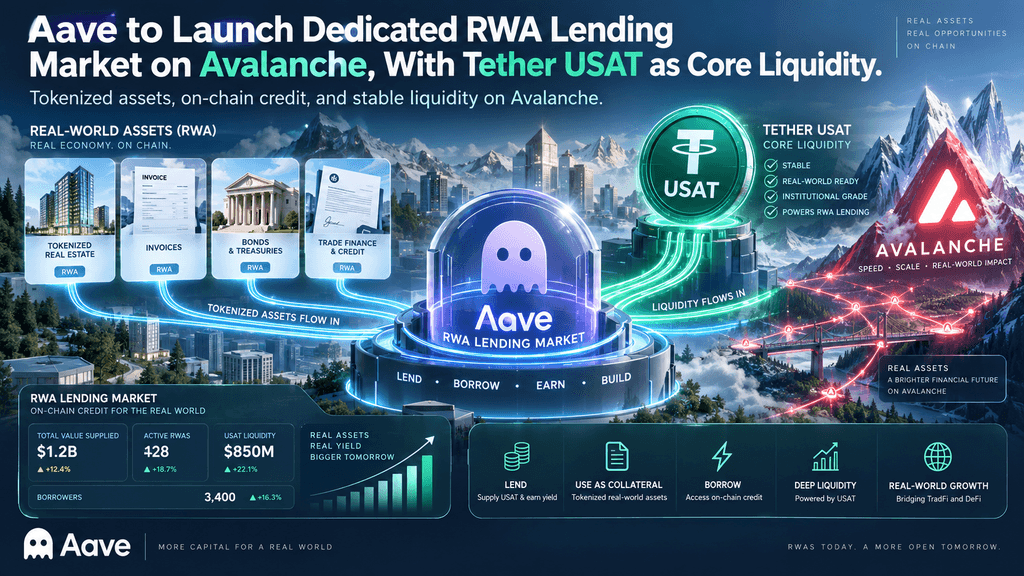
Aave Labs announced on September 16, 2026, plans for a specialized real-world asset credit market on Avalanche built on the existing Aave V4 deployment. The market, described as the first RWA Hub under V4’s hub-and-spoke design, will enable eligible institutions to post tokenized financial assets as collateral and borrow dollar liquidity without liquidating underlying positions. Tether’s USA₮, the dollar-backed stablecoin issued by Anchorage Digital Bank under federal oversight, is designated as the primary borrowing asset and initial source of dollar liquidity. Aave V4 has operated on Avalanche since mid-July 2026 and has recorded more than $20 million in deposits according to protocol statements, while DefiLlama data place net deposits for the Avalanche V4 instance near $15.9 million with roughly $6.8 million borrowed.
The broader tokenized RWA sector has expanded to figures cited above of $51 billion, with Avalanche hosting more than $3.4 billion in tokenized assets per announcement material, though independent trackers such as rwa.xyz report approximately $1.7 billion in distributed value and $11.4 billion in represented value on the network. By isolating institutional RWA collateral within a dedicated V4 spoke while drawing on shared liquidity and anchoring borrowing in a federally regulated stablecoin, Aave aims to convert tokenized holdings from static on-chain representations into productive credit instruments, extending Avalanche’s existing tokenization activity into active financing without requiring asset sales.
Institutions Gain Credit Access Against Tokenized Holdings Without Forced Sales
The core mechanism allows approved entities to pledge eligible tokenized financial assets and draw USA₮ liquidity while retaining economic exposure to the underlying instruments. Tokenization has already brought U.S. Treasuries, money market funds, private credit, real estate, and corporate bonds onto public and permissioned ledgers, yet most of these positions remain largely inactive once issued. The planned RWA Hub addresses that limitation by treating the tokens as collateral rather than requiring liquidation to free capital. Stani Kulechov, founder and chief executive of Aave Labs, stated that Avalanche combines a mature Aave lending presence with a rapidly expanding tokenized-asset ecosystem and that the RWA Hub moves those assets beyond issuance into credit markets. Because the hub operates under V4’s architecture, risk parameters, oracles, and emergency controls remain specific to the RWA spoke, isolating institutional collateral from the core liquidity pool that already lists assets such as WAVAX, BTC.b, USDC, USDt, WETH.e, EURC, and sAVAX. This separation is intended to satisfy institutional risk frameworks while still granting access to the broader protocol balance sheet through defined credit lines. No specific collateral list, loan-to-value ratios, or liquidation procedures have been published; those details await a formal Aave DAO proposal and subsequent vote.
Current Aave V4 activity on Avalanche provides a baseline. The deployment went live on July 15, 2026, as the first V4 instance outside Ethereum, and protocol communications report more than $20 million in deposits after approximately two months. Independent data from DefiLlama show lower net figures at the time of the announcement, reflecting differences in measurement of deposits versus total value locked. Across all Aave versions on Avalanche, the protocol holds roughly $280 million, while the full Aave suite across chains manages approximately $17.7 billion in deposits against $12.4 billion in outstanding borrows, confirming its position as the largest decentralized lending market. The RWA Hub will not automatically inherit those volumes; it requires separate governance approval for both the market topology and the USA₮ listing. Institutions already active in tokenization, including those holding positions linked to BlackRock’s BUIDL fund that previously exceeded $900 million on Avalanche, represent a natural demand cohort for non-sale financing of working-capital needs.
USA₮ Anchors Dollar Liquidity Under Federal Bank Issuance
USA₮ functions as the designated primary borrowing asset for the RWA Hub. Issued by Anchorage Digital Bank, N.A., a nationally chartered institution supervised by the Office of the Comptroller of the Currency, the stablecoin is branded and distributed by Tether and is structured for the U.S. market under the framework established by recent federal stablecoin legislation. Reserve attestations published by Anchorage have shown consistent full backing in cash and Treasury-collateralized reverse repurchase agreements held in segregated accounts. Circulating supply stood near 175 million tokens as of the end of July 2026 and has been reported in the 184 million range more recently on Ethereum and Celo, the two chains where it currently operates. An Avalanche deployment would constitute its third network.
Bo Hines, chief executive of Tether USA₮, noted that the stablecoin was designed to give institutions a trusted digital dollar for on-chain financial markets and that its inclusion on Aave V4 expands access to dollar liquidity as real-world assets continue moving on-chain. The choice of USA₮ distinguishes the hub from markets that rely primarily on USDt or USDC. Because the issuer is a federally supervised bank, the asset carries a different regulatory profile that may align more closely with institutional compliance requirements. Governance must still approve the listing, and no timeline for that vote or for the subsequent market launch has been disclosed. Existing Aave markets on Avalanche already support Tether’s longer-standing USDt token, which remains a separate asset from USA₮. The dual presence illustrates the protocol’s capacity to host multiple dollar instruments under distinct risk configurations.
Aave V4 restructures lending into a central liquidity hub that maintains oversight of individual spokes. Each spoke receives a credit line for borrowing and a debit line for supplying, retains its own risk parameters, oracles, and accounting, and draws on the hub’s balance sheet rather than fragmenting liquidity across independent pools. The Avalanche deployment currently operates one core hub feeding three spokes, Main, Forex, and AVAX Correlated. The forthcoming RWA Hub will add a fourth specialized spoke with topology, asset scope, and risk settings tailored to institutional tokenized collateral. Documentation published by Aave emphasizes that this design enables new credit markets at scale without pooling dissimilar risks into a single market.
The isolation feature is particularly relevant for RWAs whose valuation, custody, and legal treatment differ from purely crypto-native assets. By keeping RWA collateral outside the core pool, the architecture reduces the probability that an adverse event in one asset class propagates to unrelated markets. Liquidity remains accessible through the hub’s credit-line mechanism, avoiding the capital inefficiency of fully siloed markets. A parallel ARFC for custodied-collateral lending on Ethereum, posted in mid-September 2026 and involving Anchorage as custodian with Chainlink attestation, demonstrates that Aave Labs is developing related institutional infrastructure on multiple chains simultaneously. The Avalanche RWA Hub remains subject to its own follow-up proposal, as foreshadowed in the original ARFC that authorized V4 on Avalanche.
Tokenized Asset Volumes on Avalanche Provide Ready Collateral Base
Announcement materials state that Avalanche hosts more than $3.4 billion in tokenized assets and that the broader tokenized RWA market has grown approximately 40 percent in 2026 to exceed $51 billion. Independent data from rwa.xyz place distributed RWA value on Avalanche near $1.7 billion (up substantially year-to-date) and represented value near $11.4 billion, while global distributed RWA value excluding stablecoins stands around $38.8 billion. The discrepancy between announcement and tracker figures typically reflects differences in methodology, distributed versus represented value, inclusion of certain funds, or timing of snapshots. BlackRock’s BUIDL tokenized Treasury fund has been a significant contributor on Avalanche, previously reported above $900 million on the network and adding hundreds of millions in short periods.
These volumes indicate that a non-trivial stock of potential collateral already exists on the same ledger where the RWA Hub will operate. Institutions holding tokenized Treasuries, money-market instruments, or private-credit tokens can, once the market is live and their assets are approved, post those positions and obtain USA₮ without exiting the underlying exposure. The practical effect is an increase in capital efficiency for portfolios that previously required either selling assets or arranging traditional financing off-chain. John Nahas, chief business officer at Ava Labs, observed that the next phase of tokenization centers on putting assets to work rather than merely bringing them on-chain and that institutions will need infrastructure to borrow against holdings and access liquidity with the same effectiveness available in traditional markets.
Existing Institutional Precedent on Aave Horizon Informs Design Choices
Aave already operates an institutional RWA market under the Horizon brand, launched in August 2025 as a licensed instance on Ethereum. Horizon accepts selected fund tokens from issuers such as Superstate and Centrifuge as collateral for stablecoin borrowing and later added a VanEck Treasury fund. DefiLlama data show Horizon holding approximately $262.5 million net with $137.8 million borrowed at the time of the Avalanche announcement. Horizon is structured as a V3 fork operating under a DAO revenue-sharing license, whereas the Avalanche RWA Hub will be a native V4 market under direct DAO governance. The existence of Horizon demonstrates both the demand for on-chain RWA credit and the operational considerations, custody, oracle design, eligibility criteria, and risk isolation that the new hub must address.
Because Horizon has operated for more than a year, Aave Labs and the DAO possess practical experience with institutional onboarding, collateral valuation, and liquidation mechanics for tokenized funds. Those lessons are expected to inform the parameter set proposed for the Avalanche market. At the same time, V4’s hub-and-spoke model offers greater modularity than the earlier architecture, allowing the RWA spoke to evolve independently while still tapping shared liquidity. The combination of proven institutional usage on Horizon and the technical flexibility of V4 positions the Avalanche hub as an incremental rather than experimental step.
Governance Path Requires Separate Proposals for Market and Asset Listing
Aave Labs operates as a service provider to the Aave DAO, which retains final authority over new markets and asset listings. The ARFC that approved V4 on Avalanche in June 2026 explicitly anticipated a follow-up proposal for an RWA hub with its own topology, asset scope, oracle configuration, and risk parameters so that institutional collateral could be isolated from the core pool. That follow-up proposal had not been posted at the time of the September 16 announcement, nor had a proposal to onboard USA₮. Both will need to traverse the standard governance sequence of temperature check, ARFC, and AIP before deployment can occur.
Historical governance for the Avalanche V4 deployment itself proceeded smoothly: a temperature check in late May 2026 passed unanimously on Snapshot, the subsequent ARFC recorded strong support, and AIP 504 executed the deployment. Similar consensus would be required for the RWA Hub. Until those votes conclude, no launch date, eligible collateral list, or precise risk parameters exist. Market participants therefore treat the announcement as a clear statement of intent rather than an imminent product launch. The parallel custodied-collateral ARFC on Ethereum further signals that institutional features are advancing on multiple fronts under DAO oversight.
Capital Efficiency Gains for Portfolios Holding On-Chain Financial Assets
Institutions that already hold tokenized Treasuries, money-market funds, or private-credit instruments face a practical constraint: converting those holdings into spendable liquidity normally requires sale or traditional secured borrowing. The RWA Hub removes the sale requirement by accepting the tokens as collateral. Borrowers can therefore maintain market exposure while obtaining USA₮ for working capital, settlement, or opportunistic uses. Because USA₮ is issued by a federally chartered bank, the borrowed asset itself carries a regulatory profile that may simplify accounting and compliance relative to purely crypto-native stablecoins.
The efficiency improvement is most pronounced for entities whose portfolios already reside on Avalanche or can be bridged with acceptable friction. Avalanche’s existing concentration of tokenized assets reduces the need for cross-chain movement of collateral, lowering operational risk and latency. For asset managers and corporate treasuries that have adopted tokenization primarily for operational settlement or fractional ownership, the addition of a credit market converts a previously passive position into an active financing tool. The scale of that conversion will depend on the final collateral eligibility list and the loan-to-value ratios approved by governance.
Risk Isolation Protects Core Markets from Specialized Collateral Dynamics
Tokenized real-world assets introduce valuation, legal, and operational characteristics distinct from crypto-native tokens. Prices may depend on off-chain NAV calculations, custody arrangements can involve regulated intermediaries, and recovery processes in default scenarios may involve traditional legal systems. V4’s spoke architecture confines those characteristics to the RWA market. An adverse movement in a tokenized fund or a custody disruption would affect only the credit lines and collateral of that spoke, not the Main, Forex, or AVAX Correlated markets that serve the broader Avalanche user base.
Shared liquidity is still available through the hub’s credit-line mechanism, so the RWA market does not operate in a capital vacuum. The design therefore balances isolation with efficiency. Protocol documentation and the original Avalanche V4 ARFC both emphasize this separation as a prerequisite for institutional adoption. Market participants monitoring the forthcoming governance proposals will examine the precise oracle configuration, emergency-pause rights, and liquidation parameters to assess residual systemic exposure.
Broader Tokenization Growth Supplies Structural Demand for Credit Infrastructure
The tokenized RWA sector has expanded substantially in 2026. Figures cited in the announcement place total market size above $51 billion after roughly 40 percent growth year-to-date. Independent trackers report distributed values in the high $30 billions excluding stablecoins, with U.S. Treasuries remaining the largest single category. Avalanche ranks among the leading networks by represented value and has attracted successive institutional deployments, including large inflows into tokenized Treasury products. As the stock of on-chain financial assets grows, the demand for secondary uses, lending, borrowing, and leverage follows naturally.
Aave’s RWA Hub is positioned to capture a portion of that demand by providing the missing credit layer. Competing protocols and traditional finance platforms are also developing on-chain credit products, yet Aave’s combination of existing Avalanche liquidity, V4 modularity, and a federally regulated dollar asset differentiates the offering. The ultimate competitive position will be determined by the speed of governance approval, the breadth of accepted collateral, and the depth of USA₮ liquidity that materializes once the market is live.
Operational Timeline Remains Dependent on DAO Approval and Technical Integration
No firm launch date has been published. The sequence requires a dedicated ARFC for the RWA Hub topology and risk parameters, a separate proposal or inclusion for USA₮ listing, successful Snapshot and on-chain votes, and subsequent smart-contract deployment and oracle configuration. Aave Labs has indicated that the market will launch with USA₮ as the primary dollar asset, but the precise order of asset onboarding and any subsequent expansion to additional borrowable assets remain open. Technical integration on Avalanche benefits from the already-live V4 hub, reducing the scope of new code relative to a green-field deployment.
Market observers will track the Aave governance forum for the follow-up proposal referenced in the original Avalanche V4 ARFC. Until that proposal appears and advances, the RWA Hub remains a publicly stated roadmap item rather than a live product. The existence of the parallel custodied-collateral initiative on Ethereum suggests that Aave Labs is allocating resources across multiple institutional workstreams concurrently.
Market Reaction for Avalanche Liquidity and Institutional Onboarding
Successful deployment would increase Avalanche’s attractiveness as a venue for institutional capital by adding a native credit facility for tokenized holdings. Existing Aave liquidity on the network would deepen if the RWA spoke draws additional deposits of eligible collateral and corresponding USA₮ supply. For Avalanche itself, the hub reinforces the network’s positioning in the tokenization sector alongside ongoing activity from asset managers and infrastructure providers.
Institutions evaluating on-chain strategies gain an additional tool for balance-sheet management. The ability to borrow against tokenized assets without sale can improve returns on capital and reduce the opportunity cost of holding otherwise static positions. Realized impact will scale with the volume of approved collateral and the utilization rates achieved once the market opens. Early indicators will include the size of the initial USA₮ liquidity pool, the first wave of eligible assets, and the speed of institutional onboarding after launch.
Comparative Context with Other On-Chain Credit Initiatives
Aave’s Horizon market already demonstrates institutional appetite for RWA-backed borrowing on Ethereum. Other protocols and traditional platforms are developing comparable products, often with permissioned access or different collateral sets. The Avalanche RWA Hub differs in its use of native V4 architecture, its designation of a federally issued stablecoin as the primary liquidity asset, and its location on a network that already concentrates significant tokenized volume. These attributes do not guarantee superior adoption, but they create a distinct profile relative to both pure DeFi competitors and traditional finance experiments.
Governance transparency and the modular risk design may appeal to institutions that require clear isolation of specialized collateral. At the same time, the absence of published parameters means comparative analysis remains provisional until the ARFC details appear. Market participants will evaluate loan-to-value ratios, oracle reliability, and liquidation processes against those available elsewhere once the proposal is public.
🔥 Beyond the Headlines: What KuCoin 5.0 Means for You
Market news moves fast — but where you act on it matters just as much. This October, KuCoin launches KuCoin 5.0, transforming KuCoin into a rebuilt platform. Here's what actually changes for you:
-
One account for everything. Older platforms split your money across separate "spot," "margin," and "futures" accounts and expected you to understand why. KuCoin 5.0's unified account removes that entirely — deposit once, and everything is simply there.
-
Stocks, indices, and commodities. KuCoin 5.0 expands beyond crypto into global markets. When crypto chops sideways and equities rally (or the reverse), you rotate in minutes instead of opening a brokerage account and waiting days for fiat rails.
-
Real-world assets (RWA). Tokenized exposure to traditional assets like commodities, right inside your crypto account. One of the fastest-growing segments in global finance is no longer reserved for institutions — you access it from the same balance you trade with.
-
Earn while you learn. Not ready to trade? KCUSD lets your stablecoins earn daily, auto-compounding interest. The lowest-stress way to put your idle deposit to work for 4% yield.
-
An AI assistant in plain language. Ask questions, get market context, understand what you're looking at — built into the platform, no jargon required.
-
An app that doesn't overwhelm. Faster, cleaner, and consistent — intuitive from the first tap, not after a tutorial.
-
Safety you can check, not just trust. A MiCAR-licensed EU entity, Proof of Reserves you can verify yourself, and internationally certified security (SOC 2 Type II, ISO 27001:2022).
Create your account in minutes — and start on the platform built for where crypto is going, not where it's been.
FAQs
What exact collateral assets will the Aave RWA Hub accept on Avalanche?
No definitive list has been published. Announcement materials indicate that the structure can support tokenized Treasuries, money market funds, private credit, real estate, and corporate bonds, yet the final eligible set, loan-to-value ratios, and oracle configuration will be determined through a forthcoming Aave DAO proposal. Institutions should monitor the Aave governance forum for the ARFC that will specify asset scope and risk parameters.
When is the RWA Hub expected to go live?
No launch date has been announced. Deployment requires separate DAO approval of the market topology and the USA₮ listing, followed by technical integration on the existing Avalanche V4 hub. The original ARFC authorizing V4 on Avalanche anticipated a follow-up proposal for the RWA Hub, but that proposal had not been posted as of the September 16, 2026 announcement.
How does USA₮ differ from other Tether dollar tokens already listed on Aave Avalanche markets?
USA₮ is issued by Anchorage Digital Bank, a federally chartered institution, and is structured specifically for the U.S. market under the current federal stablecoin framework. The longer-standing USDt token already present on Avalanche Aave markets is a separate asset. Reserve attestations for USA₮ have shown full backing in cash and Treasury-backed instruments held in segregated accounts, and circulating supply has been reported in the 175–184 million range across its current chains.
Does the RWA Hub isolate risk from Aave’s existing Avalanche markets?
Yes. V4’s hub-and-spoke design assigns the RWA market its own risk parameters, oracles, and accounting while allowing it to draw on the central liquidity hub through defined credit lines. This isolation is intended to prevent specialized RWA dynamics from affecting the Main, Forex, or AVAX Correlated spokes that serve the broader user base.
What is the current scale of tokenized assets on Avalanche that could serve as collateral?
Announcement materials cite more than $3.4 billion in tokenized assets on Avalanche. Independent data from rwa.xyz report approximately $1.7 billion in distributed value and $11.4 billion in represented value. Global tokenized RWA figures excluding stablecoins stand near $38.8 billion on the same trackers, while announcement sources place the overall market above $51 billion after roughly 40 percent growth in 2026.
Disclaimer: This content is for informational purposes only and does not constitute investment advice. Cryptocurrency investments carry risk. Please do your own research (DYOR).