

A7A5 Ruble-Backed Stablecoin Turnover Reaches $140 Billion: A New Milestone in Cross-Border Settlements
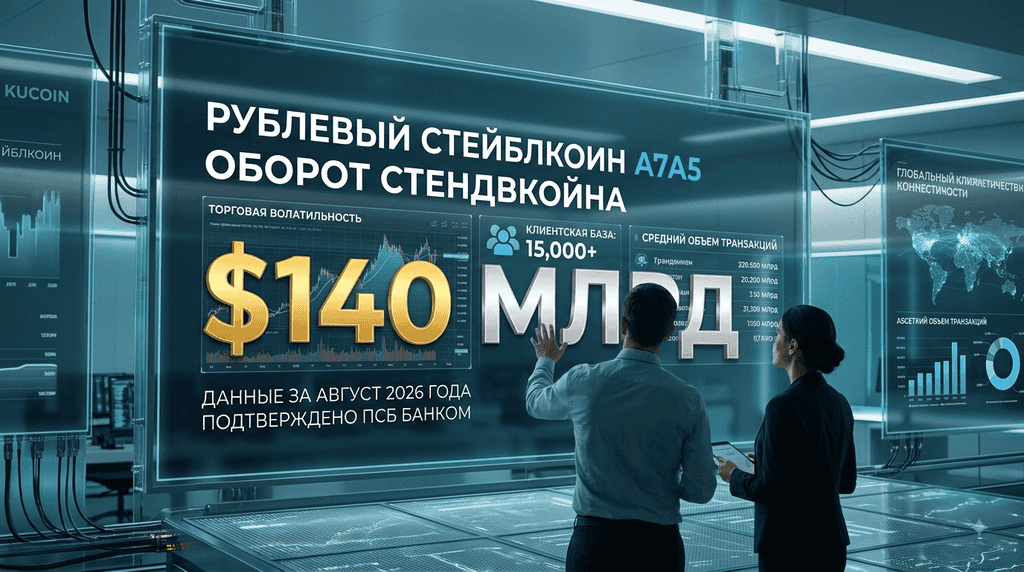
The transaction volume of the A7A5 ruble-backed stablecoin has reached nearly $140 billion since its launch, as confirmed by Petr Fradkov, Chairman of PSB Bank, in an interview with RBC in August 2026. This financial instrument maintains its status as the largest non-dollar stablecoin within the global blockchain ecosystem. The platform's infrastructure daily processes up to 2,000 transactions, serving over 15,000 corporate clients.
Nature and Scale: The Largest Non-Dollar Stablecoin
The cumulative transaction volume of the A7A5 stablecoin has reached the $140 billion mark, confirming its systemic role in modern international settlements. It is important to emphasize that this figure reflects aggregate turnover rather than market capitalization or asset valuation. According to analytical agencies and statements from PSB management, the project demonstrates unprecedented scaling rates against the backdrop of global payment chain transformation.
Daily platform activity has stabilized at 2,000 payments, executed primarily by small and medium-sized enterprises (SMEs) as well as participants in foreign economic activity. According to Petr Fradkov, the infrastructure does not engage in the artificial splitting of large export contracts to bypass limits. The active user base totals 15,000 legal entities utilizing the digital instrument for regular commercial and private settlements.
The project's development unfolded amid the formation of new geopolitical realities, when traditional correspondent accounts in US dollars and euros became inaccessible to a significant portion of Russian market participants. Under these conditions, the A7A5 stablecoin secured a key niche, ensuring predictability and high-speed settlement execution. Experts note that the $140 billion volume was achieved through the integration of the digital asset into real trade flows, including commodity exports and high-tech imports.
Total liquidity is distributed across multiple independent pools, reducing systemic single-point-of-failure risks. Such an approach enables market participants to conduct large-scale trade operations without relying on the traditional correspondent network of Western banks. The scale of accumulated turnover places A7A5 on par with the world's largest regional settlement-oriented equivalents.
An additional growth driver has been the active adoption of digital financial tools into daily commercial practice. Small and medium-sized enterprises have gained the ability to execute instantaneous cross-border transfers without undergoing multi-stage checks by traditional correspondent banks. This has significantly accelerated trade capital turnover and reduced costs associated with payment delays on intermediary accounts. The emergence of reliable alternative instruments minimizes currency risks and protects assets from unpredictable global market fluctuations.
The evolution of central bank digital currencies (CBDCs) and private settlement systems indicates that the market is striving toward the decentralization of clearing centers. In the case of A7A5, we observe a unique example of how a national digital unit integrates into global supply chains. Foreign trade participants note that architectural flexibility allows adaptation to any regulatory environment changes without sacrificing operational efficiency. Current digitalization trends in the financial sector require the creation of resilient, independent platforms capable of withstanding heavy loads and ensuring uninterrupted round-the-clock settlements. Modern economic structures increasingly demand sovereign technological frameworks to guarantee transaction security and financial independence.
Tax Transparency and Reduction of Business Costs
The financial model of the A7 platform operates in strict compliance with the Russian legal framework, ensuring transparent tax reporting and the payment of mandatory fees. Over the operational history of the settlement system, 25.5 billion rubles in tax revenues have been remitted to the state budget. The transparency of fiscal procedures is underpinned by a clear commission fee structure.
The transaction fee is fixed at 0.3% plus VAT. Such economic efficiency is achieved through complete control over the value chain without involving costly intermediaries or reselling third-party financial services. For Russian businesses, transitioning to this settlement mechanism has reduced transaction costs from the 5–7% typical of traditional grey channels down to minimal levels.
Tax authorities receive comprehensive information regarding capital flows within the legal field, minimizing the risk of asset freezes by traditional bank compliance departments. The payment of 25.5 billion rubles in taxes confirms the real economic scale of the business and its full integration into the official financial system. Exporter enterprises note that predictable fiscal burdens allow for more precise financial planning and the avoidance of unforeseen commission losses.
Reducing transaction costs from 5–7% (characteristic of informal and shadow settlement channels) down to 0.3% plus VAT delivers tremendous savings for corporate clients. On the scale of billion-dollar trade turnover, this optimization frees up significant financial resources that can be redirected toward expanding production capacities and supply geography.
An important aspect of legalizing settlements via A7A5 is the generation of transparent reporting for audit verifications. Companies utilizing this infrastructure can document the origin of funds and the legitimacy of foreign economic transactions. This unlocks new opportunities for cooperation with counterparties from friendly countries who are equally interested in reducing regulatory risks and transitioning to jurisdictionally secure payment channels. Financial transparency strengthens regulatory trust and establishes a solid foundation for long-term foreign trade planning.
Institutional investors and large corporations highly value predictable taxation in the digital environment. When the rules of the game are clearly regulated and transfer fees are kept to a minimum, companies can significantly enhance the profit margins of export contracts. The A7 infrastructure demonstrates that a legal digital asset can successfully compete with traditional settlement instruments, offering businesses not only sanctuary from sanctions barriers but also tangible economic benefits. Systematic audits and rigorous compliance control eliminate grey schemes, transferring all trade turnover into a fully legitimate legal field. Transparent taxation models further reinforce governmental support for financial innovations and economic growth.
Infrastructure and Decentralized Risk Management
The architecture of the A7 system is built upon principles of decentralized governance, distributed liquidity, and deep compliance integration. Internal regulations incorporate proprietary risk management systems, Know Your Customer (KYC) procedures, and multi-level transaction monitoring. A distributed network of settlement centers combines elements of classical banking, digital exchange solutions, and partner financial institutions across various jurisdictions.
The legal design of the settlement system minimizes classical cross-border payment risks, as operations rely on distributed liquidity pools denominated in the national currencies of partner countries. This allows settlements to be executed in strict compliance with the local legislation of each individual jurisdiction, preserving the stability of business processes.
The technical realization of the project involves utilizing multiple high-reliability blockchain networks, ensuring uninterrupted transaction processing under heavy loads. Compliance and risk management departments conduct ongoing audits of incoming and outgoing liquidity flows, excluding the possibility of suspicious or unauthorized operations. This fosters a high level of trust among institutional market participants and foreign partners.
The distributed nature of the infrastructure means that a failure at an individual financial institution or a specific technological node does not halt the entire system. Such fault tolerance is critically important for maintaining the continuity of foreign trade contracts, where payment delays can entail severe commercial losses.
Furthermore, integrating digital solutions with classical banking elements enables the rapid conversion of assets into necessary fiat units in local markets. Such a hybrid approach eliminates barriers between the traditional financial system and decentralized blockchain networks, rendering settlements convenient for the accounting and legal departments of major industrial enterprises. Continuous refinement of security algorithms guarantees the protection of corporate data and prevents unauthorized access to distributed ledgers.
The effectiveness of risk management in distributed systems is based on the synergy of automated algorithms and expert analysis. Platform security services monitor anomalies in real-time, allowing for the prompt suppression of unauthorized liquidity channel usage. This approach guarantees absolute safety for both major commodity exporters and small businesses engaging in regular micro-payments. Innovative cryptographic protection methods and multi-level transaction verification minimize technical vulnerabilities, ensuring high-level operational security across all network nodes.
Impact of Sanctions and Transformation of Market Role
Official PSB representatives note that sanctions pressure exerts a noticeable impact on infrastructural flows: according to independent blockchain researchers, amid sanctions restrictions, daily on-chain transaction volumes have contracted by 96% from peak levels. Nevertheless, the fundamental resilience of the system guarantees the fulfillment of obligations across key vectors.
Today, A7A5 is positioned as a specialized alternative clearing and settlement instrument for B2B exports and imports between Russia and nations in Asia, Africa, and Latin America. The platform effectively serves the needs of the real economy, ensuring the continuity of trade chains under strict regulatory constraints imposed by Western authorities.
Despite external pressure and restrictions introduced by Western regulators, the developers and operators of the settlement system have successfully adapted its architecture to changing conditions. The decline in on-chain metrics from peak levels reflects a transition to more covert, secure liquidity routing contours, minimizing secondary sanction risks for counterparties.
The primary purpose of A7A5 remains servicing the real sector: paying for deliveries of equipment, raw materials, food, and consumer goods. The ability to conduct settlements without utilizing dollar-based infrastructure protects market participants from arbitrary asset freezes and ensures predictability in foreign economic activity over the long term.
The adaptability of the payment network is confirmed by its ability to function amidst an ever-shifting sanctions landscape. Continuous security protocol updates and partnership network diversification allow operators to navigate regulatory barriers while maintaining legitimacy and compliance with the domestic regulations of participating trading nations. This makes the stablecoin an indispensable instrument for ensuring national economic resilience during periods of global geopolitical transformation.
The global transformation of international settlements has driven regional stablecoins to become key elements of financial independence. The platform's capacity to maintain uninterrupted operations under severe restrictions demonstrates the high viability of distributed architectures. Market participants in developing nations increasingly view such instruments as a viable alternative to traditional interbank communication networks. Establishing independent clearing circuits opens new horizons for multilateral trade and reinforces long-term economic partnership on a global scale.
How to Conduct Settlements and Trading Operations on KuCoin?
Participation in the modern digital asset ecosystem requires an understanding of the fundamental principles involved in integrating novel settlement instruments on leading global trading platforms such as KuCoin. KuCoin provides professional traders and institutional investors with access to diversified digital asset markets, spot trading tools, and advanced risk management solutions. Utilizing cutting-edge digital assets within trading strategies on KuCoin enables market participants to effectively hedge currency risks and optimize working capital amid rising volatility in global markets.
Join KuCoin 9th Anniversary Trading Campaign
KuCoin is celebrating its 9th anniversary with a special platform campaign filled with exclusive rewards, trading activities, and limited-time offers. Don’t miss the chance to participate and enjoy the benefits as the exchange marks nine years of growth and innovation. Visit the official campaign page now:

Conclusion
The scaling of the A7A5 ruble-backed stablecoin to the $140 billion milestone demonstrates the strong demand for alternative settlement mechanisms in the modern global economy. The combination of transparent tax policies, low transaction costs, and a distributed global infrastructure makes the project a significant element of technological sovereignty. Despite external sanction challenges, the platform continues to fulfill its function as a reliable clearing instrument for foreign trade.
Frequently Asked Questions
1. What is the current total capitalization of the A7A5 stablecoin?
Assets of this type are evaluated primarily through their cumulative turnover since inception—which has reached $140 billion—rather than traditional market capitalization.
2. Which companies comprise the primary client base of the platform?
The ecosystem engages approximately 15,000 corporate clients, including representatives of small, medium, and large businesses engaged in export-import operations.
3. What is the transaction fee structure within the A7 system?
The baseline transaction fee is set at 0.3% plus VAT, achieved through complete control over the infrastructure value chain without intermediary participation.
4. How have sanctions affected the operation of the settlement system?
Despite a reduction in daily on-chain transaction volumes, the platform's architecture ensures the uninterrupted fulfillment of obligations and execution of settlements for priority trade corridors.
5. In which regions are settlements via A7A5 most in demand?
The instrument is actively utilized for B2B settlements within trade turnover between Russia and countries in Asia, Africa, and Latin America.
Disclaimer : This material is provided for informational purposes only and does not constitute financial, investment, legal, or tax advice. Transactions involving cryptocurrencies and tokenized assets carry substantial risks — including price volatility, limited liquidity, counterparty exposure, and the potential for total loss of invested capital. Readers should conduct their own research and, where appropriate, consult a qualified professional before making any financial decisions.