




Author: Bbo I XHunt Operations Team; Amelia, Denise I Biteye Content Team
On March 1, 2026, X (Twitter) significantly updated its "Declare paid promotion" rules, and accounts that fail to properly disclose commercial promotions will face strict penalties starting next week.
This move was initially interpreted by outsiders as a precursor to Twitter launching its own official promotional system, even sparking widespread panic in the Web3 community. However, as the official clarification of the Crypto promotion rule confusion emerged, X’s true intentions became clear: compared to the well-established commercial promotion systems already in place domestically, X’s initiative came late. Its fundamental goal is not only to guide third parties to use the X Ads official advertising system in compliance, but also to help ordinary users clearly distinguish advertisements, purify their timeline experience, and ultimately reshape a healthier content ecosystem.
For KOLs and professionals across all fields, understanding the new regulatory boundaries has become an absolute prerequisite for safe monetization and long-term operations.
This article will deeply analyze from the following dimensions:
New regulations define criteria and penalties: clearly outline which behaviors will be classified as commercial promotion and the resulting violations.
Crypto promotion misconceptions: Clarifying recent rumors about Crypto bans and actual regional restrictions.
Global platform comparative analysis: Examining the commercialization evolution paths of platforms such as Weibo, Xiaohongshu, and TikTok.
Underlying AI moderation technology: How the platform automatically identifies hidden ads and requirements for AIGC content.
I. Breaking Down Twitter's New Rules: Not a Ban on Ads, But a Reconstruction of Trust
Twitter's new policy is not a hard landing, but rather a tiered governance built on the principle of transparency.
1️⃣ What is officially recognized as "paid promotion"?
According to Twitter's official Paid Partnerships Policy, paid partnerships refer to situations where third-party brands compensate users (such as influencers or content creators) to promote their products or services. This encompasses the following four common scenarios:
The product or service is provided by the brand or on behalf of the brand.
Creators received monetary or in-kind compensation for promoting these products or services.
These products or services enable creators to earn commissions from sales (e.g., through referral links or discount codes).
Creators have a commercial agreement with these products or services (e.g., serving as brand ambassadors).
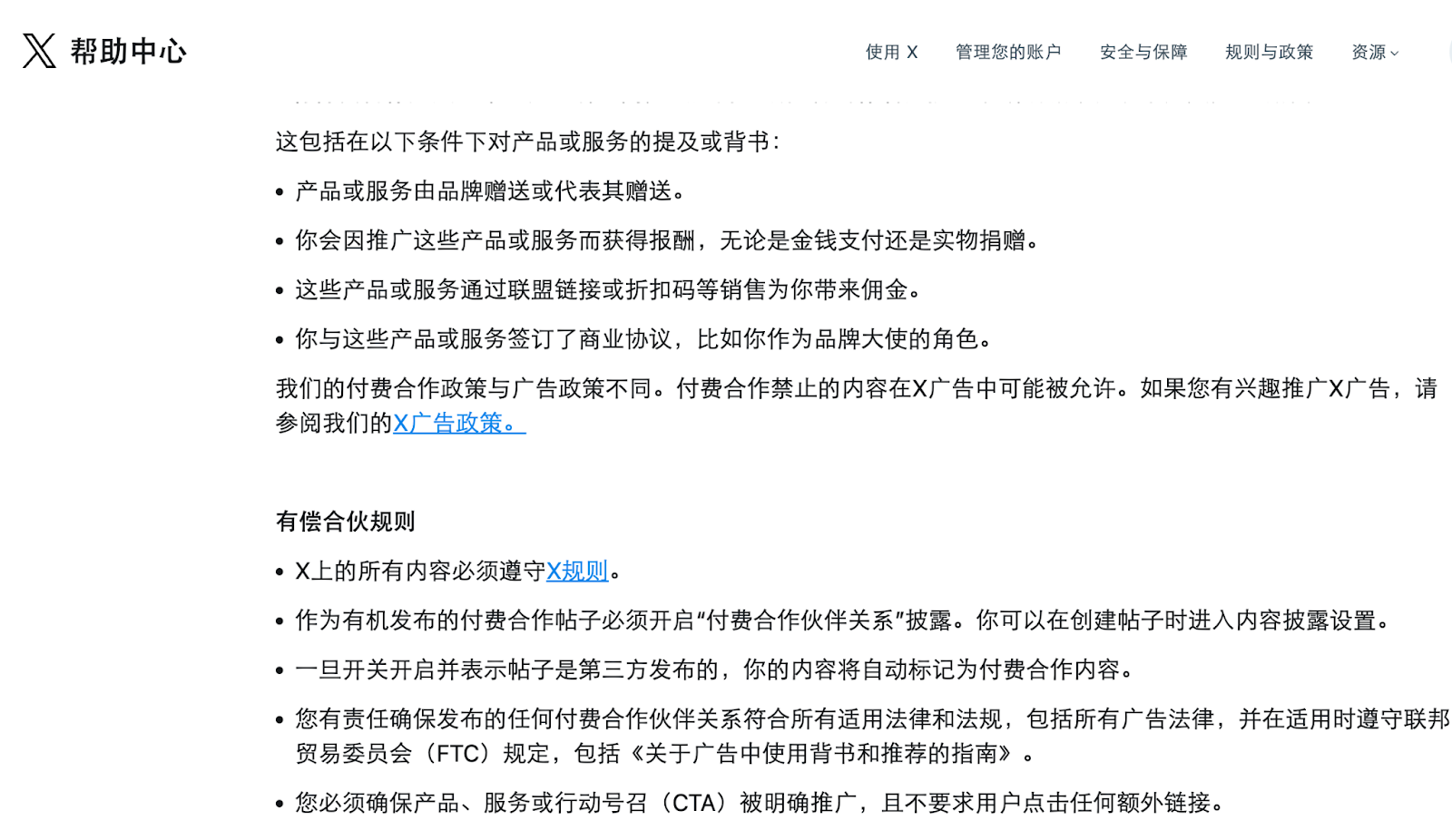
Core disclosure requirement: All paid promotional content published as organic posts must include clear and prominent language (such as “Ad” or “Promoted Content”) to indicate its commercial nature. Additionally, the promoted product, service, or call-to-action (CTA) must be clearly stated and cannot require users to click additional links to understand.
2️⃣ Non-compliant "Tiered Execution Options"
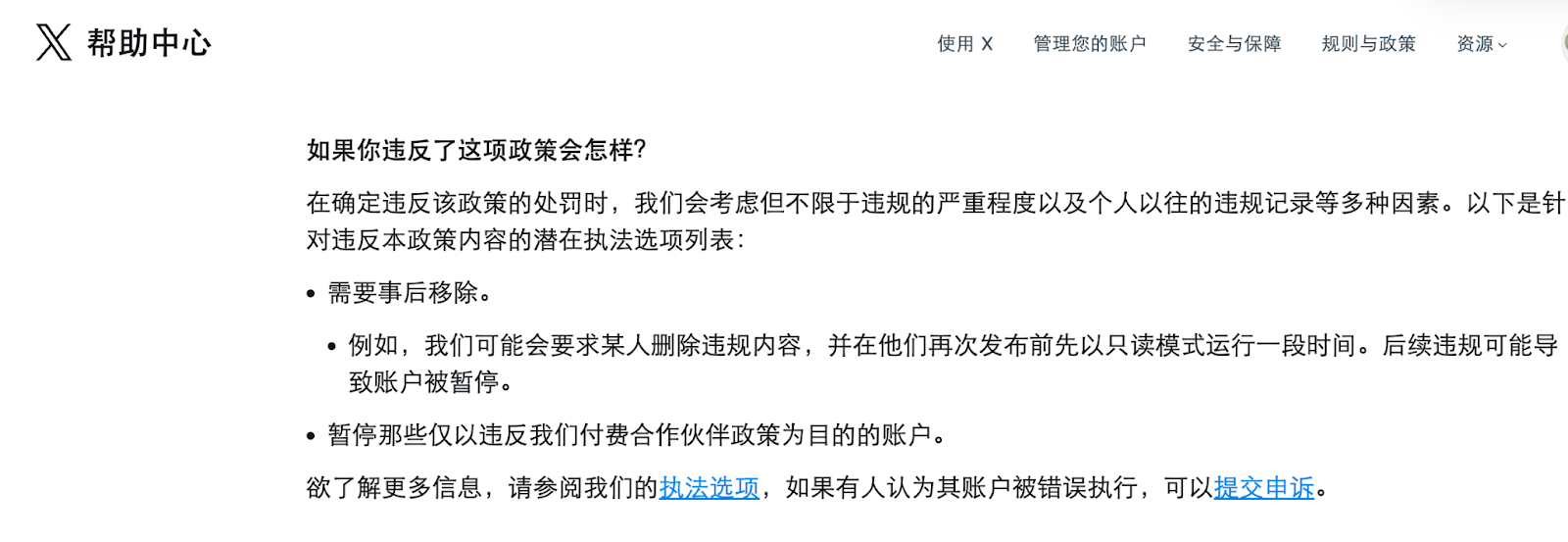
In determining penalties for policy violations, X considers multiple factors, including the severity of the violation and the individual’s prior violation history, applying a tiered enforcement approach:
Post-event removal and restrictions: The platform may require violators to remove the violating content and operate in "read-only mode" for a period before they can post again.
Repeated violations leading to suspension: Your account may be suspended only after multiple subsequent violations.
Directly suspend malicious accounts: Accounts created solely to violate the paid partnership policy will be immediately suspended.
In addition, the platform provides an appeal channel for users who believe their accounts were incorrectly actioned.
II. Twelve Hours of Panic: The Crypto Promotion Mix-Up and Regional Compliance
At the initial release of the new regulations, X’s policy page directly listed “cryptocurrency” as a prohibited category for paid promotional partnerships, causing a major shockwave through the Web3 community, leaving many KOLs tossing and turning at night, anxious that their livelihoods had been taken away.
However, this was a misunderstanding. X product lead Nikita Bier has publicly confirmed that the previous blanket restriction display was an error. The clause was updated in June 2024 and is not the latest version. The platform has since urgently fixed this clause.
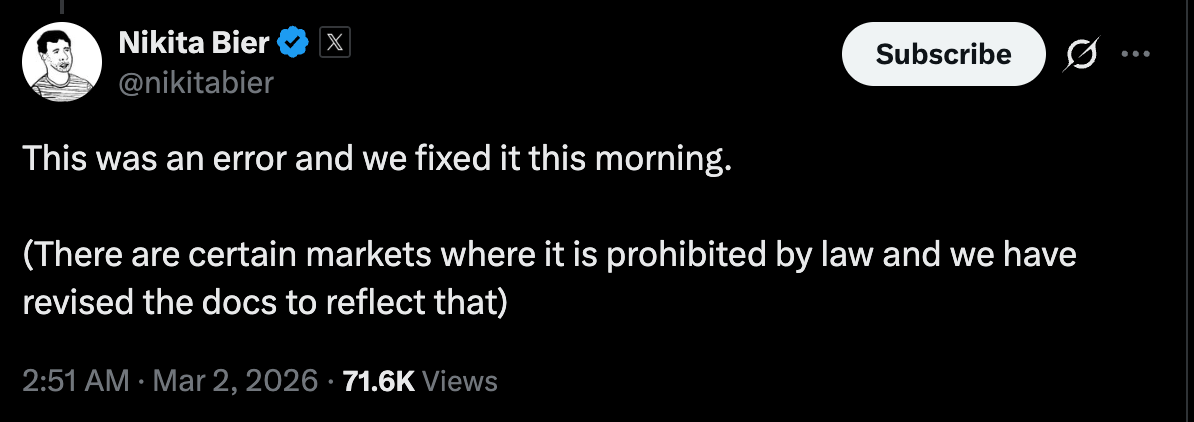
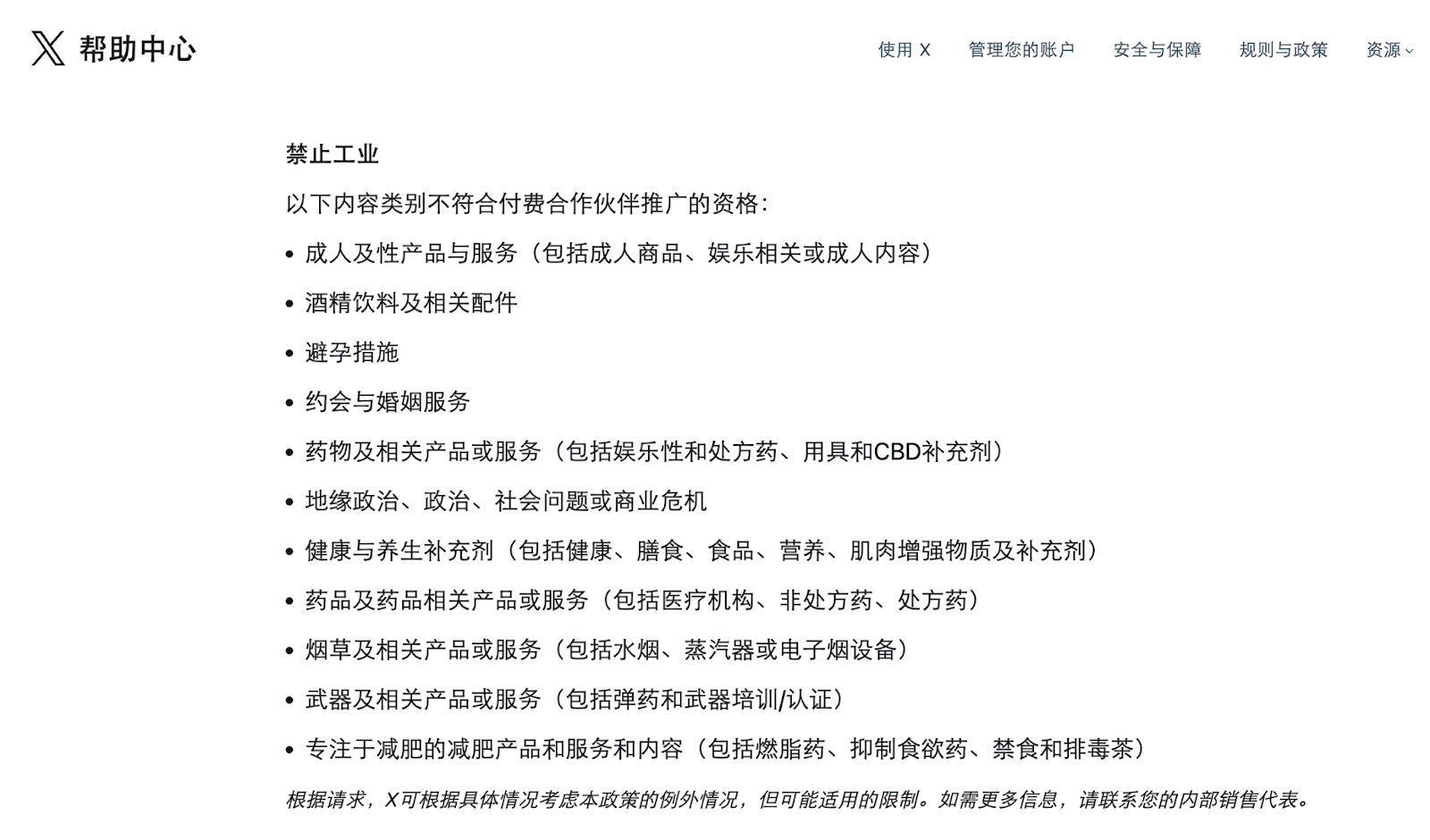
According to the latest updated policy, cryptocurrencies have not been banned globally, but have entered a compliant disclosure status with regional restrictions. Specifically:
Regional isolation红线: Currently, Australia, the European Union, and the United Kingdom are prohibited from running paid promotions for cryptocurrencies (due to local financial regulatory laws). X does not prohibit any other countries or regions outside of these three.
Mandatory transparent disclosure: Although promotional channels remain open, KOLs accepting orders in non-restricted countries must strictly adhere to transparency principles—clearly labeling all posts as sponsored collaborations. Concealed promotions, such as untagged posts disguised as personal investment insights, carry a high risk of account suspension.
Official X Ads remain the preferred choice for large institutions: Large financial projects that require cross-regional reach or do not meet individual KOL promotion criteria can still apply for official X Ads (promoted posts) and proceed with legitimate paid advertising after obtaining pre-approval.
In short, the KOL marketing channel in the crypto industry still exists, but it has officially left its wild west phase and fully entered a new, regulated stage with transparent and compliant practices.
Three Categories of Commercial Governance for Global Content Platforms
Viewed within the broader history of global platform evolution, X’s new policy is not sudden—it merely fills a long-overdue piece of the puzzle. In terms of governance models, global content platforms can be categorized into three types: mandatory official matchmaking, mandatory disclosure plus non-mandatory matchmaking, and mandatory disclosure only.
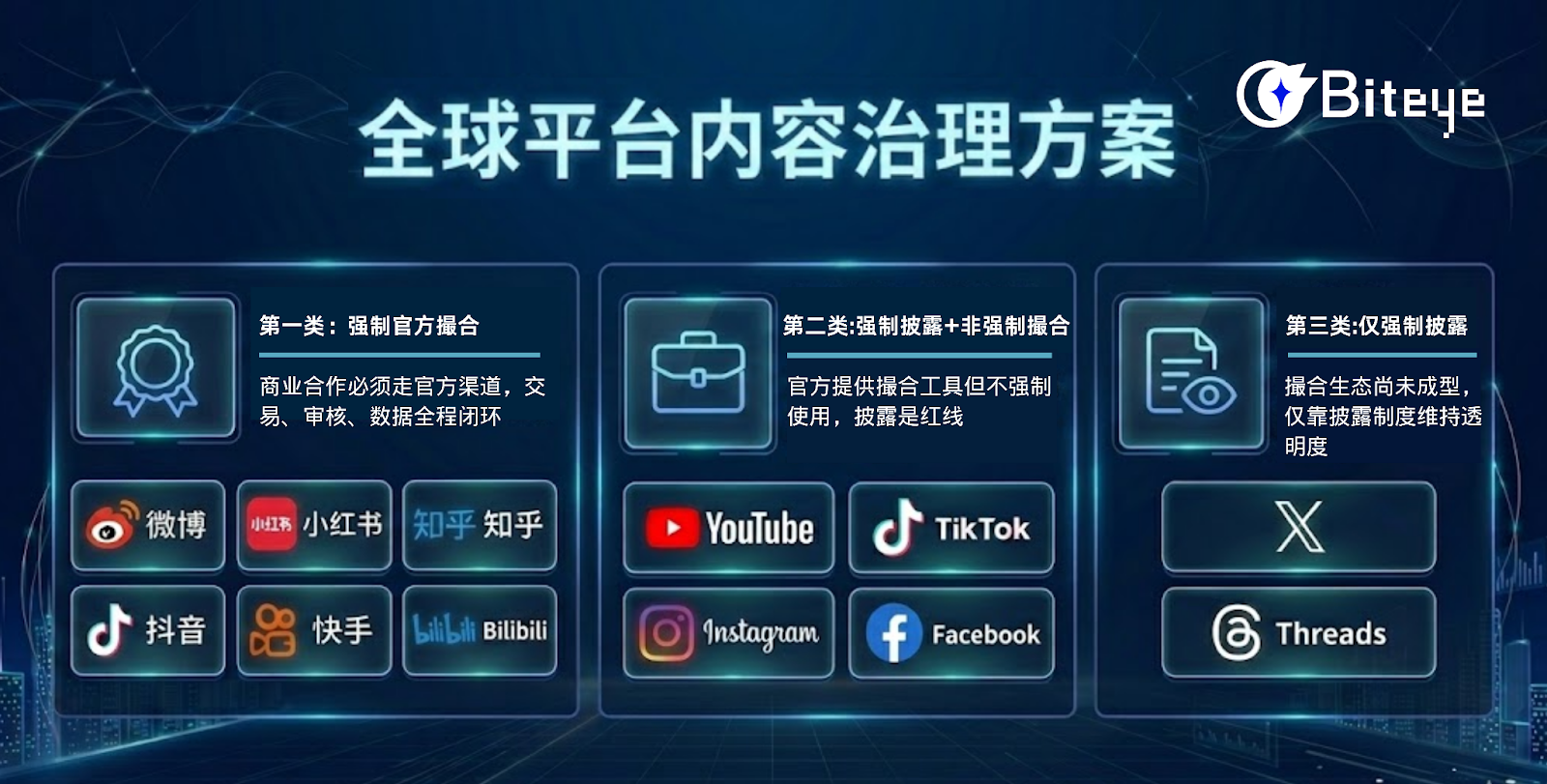
1️⃣ Mandatory Official Matching – Business Must Be Closed-Loop
The core logic of such platforms is that all business collaborations must go through official channels established by the platform; transactions, content moderation, and data tracking are all managed in a closed loop. The platform bears joint responsibility for commercial content, so full control throughout the process is essential.
Mainland China is a typical example of this model.
Weibo: Mandatory commercial advertisements must be published through official channels such as "Micro Tasks" or "Jubao Pen" and clearly labeled. Strictly crack down on the proliferation of marketing accounts and fake engagement, implementing a tiered penalty system of first limiting reach, then deducting points, followed by account suspension.
Xiaohongshu: All influencer sponsored posts must go through the official "Pugongying Platform"; fake product recommendations are strictly prohibited. Posts that fail to disclose commercial relationships will be immediately downranked, and severe violations may result in credit score deductions.
Douyin: Has the most comprehensive commercial system. It has established the "Juliuxingtu" system, along with a "Product Selection Plaza" and ad traffic system. Creators who wish to promote products or accept orders must attach links through the official product selection center. For unreported private deals (hidden ads), Douyin’s AI review system intercepts them by frame-by-frame video analysis and link detection.
Zhihu: Launched "Zhi+" and commercial plugins to integrate advertising into its platform ecosystem. Zhihu heavily cracks down on soft articles disguised as hardcore reviews; once flagged by users or detected by the system as违规 ads, an account's "Yan Value" and ranking will be significantly reduced, potentially leading to permanent suspension.
Kuaishou: Forms a closed loop with e-commerce through "Kuai Jie Dan," creating an integrated system of "content—transaction—revenue sharing." Kuaishou places greater emphasis on the authenticity of the "old-brother economy," and employs dual measures—traffic suspension and e-commerce privilege demotion—to combat false advertising and undisclosed promotional content.
Bilibili: Establish the "Huohuo Platform," requiring UP creators with at least 10,000 followers to join; all non-private commercial collaborations must be completed through the platform for contract signing, content review, and settlement. Creators who do not join will be unable to receive ad requests distributed by the platform.
Summary: The business model of mainland platforms is very clear: all commerce must occur within the platform’s ecosystem. From content to transactions, from discovery to purchase, the entire process is closed-loop and fully controlled. There is almost no boundary between content and commerce.
2️⃣ Mandatory Disclosure + Non-Mandatory Matching – The Platform Provides the Stage, Users Perform Freely
These platforms follow a "soft closed-loop" model: the official platform provides matching tools (such as the creator marketplace), but their use is not mandatory; brands and creators can still connect through external channels like email or direct messages. However, regardless of the channel used for collaboration, commercial disclosure is an absolute红线—failure to label content constitutes a violation.
YouTube: Launched the "BrandConnect" platform to streamline the entire creator collaboration process. The newly introduced "Open Call" feature allows brands to post creative briefs and solicit video proposals from over 3 million creators. It also implements a mandatory disclosure mechanism for "Includes paid promotion." YouTube's logic is: long-form video audiences value trust; labeling does not destroy traffic—deception does.
TikTok: Launched the "TikTok Creator Marketplace," bringing together high-quality creators across global vertical niches, supporting standardized processes such as data filtering, direct outreach, and commission sharing. However, using the official matchmaking platform is not mandatory—brands and creators can still connect directly via email or direct messages. Nevertheless, regardless of the channel used to secure a partnership, disclosure of commercial content is a mandatory requirement: all brand collaboration content must be published through the official invitation link to ensure inclusion of the paid partnership label; otherwise, it will not be eligible for For You page recommendations.
Instagram: Launch a "Creator Marketplace" with filtering options by country, content category, follower count, and more, along with a "Priority Messaging" feature to boost response rates. Also introduce the "Paid Partnership Label," requiring creators to clearly display brand collaborations at the top of their posts. IG has proven that even with an advertising label, users will still engage if the content is compelling.
Facebook: Launched the "Brand Collabs Manager" and "Creator Marketplace" to help brands search, filter, and connect with creators, providing official first-party data (followers, reach, engagement rate, etc.) and supporting multi-dimensional filtering by country, age, interest tags, and more. However, the official matching tool is not mandatory, and disclosure is a mandatory requirement. Facebook explicitly states: even when using the built-in Brand Collabs Manager, manual disclosure is still required.
3️⃣ Mandatory Disclosure Only – The Matching Ecosystem Has Not Yet Been Established
These platforms have currently only reached the stage of "mandatory disclosure"; official matching channels have either not been launched yet or are still in early testing phases.
X (Twitter): This update requires all paid promotions to be labeled with "Paid Promotion," or they risk being suspended. Although Musk also pays content creators, there is currently no official matchmaking system similar to "Star Map" or "Creator Marketplace."
Threads: As a direct competitor to X, it has been extremely restrained in its early approach to monetization, actively suppressing hard ads and preventing bot-driven spam marketing, aiming to attract users disillusioned with X through a sense of purity, and has not yet launched a mature commercial partnership system.
💡 Key Insight: Why do Chinese platforms tend to enforce closed loops, while overseas platforms (including TikTok) only require mandatory disclosure without enforcing closed loops?
Different legal frameworks: Domestically, there are strict entry and regulatory requirements for internet advertising. As the primary responsible party, the platform must bear joint liability for content. To minimize compliance risks, the best approach is to “close the loop” on all commercial activities—reviewing all content before publication. In contrast, the legal framework in the U.S. (FTC) and the EU centers on the “obligation to disclose.” As long as you clearly inform users that content is an advertisement through labels (e.g., #ad, #sponsored), platforms typically do not intervene in how payments are processed or contracts are signed privately.
Antitrust红线: In European and U.S. markets, if a platform adopts a forced intervention approach, it risks triggering two types of regulatory concerns: antitrust investigations and accusations of restricting market competition, as regulators may view the platform as monopolizing advertising, excluding third-party agents, and limiting creators' freedom. Such behavior is considered high-risk in both the United States and the European Union, which is why TikTok, originally developed in China, offers only a Creator Marketplace without enforcing its use.
✍️Key takeaway: Third-party matching platforms will coexist long-term with content platforms and remain indispensable.
First, laws in Europe and the United States prohibit platforms from forming absolute monopolies; second, even in a highly closed environment like China, there are still gaps for survival. For example, despite the presence of official platforms like Xiaohongshu’s Pugongying and Douyin’s Xingtu, numerous third-party data analysis and matchmaking intermediaries remain active.
IV. AI Review: Intelligent Recognition and Mandatory Tagging of AIGC Content
There's so much content on Twitter that it's impossible for the official team to review it manually. The product lead said the team has only around 30 people, so they definitely don't have the manpower. Therefore, detecting hidden ads relies mostly on AI.
1️⃣ Principle and Application of AI in Detecting Hidden Ads
The platform's AI model primarily identifies违规 content through cross-referencing multi-dimensional features:
Text semantic analysis (NLP): Accurately identify whether tweets frequently contain specific praise, token pump phrases, or highly suspicious soft promotional calls to action (such as "Buy now," "Click to register," etc.).
Link and behavior tracing: Automatically detect whether specific affiliate links or referral codes are included, and determine the commercial nature of the redirected domain.
Account relationship graph: Analyze whether this account exhibits abnormal interaction frequency or association characteristics with a specific brand matrix. If the system determines that a tweet has a very high confidence level of commercial promotion but lacks the appropriate tag, it will automatically trigger a penalty.
2️⃣ Mandatory tagging of AIGC content
Alongside the rollout of commercial disclosure requirements, Twitter is also implementing guidelines for AI-generated content. X is developing an AI-generated label, and in the future, failing to voluntarily mark AI-generated text or images will likely violate platform rules.
This move directly targets the flood of AI-generated spam accounts on Twitter. It’s not only a protection of users’ right to informed content, but also a strategic use of platform rules to incentivize creators to deliver genuine “human insight and authentic narrative value.” Low-quality AI-plagiarized content will be filtered out, while high-quality, niche information will gain greater visibility.
In the current environment where official entities are using AI under strict regulation, ordinary users and operators can also leverage AI tools to evade detection. With XHunt’s “Tweet AI Analysis” feature, you can generate a promotional tendency report for AI-generated tweets.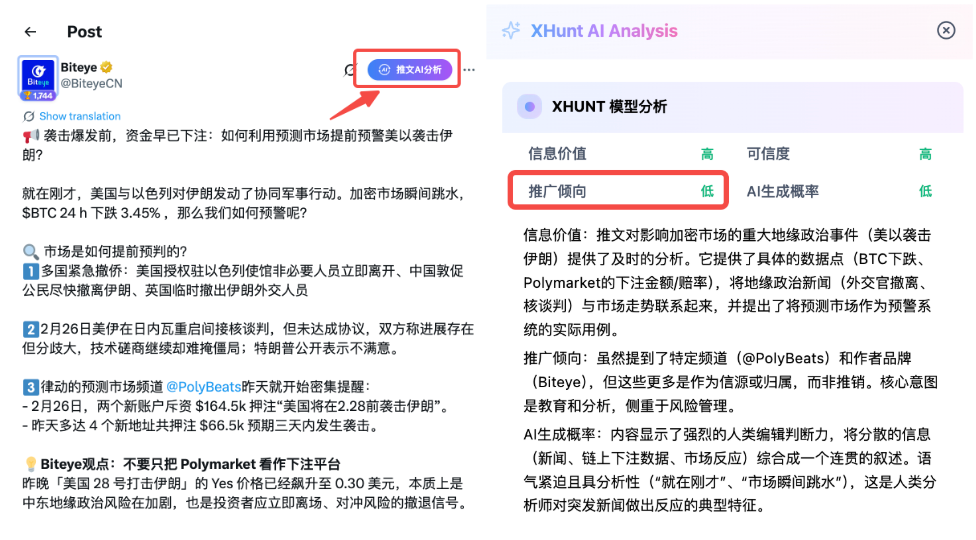
In conclusion: You hold the Imperial Sword, but the Sword of Damocles hangs above you.
The development of a platform often follows the same path: early growth relies on the active participation of creators and users; later stages depend on rules and commercialization to establish order; and when the platform becomes large enough, issues around governance and the boundaries of power emerge.
The shift of X from wild growth to commercial normalization is hard not to recall the great migration of 2022: a large number of Chinese crypto users left Weibo, carrying the frustration and distrust of banned accounts, and flooded into what seemed to be a more open public square.
Back then, Twitter was like a vast square where anyone could shout out.
Twitter today is like an emperor, so powerful that it routinely bans accounts, just as an emperor would routinely execute a traitor.
Setting rules on the platform is entirely reasonable. No ecosystem can grow large without rules to support it.
But always remember: the platform is not an emperor above its users. Even if you hold the imperial sword, a sword of Damocles must still hang above your head.
After all, nothing lasts forever. Once you lose the people’s support, you lose everything.