





A structural inflection is emerging in Ethereum’s [ETH] price action, where prolonged compression begins to give way to a potential expansion attempt.
Within this context, Ethereum rose nearly 10% in the last 24 hours at writing time, after months of sideways movement following a sustained downtrend.
Price now approaches the $2,416 resistance, which acts as the key validation level for confirming sustained upside strength.
Meanwhile, recovery follows a sharp drop toward the $1,766 zone, where buyers start rebuilding short-term structure.
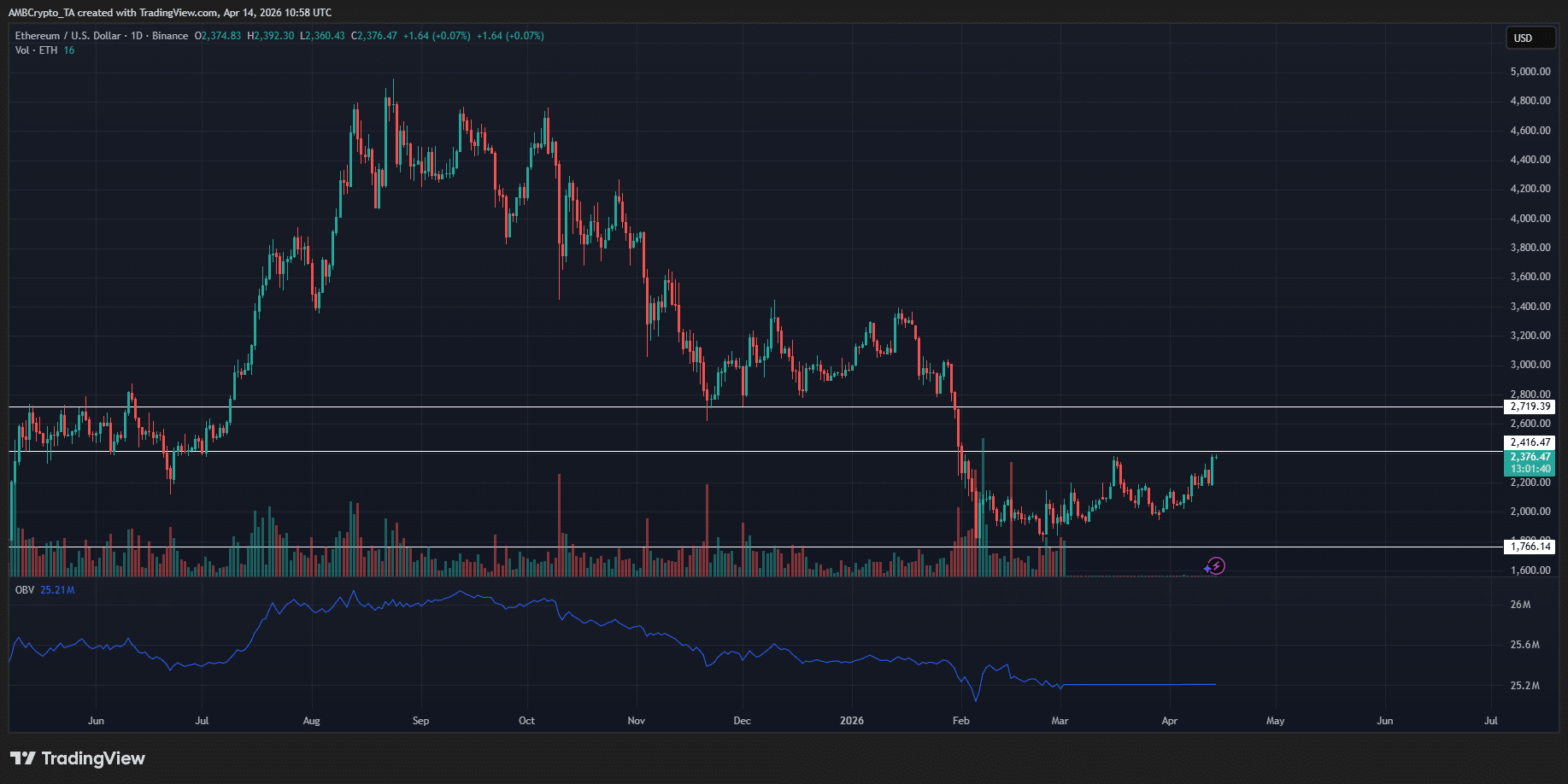
At the same time, OBV trended lower near 25.2M, indicating declining participation despite rising prices. This divergence suggests limited accumulation strength behind the move.
If the price breaks above $2,416 with stronger volume, momentum may build; otherwise, weak conviction could trigger rejection and extend consolidation.
Is $2,416 a breakout or rejection point?
A critical decision point tightened around $2,416 as Ethereum’s structure compressed within a rising channel toward resistance. ETH traded near $2,374 at press time after briefly pushing toward $2,392, showing repeated attempts to test the upper boundary.
This ascending channel reflects controlled buying pressure; however, price now clusters just below resistance, where continuation must prove strength.
A sustained move above $2,416 could open the $2,450–$2,600 range, confirming expansion beyond the channel.
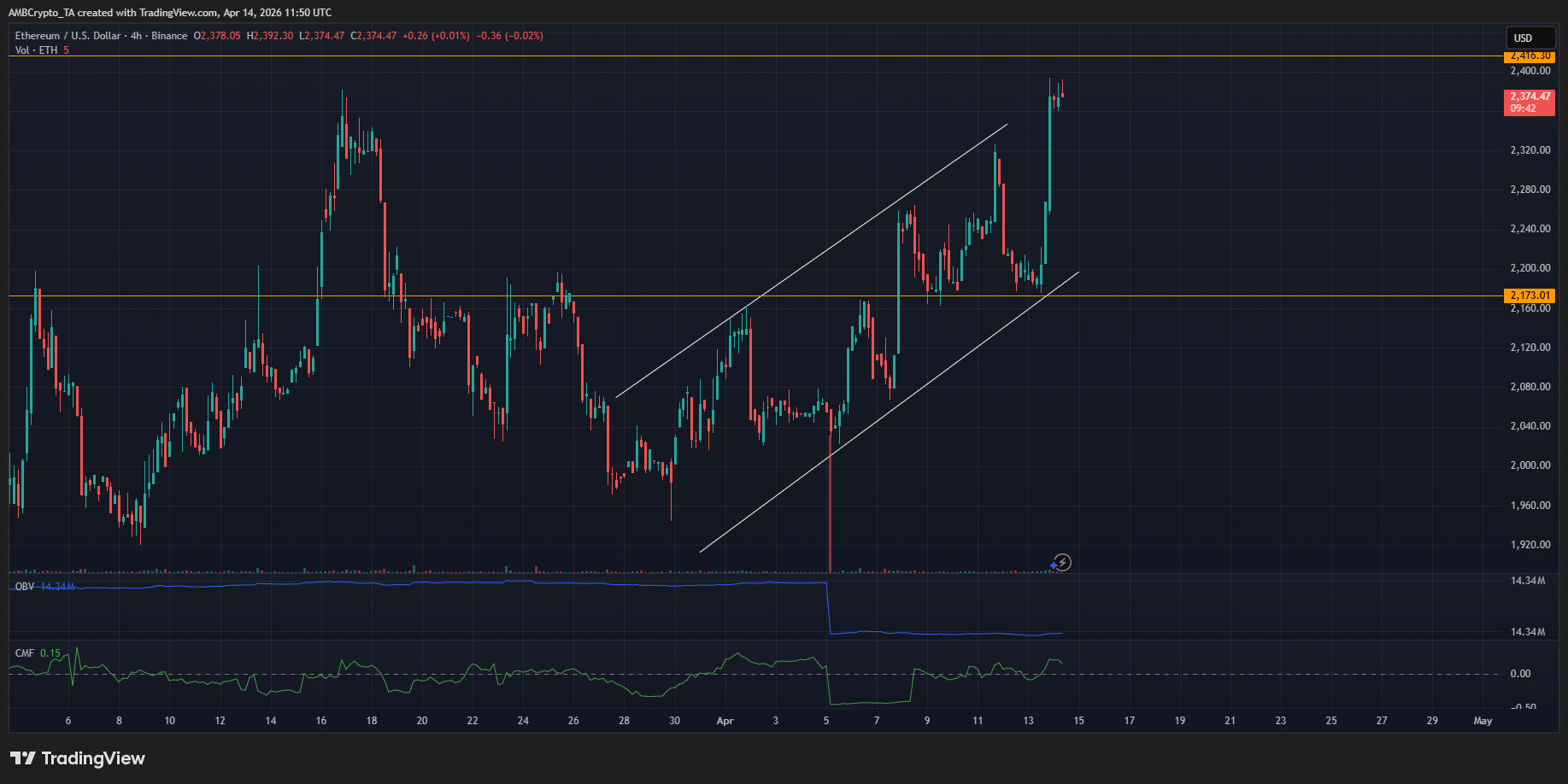
Meanwhile, the $2,173 level acts as immediate support within the structure, while the broader $2,250–$2,300 zone anchors the recovery.
At the same time, volume remained relatively muted, suggesting participation has not fully expanded alongside price. If volume rises into resistance, the breakout may hold; otherwise, weak participation could trigger rejection and return Ethereum to consolidation.
Ethereum’s $2,416 liquidity test
Ethereum approaches a defining moment, as price compresses just below $2,416 while recent gains begin to slow. After pushing toward $2,394, buyers now test whether demand can sustain beyond short-term positioning, while sellers defend resistance.
This matters because $2,416 concentrates liquidity on both sides, attracting breakout traders and short sellers. If price clears this level with strong closes, momentum may extend toward $2,600, as buy-side liquidity gets triggered.
However, hesitation reflects balance rather than weakness. Repeated rejections or long upper wicks would show supply absorbing demand, keeping price within range.
If that unfolds, price may rotate toward $2,250, while a confirmed breakout could shift the structure higher, leaving Ethereum at a clear directional crossroads.
Final Summary
- Ethereum tests $2,416 as a key pivot, where strong volume may drive expansion, while weak participation risks rejection.
- Ethereum remains balanced, with price strength meeting weak conviction, leaving direction dependent on demand versus supply.