



Author: Nancy, PANews
"This morning, we occupied Wall Street; tonight, we occupied the skies." On January 22nd, crypto custodian giant BitGo officially went public, marking the first initial public offering (IPO) of the crypto industry in 2026.
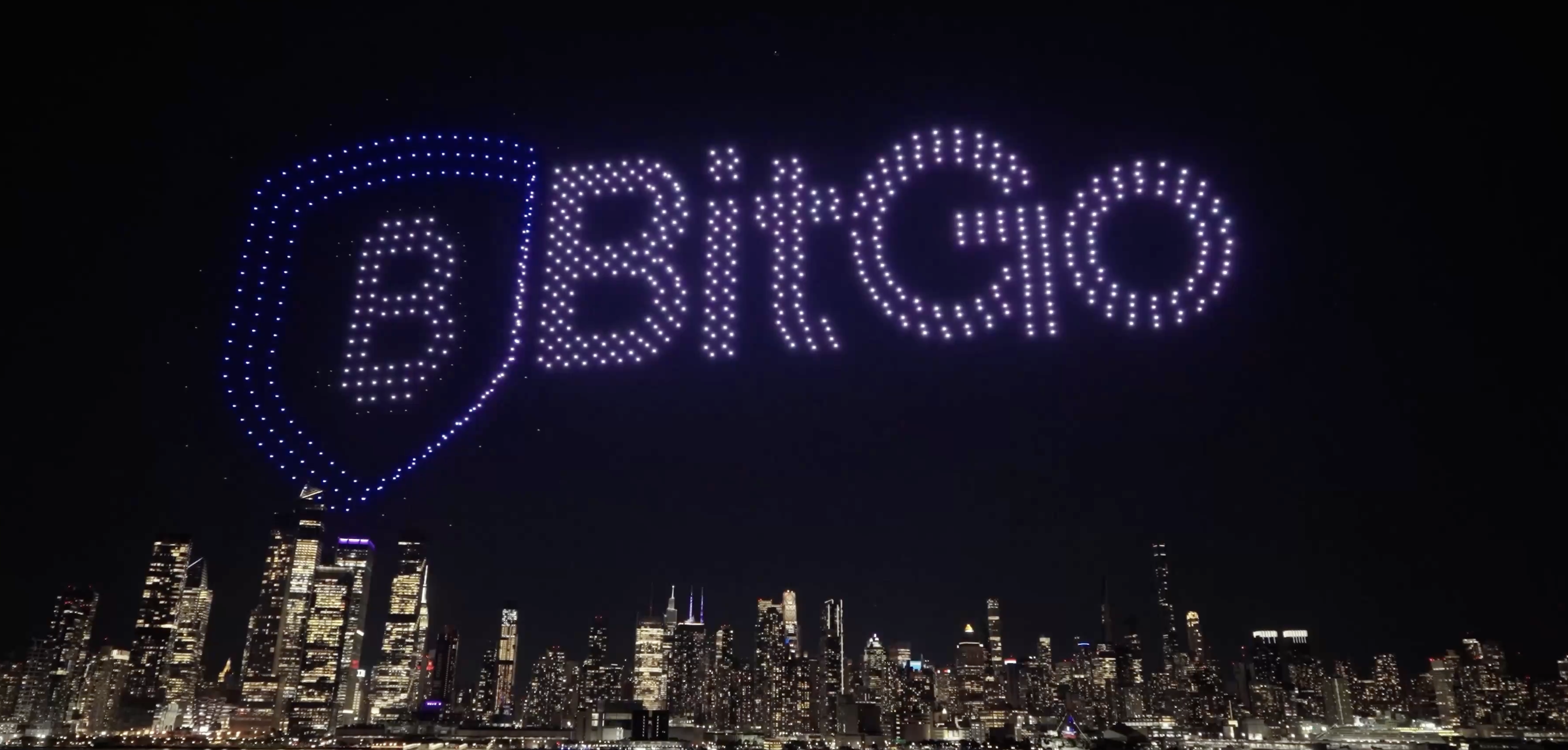
In celebration of this milestone, BitGo donated a framed copy of the Bitcoin white paper to the New York Stock Exchange, which was hung on the wall of the trading floor. That same night, a light show featuring BitGo's logo was displayed in the Manhattan sky, making a grand impression.
Successful IPO in four months, subscribing institutions' profits temporarily limited
Just four months after submitting its prospectus to the U.S. SEC, BitGo completed the sprint from filing to ringing the bell.

On its first day of trading on January 22, BitGo's stock price rose as much as 35% at one point, with the intraday peak market capitalization exceeding $2.8 billion, before giving up some of those gains. The following day, BitGo's stock closed below its offering price at $14.50. Compared to other cryptocurrency-related companies that have gone public via IPO in the past year, this valuation is not particularly high.
At the same time, as a crypto-native company, BitGo has also introduced innovative tokenized features after its listing, partnering with Ondo Global Markets to tokenize its shares, allowing investors to trade them on Ethereum, Solana, and BNB Chain.
In fact, as early as February last year, BitGo was reported to be considering an IPO. Later in September, it filed an IPO application with the U.S. Securities and Exchange Commission (SEC), planning to issue 11.8 million shares with a price range of $15 to $17 per share, aiming to raise up to $200 million. Goldman Sachs Group and Citigroup served as joint lead underwriters. Ultimately, BitGo set the offering price at $18 per share, exceeding the previous price range, and raised approximately $213 million.
According to insiders, this BitGo IPO was significantly oversubscribed, with entities such as YZi Labs announcing their participation as strategic investors. However, based on the current market valuation, the returns for these subscribers remain limited for now.
In terms of equity structure, after the IPO, BitGo's founder and CEO Mike Belshe will still retain control of the company, holding approximately 56% of the voting rights. Valor Equity Partners and Redpoint Ventures hold 4.6% and 3.9% of the voting rights, respectively.
Among them, Redpoint Ventures led BitGo's $12 million Series A funding round in 2014 and continued to increase its investment afterward. Valor Equity Partners led the approximately $42.5 million Series B funding round in 2017. Its founder, Antonio Gracias (a board member of Tesla and SpaceX), is also a member of BitGo's board of directors.
In addition, BitGo's investors include Craft Ventures, backed by David Sacks, the first "AI and Cryptocurrency Czar" in the U.S., as well as major institutions such as Goldman Sachs, Galaxy Digital, and DRW. However, since most funding rounds have not disclosed specific valuations, it is difficult to estimate the return on investment for these institutions. In 2023, when BitGo completed a $100 million Series C funding round, its valuation was approximately $1.75 billion, which does not leave a large margin of premium compared to its current market capitalization.
Hundred-Billion Revenue Accused of "Showcasing Financial Skills"
BitGo, which has been in operation for over a decade, can be considered the pioneer of cryptocurrency custody services.
As early as 2013, Mike Belshe, an early member of the Google Chrome team and one of the primary contributors to the HTTP/2 specification, co-founded BitGo. From its inception, the company launched the industry's first commercially implemented multi-signature wallet, requiring at least two to three confirmations for each transaction initiated by users, significantly raising the security standards for storing Bitcoin assets. Since then, BitGo has continuously iterated its wallet technology and API interfaces, and pioneered the compliance custody sector, becoming one of the earliest cryptocurrency companies to offer regulated and qualified custodial services.
In 2020, BitGo launched the BitGo Prime platform, marking its transition from a single custodian service provider to a comprehensive institutional financial platform. It began offering liquidity services such as trading, lending, custody, and financing to institutional clients. In the following years, BitGo also successively obtained a trust license from the New York State Department of Financial Services (NYDFS) and multiple international regulatory approvals. In 2025, it was approved to transition into a banking institution, further deepening its compliance strategy.
It is worth noting that Galaxy Digital had previously planned to acquire BitGo for $1.2 billion, which would have been the largest merger and acquisition deal in the cryptocurrency industry at that time. However, the transaction failed to meet closing conditions, and Galaxy Digital eventually unilaterally terminated the agreement, leading to legal disputes between the two parties. BitGo sought $100 million in compensation, but the court ultimately ruled in favor of Galaxy Digital, and the deal was thus "aborted."
As of now, BitGo manages assets exceeding $82 billion, serving over 5,100 institutional clients across more than 100 countries, including hedge funds, exchanges, mining companies, and traditional financial institutions.
The continuous expansion of its business scale has driven BitGo's rapid revenue growth, making it one of the few cryptocurrency companies that can maintain stable profitability. According to its prospectus, in the first nine months of 2025, BitGo achieved approximately $10 billion in revenue, a significant increase from $1.9 billion in the same period in 2024. This growth was primarily driven by the development of business areas such as digital asset sales, staking, subscription fees, settlement services, and high-frequency trading. However, despite the substantial revenue, its net profit remains very low. In the first three quarters of last year, its net profit was approximately $35.3 million, an increase from $5.1 million in the same period in 2024, but it accounted for only about 0.35% of total revenue.
Behind the rapid growth in numbers is BitGo's transformation from a mere custodian to a broker. As a broker, the amount of transactions executed on behalf of clients can be counted as revenue, while the actual profit comes only from the commissions paid by clients.
In response, Dovey Wan, a founding partner at Primitive Ventures, also analyzed and pointed out that from the perspective of revenue quality and growth structure, BitGo is not a high-quality target. The core revenue it discloses is almost entirely GAAP revenue (Generally Accepted Accounting Principles revenue), with very little actual cash revenue.
She pointed out that in terms of real revenue performance, 2023 saw $146.4 million, which dropped to $131.9 million in 2024, and reached $100.5 million in the first half of 2025. Considering the usual practice of inflating figures before an IPO, these numbers should still be viewed with a significant discount. The customer trading business, which contributes most of the GAAP revenue, actually has a gross margin of only about 0.3%. In the first half of 2025, this segment generated $58.8 million in revenue, compared to just $500,000 in the same period the previous year. Collateral income is essentially a bookkeeping revenue and can be considered negligible. The only business segment that could demonstrate growth potential—subscriptions and services—instead showed a clear decline. Revenue from this segment was $136.8 million in 2023, dropped to $71.7 million in 2024, and reached $40.1 million in the first half of 2025, showing only a slight increase from $38.3 million in the same period the previous year. Moreover, BitGo's lending book is highly concentrated in risk, with the top three clients accounting for more than 50% of the business.
Dovey also revealed that in October last year, investment banks had speculated that BitGo's IPO valuation would be between $2.75 billion and $3 billion, with plans to raise about $300 million. However, due to declining market interest, the fundraising target was later reduced to approximately $200 million.
However, Matthew Sigel, head of digital asset research at VanEck, is optimistic about BitGo's growth potential. He noted that BitGo is the first publicly traded company to offer a pure-play cryptocurrency custody service, and it is expected to be among the few listed crypto firms with revenue growth exceeding 50% by 2025. Benefiting from the expansion of tokenization services, institutional adoption of digital assets, and a more relaxed regulatory environment, BitGo—being a high-quality custodian with a clean record of zero hacking incidents—has significant upward potential.
Moreover, BitGo has also demonstrated strong operational momentum. According to Matthew Sigel's projections, BitGo is expected to maintain a 26% revenue growth rate before 2028, achieving over $400 million in revenue and more than $120 million in EBITDA. This would correspond to a reasonable market valuation of over $3 billion.
BitGo has rung the bell for institutional crypto listings this year, with many more crypto firms waiting in line for their initial public offerings (IPOs). Major industry players such as Kraken, ConsenSys, Ledger, Animoca Brands, Upbit, and Bithumb have either planned or already submitted applications for their own listings.
Although the market appears somewhat subdued, the crypto bells on Wall Street are destined to ring continuously this year.