

Walrus (WAL) is an efficient, decentralized storage network. You can use Walrus to store large amounts of data securely. It uses advanced coding techniques and blockchain technology to keep your data safe and available.
Introduction
You live in a digital world where data is king—and you need fast, secure, and cost-effective storage solutions. Walrus transforms data management with a decentralized storage network built on Sui, designed to lower costs and boost reliability. In March 2025, the Walrus Foundation secured $140 million in a private token sale led by Standard Crypto, with backing from major players like a16z crypto, Electric Capital, and Creditcoin. This massive fundraising round paves the way for the Walrus Mainnet launch on March 27, unlocking new possibilities for managing everything from AI datasets and rich media files to blockchain history.
With Walrus, your data isn’t stored on a single central server. Instead, it is distributed across hundreds of storage nodes, ensuring high availability and security. Walrus makes data programmable and interactive through Move-based smart contracts, enabling you to manage on-chain and off-chain files—called blobs—throughout their entire lifecycle. This innovative approach allows dynamic data interactions, smart automation, and even financial applications, setting a new standard for decentralized storage.
As businesses and applications increasingly demand scalable, flexible, and verifiable data solutions, Walrus is uniquely positioned to meet these challenges. Join us in exploring how Walrus leverages cutting-edge technology and significant investment to revolutionize data storage for the coming era of blockchain adoption.
What Is Walrus (WAL)?
Walrus is a decentralized secure blob storage network. It is built on modern blockchain technology. The project uses the Sui blockchain as its control plane. Walrus leverages fast erasure codes for encoding data. It runs on a permissionless network of storage nodes. You can trust Walrus to store digital assets, media files, and other large files. Its design makes it scalable and resilient.
Walrus is different from other storage networks. Traditional blockchains require all validators to copy full data, which increases costs. Walrus avoids this by using efficient erasure coding. You benefit from lower storage overhead and faster data recovery. The native token, WAL, powers the economic model and governance of the network.
Key Features of Walrus (WAL)
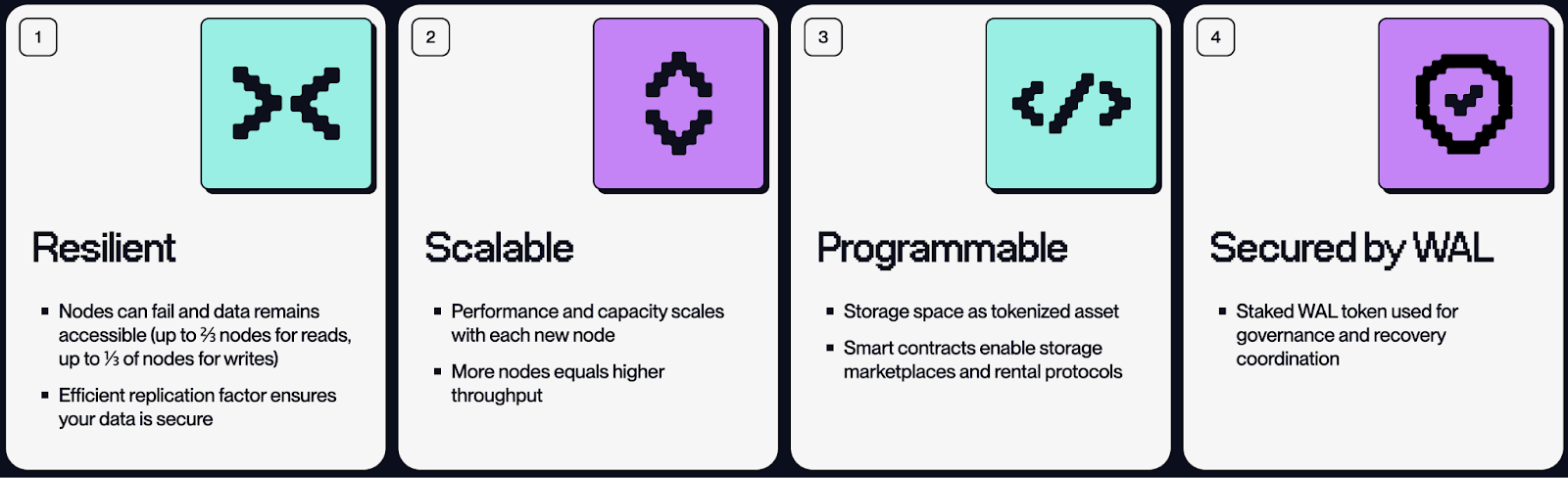
> Data Recovery: Walrus keeps your file safe by splitting it into slivers stored on multiple nodes. If one node loses its sliver, it can quickly recover it from others, ensuring your file remains intact even when some nodes go offline.
> Storage Proofs and Challenges: Walrus verifies that nodes hold the correct data through storage proofs and challenge protocols. Nodes must respond to challenges with parts of the stored data, and authenticated verification using Merkle trees and digital signatures prevents tampering, keeping the network honest and secure.
How Does Walrus’s Decentralized Storage Solution Work?
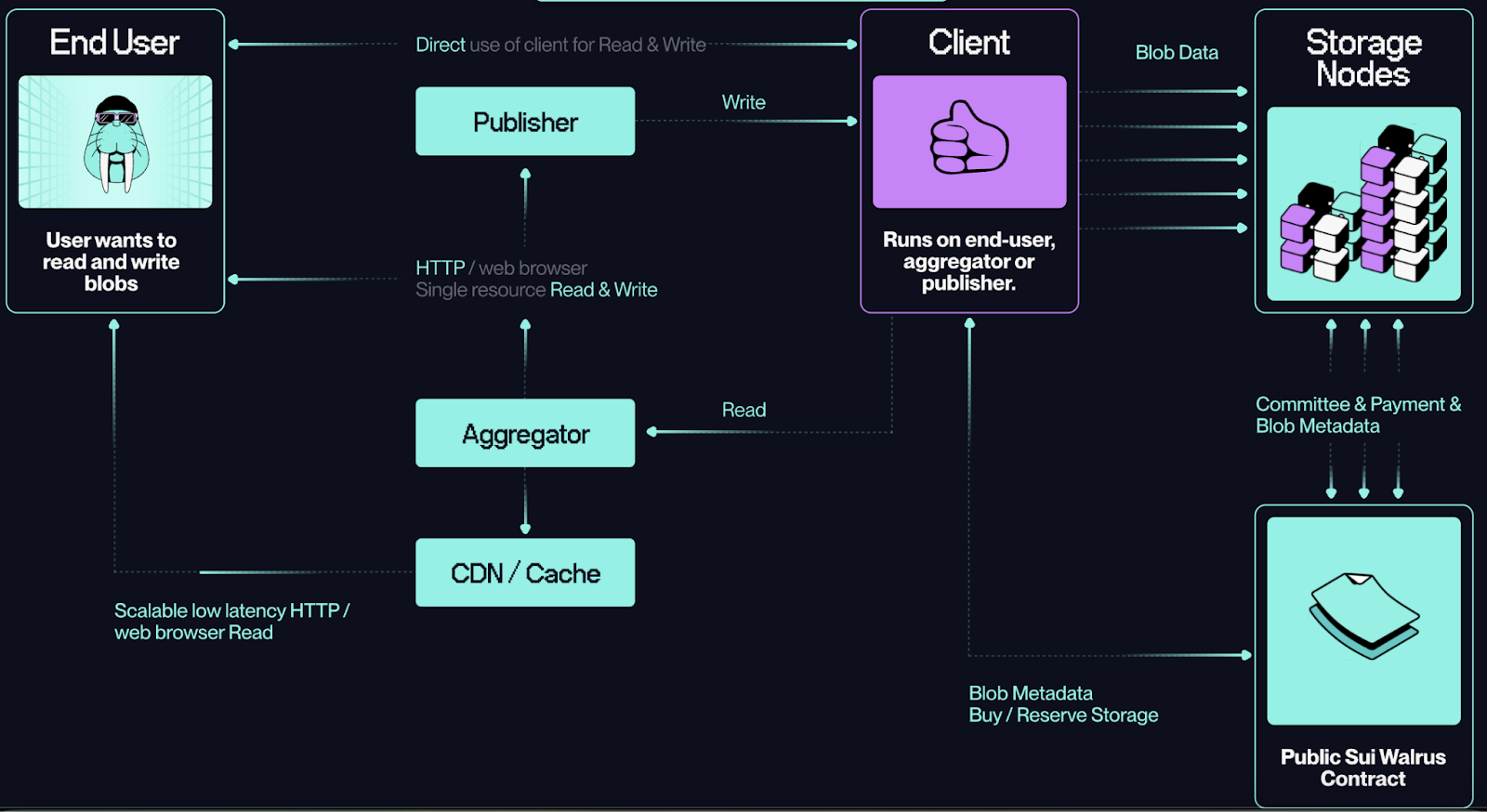
Walrus takes a fresh approach to decentralized storage. It combines coding algorithms with blockchain governance to solve common storage problems.
Decentralized Storage Basics
Traditional storage copies your entire file across many nodes, which is secure but expensive. Walrus uses erasure coding to split your file into small pieces called slivers, so you only need a subset to recover your data. This lowers costs and speeds up recovery.
The Walrus Architecture
The Sui blockchain acts as the control plane, managing storage nodes and file metadata. Storage nodes work together in committees, with each node holding only a fraction of your file. The network operates in fixed periods called epochs, which help manage data writes, reads, and recovery efficiently.
The Red Stuff Encoding Protocol
At the heart of Walrus is the Red Stuff encoding protocol. It is a two-dimensional erasure code that you can think of as a smart way to split and protect your data.
> Walrus’s Red Stuff protocol splits your file into primary and secondary slivers.
> You only need a certain number of slivers (f + 1 out of many) to reconstruct your file, ensuring availability even if some nodes fail.
> The encoding uses simple operations like XOR for fast, lightweight processing.
> If a node loses a sliver, it quickly recovers the missing piece from other nodes, and security is maintained through Merkle trees and digital signatures.
Writing and Reading Data on Walrus
Walrus makes it simple to store and access your data. This two-step process of writing and reading ensures that you have full control over your data. You only download what you need, and the system minimizes overhead by relying on erasure codes.
Writing Data
When you write a file on Walrus, you first encode it into primary and secondary slivers using the Red Stuff protocol. Next, you register your file on the Sui blockchain by sending a transaction that reserves storage space and generates a unique blob ID from the file’s metadata.
Then, you distribute the sliver pairs to storage nodes, which verify the data against the published commitments and acknowledge receipt. Finally, once enough acknowledgments (typically 2f + 1) are collected, you publish a certificate on-chain to prove your file’s availability.
Reading Data
To read your data, you send a request to selected storage nodes for the file’s metadata and slivers. You then collect enough primary slivers (f + 1) that include verifiable proofs, allowing you to reconstruct the original file.
This process ensures that if the data matches the stored commitment, you successfully retrieve your file; otherwise, you receive a failure signal, ensuring integrity and control over your data.