



KuCoin Cross Margin Deep Dive: Unleashing Advanced Trading Strategies and Quantitative Potential
2025/12/09 06:51:02
In the domain of elite crypto trading, the KuCoin Cross Margin model has become a cornerstone for capital efficiency and centralized risk management. This extended analysis moves beyond basic concepts, exploring how to utilize the core mechanisms of KuCoin Cross Margin to execute complex quantitative strategies and hedge systemic risks, thereby aiming to maximize KuCoin capital appreciation.
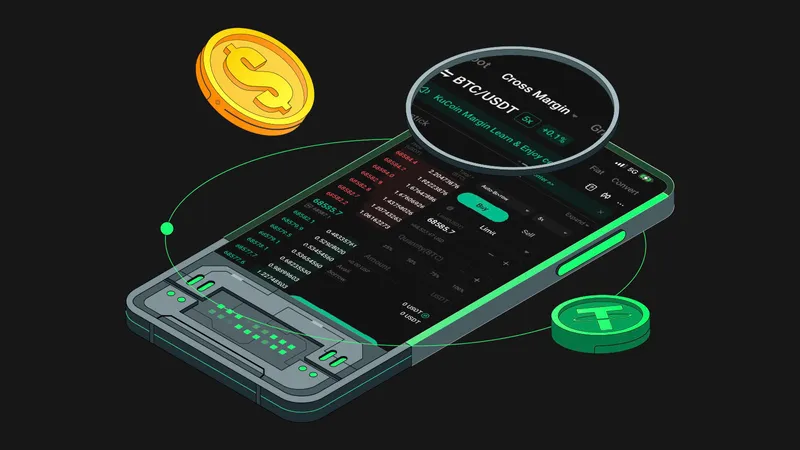
I. Technical Implementation and Fund Pooling Mechanics of KuCoin Cross Margin
The primary advantage of KuCoin Cross Margin lies in its dynamic shared margin pool mechanism. Understanding these technical details is crucial for quantitative and high-frequency traders.
1.1 Dynamic Capital Reallocation
Unlike Isolated Margin mode, which requires manual calculation and transfer, the KuCoin Cross Margin account treats all assets of the same settlement currency (e.g., USDT) as a single liquidity pool.
-
Closure/Profit Injection: When a position (e.g., a BTC long) is closed with a profit, the profit immediately and automatically enters the shared margin pool. This new capital can instantly be used to support another position that is facing losses or requires additional margin (e.g., an ETH short). This frictionless capital transfer is key to maximizing KuCoin trading efficiency.
-
Margin Pressure Diversification: Theoretically, the liquidation risk posed by five small losing positions is much lower than the risk of a single isolated position being liquidated due to severe price swings. KuCoin Cross Margin enhances the overall account's resilience by distributing the pressure.
1.2 The Boundaries of Non-Homogeneous Currency Margins
While USDT-margined contracts can share the USDT balance, it is essential to note:
Professional Tip: Coin-Margined contracts (like BTC-denominated contracts) use the base currency (BTC) as margin. Even in KuCoin Cross Margin mode, BTC-M and ETH-M positions cannot share margin. Traders must calculate margin requirements separately when designing cross-currency strategies.
II. Advanced Risk Quantification and Management: In-Depth TMMR Application
The core risk indicator for KuCoin Cross Margin is the Total Maintained Margin Rate (TMMR). Professional traders must treat TMMR as the primary risk management tool.
2.1 Aggregated Liquidation Price Dynamics
In Cross Margin mode, there is no single liquidation price. Liquidation is not triggered by the price of a single asset but by the TMMR falling to the liquidation threshold (e.g., 100%).
The TMMR is calculated as:
TMMR = (Total Net Equity) / (Total Maintenance Margin Required)
-
Liquidation Trigger Mechanism: TMMR represents the ratio between the total loss of all positions (causing Total Net Equity to drop) and the total required maintenance margin. The account is only subject to forced liquidation when extreme market volatility causes the Total Net Equity to rapidly approach the minimum maintenance margin required by all positions combined.
-
Strategic Significance: This allows traders to withstand greater short-term volatility on individual assets, provided that the value or profit/loss of other assets in the account can hedge or absorb these fluctuations. This is the quantitative foundation for realizing how KuCoin Cross Margin helps hedge risk.
2.2 The Trade-Off Between Insurance Fund and Auto-Deleveraging (ADL)
KuCoin's Insurance Fund is a critical buffer against clawbacks (i.e., insolvency during liquidation).
| Mechanism | Function | Trader Impact |
| Insurance Fund | Absorbs losses when liquidations cannot be executed at a price better than the bankruptcy price. | Reduces the likelihood of users being hit by ADL, ensuring system stability. |
| Auto-Deleveraging (ADL) | A passive liquidation process for the most profitable and highest-leveraged traders, triggered when the Insurance Fund is insufficient to cover losses during extreme volatility. | High-leverage users of KuCoin Cross Margin must monitor their ADL rank and consider lowering leverage or diversifying profits appropriately. |
III. Executing Advanced Strategies Using KuCoin Cross Margin
3.1 Funding Rate Arbitrage Strategy
KuCoin Cross Margin provides the perfect environment for executing funding rate arbitrage strategies.
-
Hold Spot: Purchase the underlying asset (e.g., BTC spot).
-
Short Futures: Open an equivalent short position on a BTC Perpetual Contract in the KuCoin Cross Margin account.
-
Cross Margin Advantage: The spot assets can serve as collateral/part of the margin pool (if supported). Crucially, KuCoin Cross Margin ensures that the margin for your short and spot positions is managed collectively, isolating risk and boosting capital efficiency.
3.2 Diversified Beta Strategy
By simultaneously holding assets with different Beta values (correlation to the overall market), traders can use KuCoin Cross Margin to achieve low-correlation risk in their portfolio.
-
Core Assets: Deploy highly-leveraged core positions in BTC/ETH.
-
Low-Beta Assets: Deploy low-leverage, low-correlation altcoin hedge positions.
The goal of this strategy is to capitalize on the high return potential of core assets while using the flexibility of KuCoin Cross Margin to allow secondary assets to absorb minor adverse movements of the core assets, preventing unnecessary liquidation. This is an advanced application of KuCoin Cross Margin trading techniques.
Conclusion: KuCoin Cross Margin Powers Professional Quantitative Trading
KuCoin Cross Margin is designed for professional traders seeking "KuCoin free trading," deep control, and maximized capital turnover. It offers an environment that is both efficient and secure through its dynamic margin pool, aggregated risk metrics (TMMR), and Insurance Fund system. Mastering KuCoin Cross Margin trading techniques is not just about using leverage, but about professional hedging, arbitrage, and quantified risk management.