

Digital Ruble in Russia: How Offline Payments, Pensions, and Bank Secrecy Will Work
2026/08/25 15:44:00
Introduction
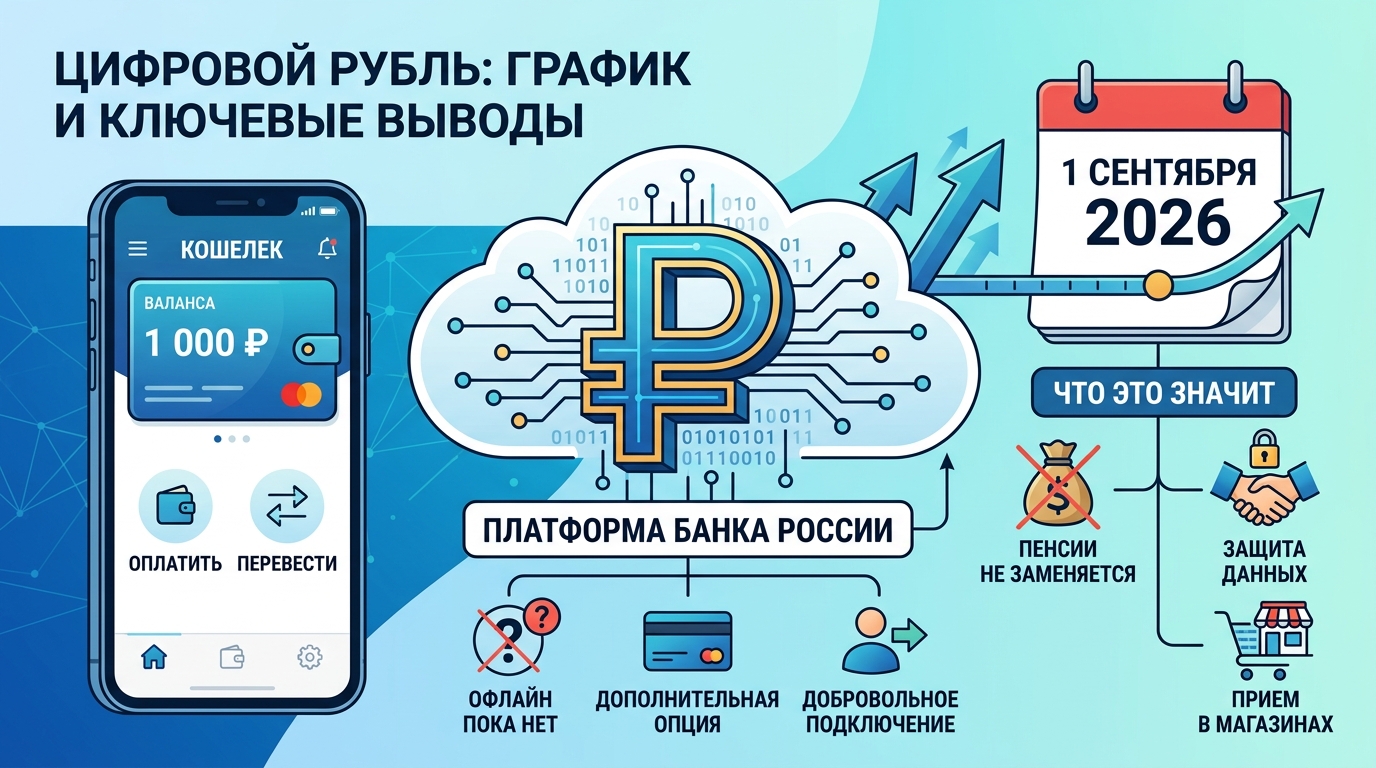
The digital ruble will not become a mandatory replacement for either cash or money held on bank cards, and it cannot yet be used for payments without internet access. The most important milestone ahead of mass rollout is that, from September 1, 2026, 12 systemically important banks are ready to give customers access to digital-ruble accounts; together, these banks account for more than 80% of the payments market.
For ordinary users, the key answers are already clear. The Bank of Russia is planning offline payments, but it will first complete its technology research and move on to testing. Pensions, social benefits, and salaries will not be forcibly transferred to digital accounts. Information about balances and spending should be protected by bank secrecy, while suspicious transfers will still be screened by anti-fraud systems.
What Will Change When the Digital Ruble Launches on September 1, 2026?
September 1 will mark not a one-time replacement of familiar money, but a phased expansion of access to a new form of the ruble. The digital ruble is the third form of Russia's national currency alongside cash and non-cash money. It exists on the Bank of Russia's platform, while users can access their accounts through the mobile app or online bank of a connected credit institution.
The practical value of this architecture is that a digital-ruble account is not tied to the balance sheet of any one commercial bank. A bank provides the interface for opening a wallet and conducting transactions, but the wallet itself is hosted on the regulator's infrastructure. If a user changes their connected bank, phone, or app, access to the account can be restored through available channels; the account itself should not disappear along with a single banking app.
According to the Bank of Russia, access will be provided not only by the 12 systemically important banks but also by credit institutions recognized as significant in the payments market. For customers, however, another point is fundamental: a wallet can be opened only voluntarily. A digital account will not appear automatically, and citizens will not be required to use one.
|
What is changing
|
What it means for users
|
|
Access through banks
|
A wallet is opened voluntarily in the app of a connected bank, but it is hosted on the Bank of Russia's platform.
|
|
Merchant acceptance
|
Merchants with annual revenue exceeding RUB 120 million in the preceding year must enable acceptance according to the rollout schedule and under the conditions established by law.
|
|
Marketplaces
|
Ozon has said it will test digital-ruble acceptance from September 1 and expand it later; Wildberries has said it is operating in line with the Bank of Russia's requirements.
|
|
Payments for individuals
|
Transfers and payments on the platform for individuals have been declared free of charge.
|
Large retailers will become a visible entry point into the new infrastructure. Under the rollout schedule, merchants with revenue above RUB 120 million in the preceding calendar year must begin accepting the digital ruble no later than September 1, 2026, if the legal conditions regarding an agreement with the relevant credit institution are met. Businesses with lower revenue are scheduled to join at later stages.
Marketplaces are also preparing to support this payment method. On August 21, 2026, RIA Novosti reported that Ozon plans to accept digital rubles in test mode from September 1 alongside other payment methods and then expand access, while Wildberries is operating in accordance with regulatory requirements and current rules. This does not eliminate other payment methods: the digital ruble is being added to them, not replacing them.
Will It Be Possible to Pay With Digital Rubles Without Internet Access?
No. As of August 25, 2026, offline digital-ruble payments have not yet launched; the Bank of Russia is only preparing a solution and a subsequent pilot. Alla Bakina, Director of the Bank of Russia's National Payment System Department, said that the regulator is studying the technological capabilities of Russian companies and international experience because the ability to make payments without a connection is important to both citizens and businesses.
The plan is sequential: research is expected to conclude in autumn 2026, after which the Bank of Russia will choose a suitable technical solution and begin testing it. Launching the service can only be discussed after it has been confirmed to operate correctly and safely. Therefore, it would be premature to claim that digital-ruble payments will be possible from September 1 on an airplane, in an underground station without a signal, or in a remote settlement.
Offline payment should not be confused with a standard payment made through a mobile app when the signal is weak. For a truly autonomous transaction, the system would need to confirm a transfer temporarily without accessing the central platform at the moment of payment, and then reconcile the data once connectivity returns to prevent the same amount from being spent twice. The Bank of Russia has not yet publicly disclosed exactly how this logic will work on the Russian platform.
Will Money Be Lost if a Smartphone Is Lost During an Offline Payment?
At present, it is impossible to state reliably either that money will be lost or that it will be restored automatically: the final mechanism for offline storage and loss resolution has not been published. Only the research, solution-selection, and testing stage has been officially confirmed, not a completed operating model for the function.
In international practice, offline payments often involve a limited local balance held in a protected hardware area of a device, known as a Secure Element. This approach allows a phone to temporarily store payment credentials and reduces the risk of data copying. However, this is only a possible technical model, not a description of the already approved architecture for Russia's digital ruble.
The key unresolved issue is how the platform should establish the final balance if a device is lost, damaged, or remains offline for a prolonged period. Rules will be needed to synchronize transactions, verify the owner, identify disputed amounts, and determine losses. Until the regulator announces a final protocol and publishes test results, it is sensible to view offline payment as a prospective feature rather than a promised way to store money without connectivity.
Users should not share their phones, access codes, or banking-app data with third parties while waiting for the new function to appear. The technology does not eliminate the need for basic digital hygiene: reliable device locking and prompt contact with a bank after losing access remain essential for all forms of cashless payment.
Will Pensions, Benefits, and Salaries Be Paid in Digital Rubles?
No. A mandatory transfer of pensions, social payments, or salaries into digital rubles is neither planned nor under discussion. On August 21, 2026, Yaroslav Nilov, head of the State Duma Committee on Labor, Social Policy and Veterans' Affairs, explicitly described the rollout as voluntary and phased: there is no obligation to open a digital account or receive payments into it.
This means pensioners retain the choice of their usual way of receiving money. A pension can continue to be paid to a bank card, while cash may still be delivered by a postal worker. The digital ruble is positioned as an additional option rather than a condition for receiving a state payment.
“There will be no forced transfer of social payments, pension payments, or salary payments to a digital account, and no obligation to hold digital rubles,” Yaroslav Nilov said in a comment to TASS on August 21, 2026.
Voluntary use applies to more than pensions. If an employer or government agency offers digital-ruble payments in the future, the recipient will retain the right to choose whether to use that channel. Therefore, an elderly person does not need to learn a new app or open a wallet merely because of launch-related news: not having digital rubles will not deprive them of their pension or alter their existing payment arrangements.
It is important to distinguish a policy commitment to voluntary participation from what the infrastructure can technically support. The digital ruble may technically be used for transfers and payments, including selected payments received with a person's consent. However, technical availability does not create a legal obligation. This is the key difference between a new payment option and a forced replacement of existing social-payment channels.
Are Digital-Ruble Transactions Protected by Bank Secrecy, and Can Funds Be Frozen?
Digital-ruble accounts and transactions are subject to the same bank-secrecy rules as funds held in traditional accounts, and no one can arbitrarily dispose of a citizen's money. On August 20, 2026, Bank of Russia Deputy Governor Zulfiya Kahrumanova said that information about where and how a person spends their money is not published and remains within the relationship between the customer and the financial system.
Bank secrecy does not mean that transactions are invisible to the payments infrastructure needed to process them. In a cashless payment, a bank also sees technical information about the transfer and the merchant, but that does not give it the right to publish the information or disclose it to third parties. The same confidentiality principle has been announced for the digital ruble.
The official clarification also states that digital rubles belong to the citizen and cannot be frozen arbitrarily. This wording should be read together with another element of the regulator's position: transfers are screened through anti-fraud systems and anti-money-laundering mechanisms. If a transaction appears suspicious—for example, if it resembles an action taken under the influence of fraudsters or an attempted money-laundering operation—the system may request confirmation that the payment is being made knowingly.
Therefore, anti-fraud screening is not the same as constant surveillance of every everyday purchase, nor does it override bank secrecy. It is a protective layer intended to respond to risk indicators. If no suspicious signs are detected, Kahrumanova said, a person can make a transfer in the usual way.
The main takeaway for users is simple: the digital ruble should not be viewed as a public ledger of personal spending or as money the state can use at its own discretion. At the same time, it should not be seen as fully insulated from financial-security rules. Confidentiality and fraud prevention operate in parallel rather than excluding one another.
What Fees and Limits Apply to a Digital-Ruble Wallet?
For individuals, digital-ruble payments and transfers have been declared free of charge, while the monthly RUB 300,000 limit applies only to topping up a wallet from the user's own non-cash account. This distinction matters: the limit does not mean that a person may transfer or spend only RUB 300,000 on the platform each month.
Alla Bakina told RIA Novosti that, once funds are credited, citizens may use the money in their wallets freely, and no limits on transfers within the platform have been announced. The limit applies to converting one's own non-cash rubles into digital rubles—that is, to the incoming transfer from the user's bank account.
The process can be understood in two steps. First, ordinary non-cash rubles are transferred to the digital wallet at a one-to-one rate. The digital rubles can then be used to pay for goods or transfer funds to another user, if the relevant service is available. To obtain cash, the funds must first be transferred back to a conventional bank account and then withdrawn at an ATM or bank branch.
It is also worth noting that the digital ruble is designed as a settlement tool rather than a deposit or lending product. No interest is paid on wallet balances, and it is not possible to open a deposit or take out a loan in digital rubles. For savings, lending, or investment purposes, funds must be transferred to an appropriate financial instrument outside the digital wallet.
How Does the Digital Ruble Differ From Money on a Bank Card and From Cryptocurrency?
The digital ruble is a liability of the Bank of Russia and a payment instrument with a fixed one-to-one relationship to the conventional ruble; it is neither a cryptocurrency nor a bank deposit. It has no independent market price, mining mechanism, or exchange rate: one digital ruble equals one cash ruble and one non-cash ruble.
Money on a bank card is typically recorded on the balance sheet of a particular commercial bank. The digital ruble is held on the Bank of Russia's platform, while banks act as access channels. As a result, a user has a single wallet that can be accessed through the apps of connected banks, rather than separate independent balances at each bank.
Cryptocurrency works differently. Its price is set by the market and can change sharply, while the operation of its network depends on the rules of a particular blockchain or token issuer. The digital ruble is not intended for speculative trading and does not replace digital assets traded on cryptocurrency platforms. Its purpose is to facilitate payments within the established national payments infrastructure.
This distinction is especially important for security. Advertisements offering a “profitable purchase” of digital rubles, promises of returns, or requests to transfer money to someone else's wallet in order to receive digital rubles should be treated with caution. The official digital ruble is accessed through connected banking infrastructure, not bought from a discounted intermediary. When in doubt, users should check information in their banking app and never disclose one-time codes or access credentials to strangers.
KuCoin Offers A More Stable Option in A Volatile Market
If you worry about the frequent ups and downs in the market, and pursue a more stable option to earn money passively, KuCoin is the right place to come:
Simple Earn: Deposit and withdraw tokens anytime, earning stable returns.
Kucoin Earn: Earn stable profits with professional asset management.
Hold to Earn: Earn rewards by holding assets in Funding, Trading, Margin, Futures, Mining, and Unified Accounts.
Staking: Unlock the earning potential of on-chain assets.
Advanced Investments: Advanced Investments offer a variety of structured products to help your money grow in any market.
Shark Fin: Principal Protection and Guaranteed Gains
Dual Investment: Buy low and sell high with transparent return calculations.
Snowball: High yields, with price protection.
Discount Buy: Buy crypto at discount prices.
KCS Loyalty: Level up to enjoy exclusive perks by staking ≥ 1 KCS.
KuCoin Wealth: Discover future value and begin your smart investing journey.
KCS Benefits: Hold and stake KCS to access benefits across the platform.
KCS Staking 2.0: Participate in KCS on-chain governance to earn yield.
Conclusion
The digital ruble is approaching mass rollout as an additional form of national money, not as the abolition of cash, bank cards, or familiar payment channels. From September 1, 2026, the largest connected banks are expected to begin providing wallet access, while major merchants are expected to accept this payment method according to the established schedule. For individuals, transfers and payments have been declared free of charge, while top-ups from their own non-cash accounts are limited to RUB 300,000 per month.
The main user questions now have unambiguous answers. Offline payments without internet access remain at the research and future-pilot stage, so they should not be treated as an available feature. Pensions, benefits, and salaries will not be forcibly transferred into digital rubles. Transactions and information about them are protected by bank secrecy, although suspicious transfers will be checked through protective mechanisms.
The core principle is straightforward: open a wallet only if you need one, use it through the official app of a connected bank, and do not confuse the digital ruble with a tradable cryptocurrency. This will help users adopt the new payment instrument thoughtfully and without unrealistic expectations.
FAQs
1. Do I Need to Install a Separate App for the Digital Ruble?
No. A separate app is not required. Access to a digital-ruble account is expected to be available through the usual mobile app or online bank of a credit institution connected to the Bank of Russia's platform. Before opening an account, users should make sure that the app was downloaded from an official app store or the bank's official website.
2. Does a Digital-Ruble Balance Earn Interest?
No. No interest accrues on a digital-ruble balance. The digital ruble is intended for payments and transfers rather than savings: users cannot open a deposit, savings account, or loan in this form. For those purposes, funds must first be transferred to a standard bank account.
3. Can Digital Rubles Be Withdrawn Directly From an ATM?
No. They cannot be withdrawn directly from a digital wallet. Digital rubles must first be transferred to a regular bank account through the app and can then be withdrawn as cash from an ATM or bank branch. This is because the digital ruble does not have a physical banknote form.
4. Which Merchants Are Exempt From the Requirement to Accept the Digital Ruble?
Small merchants and points of sale without internet access may fall outside the acceptance requirement. The rollout guidance lists exemptions for companies with total annual revenue below RUB 20 million, retail outlets with revenue below RUB 5 million, and places of sale without internet access.
5. Will Businesses Need to Replace Their Terminals to Accept Digital Rubles?
Not always. If a business already accepts payments through Russia's Faster Payments System, or FPS, it may not need specialized equipment. According to RBC's explanation, from September 1, 2026, such merchants will be able to use their existing online channels and terminals to accept the digital ruble after completing the necessary organizational and technical setup.
Disclaimer : This material is provided for informational purposes only and does not constitute financial, investment, legal, or tax advice. Transactions involving cryptocurrencies and tokenized assets carry substantial risks — including price volatility, limited liquidity, counterparty exposure, and the potential for total loss of invested capital. Readers should conduct their own research and, where appropriate, consult a qualified professional before making any financial decisions.