

Cryptocurrency in Russia’s Financial System After the PLUS Forum: What Federal Law No. 282-FZ Changes
Introduction
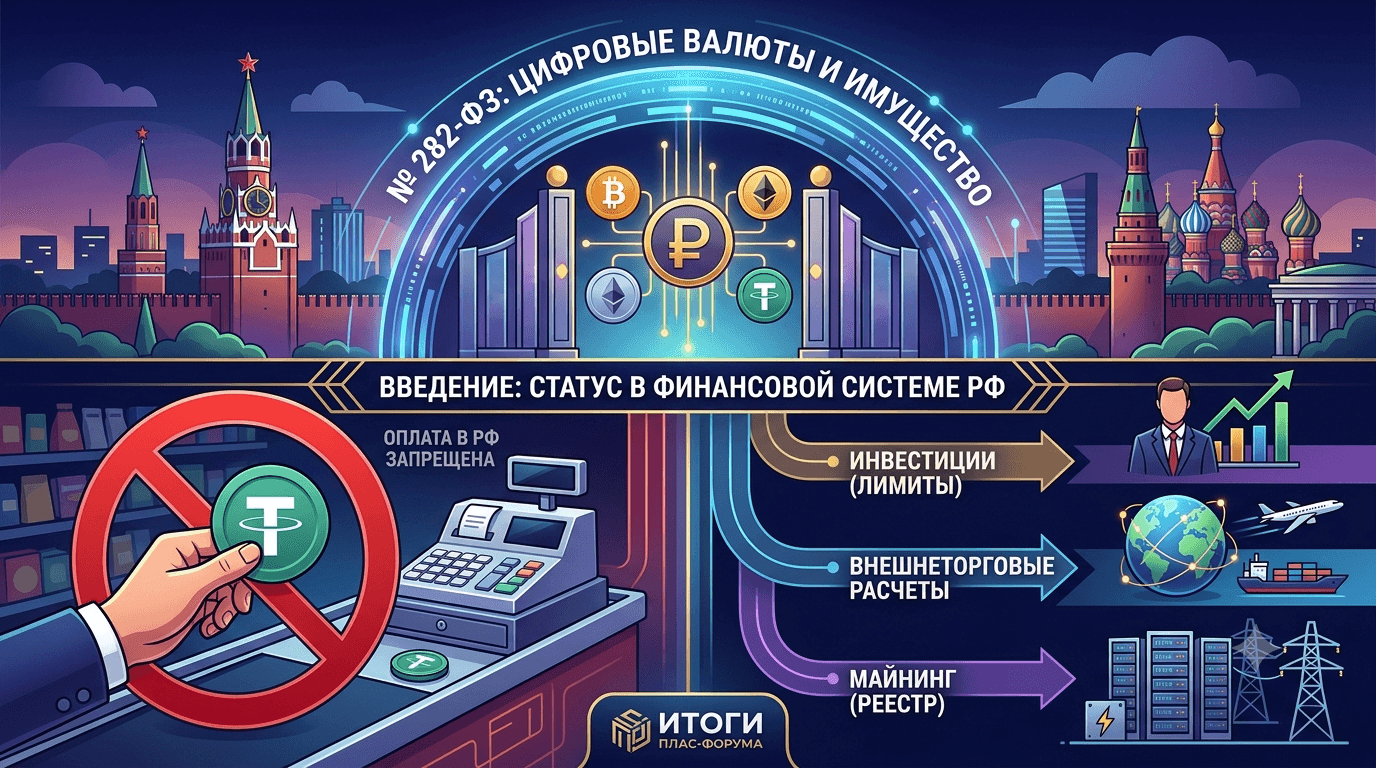
Can cryptocurrency be considered part of Russia’s financial system if it still cannot be used to pay for purchases inside the country? After September 1, 2026, the answer is yes, but only in a limited and strictly regulated role. Federal Law No. 282-FZ of August 4, 2026, “On Digital Currencies and Digital Rights,” recognized digital currency as property and established rules for investors, miners, exchange services, and cross-border settlements, while retaining the ban on using cryptocurrency to pay for goods and services in Russia.
The results of the 17th International PLUS Forum “Payment Business and Money Circulation,” held in Moscow on September 8–9, 2026, showed the practical direction of the reform. Participants discussed stablecoins as payment rails, cryptocurrency settlements in foreign trade, Web3, DeFi, and digital infrastructure—not the replacement of the ruble in the everyday economy.
What Exactly Did Federal Law No. 282-FZ Change?
The main change is that cryptocurrency has received a defined property and regulatory status. Federal Law No. 282-FZ treats digital currency as property, so individuals are generally allowed to hold, buy, sell, gift, and inherit it. However, recognizing cryptocurrency as property does not turn it into a legal means of payment in Russia.
Starting September 1, 2026, Russian companies and individuals may not accept digital currency or digital rights as payment for goods, work, services, information, or intellectual property. The ban also applies to advertising cryptocurrency payments inside the country. In other words, a person may own BTC, ETH, or USDT as an asset, but a store may not set a price in USDT and accept that token instead of rubles.
At the same time, lawmakers created separate rules for digital depositories, crypto exchanges, access to transactions, and the analysis of digital currencies. This marks a shift from a model in which “the market exists outside the legal field” to a model of controlled access through authorized infrastructure. In practice, not only the asset matters, but also the intermediary’s status, the source of funds, customer identification, and the ability to substantiate the transaction.
The law also provides a transition period until July 1, 2027, for certain requirements. Therefore, in September 2026, the market is already operating under the new framework, but some mechanisms still depend on implementing regulations and Bank of Russia procedures. For users, this means they must check not only the text of the law but also the current rules of a particular intermediary.
How Does Federal Law No. 282-FZ Regulate Individual Investors?
Individual investors have the right to buy and sell cryptocurrency, but access for non-qualified investors is restricted by testing, established limits, and the use of an official intermediary. Under the new regime, after passing the required test, a non-qualified investor may purchase highly liquid tokens, including BTC, ETH, and USDT, through a licensed or otherwise authorized intermediary up to a limit of 300,000 rubles per year.
This limit applies to purchases through a regulated channel, not to the mere ownership of digital assets. It does not mean that a citizen must sell assets after reaching the threshold or that an increase in the value of cryptocurrency already purchased automatically becomes a violation. However, transactions through uncontrolled services create additional risks of blocking, source-of-funds checks, and the inability to prove the acquisition cost.
Starting July 1, 2027, compliance through the relevant intermediaries is expected to become mandatory for cryptocurrency trading. The transition period gives participants time to organize their records, identification procedures, and documents. Investors should already retain purchase confirmations, wallet information, transfer histories, and fee records.
The main mistake is to treat legalization as an unconditional guarantee of returns or protection against volatility. The law establishes permissible transaction boundaries, but it does not compensate for a price decline, an incorrect blockchain transfer, lost keys, or the risk of an unreliable service. A regulated channel reduces legal and operational risks, but it does not eliminate investment risk.
How Is Cryptocurrency Sales Income Taxed?
Tax arises when cryptocurrency is sold at a profit, not merely when it is held or increases in value in a wallet. The taxable result is calculated as sales income minus documented acquisition expenses. Depending on the income amount, a personal income tax rate ranging from 13% to 22% applies.
Investors should therefore distinguish among three events: purchase, unrealized appreciation, and sale. If BTC becomes more valuable but remains with the owner, the price increase itself does not create realized income. If the asset is sold, its acquisition cost may be deducted only when supported by evidence, such as an intermediary statement, bank payment record, exchange report, or comparable documentation.
A lack of documents increases the risk that the tax base will be calculated without fully accounting for costs. Active traders will also need to reconcile trades, fees, swaps from one token to another, and transactions through foreign platforms. Starting May 2, 2027, residents will also be required to report transactions involving digital currencies on foreign systems.
What Will Change for P2P Transactions and Withdrawals?
One-off transactions between individuals are not directly prohibited, but systematic exchange activity must be conducted through the official registry and authorized infrastructure. The dividing line is determined not only by the name of the transaction but also by its scale, frequency, purpose, and economic substance.
Selling one’s own asset occasionally is different from regularly accepting rubles from clients in exchange for USDT. The latter may constitute professional exchange activity requiring an appropriate status. The use of multiple cards, repeated transfers from different individuals, and public solicitation of clients increase the likelihood that transactions will be classified as organized exchange activity.
Starting July 1, 2027, banks will be required to refuse transfers to unauthorized recipients suspected of illegally exchanging cryptocurrency without inclusion in the official registry. The Bank of Russia will provide credit institutions with information about foreign payment services connected with such transfers. This changes the withdrawal process: the technical ability to send a transfer does not mean that the transaction is legally acceptable.
|
Scenario
|
Legal meaning after September 1, 2026
|
Main risk
|
|
Sale of one’s own asset
|
Permissible if rules and tax accounting requirements are followed
|
Unsubstantiated acquisition cost
|
|
One-off P2P exchange
|
Not automatically prohibited
|
Incorrect payment block
|
|
Regular exchange for clients
|
Must use the official registry and authorized infrastructure
|
Activity being classified as illegal
|
|
Paying for goods with cryptocurrency in Russia
|
Prohibited
|
Violation of the domestic payment ban
|
A safer strategy for users is not to use a personal card as a settlement hub for other people’s transactions, to verify a counterparty’s status, and to retain the purpose and confirmation of every transaction. In a disputed transaction, a bank may request documents showing the origin of the funds and the economic purpose of the transfer.
How Do the New Rules Affect Mining?
Mining remains possible in Russia, but it is subject to registration, energy, tax, and regional restrictions. The Federal Tax Service states that individual entrepreneurs and Russian legal entities must be included in the registry of persons conducting digital-currency mining before beginning such activity; applications are submitted through the “Mining Registry” service using an electronic signature.
For an individual who is not an individual entrepreneur, the electricity-consumption limit is 6,000 kWh per month. Exceeding this level moves the activity into a category where the simplified household-mining regime cannot be claimed. Regardless of scale, a miner must submit information about mined coins and wallet addresses to the Federal Tax Service no later than the 20th day of the month following the reporting month.
There is also a territorial restriction. A complete mining ban applies in 16 specifically designated regions, including Moscow, the Moscow Region, southern Irkutsk Region, and Dagestan. Before launching equipment, miners must check the current list of restricted territories and seasonal power-system restrictions, because the region’s status matters more than the availability of spare capacity for an individual consumer.
Proper mining records should include the volume of coins mined, receipt dates, wallet addresses, electricity consumption, and subsequent sales. Sales income is taxed under the rules applicable to individual income. Mining should not be viewed as a way to bypass purchase rules: mined coins also become part of the owner’s tax and information trail.
Can Russian Businesses Use Cryptocurrency in Foreign Trade?
Yes. Federal Law No. 282-FZ allows settlements in digital currency under foreign-trade contracts between Russian residents and foreign counterparties, but these transactions are neither unrestricted nor anonymous. They must be conducted within the framework of currency control, bank recordkeeping, and a documented foreign-trade obligation.
The practical importance of this rule is that BTC or USDT can be used as a settlement instrument when the traditional cross-border payment chain is slow, expensive, or unavailable. At the PLUS Forum, financial-sector representatives specifically discussed cross-border settlements, stablecoins, and reducing the number of payment intermediaries.
However, a foreign-trade settlement does not eliminate the need to verify the contract, price, counterparty, source of funds, and economic purpose. According to explanations published after the law was adopted, foreign-trade contracts involving settlements in digital currencies are subject to bank-registration requirements, with thresholds of 3 million rubles for imports and 10 million rubles for exports remaining in place. Banks must also record information about such settlements in bank-control statements.
For a company, this means that cryptocurrency becomes an additional payment rail rather than a replacement for accounting. The contract should specify the asset, network, settlement moment, conversion rate, fees, refund procedure, and actions to be taken in the event of a technical error. The sanctions, AML, and tax risks of both parties must also be assessed separately.
Why Did Stablecoins Become a Central Topic at the PLUS Forum?
Stablecoins became central to the discussion because they combine the characteristics of blockchain transfers with a peg to a fiat currency. Compared with volatile tokens, they are more convenient for settlements and liquidity management, although they do not eliminate issuer, reserve, address-freezing, or regulatory-change risks.
At the PLUS Forum session “Cryptocurrencies 2026—Integration into the Payment System. Web3 and DeFi Today,” participants discussed stablecoins as new payment rails, the BRICS blockchain, cross-border transactions, and digital-asset infrastructure. This set of topics shows that the market is moving not toward unrestricted use of cryptocurrency at the cash register, but toward specialized channels connecting financial institutions, exporters, importers, and technology platforms.
This is particularly important for Russia’s foreign trade. A stablecoin can reduce the number of intermediaries and accelerate settlement, but its use requires wallet screening, sanctions-list checks, counterparty verification, and accurate documentation. Technological speed does not replace legal certainty.
Web3 and DeFi have not received automatic immunity either. A smart contract may execute without a bank, but the Russian participant remains responsible for tax consequences, the legality of the source of funds, and compliance with prohibitions. Decentralization alone does not prove that a transaction falls outside the jurisdiction.
How Does Cryptocurrency Fit into Russia’s Financial System?
Cryptocurrency occupies a niche in Russia’s financial system as property, an investment asset, and an instrument for certain foreign-trade settlements, but it does not have the status of national money. This distinction was the main conclusion of the PLUS Forum.
The first level consists of citizens and investors who buy and sell digital assets through regulated channels. The second consists of intermediaries, digital depositories, and exchange infrastructure responsible for access, identification, and control. The third is business using digital currency in international contracts. The fourth includes government agencies, banks, and the tax service, which monitor flows, reporting, and risks.
|
System level
|
Role of digital currency
|
What limits its use
|
|
Private investment
|
Property and transaction object
|
Testing, purchase limit, taxes, and volatility
|
|
P2P and exchange
|
Asset sale or conversion channel
|
Registry, bank control, and the ban on illegal exchange
|
|
Foreign trade
|
Settlement instrument under a contract with a nonresident
|
Currency control, documentation, and AML checks
|
|
Domestic purchases
|
Not permitted as a means of payment
|
Direct ban on payment for goods and services
|
|
Mining
|
Method of obtaining digital currency
|
Registry, energy limit, reporting, and regional bans
|
This approach explains the apparent contradiction in the reform. Russian law permits ownership of cryptocurrency and its use in certain economic scenarios, but at the same time prevents cryptoassets from competing with the ruble in everyday payments.
Should You Buy or Trade Cryptocurrency Through KuCoin?
Trading digital assets makes sense only after checking your status, the restrictions under Russian law, your tax obligations, and the availability of the particular service. KuCoin may be used as an international-market trading platform, but users are individually responsible for ensuring that their transactions comply with local law, bank requirements, and income-recordkeeping obligations.
Before registering, define your objective—long-term holding, short-term trading, or transferring an asset for a foreign-trade settlement. Then check whether the selected service supports identification, provides a transaction history, and allows users to export trade and fee data. This information is necessary for calculating the tax base.
Do not use a cryptocurrency exchange to pay for Russian goods or services, disguise commercial exchange as personal P2P transfers, or send rubles to unknown exchangers. Beginning investors should consider the limits applicable to non-qualified participants, complete the required testing, and avoid using borrowed funds.
KuCoin does not guarantee capital preservation, a stable exchange rate, or the absence of restrictions imposed by banks and regulators. Every trading strategy should begin with checking the legal channel, not with a promise of high returns.
Beyond the Headlines: What KuCoin 5.0 Means for You
Market news moves fast — but where you act on it matters just as much. This October, KuCoin launches KuCoin 5.0, transforming KuCoin into a rebuilt platform. Here's what actually changes for you:
-
One account for everything. Older platforms split your money across separate "spot," "margin," and "futures" accounts and expected you to understand why. KuCoin 5.0's unified account removes that entirely — deposit once, and everything is simply there.
-
Stocks, indices, and commodities. KuCoin 5.0 expands beyond crypto into global markets. When crypto chops sideways and equities rally (or the reverse), you rotate in minutes instead of opening a brokerage account and waiting days for fiat rails.
-
Real-world assets (RWA). Tokenized exposure to traditional assets like commodities, right inside your crypto account. One of the fastest-growing segments in global finance is no longer reserved for institutions — you access it from the same balance you trade with.
-
Earn while you learn. Not ready to trade? KCUSD lets your stablecoins earn daily, auto-compounding interest. The lowest-stress way to put your idle deposit to work for 4% yield.
-
An AI assistant in plain language. Ask questions, get market context, understand what you're looking at — built into the platform, no jargon required.
-
An app that doesn't overwhelm. Faster, cleaner, and consistent — intuitive from the first tap, not after a tutorial.
-
Safety you can check, not just trust. A MiCAR-licensed EU entity, Proof of Reserves you can verify yourself, and internationally certified security (SOC 2 Type II, ISO 27001:2022).
Create your account in minutes — and start on the platform built for where crypto is going, not where it's been.
Conclusion
After Federal Law No. 282-FZ entered into force, cryptocurrency in Russia received not the status of free money but the status of regulated property. Holding, buying, selling, gifting, and inheriting digital assets are permitted, but individual-investor transactions are limited by testing, thresholds, and intermediary requirements. Profit from sales is subject to personal income tax, while a lack of documents proving acquisition cost may increase the tax burden.
P2P exchange is not automatically prohibited, but systematic activity must be conducted through the official registry. Starting July 1, 2027, banks may block transfers to unauthorized exchangers. Mining requires recordkeeping, compliance with the 6,000 kWh limit for individuals, reporting by the 20th day, and verification of regional bans.
The main potential of the new regime lies in investment, digital infrastructure, and foreign trade. At the PLUS Forum, cross-border settlements, stablecoins, Web3, and DeFi were the subjects of professional discussion. At the same time, domestic payments for goods and services in cryptocurrency remain prohibited. Russia’s model is therefore based not on replacing the ruble, but on the controlled integration of digital assets into selected segments of the financial system.
Frequently Asked Questions
1. Can BTC and ETH be held in Russia after September 1, 2026?
Yes. The law recognizes digital currency as property, so individuals may hold BTC, ETH, and other assets. Tax does not arise merely from holding an asset or seeing its price increase; it arises when the asset is sold at a profit.
2. Can cryptocurrency be used to pay for a car or real estate in Russia?
No. Starting September 1, 2026, digital currency cannot be accepted as payment for goods, work, services, information, or intellectual property in Russia.
3. Are USDT transfers between individuals permitted?
A one-off transaction between individuals is not automatically prohibited. However, regular exchange for clients must be conducted through authorized infrastructure, and transactions involving unofficial exchangers may result in a bank refusal.
4. Does an individual need to register to mine cryptocurrency?
An individual who is not an individual entrepreneur may mine within the 6,000 kWh monthly limit without registering as an individual entrepreneur. However, the person must submit information about mined coins and wallets within the required deadlines and comply with territorial bans.
5. Can a Russian company accept payment in BTC from a foreign client?
Yes. Settlements under a foreign-trade contract between a Russian resident and a foreign counterparty are permitted. The company must execute the contract, pass bank and currency-control procedures, verify the counterparty, and record the transaction in its reporting.
Disclaimer : This material is provided for informational purposes only and does not constitute financial, investment, legal, or tax advice. Transactions involving cryptocurrencies and tokenized assets carry substantial risks — including price volatility, limited liquidity, counterparty exposure, and the potential for total loss of invested capital. Readers should conduct their own research and, where appropriate, consult a qualified professional before making any financial decisions.