



KuCoin AMA With Union (U) — Building a Decentralized, Quantum-Secure Bridge for Modern Finance
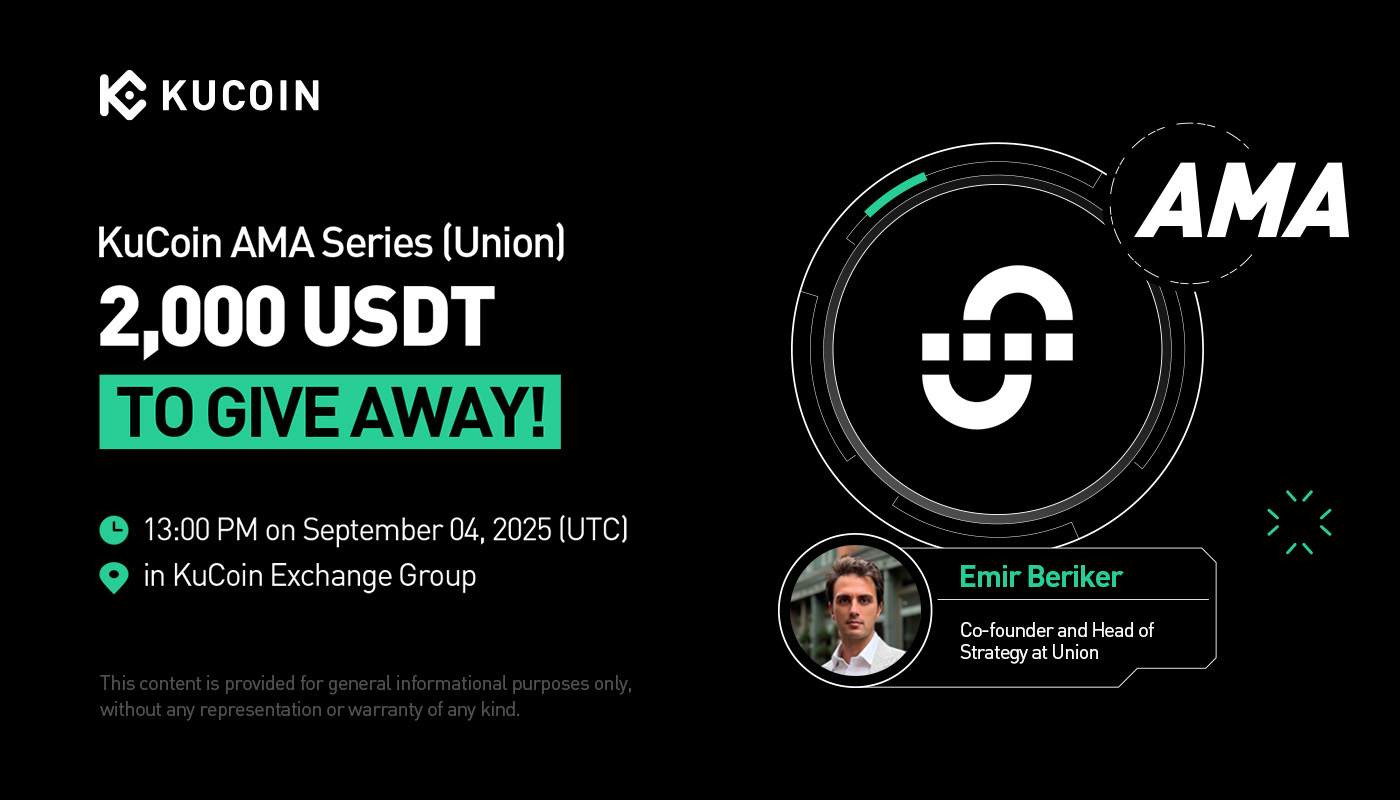
Dear KuCoin Users,
Time: September 04, 2025, 13:00 - 14:32 (UTC)
KuCoin recently hosted an AMA (Ask Me Anything) session in the KuCoin Exchange Group, featuring Karel Kubat, Co-Founder and CEO at Union.
Official Website: https://union.build/
Q&A from KuCoin to Union
Q: What is Union (U), and what function does it serve within the blockchain ecosystem?
Karel: Union is like an octopus that connects blockchains as well as banks and traditional finance companies. You can think of it as a modern version of S.W.I.F.T., but fully decentralized and quantum secure. We don’t rely on private keys or oracles for security; instead, we use zero-knowledge cryptography, similar to Worldcoin. This approach makes us extremely efficient and scalable.
Our infrastructure is used by asset issuers and blockchains, and we see the most traction with larger institutional parties, who use us as a native bridge for transfers ranging from $5 million to $40 million. Our focus is on making crypto as seamless as Web2 and widely accessible.
Q: Could you explain the differences between Union and other interoperability protocols?
Karel: The biggest difference is that Union is not primarily built for regular users. It is designed for developers and companies to build on, making it highly programmable with SDKs in various programming languages. We support MoveVM, Rust, Solidity, and soon Solana as well.
Unlike regular bridges, which rely on oracles or multisig for security—methods that are far less secure than zero-knowledge cryptography—Union is built with security at its core. Bridge hacks are one of the biggest problems in crypto, causing users to lose billions of dollars. Union is specifically designed to address this issue.
Q: How does U’s tokenomics align the community, investors, and core contributors?
Karel: The U token is the central hub for all revenue. All fees generated are effectively converted into U and distributed to our stakers. Additionally, our products, such as AuroBTC, generate revenue that is used to buy back U. Essentially, if you believe that cross-chain volume will grow and more businesses will build their own blockchains, U is the token that represents this potential.
The team is excluded from staking rewards until their tokens are fully vested, meaning that currently only unlocked community members earn yield. This also helps prevent sell pressure from VCs and team members. Our investors come from the tech sector and their holdings are locked for an additional two years.
Q: What strategies did Union use to cultivate a devoted zkgm community?
Karel: We didn’t actively build a community; we simply developed in the open. One thing we are proud of is shipping often and in public. This allows community members to see new features as we work on them and understand the effort the team puts in. Over time, this transparency builds trust, which naturally fosters a strong and engaged community.
Q: What is Union's role in BTCfi?
Karel: Since Union’s core characteristics are high security and decentralization, it aligns closely with Bitcoin’s core values. Large Bitcoin holders—think 10,000 BTC or more—value self-custody and security above all else. Union connects these funds with DeFi protocols, enabling BTC to earn more yield while making DeFi more efficient.
Additionally, we serve as a core infrastructure partner for Babylon, acting as the native bridge for the BABY token. Babylon is one of the largest BTC staking providers, positioning Union at the heart of BTCfi.
Q: Where do you see Union next year?
Karel: We have three major catalysts:
1. Expansion into stablecoins: We aim to replicate our success with BTC in the stablecoin space.
2. Faster infrastructure: Currently, our bridge time is around 20 seconds. We are confident we can reduce this to under 6 seconds.
3. TradFi: Providing blockchains with access to stocks and other traditional financial products.
With these components, we expect Union to become a dominant player in the blockchain space. Our roadmap is for the next 3 years. We have a lot of exciting products to build. So in 1 year, we will have barely started with the master plan. Ultimately, our goal is for Union to become a trillion-dollar ecosystem.
Free-Ask from the KuCoin Community to Union
Q: Union emphasizes a seamless user experience while leveraging advanced technologies behind the scenes. How does Union balance the complexity of its underlying architecture with the simplicity needed for everyday users? In what ways does this approach differentiate Union from other projects trying to combine robust technology with mass adoption?
Karel: Union’s strong technology actually makes the user experience easier—not because we expect users to fully understand Union, but because we want developers to understand it and integrate it into their own products. For example, Escher.finance directly embeds Union in their app in a chain-abstracted way. This means users don’t even need to know Union is running under the hood. That’s our end goal: to be the “sleeping giant” powering most applications.
Q: The crypto industry has seen numerous bridge hacks costing billions in losses. How does Union's zero-knowledge consensus verification approach fundamentally address these security vulnerabilities?
Karel: With zero-knowledge proofs, there are no private keys for hackers to steal. Major bridge hacks typically happen when hacker groups gain access to developer laptops or servers, and through that, the private keys used to operate the bridge.
Zero-knowledge proofs work differently. Instead of relying on private keys, we create a mathematical proof of a block and use that as the underlying security for a transfer. For example:
Bob locks $100 on Ripple and wants to move it to Ethereum.
We provide this proof to a smart contract on Ethereum, which can now be 100% certain it is safe to release $100 to Bob.
It may seem simple and almost magical, but this represents a fundamental shift in bridge security—on a scale comparable to moving from steam power to electricity.
Q: How does Union balance advanced Web3 mechanisms with user-friendly design to appeal to both newcomers and experienced crypto users, and how does this strengthen its market positioning?
Karel: One thing I hate is the idea of switching chains. I don't want a wallet to tell me I have $20 on Solana and $80 on Tron. I want to see I have $100, and when I trade or LP, I want the underlying bridge to convert for me. We are not fully there yet, but this is what we are building towards. And that is what I think is necessary for both new users, but also existing users.
I don't think experienced crypto users like using crypto. We do it because we are early and understand the opportunity. But the UX isn't as good as outside of crypto. So on our end, now that our core technology has been built, we are switching gears and focussing 90% on UX. UX for users, UX for developers.
Q: What are Union’s long-term goals for driving DeFi adoption, and how do you envision KuCoin supporting that vision?
Karel: DeFi is potentially the most efficient way to generate yield, since it eliminates the need to pay middlemen. This means exchanges like KuCoin should integrate DeFi protocols and offer them directly to their users. While we already see this happening, it hasn’t yet reached its full potential. KuCoin is clearly more advanced than most exchanges in this regard.
By contrast, platforms like Revolut currently only allow trading and don’t integrate DeFi. We envision a future where banks like Revolut, or exchanges like KuCoin, use Union to connect their products to hundreds of blockchains, enabling them to offer the best possible yield to their users.
Q: Union recently announced 'U' as its native token, designed for fees, staking, and cross-chain governance. Can you explain how 'U' functions as gas, secures the network, and enables governance across chains?
Karel: Yes. As part of the core protocol, we take many bridge transfers and zero-knowledge proofs and batch them together. Batching makes execution more efficient, which reduces fees. However, batching must occur on the Union ZK L1, where U is used as gas to process these batches. Other protocols can also deploy smart contracts here to interact with these batches, creating additional demand for U. This benefits U holders, as the ecosystem uses U to run complex logic, and stakers benefit from the resulting revenue.
On top of that, U is used for governance—holders can vote on fee levels, new chains to be added, and other protocol parameters. One particularly cool feature is that U is a truly cross-chain token. You can use U on Ethereum in DeFi while still receiving staking rewards and voting on proposals, then move it to Babylon and continue enjoying the same benefits.
Q: Union isn't just pipes, it’s powering asset transfers, NFTs, DeFi routes, and cross-chain messaging. Which real-world apps or use cases are already live or in development that best demonstrate its capabilities?
Karel: Native bridging is fully live and currently powers around $600 million in capital.
Escher uses it for cross-chain staking and DeFi. We also leverage it for AuroBTC to handle yield distribution. Additionally, Babylon uses our cross-chain messaging to provide security for its Bitcoin Supercharged Networks. At present, we process roughly 5,000 API requests per minute on behalf of protocols integrating with Union.
Q: Union uses PoS for network security, with staking that includes dynamic inflation and cross-chain participation. How does staking work, what is the emissions schedule, and how can users vote or govern across chains like Ethereum using 'U'?
Karel: Stakers delegate to nodes, which handle computation and batching. These nodes are operated by professional parties, though you can also run a node yourself if you have the technical skill. As nodes earn fees, 95% is distributed to stakers and 5% goes to the node operator.
Union also has token emissions, which are distributed to stakers. These emissions decrease each year and are primarily intended to bootstrap the network. Users can use U to create proposals and lock U to vote on them. It’s possible to stake and vote simultaneously. Current emissions are 6%, and votes can be used to adjust this rate, although 6% is considered a healthy schedule.
Q: Beyond the current 2025 roadmap, what is Union’s single biggest long-term goal, and which key metric—aside from token price or market cap—will you use to measure its success over the next 3–5 years?
Karel: Number of grandmas using Union (even if they do not know it). So effectively; how deeply can we penetrate the market at all layers. Such that even the least technical people use Union in some way.
Q: Can you tell us more about the background and experience of the team behind Union? What makes them uniquely qualified to develop and manage the project?
Karel: We are a team of senior engineers, former ConsenSys consultants, and even have the head of operations from a nuclear warship serving as our COO.
Union prioritizes hiring highly skilled individuals who are driven to make a meaningful impact. Our team is global, spanning Australia, India, China, Europe, and the US. Personally, I collaborate with the Dutch National Bank on crypto research for EU stablecoin architecture and advise over 10 other projects.
Q: What advantages does the U token offer that might convince someone to switch from their favorite token? Many investors focus on short-term price movements rather than the project’s real value. Can you explain the long-term motivation and benefits of holding $U?
Karel: We are not looking for investors who want to flip $U in a few weeks. $U is a multi-year play for those who believe in crypto. The potential upside is significant, but the payoff horizon is long. Ripple holders had to wait years—and $U holders may face a similar timeline, or possibly shorter. Even I don’t know for sure.
The advantage of $U is that it functions as the flywheel of our ecosystem. Early holders received $BERA and are currently earning yields from Escher and Tower as well.
Q: Do you have audit certificates, or are you currently undergoing audits to enhance the security and reliability of your project?
Karel: Union has been audited twice by Cantina and Informal Systems, two of the top auditors in the blockchain space.
Q: Can you elaborate on $U’s tokenomics, specifically how its vesting schedule and unlock mechanism are designed to reduce market volatility, maintain a stable ecosystem, and incentivize long-term participation in the Union network?
Karel: Team is vesting for 3 years, ensuring they remain committed even longer than investors.
Unlocks are smoothed instead of suddenly, so the market has time to absorb them instead of an immediate sell shock.
Q: How does Union plan to maintain consistent risk modeling across different ecosystems such as Ethereum, BNB Chain, Solana, and Layer 2 solutions?
Karel: We collaborate with partners like range.security for risk modelling.
Q: First of all, thank you for the amazing AMA. Do you have any plans to implement token burns in the future to reduce the supply of $U and increase investor appeal? If so, could you share some details?
Karel: Yes—potentially through the revenue generated from bridging and AuroBTC.
Q: Is Union a global or a local project? Which markets are you currently focusing on, and is your primary goal to grow customers, users, and partner profits?
Karel: We are currently focused primarily on the US, EU, and China. China is a key market because it has a large number of BTC projects and holders.
Q: Do you welcome suggestions and feedback from the community? Are community members involved in decision-making, and are their opinions taken into consideration?
Karel: Yes—through governance, the community has direct influence over the protocol.
KuCoin Post AMA Activity — U
🎁 Participate in the Union AMA quiz now for a chance to win 10 USDT.

The form will remain open for five days from publishing this AMA recap
Union - U Giveaway Section
KuCoin and Union have prepared a total of 2,000 USDT to give away to AMA participants.
1. Pre-AMA activity: 800 USDT
2. Free-ask section (Main group): 50 USDT
3. Free-ask section (Other groups): 100 USDT
4. Flash Mini-Game: 300 USDT
4. Post-AMA quiz: 750 USDT
Sign up for a KuCoin account if you haven’t done so yet, and ensure you complete your KYC verification to be eligible for the rewards.