
What is the Difference Between Proof of Work (PoW) and Proof of Stake (PoS)?
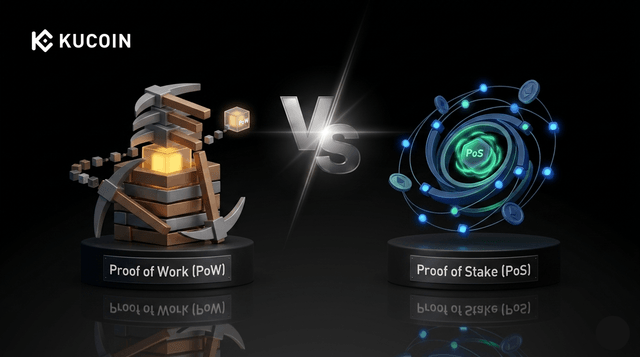
The consensus mechanism is the bedrock of any blockchain, determining its security, scalability, and economic incentives. As we navigate the 2026 digital asset landscape, the debate between Proof of Work (PoW) and Proof of Stake (PoS) has evolved from a theoretical technical choice to a strategic portfolio decision. For traders on KuCoin, understanding these mechanisms is essential for evaluating long-term asset viability and yield opportunities.
Key Takeaways
-
Mechanism Core: PoW relies on computational power (hardware/energy) to secure the network, whereas PoS utilizes capital (staked tokens) to achieve consensus.
-
Security vs. Efficiency: PoW is often viewed as the gold standard for decentralized security (e.g., Bitcoin), while PoS offers significantly higher transaction throughput and energy efficiency (e.g., Ethereum).
-
Investor Value: PoW assets typically serve as "Digital Gold" or store-of-value assets; PoS assets provide native yield through staking, allowing for compounding returns.
-
KuCoin Integration: Whether you prefer the raw security of PoW or the passive income of PoS, KuCoin Spot Market and KuCoin Earn provide the necessary infrastructure to trade and grow these assets.
The 2026 Consensus Landscape: A Bifurcated Market
In 2026, the crypto market has matured into a two-pillar system. On one hand, PoW remains the fortress for sovereign wealth and institutional reserves, led by Bitcoin. On the other hand, PoS has become the engine of the "Programmable Economy," powering DeFi, AI-agents, and DePIN projects.
Institutional adoption has forced a clearer distinction: PoW is increasingly integrated with renewable energy grids, serving as a global load balancer, while PoS has become the standard for environmentally conscious ESG mandates. For the active trader, this means PoW assets often exhibit lower volatility and higher "safe haven" characteristics, whereas PoS assets provide the "tech-growth" beta of the crypto world.
Deep Dive: Proof of Work (PoW)
Core Value Proposition
Proof of Work is the original consensus mechanism introduced by Satoshi Nakamoto. Its value lies in unforgeable costliness. Because securing the network requires physical energy and specialized hardware (ASICs), it is prohibitively expensive to attack. This creates a "gravity" for the asset's value, as it is anchored to the physical world's energy costs.
Technical Edge & Economic Model (Tokenomics)
PoW operates on a competitive basis. Miners solve complex mathematical puzzles; the first to solve it gains the right to add a block and receive a reward.
-
Hard Cap Supply: Most PoW assets, like Bitcoin (BTC) and Litecoin (LTC), feature strictly capped supplies or decreasing emission schedules (halvings).
-
Decentralization: By decoupling the consensus power (hashrate) from asset ownership, PoW prevents a "the rich get richer" feedback loop in governance.
How to Trade PoW Assets on KuCoin Lite
For users who value simplicity, KuCoin Lite offers a streamlined way to accumulate major PoW assets. By using the "Buy Crypto" or "Convert" features, traders can quickly swap stablecoins for BTC, LTC, or KAS. This is ideal for dollar-cost averaging (DCA) into assets that serve as the foundation of a long-term crypto portfolio.
Deep Dive: Proof of Stake (PoS)
Strategic Advantage
Proof of Stake replaces miners with validators. Instead of burning energy, validators lock up (stake) their native tokens as collateral. This shift allows for massive scalability and near-instant finality. The strategic advantage of PoS is its capital efficiency; the capital used to secure the network also earns a direct return for the holder.
Ecosystem Growth & 2026 Outlook
By 2026, the PoS ecosystem has expanded to include "Liquid Staking" and "Restaking" layers. Assets like Ethereum (ETH), Solana (SOL), and Polkadot (DOT) are no longer just tokens but productive assets. The transition of major networks to PoS has led to a "net-deflationary" trend in many tokenomics models, where transaction fees are burned, potentially increasing the scarcity of the remaining supply.
Maximizing Returns with KuCoin Earn
Traders looking for consistent cash flow favor PoS assets. Through KuCoin Earn, users can participate in soft staking or locked staking.
-
Staking Rewards: Earn a percentage yield on your SOL, ETH, or ADA.
-
Flexibility: KuCoin provides options for flexible redemptions, ensuring you can move back to the Spot Market if market conditions shift.
Comparison Analysis: PoW vs. PoS
| Feature | Proof of Work (PoW) | Proof of Stake (PoS) |
| Security Foundation | Physical Energy / Hashrate | Financial Capital / Staked Tokens |
| Throughput (TPS) | Generally lower (7-60 TPS) | High (1,000 - 100,000+ TPS) |
| Energy Consumption | High (Necessary for security) | Extremely Low (99% more efficient) |
| Inflation Model | Mining Rewards (Predominantly) | Staking Rewards & Fee Burning |
| Barrier to Entry | High (Hardware/Electricity costs) | Low (No hardware needed to stake) |
| Investor Profile | Store of Value / Macro Hedges | Yield Seekers / Ecosystem Users |
Trading Insights: Which fits your Portfolio?
-
The "Digital Gold" Allocator (PoW Focus)
If your goal is capital preservation and hedging against fiat debasement, your portfolio should lean toward PoW. These assets are "finished products" with stable codebases. Look for entry points on KuCoin's BTC/USDT or LTC/USDT pairs during market consolidations.
-
The "Active Yield" Strategist (PoS Focus)
For traders aiming to outperform the market through compounding, PoS assets are superior. By holding ETH or SOL and utilizing KuCoin Earn, you earn the underlying price appreciation plus the staking APY. This is particularly effective in bullish or sideways markets.
-
The Balanced Hybrid
A sophisticated 2026 portfolio often carries a 60/40 split. Use PoW for the "core" (stability) and PoS for the "satellite" (yield and growth). You can manage this entire balance seamlessly within your KuCoin account, moving assets between the Funding and Trading accounts as needed.
Conclusion & Strategic Guidance
The choice between Proof of Work and Proof of Stake isn't about which is "better," but which serves your specific financial objective. PoW offers the unyielding security of physical cost, making it the premier choice for long-term wealth storage. PoS offers the agility and productivity of modern finance, making it the engine for active growth.
FAQs for Proof of Work vs. Proof of Stake
-
Is Proof of Stake less secure than Proof of Work?
In 2026, the consensus is that both are secure but against different attack vectors. PoW is resistant to financial manipulation but vulnerable to hashrate centralization. PoS is resistant to physical attacks but requires careful governance to prevent large stake-holders from exerting too much control.
-
Can I earn passive income on PoW coins?
Directly, no. PoW requires mining. However, you can use KuCoin Earn to deposit PoW assets into "Savings" or "Lending" products, where you earn interest from other traders borrowing your assets for margin trading.
-
Why did Ethereum switch from PoW to PoS?
The move (The Merge) was driven by the need for scalability and a 99.9% reduction in energy consumption. This allowed Ethereum to support a much larger ecosystem of dApps and institutional users who require ESG compliance.
-
Which mechanism is better for long-term holding?
PoW (like Bitcoin) is historically favored for decade-long holding due to its simplicity and immutable nature. PoS is often better for 1-3 year horizons where the compounding effect of staking rewards can significantly boost total returns.
-
Does staking on KuCoin involve a lock-up period?
It depends on the product. KuCoin Earn offers "Flexible" options with no lock-up and "Fixed" options with higher yields for 30, 60, or 90 days. Always check the specific asset's terms before committing.
Further Reading: Proof of Work (PoW) | Learn


