
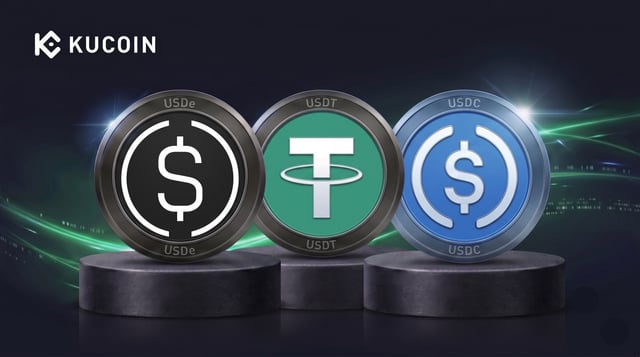
What Is the Difference between Ethena (USDe) and Traditional Stablecoins?
Key Takeaways
-
Yield Generation: Ethena (USDe) is a "synthetic dollar" that provides native yield through delta-neutral hedging and staking rewards, whereas traditional stablecoins (USDT/USDC) typically require third-party lending protocols to generate returns.
-
Collateral Architecture: Traditional stablecoins rely on fiat reserves and U.S. Treasuries in legacy banks; USDe is backed exclusively by crypto-native assets (stETH, BTC) and offsetting short futures positions.
-
Risk Profiles: USDe carries "funding rate risk" and exchange counterparty risk, while traditional stablecoins are exposed to regulatory shifts and banking system insolvency.
-
KuCoin Optimization: Traders can utilize KuCoin Lite for instant USDe/USDT swaps and KuCoin Earn to maximize ENA (governance token) staking productivity.
Market Context: The Stablecoin Evolution of 2026
As of February 2026, the stablecoin sector has bifurcated into two distinct paths: Liquidity Rails and Yield Engines. While the total market cap for stablecoins has surged toward $300 billion, the dominance of fiat-backed assets like USDT is being challenged by "Internet Bonds" like Ethena’s USDe.
In the current high-volatility environment of 2026, institutional capital has begun to favor USDe for its ability to capture basis spreads and funding rates natively on-chain. Conversely, retail traders on KuCoin continue to use traditional stablecoins as their primary "safe-haven" during flash crashes. Understanding the fundamental mechanics of these assets is no longer optional; it is the difference between stagnant capital and a productive 20% APR portfolio.
Deep Dive: Ethena (USDe) – The Synthetic Internet Bond
Core Value Proposition
Ethena (USDe) is not a stablecoin in the traditional sense; it is a synthetic dollar. Its primary goal is to provide a scalable, crypto-native dollar that does not rely on the legacy banking system. By decoupling from traditional banks, USDe offers a "censorship-resistant" alternative that turns the volatility of the crypto market into a source of revenue.
Technical Edge & Economic Model (Tokenomics)
The stability of USDe is maintained via a Delta-Neutral Hedging strategy.
-
The Hedge: For every $1 of crypto collateral (like staked ETH or BTC) held by the protocol, an equivalent short perpetual futures position is opened on centralized exchanges.
-
The Yield: USDe holders earn yield from two sources:
-
Staking Rewards: Accrued from the underlying liquid staking tokens (LSTs).
-
Funding Rates: Periodic payments from long traders to short traders, which in 2026's structurally bullish market, remain the primary driver of USDe's high APR.
-
-
The ENA Token: ENA serves as the governance backbone, allowing users to vote on collateral types and reserve fund allocations.
How to Trade/Stake ENA/USDe on KuCoin Lite
For intermediate traders looking to capitalize on this synthetic growth:
-
Instant Conversion: Use KuCoin Lite to swap USDT directly for ENA or USDe derivatives.
-
Market Execution: Trade the ENA/USDT pair on the KuCoin Spot Market to hedge your delta-neutral exposure during periods of funding rate compression.
Loading chart…
Deep Dive: Traditional Stablecoins (USDT & USDC) – The Liquidity Bedrock
Strategic Advantage
Traditional stablecoins like Tether (USDT) and USD Coin (USDC) are the "gold standards" of liquidity. Their value is derived from 1:1 backing by real-world fiat reserves, such as cash and U.S. Treasury bills. Their primary advantage is price certainty; in any market condition, $1 USDT is intended to be redeemable for $1 USD.
Ecosystem Growth & 2026 Outlook
In 2026, traditional stablecoins have become the primary settlement layer for global crypto commerce.
-
USDC: Now the favorite for institutional compliance, following the full implementation of the GENIUS Act in the United States.
-
USDT: Remains the king of cross-border liquidity and the most traded asset on the KuCoin Spot Market.
Loading chart…
Maximizing Returns with KuCoin Earn
Unlike USDe, these assets do not have "native" yield. To earn, you must engage with KuCoin Earn:
-
Flexible Savings: Deposit USDT to earn a stable, low-risk interest rate that usually outperforms traditional bank savings.
-
Dual Investment: Advanced traders use USDT/USDC in dual-investment products to earn high yields while setting target buy/sell prices for BTC or ETH.
Loading chart…
Comparison Analysis: Synthetic vs. Fiat-Backed
| Feature | Ethena (USDe) | Traditional (USDT/USDC) |
| Stability Mechanism | Delta-Neutral Hedging | Fiat Reserve Backing |
| Primary Yield Source | Funding Rates + Staking | Third-party Lending Markets |
| Backing Type | Crypto (BTC, stETH) | Cash & U.S. Treasuries |
| Risk Factor | Negative Funding / Exchange Fail | Regulatory Action / Bank Runs |
| KuCoin Utility | High-Yield "Internet Bond" | Trading Base / Safe Haven |
Trading Insights: Which fits your Portfolio?
-
The "Yield-Optimized" Portfolio (Advanced)
For traders seeking to outperform the market in a bull run, USDe is the clear winner. The positive funding rates on KuCoin’s futures platform translate directly into higher rewards for USDe stakers.
-
The "Risk-Averse" Portfolio (Intermediate)
If you are prioritizing capital preservation and need an asset that remains stable even if perpetual funding rates turn negative, stick with USDT or USDC. These are best kept in KuCoin Earn for consistent, predictable growth.
-
The "Hedge Strategy"
Many successful KuCoin traders maintain a 70/30 split: 70% in traditional stablecoins for liquidity and 30% in USDe (or staking ENA) to capture high-beta yields during market upswings.
Conclusion & Strategic Guidance
The choice between Ethena (USDe) and Traditional Stablecoins is no longer a choice of "which is better," but rather "what is your objective?" USDe is a revolutionary tool for yield generation, transforming your portfolio into a productive internet bond. Traditional stablecoins like USDT and USDC remain the indispensable liquidity foundation for all trading activities on KuCoin.
Create your free KuCoin account today to access over 700+ global crypto assets and the latest gems. Sign Up Now!
FAQs for Ethena (USDe) vs. Traditional Stablecoins
Can USDe "de-peg" like UST?
Unlike Terra’s UST, USDe is fully collateralized by stETH and BTC. A de-peg would only occur if the hedging mechanism fails or if there is a massive failure of the underlying exchanges where the short positions are held.
What happens to USDe when funding rates are negative?
If funding rates turn negative for an extended period, the "yield" for USDe can drop to zero or even become slightly negative. Ethena uses a Reserve Fund to mitigate this, but it remains the primary risk for USDe holders compared to fiat-backed coins.
Which stablecoin is best for trading on KuCoin?
USDT remains the most versatile for trading pairs. However, for users who want to earn passive income without actively trading, USDe provides a superior native return.
Is USDC safer than USDT in 2026?
Following the 2025/2026 regulatory clarity in the US, USDC is often viewed as "institutionally safer," while USDT is viewed as "operationally more liquid" globally. Both are highly secure on the KuCoin platform.
How do I stake ENA on KuCoin?
Navigate to KuCoin Earn, search for ENA, and select your preferred lock-up period. Staking ENA often provides access to "Sats" or future protocol airdrops within the Ethena ecosystem.
Learn More:


