



KuCoin AMA With Scor (SCOR)
KuCoin AMA With Scor (SCOR) — Revolutionizing Sports IP Through On-Chain Infrastructure and Tokenization
Dear KuCoin Users,
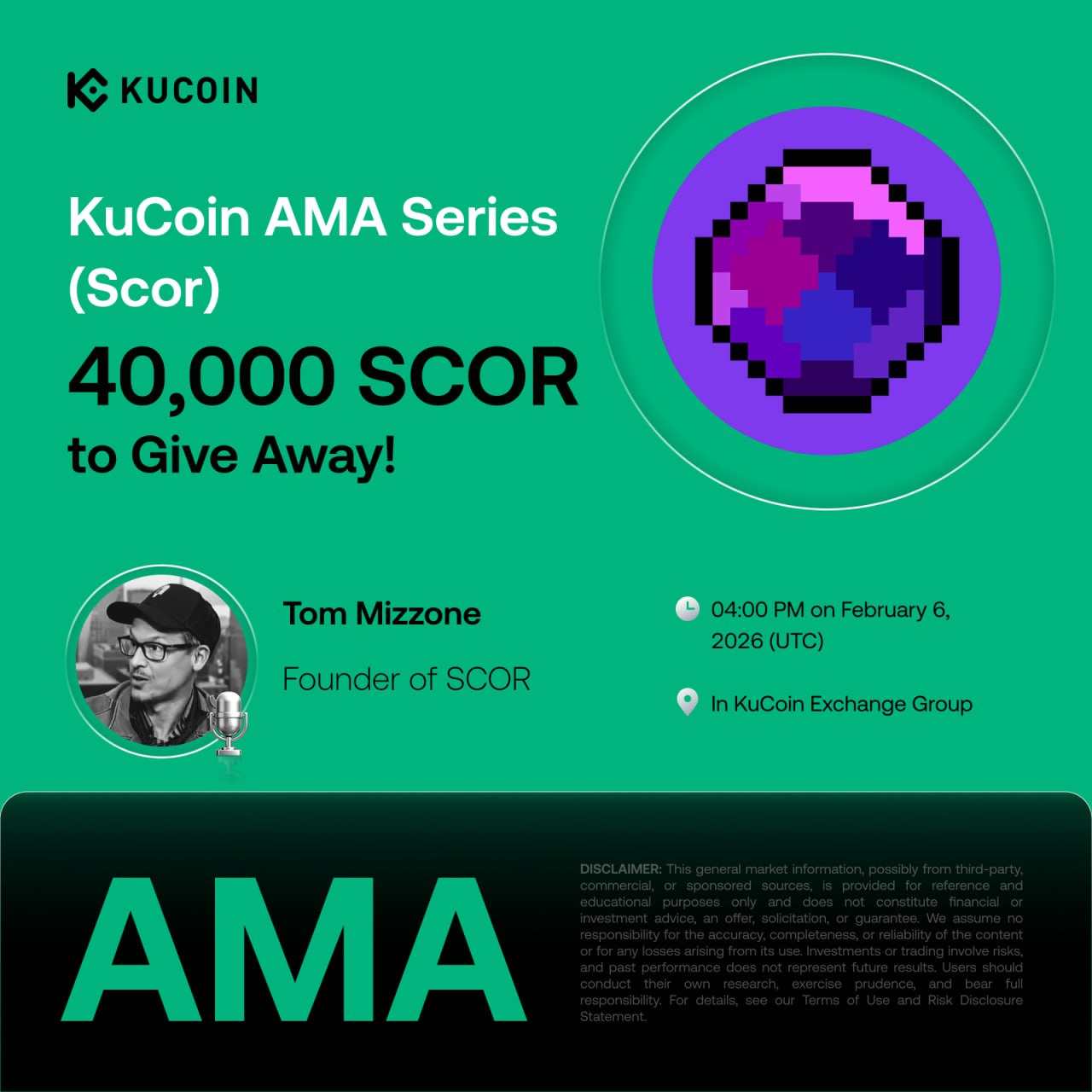
KuCoin recently hosted an AMA (Ask Me Anything) session in the KuCoin Exchange Group, featuring Olya K., Marketing Lead of Scor, and Tom Mizzone, Founder of Scor.
Time: February 06, 2026, 04:00 PM - 5:34 PM (UTC)
Official Website: https://scor.io/
Follow Scor on X, Telegram & Discord
Q&A from KuCoin to Scor
Q: How did you get into the crypto industry?
Tom: Great question! My background has been building scalable technology companies in the entertainment industry. I started my first company in 1996! I've tried to be at the intersection of transformative technology. We have worked with Disney, Warner Bro. HBO and many of the big entertainment giants. I took a break from tech to start SpeedVegas.com, and that's when I started reading about blockchain. I came back to NY and started Sweet.io. And we have been a pioneer in activating sports IP on-chain.
Sweet is the Labs Co. behind the SCOR Protocol. We now have over 2,000 pro sports partnerships in place, and a powerful fan engagement platform.
Q: What is SCOR?
Tom: As a company and team with a lot of experience in pro sports licensing and fan engagement we saw some fundamental problems with the current models. On the fan side: fans are the lifeblood of sports, yet their passion is mostly passive. Fans buy jerseys, watch the game, and engage across digital ecosystems, yet don’t "own" their status as a fan in any verifiable way. SCOR makes fandom a two-way street where knowledge, merit, and engagement are recorded on-chain as a veritable asset - all owned by the fan.
On the Sports IP side, today, the sports industry has a few big structural problems. First, monetization is outdated. Sports IP still lives in a world of slow intermediaries and rigid contracts. Deals take forever, they’re expensive, and once they’re signed, the IP can only be used in very limited ways. That makes innovation hard and leaves a lot of potential untapped value.
Second, there’s no real digital infrastructure for sports IP. If someone wants to build a game or an interactive product using real teams or athletes, it’s extremely difficult to do quickly or at scale. Everything is gated and fragmented. Bringing sports IP onchain makes it usable in a flexible, programmable way, while still keeping it trackable and protected. SCOR is the infrastructure to solve both the fan and the sports brand side.
Olya: I will just add 2 cents on our mission which is to transform the $500B sports IP market by making IP trackable, fairly used, and globally accessible. 500B! As a result, you will see an ecosystem with liquid IP markets, skill-based fan engagement, verifiable rewards, and fan digital identity, all coming together in a 24/7, real-time fan economy.
Q: How long has SCOR been in the market, and does it already have a track record?
Olya: SCOR started as a whitepaper in early 2025, about a year ago. Since then, we have moved well beyond theory and proved there is real demand on both sides of the ecosystem, from sports IP holders and from fans.
Tom: Sweet has been in business for over 8 years. We have shown real strength and longevity in Web3. We looked at launching the protocol and token many years ago but decided it was best to be disciplined. First build the platform, secure real deals, and onboard real fans. May token project launch with no traction, and we are the exact opposite.
Olya: And today, when SCOR in its existing form is already live, on the IP side, we have onboarded 3,000+ teams, tournaments, and professional athletes. That includes F1 teams like McLaren and Red Bull Racing, NBA teams like the Knicks, Cavs, and Bucks, NHL teams like the Blackhawks, Stars, and Rangers, ATP, and legends like Sidney Crosby, Alex Ovechkin, Connor McDavid, Wayne Gretzky, Lionel Messi, Aryna Sabalenka, and many more.
On the fan side, SCOR games have already been played by over one million users, with tens of thousands of monthly active users monthly.
Q: What problems is SCOR solving?
Olya: The challenges around sports IP and digital innovation are structural: limited revenue streams, poor fan understanding, a lack of real reward mechanisms, and weak IP protection in an AI-driven world.
The first big problem is monetization. Sports IP still relies on old-school intermediaries. Deals take forever to negotiate, they’re expensive, and once they’re signed, the IP can only be used in very limited ways. That kills experimentation and leaves a lot of money on the table. The second issue is the lack of real digital infrastructure for sports IP.
Tom: Every company I have started, always begins with a problem that needs to be solved. In the case of the SCOR Protocol:
1. Fans provide so much value, and it's all lost to intermediary platforms. With SCOR and SCOR-ID we are turning fan engagement into an on-chain asset owned by the FAN.
2. On the sports IP side, the industry is missing out on a much bigger revenue and engagement play. We are providing the infrastructure for scale, and programmatic royalties.
Q: Sports engagement and Web3 games bring an interesting mix, but how does this model actually work?
Tom: We tokenize licensed sports IP and use it in real on-chain products. Right now, those products are games, but the framework goes far beyond gaming. On top of that, SCOR acts as the value layer. Fans play, compete, and engage, fans get rewarded, and IP holders get paid automatically in SCOR. In simple terms, SCOR is a value exchange between fandom and licensed sport.
Today, we already have 2,000+ agreements with athletes, teams, and leagues to use their IP on-chain. We have 8 live games and tens of thousands of users actively playing them. You can check out some of our programs at fun.scor.io and nhlbreakaway.com. We are also extending the utility of $SCOR into other ecosystems such as this.
By depositing with $SCOR, users unlock immediate platform benefits, including 100 free casino spins and $25 in sportsbook free play credit, with exclusive token-holder poker tournaments coming soon.
Olya: 3,000+ agreements already! The number of agreements is growing fast!
Q: What can users do in the SCOR ecosystem and what’s the best way to start with the SCOR Ecosystem?
Olya: To get started, users can go here, connect a wallet on Base or another popular wallet, choose a game like football, tennis, or American football, and start playing. You can play against the system, compete in head-to-head tournaments, or invite friends directly by sharing a link.
You can start completely for free. The games use two in-game currencies. $SCOR is the utility token of the ecosystem. Gems are performance-based points you earn by playing well.
Gems can be converted via the Polisher into $SCOR, which is a liquid token traded on exchanges, including KuCoin. Gems are also used for upgrades, such as leveling up or strengthening your player. You can also mint your SCOR-ID in the SCOR wallet - it's your digital passport that stores your achievements and engagement. Also, gems can be polished into $SCOR. You may check here.
Q: Tell us about the $SCOR token. What’s its role in the SCOR Ecosystem?
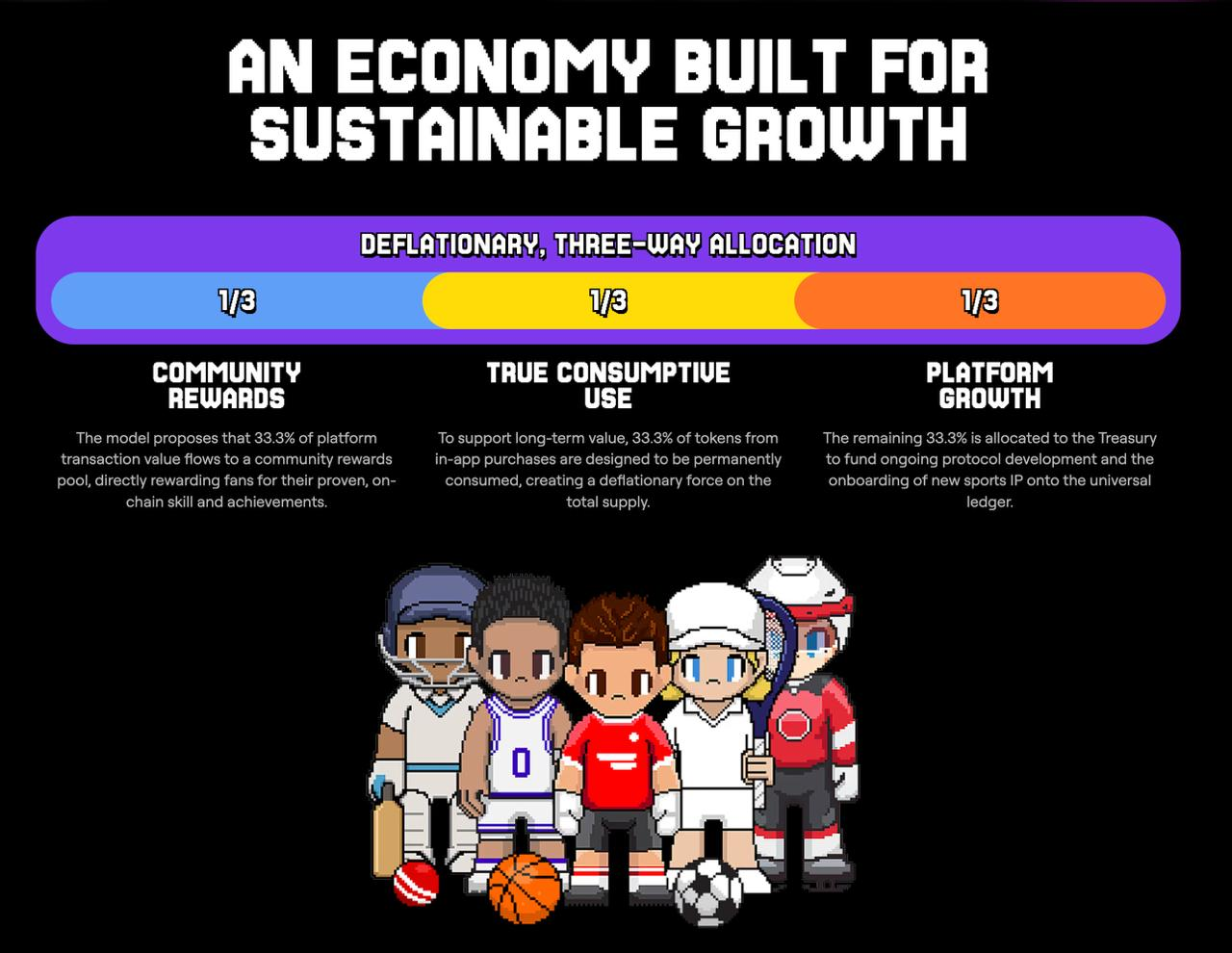
Olya: At the most basic level, $SCOR is the currency that powers everything in the ecosystem. You use it for game entries, PvP battles, tournaments, upgrades, and marketplace purchases. And it’s not limited to games either. It's an ERC-20 token btw meaning that it's easy to buy and store in any popular Web3 wallet. Its economics are directly tied to usage: 33.3% is burned, 33.3% goes to rewards and IP royalties, and 33.3% goes back to the platform. It's important to understand that SCOR is the settlement layer for royalties.
Whenever value is generated on-chain, SCOR is used to automatically distribute revenue to athletes, clubs, leagues, and other rights holders, without manual payouts or middlemen.
Q: What metrics matter most to you in the next 3 months?
Olya: Over the next three months, we’re mostly focused on adoption and real usage across the broader SCOR ecosystem. One example of it is BetOnline's integration. We're working on more use cases like this.
We will continue to grow the ecosystem through integrations where $SCOR actually makes sense, like ticketing, betting, and other fan-facing platforms, and more games, of course!
Tom: Yes, we have a strong roadmap within fun.scor.io which includes staking rewards, more head to head social gaming, and ways to use dormant sports NFTs for in-app upgrades. Additionally, we have more partnerships like BetOnline in the works to extend the utility for SCOR across other sports based ecosystems. It's a good time to get some $SCOR on KuCoin!
Questions from the KuCoin Community to Scor
Q: How does SCOR-ID work as an on-chain identity, and what kind of data or reputation does it record?
Olya: SCOR-ID is a unique on-chain token that represents your identity within the SCOR ecosystem. When you claim your SCOR-ID, it is minted to your wallet. At a high level, it records different verifiable signals like gameplay participation, performance outcomes, progression, achievements, and engagement milestones. It's basically your on-chain passport.
Q: DeFi often suffers from fragmentation, users need separate scores for each platform. How does Scor plan to become the de-facto credit layer across multiple protocols and blockchains?
Olya: First of all, the SCOR ecosystem is currently anchored on Base, one of the fastest and most cost-efficient blockchains with deep market liquidity. This means that tokenized IP within SCOR exists in an EVM environment, making it easily composable with a wide range of other chains, protocols, and applications.
The same applies to the $SCOR token. It follows the ERC-20 standard and is currently available on Base and Mantle, which already enables broad interoperability.
Q: How does $SCOR plan to make fan rewards sustainable long-term, especially with skill-based gameplay and programmable assets? Is there a revenue model (fees, licensing cuts) that feeds back into the ecosystem?
Olya: The main thing is that $SCOR rewards are based on real activity, not on printing tokens out of nowhere. The economy is pretty straightforward:
Players spend $SCOR to enter arenas, tournaments, upgrades, and IP-related items. That spending drives value through actual usage. From every transaction,
• 33.3% of $SCOR gets burned,
• 33.3% goes back to users as rewards and IP holders as royalties,
• and 33.3% supports the platform and eco
Q: SCOR already has a large number of athletes and teams opted in, which is a massive foundation, as you onboard more big league partners, how does this specifically translate into utility and demand for the $SCOR token? Will new teams be required to use $SCOR for their IP licensing or in-game economy?
Tom: The more new IP we bring onchain, the more use cases we can build around it. If we’re talking about games, it simply means we can expand into more game titles. And games are not the only use case for IP, as we discussed earlier.
The more games we launch, the more utility IP gets, and the more royalties SCOR as an ecosystem can generate and return back to IP holders. This also creates a very strong source of authority and go-to infrastructure for other platforms to tap into IP.
We are also working on using this database as a source of authority to deal with unlicensed AI derivatives. And also allow for AI directives to be authorized and valid, with true provenance back to the IP holder.
Q: How does $SCOR plan to turn fan engagement into real, lasting value, especially with so many sports tokens failing? What’s the one thing that makes SCOR different?
Olya: Most sports and GameFi tokens failed for two simple reasons: poorly thought-through tokenomics and weak experiences. Since then, the industry has learned a lot. Tokenomics have evolved, and SCOR in particular built its model based on the hard lessons of that earlier generation.
The main problem was that projects printed tokens much faster than real demand was growing. In SCOR, this is solved by design: rewards are tied to real activity, spending has clear token sinks, and the burn model keeps the system balanced.
In SCOR, this is solved by design: rewards are tied to real activity, spending has clear token sinks, and the burn model keeps the system balanced. The second big issue was the experience itself. Building a fun, repeatable experience is a craft, SCOR games are simple, competitive, and easy to enjoy. They’re designed to be accessible and emotionally engaging, not overloaded with crypto mechanics.
Plus we have something most projects never had: real IP from real athletes and teams. Fans aren’t just playing a random blockchain game, they’re interacting with the brands and idols they already care about. That creates a completely different level of emotional connection.
Q: Token utility matters more than price. Where and how can SCOR tokens actually be used right now, and how will this utility expand in the future?
Tom: SCOR can be used on fun.SCOR.io for PvP battles, skill based wagers. Additionally, we have a massive partnership in place with BetOnline which provides strong incentives for SCOR holders. You may check this link.
Q: Do you have any plan for burning $SCOR tokens in the future to reduce the supply of the $SCOR token and increase its investment attractiveness?
Tom: We have built in a deflationary mechanism into the tokenomics based on consumptive use. You can read more about it on scor.io and in the white paper.
Q: What is your strongest advantage that you think will make your team leading the market?
Olya: Existing IP agreements with 3k+ athletes, leagues, teams. It's a huge moat. Sports IP holders trust SCOR to make it an exclusive tokenisation partner.
Q: I want to know if your $SCOR token is still available on any exchange? How can I buy your $SCOR tokens?
Olya: It is, on several exchanges! You should start with KuCoin - $SCOR is available there.
Q: What are the benefits of holding your $SCOR token as a long term investment? Can you tell us about the motivation and benefits for investors to keep your token in the long run?
Olya: Do you believe that the future of finance is onchain?
Sports IP is no different. It's one of the biggest asset classes of the traditional economy, but highly unutilised. The entire market is estimated at $500B but there's nothing you can do with it onchain.
Another aspect which is driving sports onchain is the IP right protection - unless IP is the programmable and verifiable asset, there's no way for IP holders to protect themselves.
So everything is moving onchain, including sports.
KuCoin Post AMA Activity — Scor
🎁 Participate in the SCOR AMA quiz now for a chance to win 200 SCOR.

The form will remain open for five days from publishing this AMA recap
Scor - SCOR Giveaway Section
KuCoin and Scor have prepared a total of 40,000 SCOR to give away to AMA participants.
1. Pre-AMA activity: 14,000 SCOR
2. Community Voice: 1,000 SCOR
3. Free-ask section (Main groups): 1,000 SCOR
4. React King: 4,000 SCOR
5. Flash Mini-games: 4,000 SCOR
6. Post-AMA Quiz: 16,000 SCOR
Sign up for a KuCoin account if you haven’t done so yet, and ensure you complete your KYC verification to be eligible for the rewards.
Follow us on X, Telegram, Instagram, and Reddit.