

Layer 1 vs Layer 2 Blockchains: Key Differences, Examples and How They Work
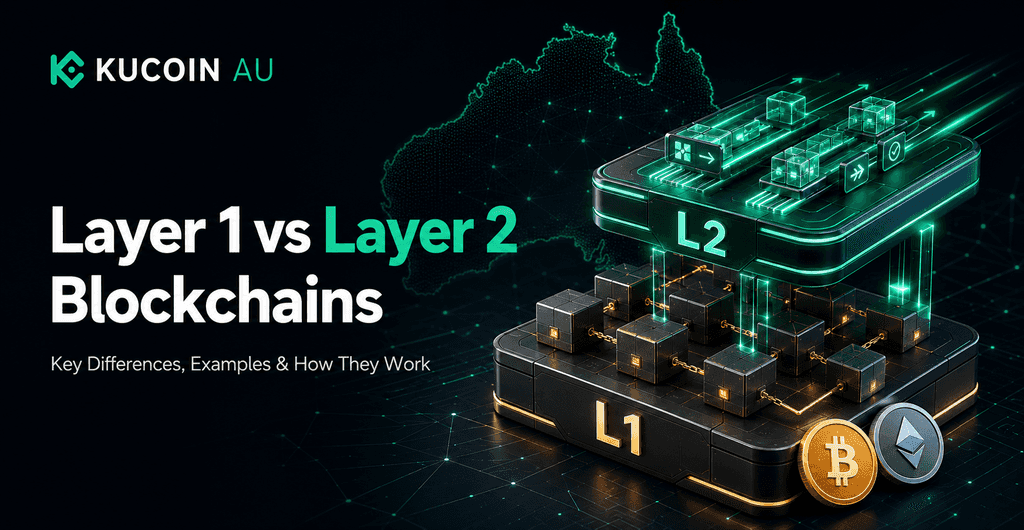
Layer 1 and Layer 2 blockchains play different roles in crypto scalability. Layer 1 networks such as Bitcoin, Ethereum and Solana provide consensus and final settlement, while Layer 2 solutions such as Base, Arbitrum and Lightning can reduce fees and increase transaction capacity. This article compares their security, speed, costs, risks and use cases, including what Australian users should check before transferring assets between networks.
What Are Layer 1 and Layer 2 Blockchains and How Do They Work?
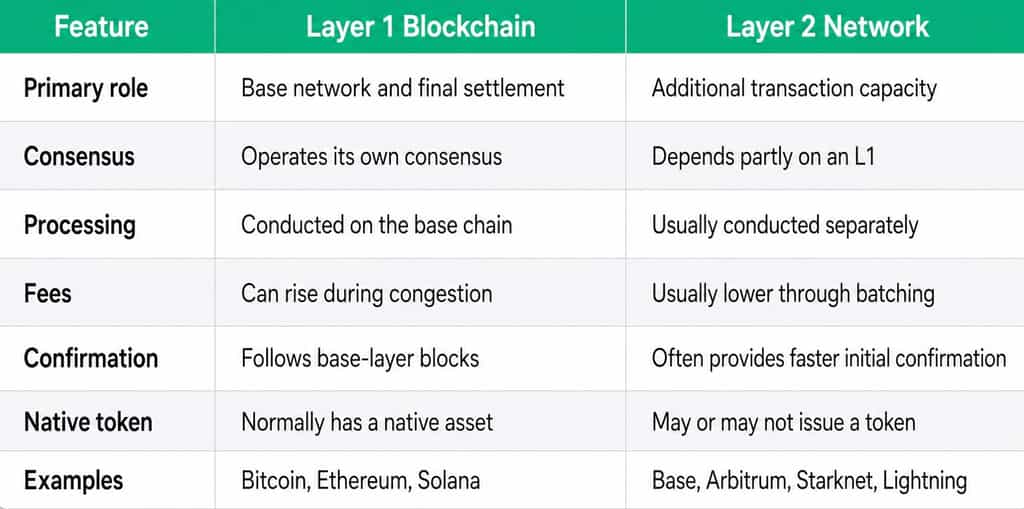
The central difference between Layer 1 and Layer 2 is where consensus and final settlement occur. Layer 1 maintains the authoritative blockchain ledger, while Layer 2 expands the amount of activity that can be processed around it.
Layer 1 vs Layer 2: Quick Comparison
What Is a Layer 1 Blockchain and How Does It Scale?
Layer 1 establishes the rules for validating transactions, producing blocks and determining the correct state of the blockchain. Its miners or validators maintain consensus without depending on another network. Where supported, the base chain also executes smart contracts and stores the information needed for nodes to verify transactions independently. Bitcoin uses BTC for transaction fees and mining rewards. Our Australian readers can find an overview of the Bitcoin blockchain and BTC, including how mining, blocks and its fixed supply support the network. Ethereum uses ETH for gas fees and proof-of-stake participation, while Solana uses SOL for fees and validator staking. A native token alone does not make a network Layer 1; the defining feature is independent consensus and final settlement.
Layer-1 scaling involves modifying the base protocol itself. Developers may increase block or gas capacity, optimise transaction execution, process some operations in parallel or reduce the resources required to maintain network state. These improvements must balance higher performance against security, hardware requirements and decentralisation.Ethereum continues to increase Mainnet execution and data capacity, but rollups have become its principal strategy for supporting greater transaction activity. Its transition from proof of work to proof of stake changed consensus and energy consumption but did not substantially increase transaction speed. The Ethereum network and ETH remain the settlement and fee foundation for many rollups built around Ethereum.
What Is a Layer 2 and How Do Transactions Work?
A Layer 2 is a network or protocol designed to increase the capacity of an underlying blockchain. Ethereum rollups resemble separate networks because they support wallets, applications and smart contracts. Bitcoin’s Lightning Network instead uses payment channels, demonstrating that an L2 does not always need to operate as a conventional blockchain.
An Ethereum rollup transaction generally passes through four stages:
-
Submission: A user sends a transaction to Layer 2.
-
Execution: A sequencer orders and processes the transaction.
-
Batching: Multiple transactions are compressed into a batch.
-
Settlement: Data, state commitments or proofs are submitted to Ethereum.
Batching allows many users to share the cost of using Ethereum. A sequencer may provide a rapid preliminary confirmation, but complete settlement happens later according to the rollup’s proof system and interaction with Layer 1. Bitcoin follows a different approach. The Bitcoin Lightning Network allows participants to complete multiple payments through channels without recording each payment separately on the Bitcoin blockchain. The final channel state can later be settled on Bitcoin.
Layer 1 vs Layer 2: Security, Fees, Speed and Scaling Differences
A network’s layer is not a complete security rating. Two rollups can have different contracts, administrator controls, withdrawal mechanisms and data-availability arrangements even when both settle on Ethereum.
Security and Settlement Differences
A Layer 1 transaction is protected directly by the base blockchain’s consensus system. Layer 2 security can also depend on smart-contract correctness, fraud or validity proofs, bridge contracts, sequencer operation, upgrade keys and security councils.
Rollup maturity is commonly described through three broad stages. Stage 0 projects remain heavily dependent on their operators, Stage 1 projects introduce stronger safeguards, and Stage 2 systems are primarily controlled by code. These stages indicate decentralisation maturity rather than guaranteeing protection against every contract bug or exploit.
Users should distinguish a sequencer confirmation from the final Layer-1 settlement. If a sequencer becomes unavailable, transaction processing may be interrupted even when funds remain recorded by the rollup contracts. More mature systems provide mechanisms for users to submit transactions, force inclusion or withdraw through the underlying Layer 1 without depending entirely on the operator.
Bridge security also matters. A canonical rollup bridge is normally connected to the rollup’s core contracts, while a third-party bridge may rely on separate validators, liquidity providers or messaging systems. A fast bridge transfer can reduce waiting time, but it may introduce additional counterparties and smart-contract risks.
Fees, Speed and Scalability Trade-Offs
Layer 2 fees can include the cost of executing a transaction, publishing data to Layer 1 and generating or verifying proofs. These costs vary with network demand, transaction complexity and the base blockchain’s data market. Bridging can create a separate charge, meaning an L2 is not automatically cheaper for every small, one-time transfer.
Transaction speed can refer to several different events:
-
The sequencer’s initial confirmation
-
Inclusion in an L2 transaction batch
-
Publication of data to the Layer 1
-
Proof acceptance or challenge completion
-
Availability of a canonical withdrawal
Optimistic-rollup withdrawals may take longer because an incorrect state update must remain challengeable. ZK-rollup withdrawals depend on proof generation and verification. Third-party liquidity bridges can provide faster transfers, but they add separate contract and liquidity-provider risks.
Transactions-per-second figures also require caution. Networks may count activity differently, and a basic token transfer does not require the same resources as a complicated smart-contract interaction. High headline throughput does not automatically demonstrate stronger decentralisation, greater economic activity or faster final settlement.
Optimistic Rollups, ZK-Rollups, Validiums and Sidechains
Different scaling systems make different trade-offs between transaction cost, data availability and security:
-
Optimistic rollups publish data to the L1 and allow incorrect results to be challenged through fraud proofs. Canonical withdrawals may be delayed by the challenge period.
-
ZK-rollups publish transaction data and validity proofs to the L1. Verification can be efficient, but generating the proof may require complex infrastructure.
-
Validiums use validity proofs but keep transaction data outside the L1, creating reliance on an external data provider or committee.
-
Optimums combine an optimistic verification model with external data availability, reducing costs but adding separate data and dispute risks.
-
Sidechains maintain their own consensus and validator systems, so they do not inherit Ethereum’s security in the same manner as rollups.
Neither optimistic nor ZK technology is automatically safer in every implementation. Security depends on the entire system, including its smart contracts, proof mechanism, upgrade controls, data availability, bridge and withdrawal process.
This distinction is important for Polygon. Polygon PoS, now called Polygon Chain, is a sidechain, while Polygon zkEVM is a ZK-rollup. Identifying the exact network prevents the misleading assumption that every Ethereum-compatible chain has the same settlement and security guarantees.
Layer 1 and Layer 2 Examples, Benefits, Risks and Future Trends
Different blockchain layers are designed for different types of activity. Some prioritise monetary settlement or general-purpose smart contracts, while others focus on lower-cost trading, payments, gaming or consumer applications.
Popular Layer 1 and Layer 2 Examples
Popular Layer 1 blockchains include:
-
Bitcoin: Focuses on decentralised monetary settlement.
-
Ethereum: Supports smart contracts and provides settlement and data availability for rollups.
-
Solana: Uses an integrated architecture intended to process high transaction volumes on its base network.
Popular Layer 2 systems include:
-
Base: An Ethereum optimistic rollup supporting consumer and onchain applications.
-
Arbitrum One: An optimistic rollup widely used for DeFi and smart contracts.
-
OP Mainnet: An optimistic rollup supporting Ethereum-compatible applications.
-
Starknet: A validity rollup using zero-knowledge proof technology.
-
Lightning Network: A Bitcoin payment-channel network designed for faster BTC payments.
The size or transaction count of a network should not be used as its only quality measure. Activity can be influenced by automated transactions, incentives or low-value transfers, while total value figures can change with token prices. Users should consider security maturity, application quality, liquidity and withdrawal safeguards alongside adoption statistics.
Benefits, Risks and Which Layer to Use
Layer 1 provides direct access to base-network settlement, established liquidity and broad infrastructure support. It may be suitable for larger transfers or users who want to avoid additional bridge and rollup dependencies. Its main limitation is that transaction fees can rise when many users compete for limited block space.
Layer 2 is often more practical for frequent transfers, trading, gaming and applications where transaction costs affect the user experience. However, lower fees introduce additional considerations involving network selection, bridge routes, gas assets and withdrawal procedures.
When depositing or withdrawing through our Australian platform, select the exact network displayed on the transaction page. Ethereum, Base and Arbitrum may support versions of the same asset, but they are not interchangeable deposit routes. Sending an asset through an unsupported network or to an incompatible wallet may result in complete loss. Network support can also change, so it should be verified immediately before confirming a transfer.
Before selecting a network, check:
-
Whether the asset and receiving platform support that network
-
The rollup’s maturity and administrator controls
-
Available liquidity and wallet compatibility
-
Canonical and third-party withdrawal options
-
Total deposit, bridging and withdrawal costs
-
Whether independent withdrawal is available during an outage
Layer 1 may be more suitable for direct settlement and larger transfers, while Layer 2 can be more efficient for regular onchain activity. The appropriate choice depends on the transaction rather than the assumption that one layer is universally faster or safer.
Australian Regulatory and Tax Considerations
Our Australian platform is operated by Axis One Markets Pty Ltd, an AUSTRAC-registered digital currency exchange provider. Under current AUSTRAC rules, additional information may be required when transferring assets between Layer 1 and Layer 2 networks. A transfer is not automatically taxable, but bridging that swaps or wraps an asset may trigger a CGT event under ATO crypto guidance. Users should retain transaction dates, AUD values, fees and wallet records.
Latest Layer-2 Trends in 2026
Ethereum’s 2026 scaling strategy is increasing both base-layer execution and rollup-data capacity. PeerDAS is designed to expand blob capacity more efficiently, while interoperability work focuses on reducing fragmented liquidity and simplifying transfers between rollups. Native rollups are also being researched to allow Ethereum to verify L2 execution more directly, although the technology remains under development.
Frequently Asked Questions
1. Do Layer 2 Networks Use the Same Wallet Address as Ethereum?
Many EVM-compatible Layer 2 networks use the same address format as Ethereum Mainnet, and the same private key may control both addresses. However, matching addresses do not make the networks interchangeable. The wallet and receiving platform must support the selected network.
2. Do All Ethereum Layer 2 Networks Use ETH for Gas?
No. Many Ethereum rollups use ETH to pay transaction fees, but some networks use another gas token or support sponsored transactions. Users should confirm the required gas asset before transferring funds.
3. Where Can I Track a Layer 2 Transaction?
Individual L2 transactions are normally tracked through that network’s block explorer. Ethereum Mainnet may display the rollup’s batch, data or proof rather than every user transaction separately. Searching an L2 transaction hash only on an Ethereum explorer may therefore return no result.
4. What Is the Difference Between Native and Bridged Tokens?
A native token is issued directly on its network, while a bridged token represents an asset transferred from another blockchain. Tokens can share the same ticker but use different contracts and security arrangements. Verify the network, issuer and contract address before transferring an asset.
5. Is a Bridge Always Required to Use Layer 2?
No. Users can receive assets directly on an L2 or withdraw to a supported L2 from a compatible platform. A bridge is generally needed when assets are already on another blockchain and no direct transfer route is available.
6. Why Can Layer 2 Withdrawals Take Longer Than Deposits?
Deposits may become available after sufficient L1 confirmation, while canonical withdrawals can require fraud-challenge periods or proof verification. Faster third-party routes may be available, but they introduce separate liquidity and smart-contract risks.
Disclaimer: This article is for general information only and does not constitute financial, legal or tax advice. Crypto assets are volatile and may result in loss.