

Crypto Glossary: Key Terms Every Australian Trader Should Know
Understand essential crypto, blockchain, trading, wallet, DeFi, security, tax and regulatory terms every Australian trader should know.Crypto markets use specialised terminology that can affect how users value an asset, place an order, protect a wallet and report transactions for Australian tax purposes. Understanding terms such as market capitalisation, slippage, liquidation, private key and CGT event can help traders recognise risks and make more informed decisions.
This practical crypto glossary explains the key blockchain, trading, wallet, DeFi and regulatory terms Australian users are likely to encounter without unnecessary technical detail.
Essential Cryptocurrency and Blockchain Terms for Australian Traders
Before trading crypto, Australian users should understand the terminology used to describe digital assets, blockchain networks and token valuations.
Crypto Asset and Cryptocurrency: A crypto asset is a digital representation of value or rights that can be transferred, stored or traded electronically. The category includes cryptocurrencies, tokens, stablecoins and non-fungible tokens. Cryptocurrency generally refers to crypto assets designed primarily to transfer or store value. The ATO crypto glossary uses “crypto asset” as the broader term in Australian tax guidance.
Blockchain and Distributed Ledger Technology: A blockchain is a shared digital ledger that records transactions in cryptographically connected blocks. Distributed ledger technology, or DLT, is the broader category of systems that maintain synchronised records across multiple computers or participants. Blockchain is one form of DLT, but not every distributed ledger uses blocks or operates as a public cryptocurrency network.
Coin, Token and Altcoin: A coin is generally the native asset of its own blockchain, such as BTC on Bitcoin or ETH on Ethereum. A token is usually created on an existing blockchain through a smart contract and may provide access, governance rights, rewards or exposure to another asset. An altcoin is a broad term for a crypto asset other than Bitcoin.
Bitcoin, BTC, Ethereum and ETH: Bitcoin is the blockchain network, while BTC is its native cryptocurrency. Ethereum is a programmable blockchain that supports smart contracts, tokens and decentralised applications, while Ether, represented by ETH, is its native asset. Our crypto basics provide additional context on how digital assets and blockchain networks operate.
Stablecoin: A stablecoin is a token designed to track a reference asset, commonly the US dollar. Stablecoins may be backed by cash, short-term securities, crypto collateral or algorithmic mechanisms. They can still face issuer, reserve, liquidity, smart-contract and de-pegging risks.
Smart Contract and dApp: A smart contract is blockchain-based code that performs programmed actions when specified conditions are met. A decentralised application, or dApp, uses smart contracts to provide services such as trading, lending, gaming or digital ownership. Some dApps may still depend on developers, administrators, websites or external data providers.
Decentralised Finance: Decentralised finance, or DeFi, refers to blockchain applications that provide trading, borrowing, lending, staking and liquidity services. DeFi can reduce reliance on traditional intermediaries but introduces smart-contract, governance, oracle, bridge and liquidity risks.
Non-Fungible Token: A non-fungible token, or NFT, is an individually identifiable blockchain token that may represent artwork, membership, access, gaming items or another asset. Owning an NFT does not automatically provide copyright, intellectual-property rights or ownership of an associated physical item.
Layer 1 and Layer 2: A Layer 1 is a base blockchain that maintains its own security, consensus mechanism and transaction history. A Layer 2 is built above a Layer 1 to process transactions more efficiently before settling relevant information on the base network. Layer 2 systems can reduce transaction fees and improve capacity but may introduce bridge, sequencing, administration and withdrawal risks.
Consensus, Proof of Work, Mining, Proof of Stake and Staking: A consensus mechanism is the method a blockchain uses to agree on valid transactions. Proof of work relies on computational resources and miners to secure a network, while proof of stake relies on validators committing assets. Staking rewards are not guaranteed and can be affected by token prices, inflation, validator commissions, lock-up periods and slashing penalties.
On-Chain and Off-Chain Transactions: An on-chain transaction is recorded directly on a blockchain and can generally be checked through a block explorer. An off-chain transaction is processed outside the main blockchain record, such as an internal balance transfer between two customers on a custodial trading platform.
Bridge and Oracle: A blockchain bridge transfers or represents assets between separate networks. An oracle supplies external information, such as market prices, to smart contracts. A bridge exploit or inaccurate oracle can cause losses even when the underlying blockchain continues operating normally.
Market Capitalisation and Token Supply: Market capitalisation is generally calculated by multiplying an asset’s price by its circulating supply. Circulating, total and maximum supply describe different measures of token availability. A low unit price does not automatically mean an asset is undervalued because the number of tokens in circulation also affects its valuation.
Fully Diluted Valuation: Fully diluted valuation, or FDV, estimates a crypto asset’s value using a broader supply figure, usually its total or maximum supply. A large difference between market capitalisation and FDV may indicate that substantial future token issuance, emissions or unlocks remain.
Crypto Trading, Market and Risk Management Terms Explained
Understanding crypto trading terms is important because choosing a promising asset does not guarantee a favourable execution price or manageable risk. Australian traders should understand trading pairs, order books, order types, leverage and risk controls before committing funds, particularly during volatile market conditions.
Reading Crypto Markets: Trading Pairs, Liquidity and Price Signals
A trading pair shows which two assets can be exchanged. In a hypothetical BTC/AUD pair, BTC is the base asset and AUD is the quoted asset. The displayed price shows how many Australian dollars are required to buy one BTC. The same asset can trade through several pairs, with each market offering different liquidity, trading volume and spreads.
An order book lists buy and sell orders waiting to be matched. The highest price a buyer is prepared to pay is the bid, while the lowest price a seller will accept is the ask. The difference between them is the bid–ask spread. A narrow spread generally indicates a more active market, while a wide spread can increase the cost of entering or leaving a position.
Important crypto market terms include:
-
Liquidity: How easily an asset can be bought or sold without causing a substantial price movement.
-
Market depth: The quantity of buy and sell orders available at different prices in an order book.
-
Trading volume: The amount or value traded during a stated period, commonly 24 hours.
-
Volatility: The size and speed of price movements over time.
-
Slippage: The difference between the expected trading price and the actual average execution price.
-
Bull and bear markets: Extended periods of broadly rising or falling prices.
-
Support and resistance: Price areas where buying or selling has previously strengthened, although these levels are not guaranteed to hold.
High trading volume can support liquidity, but the two terms are not identical. An asset may report considerable volume while having limited order-book depth near its current price. Slippage can therefore increase when markets move quickly, liquidity becomes thin or an order is large relative to the available depth.
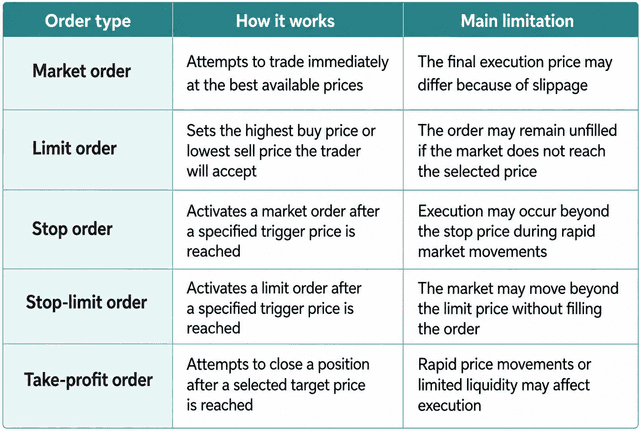
Market, Limit and Stop Orders: Key Differences
Spot, Margin and Crypto Derivatives Terms
Spot trading involves buying or selling the crypto asset itself at the current or agreed market price. Margin trading and derivatives provide increased market exposure or allow users to take positions based on future price movements, but they introduce additional costs, complexity and liquidation risks.
The main leveraged trading terms are:
-
Long position: A position intended to benefit if the market price rises.
-
Short position: A position intended to benefit if the market price falls.
-
Margin: The funds committed to open and maintain a leveraged position.
-
Collateral: The assets supporting a loan or leveraged position.
-
Leverage: Increased market exposure relative to the collateral provided.
-
Liquidation: The forced closure or reduction of a position when collateral falls below the required level.
-
Futures contract: A derivative linked to an underlying asset and a future settlement or expiry.
-
Perpetual contract: A derivative with no fixed expiry that commonly uses recurring funding payments.
-
Funding rate: A periodic payment between long and short perpetual-contract holders.
-
Open interest: The number or notional value of derivative contracts that remain open.
Essential Crypto Risk Management Terms
Crypto risk management aims to limit the potential effect of losses rather than predict every market movement correctly. Risk controls can reduce exposure, but they cannot eliminate losses during sudden or illiquid market conditions.
Important risk-management terms include:
-
Position sizing: Deciding how much capital to allocate to one trade.
-
Stop-loss: An order intended to reduce losses after a specified price is reached.
-
Take-profit: An order intended to secure gains at a selected target.
-
Risk–reward ratio: A comparison between the potential loss and potential gain.
-
Diversification: Spreading exposure across different assets or strategies.
-
Dollar-cost averaging: Investing a fixed amount at regular intervals.
-
Realised profit or loss: The result recorded after an asset is sold or a position is closed.
-
Unrealised profit or loss: The changing result of an asset or position that remains open.
-
Risk tolerance: The level of loss and volatility a person can financially and emotionally withstand.
Diversification within crypto may provide less protection than expected because different assets can become highly correlated during broad market declines. Dollar-cost averaging spreads entry prices but cannot prevent losses if an asset continues falling. A stop-loss may also execute beyond its trigger price during a sharp market movement.
Effective risk management combines sensible position sizing, realistic loss limits and cautious use of leverage. Australian traders should also include fees, spreads, slippage, funding payments and possible tax consequences when assessing whether a trade was genuinely profitable.
Frequently Asked Questions
1. Can a cryptocurrency transaction be cancelled after it is sent?
Most confirmed blockchain transactions cannot be cancelled, reversed or recalled. Users should verify the complete wallet address, selected network, asset and amount before approving a transfer.
2. What happens if crypto is sent through the wrong network?
The outcome depends on whether the receiving wallet or platform supports the selected network. Recovery may sometimes be possible, but a custodial provider may be unable to access the funds or may charge a recovery fee. Sending a small test transaction can reduce the risk before making a larger transfer.
3. Why do crypto deposits sometimes take longer than expected?
A platform may require several blockchain confirmations before crediting a deposit. Network congestion, low transaction fees, wallet maintenance, compliance reviews or a missing destination tag or memo can also cause delays. The transaction identifier can be checked through a block explorer to confirm its on-chain status.
4. Are crypto tax calculators always accurate?
Crypto tax software can help organise transaction data, but its calculations depend on accurate imports and correct transaction classifications. Wrapped-token conversions, liquidity-pool deposits, staking rewards and DeFi activity may require manual review. Users should retain original records rather than relying only on an automatically generated report.
5. How is a thinly traded crypto token valued in Australian dollars?
A reasonable valuation may use an available exchange price, a trading-pair conversion or another supportable market-value method at the relevant transaction time. When liquidity is limited, users should retain evidence of the source, time and method used to calculate the Australian-dollar value.
6. Can a public wallet address identify its owner?
A public blockchain address can show transaction activity but does not necessarily reveal the legal identity of its owner. However, an address may become linked to a person through exchange records, public disclosures, transaction patterns or information supplied during compliance checks.
Disclaimer: This article is for general educational purposes only and does not constitute financial, legal or tax advice. Crypto assets and derivatives involve substantial risk and may result in loss. Consider your circumstances and seek independent professional advice where appropriate.
For Australian users, Axis One Markets Pty Ltd (ABN 41 660 251 141) operates a digital currency exchange registered with AUSTRAC and is a Corporate Authorised Representative (CAR 1318896) of Echuca Trading Pty Ltd. Echuca Trading Pty Ltd (ACN 115 459 124) is an Australian financial services licence holder (AFSL No 297499). Echuca Trading is the product issuer of the derivative products contained in this communication and provides the relevant trading services. Before you start trading with Echuca Trading, you should read the Product Disclosure Statement, Financial Services Guide, Terms of Use, Target Market Determination, and other disclosure documents. For Wholesale Clients, please read the Terms of Use and Wholesale Client Information Statement. When you invest with Echuca Trading, you are not entitled to ownership of the underlying assets.
General Advice Warning: Any information in this blog is general information only and has been prepared without taking into account your objectives, financial situation or needs. You should consider whether it is appropriate for you.
Risk Warning: The unpredictable nature of cryptoasset markets may result in the loss of funds. Past performance does not have any indication for future. It is recommended that you seek independent advice on your investment and tax position.
The content contained in this blog is solely for general informational purposes and does not constitute investment or financial product advice. It should not be interpreted as a recommendation or solicitation to buy, sell, or hold any cryptoasset, or to engage in any specific trading strategy.