



How to Earn SOL on KuCoin: Passive Income Strategies, Risks, and Real Returns

Two investors buy Solana at the same price, hold for twelve months, and sell on the same day. One ends up with more SOL than the other, without trading more often or timing the market better. The difference comes down to a single choice: what they did with their assets while waiting.
That gap highlights a shift in how crypto portfolios are managed. Buying low and selling high remains important, but it is no longer the only way to grow holdings. Markets do not move in straight lines. During periods of sideways movement or unpredictable volatility, idle assets can sit unproductive for months.
This is where passive earning strategies come in. Instead of waiting for price appreciation, investors can deploy assets to generate additional returns over time. The approach is straightforward: keep exposure to the asset while allowing it to work in the background.
For Solana holders, this has become increasingly relevant. As one of the most actively supported assets on KuCoin’s earning ecosystem, SOL can be used across multiple products designed for different risk levels and market outlooks.
This guide breaks down the available SOL earning options on KuCoin, how each one works, what to expect in terms of returns, the risks involved, and how to choose the right strategy based on your goals.
Active vs Passive: Two Ways to Earn SOL on KuCoin
Before diving into passive strategies, it is worth briefly acknowledging that KuCoin also supports active earning approaches for SOL.
Active traders can earn through spot trading using limit buy and sell orders to capture price differences, scalping on short timeframes, margin trading to amplify positions, and futures contracts to profit from both upward and downward price movements. These methods can generate significant returns, but they demand time, experience, and a high tolerance for risk.
This article is not about those.
This guide focuses on passive earning: strategies where your SOL generates returns simply by being held, staked, or deployed into structured products. You stay in control of your assets. The platform does the work.
Hold to Earn on KuCoin: The Simplest Way to Earn Passive SOL
Not every earning strategy requires locking funds or actively managing positions. For SOL holders who want a straightforward starting point, Hold to Earn offers a low-effort way to generate rewards while maintaining full access to their assets.
What Is Hold to Earn?
Hold to Earn is one of the most accessible earning features on KuCoin. Once enabled, it automatically generates staking rewards on supported tokens held across your Funding, Trading, Margin, Futures, and Mining accounts.
There is no need to lock assets or transfer funds between products. Your SOL remains fully available for trading, withdrawals, or deposits at any time, while rewards accumulate in the background.
Key Features of Hold to Earn
-
No lock-up period or commitment
-
Works across multiple account types
-
Full flexibility to trade or withdraw anytime
-
Automatic daily reward distribution
How Hold to Earn Works for SOL
As of March 2026, Hold to Earn for Solana offers a reference APR of 0.8%, with a minimum qualifying balance of 0.2 SOL and a reward cap of 10,000 SOL. Any balance above this cap does not generate additional rewards.
Rewards are calculated based on your daily average balance. Snapshots begin at 00:00 (UTC+8) the day after activation, with the first distribution arriving at 18:00 (UTC+8) two days later. After that, rewards are paid out daily.
How Much Can You Earn from Hold to Earn?
Returns are modest but consistent, making this approach suitable for passive accumulation.
Example: Earning with 500 SOL
If you hold 500 SOL with Hold to Earn enabled:
-
APR: 0.8%
-
Daily: ≈ 0.011 SOL
-
Monthly (30 days): ≈ 0.33 SOL
-
Yearly: ≈ 4 SOL
At a SOL price of $83, this translates to roughly $332 per year in passive rewards, earned without locking your assets or changing your trading activity.
Who Should Use Hold to Earn?
Hold to Earn is best suited for long-term SOL holders, users with idle balances, and those who prefer a low-effort approach to earning. It is particularly useful for investors who want to maintain flexibility while still generating incremental returns over time.
The returns are relatively modest, but the advantage lies in consistency. For holders who are already committed to Solana, it provides a simple way to accumulate additional tokens without adding complexity or restricting access to funds.
Simple Earn on KuCoin: Flexible and Fixed Ways to Earn Passive SOL
For users willing to take a more active approach to earning, Simple Earn offers higher potential returns by lending out idle Solana. Unlike Hold to Earn, it introduces a clear trade-off between flexibility and yield.
What Is Simple Earn?
Simple Earn is a core lending product on KuCoin that allows users to earn interest by supplying their Solana to the platform. Instead of leaving assets idle, users can put their SOL to work and generate passive income over time.
Unlike Hold to Earn, which runs automatically in the background, Simple Earn requires users to actively choose how they want to deploy their assets. This offers a balance between flexibility and higher potential returns.
How Simple Earn Works
When you subscribe, your SOL is lent out through KuCoin’s lending infrastructure, and you earn interest in return. The process is straightforward, with returns determined by market demand and product type.
Flexible vs Fixed Options
Simple Earn offers two modes:
-
Flexible: You can subscribe and redeem at any time, with funds returned immediately. This option prioritizes liquidity and convenience.
-
Fixed: Your SOL is locked for a predefined term in exchange for higher returns. Funds are released only at maturity.
SOL APR and Earning Potential on Simple Earn
As of March 2026, Simple Earn offers a reference APR range of 0.1% to 5.6% for SOL, depending on market conditions and product type. Flexible products typically sit at the lower end of the range, while fixed-term options offer higher yields.
Example: Flexible vs Fixed Returns (200 SOL)
If you allocate 200 SOL:
Flexible (1.5% APR):
-
Yearly: ≈ 3 SOL
-
Monthly: ≈ 0.25 SOL
Fixed (5% APR, 12 months):
-
Yearly: ≈ 10 SOL
This results in a difference of 7 SOL over one year. At a SOL price of $83, that equates to roughly $581 in additional returns.
The trade-off is liquidity. Fixed products require you to lock your SOL for the full term, meaning you cannot access those funds if market conditions change.
Who Should Use Simple Earn?
Simple Earn is best suited for users who want more control over how their assets generate yield.
Flexible products are ideal for holders who want to earn while maintaining access to their SOL. Fixed products, on the other hand, are better suited for users with a strong long-term conviction who are willing to sacrifice liquidity in exchange for higher returns.
SOL Staking: Earn 5% APR While Supporting the Network
Staking on KuCoin allows you to participate in Solana's proof-of-stake consensus and earn network rewards. KuCoin handles the technical process of delegating your SOL to validators. You simply commit your tokens and collect rewards.
As of March 2026, SOL staking on KuCoin carries a reference APR of 5% on a flexible term. A 5-day redemption period applies when you choose to unstake, during which no rewards are earned.
Simple Calculation: Staking 300 SOL at 5% APR
If you stake 300 SOL at a 5% APR:
-
Yearly: ≈ 15 SOL
-
Monthly: ≈ 1.25 SOL
-
Daily: ≈ 0.041 SOL
At a SOL price of $83, this amounts to roughly $1,245 in annual rewards.
For long-term holders, this represents a meaningful return generated simply by staking an asset that would otherwise remain idle.
Risk Consideration: The 5-Day Redemption Window
The primary risk with staking is not financial in the traditional sense. It is a liquidity risk. If SOL experiences a sharp price drop and you want to exit quickly, you cannot access your staked SOL for 5 days after initiating a redemption. During that window, prices can move significantly.
For long-term holders who are not watching price movements daily, this is a minor consideration. For active traders who may need to act quickly, it is worth factoring in before committing large amounts.
Dual Investment: High Yield With Market Awareness Required
Dual Investment introduces a more advanced way to earn yield by linking returns to market conditions. Instead of offering a fixed outcome, it uses predefined price targets to determine how your investment is settled at maturity. This structure allows investors to access higher potential yields while accepting exposure to price movements of Solana.
What Is Dual Investment?
Dual Investment is a structured financial product available on KuCoin that allows users to earn yield by committing assets such as SOL or stablecoins for a fixed period while setting a target price.
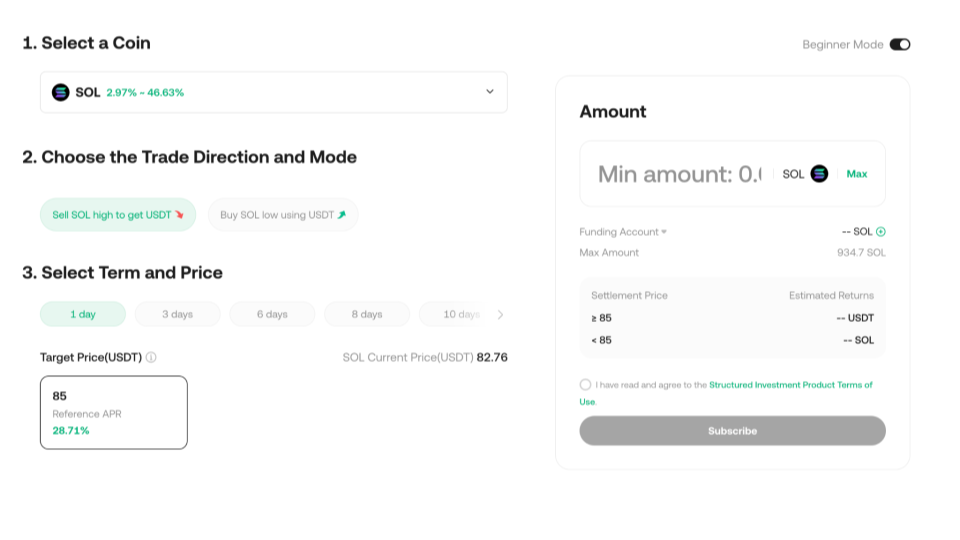
When you subscribe, you select an asset, a target price, a term, and an expected yield. At maturity, the final outcome depends on how the market price of SOL compares to your chosen target price. This introduces variability in settlement while offering higher potential returns compared to more traditional earning products.
If the market price reaches or exceeds the target price at maturity, the investment is settled in a stablecoin such as USDT at the target price, along with the earned yield. If the market price remains below the target, the investment is settled in SOL, also including the accrued yield. This dual-outcome mechanism is the defining feature of the product.
Dual Investment typically offers higher APRs than standard earning products. For SOL, yields can vary widely depending on market conditions, target price selection, and term length. In general, closer target prices tend to offer higher yields due to the increased likelihood of settlement at those levels.
Example: Dual Investment with SOL
To understand how this works in practice, consider a scenario where an investor allocates 100 SOL into a Dual Investment product with a target price of $90, an APR of 300%, and a term of 14 days, while the current market price is $83.
If, at maturity, the price of SOL rises above the target level, for example to $95, the investment is settled in USDT at the target price. In this case, the investor receives approximately $10,035 in total value, which includes both the principal equivalent at the target price and the yield earned over the term. Compared to simply holding and selling at the market price of $95, the outcome reflects the additional benefit of the yield component, though gains are capped at the target-based settlement.
However, if SOL continues to rise significantly beyond the target price, such as reaching $110, the Dual Investment payout remains based on the target price settlement. This creates an opportunity cost, as the investor would have realized a higher return by holding and selling directly at market price.
In a scenario where the price of SOL falls below the target, for example to $78, the investment is settled in SOL. The investor receives approximately 111.5 SOL, which includes the original principal plus the earned yield. At that price level, the total value is higher than simply holding 100 SOL, as the additional yield helps offset the decline in market value.
Risks of Dual Investment
The primary consideration in Dual Investment is opportunity cost. While the product offers higher potential yields, those returns are tied to predefined conditions that may limit upside exposure if the market moves significantly beyond the target price.
Once a subscription is confirmed, it cannot be canceled, meaning the investor must hold the position until maturity regardless of market fluctuations. This makes it important to select target prices and terms that align with both market expectations and personal risk tolerance.
Who Should Use Dual Investment?
Dual Investment is best suited for users who have a directional view on the market and are comfortable with outcome-based settlement. It works well for investors who are willing to exchange flexibility for higher yield potential and who do not require certainty over the exact asset they will receive at maturity.
For holders of SOL who are already comfortable with market exposure, it can serve as a way to enhance returns within a structured framework, provided the trade-offs are clearly understood.
Range Bound: Earn More When SOL Consolidates
Range Bound is a structured yield product on KuCoin designed for sideways markets. It allows you to earn returns when the price of Solana stays within a target price range you select for a fixed duration.
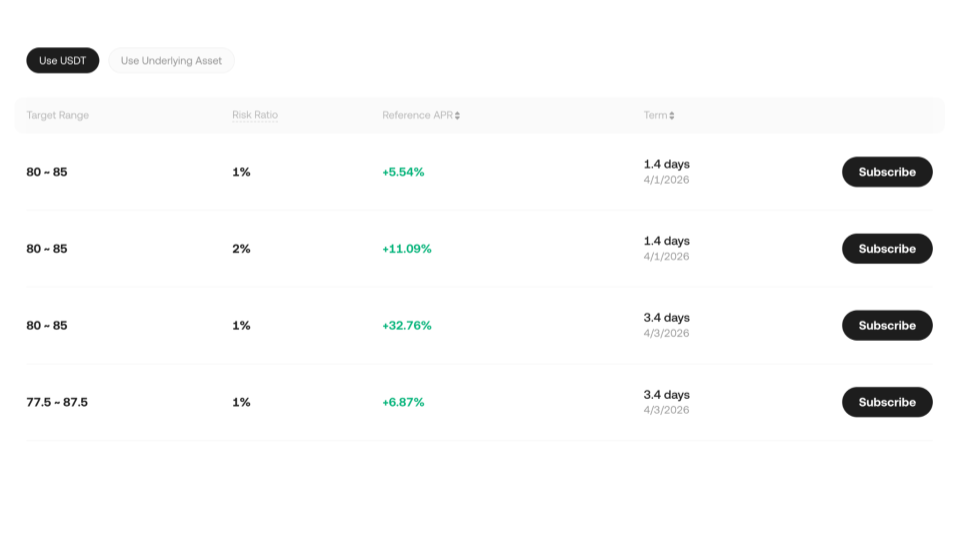
After subscribing, the position is automatically managed. If the price remains within the range until maturity, you receive the full estimated return. If the price moves outside the range at any point, the position is knocked out early and settled at a reduced return.
Range Bound charges zero trading fees, and no active management is required after subscription.
How Range Bound Earnings Are Calculated
Earnings depend on whether the price stays within your selected range or exits it early.
If SOL stays within your range? (full term)
Returns are based on a time-weighted yield:
Returns = Principal × Estimated APR × (Days Subscribed / 365)
This applies when the price remains within your chosen range for the entire duration.
If SOL exits your range? (knockout)
If the price moves outside your range before maturity, the position is settled early:
Settlement Amount = Principal × (1 − Risk Ratio)
-
The risk ratio is set at the time of subscription
-
Higher risk ratios generally offer higher potential APRs
-
But also lead to greater reduction if a knockout occurs
Simple Example: Range Bound on SOL
Suppose Solana is trading at $83. You select a range of $75 to $95, a 14-day term, an APR of 30%, and invest 500 USDT.
If SOL stays within $75–$95 for 14 days:
Returns = 500 × 30% × 14 / 365 ≈ $5.75
Total received: $505.75
If SOL drops to $72 (knockout occurs):
Settlement = 500 × (1 − 10%) = $450
Loss on principal: $50
This highlights the trade-off between range selection and outcomes. Wider ranges reduce the chance of knockout but typically offer lower APR, while tighter ranges increase yield potential but come with higher risk of early settlement.
Who Is Range Bound Best For?
Range Bound is suitable for investors who expect Solana to trade within a defined range over the short to medium term, and who want to earn yield without active trading.
It is best suited for users seeking higher returns than traditional staking or hold-based products, while accepting the possibility of reduced principal in knockout scenarios.
SOL Earning Strategies on KuCoin: Side-by-Side Comparison
|
Strategy |
Reference APR |
Flexibility |
Principal Risk |
Best For |
|
Hold-to-Earn |
0.8% |
Full |
None |
Casual long-term holders |
|
Simple Earn (Flexible) |
0.1% to 2%+ |
Full |
None |
Liquidity-conscious holders |
|
Simple Earn (Fixed) |
Up to 5.6% |
Locked until maturity |
None |
Committed long-term holders |
|
Staking |
5% |
Flexible with 5-day redemption |
Low (liquidity only) |
Long-term holders comfortable with unlock delay |
|
Dual Investment |
3.28% to 44.38% |
Locked for term |
Moderate (opportunity cost) |
Directional traders, yield seekers |
|
Range Bound |
Varies by range |
Locked for term |
Moderate to High |
Sideways market investors |
How to Choose the Right SOL Earning Strategy
Choosing the right earning strategy for Solana depends on more than just expected returns. It requires understanding how much risk you are willing to take, how actively you want to manage your assets, and what market conditions you expect in the near term.
Different strategies are designed with different objectives in mind. Some prioritize simplicity and capital preservation, while others target higher yields in exchange for structured exposure to market movements. With these factors in mind, the next step is to evaluate strategies based on your personal risk tolerance and prevailing market outlook.
Align Your Strategy with Your Risk Tolerance
If you want zero complexity and no additional risk beyond holding Solana, Hold to Earn is the simplest option. You enable it once and continue holding your assets. The yield is modest at 0.8% APR, but it requires no active management and does not restrict your ability to trade or withdraw.
If you are comfortable committing your SOL for a fixed period and want higher passive returns, Fixed Simple Earn or Staking at around 5% APR are the next logical steps. These options are straightforward, widely used, and do not involve structured product mechanics.
If you are willing to explore structured products in pursuit of higher yields, Dual Investment and Range Bound may be more suitable. However, both require a clear understanding of their settlement mechanisms before subscribing. Higher potential yields are typically associated with additional conditions and outcomes, making it important to review the terms carefully.
Align Your Strategy with Market Conditions
In a strongly trending market for Solana, whether upward or downward, Dual Investment can offer attractive yield opportunities. However, strong price movements beyond target levels may result in opportunity cost, as assets could be settled at predetermined conditions rather than capturing the full market move.
In a consolidating or range-bound market, Range Bound strategies tend to perform well. These products are designed around the assumption that prices remain within a defined band, making them particularly suitable when the market is moving sideways.
Across all market conditions, Hold to Earn, Simple Earn, and Staking continue to generate returns in the background, regardless of price direction. These options provide more stability and consistency compared to structured products, which are more sensitive to market behavior.
How to Get Started Earning SOL on KuCoin
Getting started is straightforward regardless of which strategy you choose. Here is the general process:
-
Create a KuCoin account and complete KYC verification. This is required for all earning features.
-
Deposit or purchase SOL within the KuCoin app.
-
Navigate to the Earn section from the KuCoin homepage.
-
Select your preferred product: Hold to Earn, Simple Earn, Staking, Dual Investment, or Range Bound.
-
Review the current APR, terms, minimum amounts, and any applicable risk ratios.
-
Confirm your subscription and authorize with your trading password.
For Hold to Earn, you only need to click Enable once. All supported tokens, including SOL, begin earning automatically from the next day.
For Dual Investment and Range Bound, take time to read the product terms before subscribing. Both products are locked once entered and cannot be cancelled.
Things to Keep in Mind Before You Start
-
APRs are not fixed: The reference APRs listed in this guide reflect rates as of March 2026. Rates for Hold to Earn, Simple Earn, and Staking are updated regularly based on market conditions. Always check the current rate on the KuCoin platform before making decisions.
-
SOL's price fluctuates. All yield figures above are expressed in SOL. The USD value of those earnings will vary with SOL's market price. Earning 15 SOL in a year is more valuable if SOL rises and less valuable if it falls.
-
Structured products carry principal risk. Hold to Earn, Simple Earn, and Staking do not put your principal at risk. Dual Investment and Range Bound do, under specific conditions. Know which category your chosen product falls into.
-
Tax obligations may apply. In many jurisdictions, earning cryptocurrency through staking or yield products is a taxable event. Consult a tax professional familiar with crypto regulations in your country before deploying significant capital.
-
KYC is required. All KuCoin earning features require a verified account. Make sure your identity verification is complete before attempting to subscribe to any product.
Conclusion
Solana is one of the most dynamic assets in crypto, and for KuCoin users, it is also one of the most productively deployable. Whether you are a conservative holder who simply wants to earn a little extra on top of your long-term position, or an advanced investor willing to engage with structured products for higher yields, there is a strategy on KuCoin that fits.
Hold to Earn and Simple Earn offer a low-barrier entry point for anyone getting started with passive income. Staking at 5% APR delivers solid returns for committed holders with a flexible setup. And for those ready to go further, Dual Investment and Range Bound unlock yields that few traditional financial products can match, provided you understand and accept the associated risks.
The key is not finding the highest APR and chasing it blindly. It is matching the right product to your circumstances: your risk tolerance, your time horizon, and your read on the market. Start simple, understand each product before committing, and let your SOL do the work while you focus on the bigger picture.
Frequently Asked Questions
Can I earn SOL on KuCoin without locking my assets?
Yes. Hold to Earn and Simple Earn (Flexible) let you earn rewards while keeping your SOL available for trading and withdrawals.
What is the highest APR available for SOL on KuCoin?
Dual Investment products can offer APRs up to 44.38% for SOL, but higher yields come with higher risk and more complex settlement conditions.
Is staking SOL on KuCoin safe?
Staking carries relatively low risk, but funds are subject to a redemption period (around 5 days), during which you cannot access your SOL.
What happens if SOL’s price drops while I am in a Dual Investment product?
If SOL settles below the target price at maturity, you receive your principal plus yield in SOL. The final value depends on the market price at settlement.
Can I run multiple earning strategies at the same time on KuCoin?
Yes. You can combine Hold to Earn, Simple Earn, and Staking simultaneously, as they operate independently.
Is there a minimum amount needed to start earning SOL on KuCoin?
Yes. Hold to Earn requires a minimum of 0.2 SOL, while other products have their own minimum requirements listed on the KuCoin Earn page.