

Why Nearly One-Quarter of Russia’s Credit Institutions Became Unprofitable in 2026
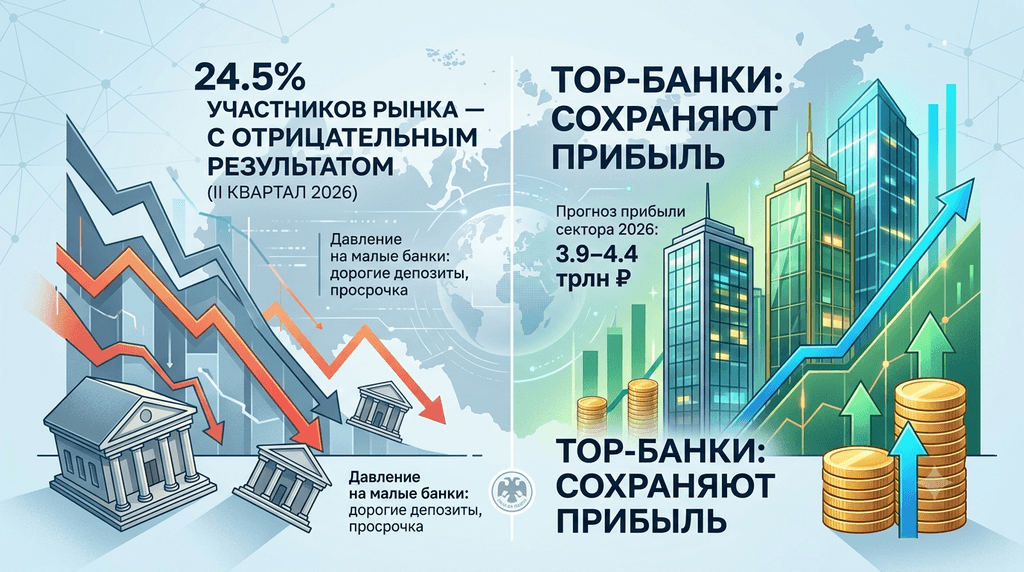
Nearly one in four credit institutions in Russia ended the second quarter of 2026 with a negative financial result. According to data from the Bank of Russia analyzed by Izvestia on September 8, 2026, the share of unprofitable market participants reached 24.5%, up from 18% a year earlier. Since the beginning of the year, the number of such institutions has increased by 87% to 86 as of August. This does not indicate a systemic banking crisis: most losses are concentrated among small and regional players, while the largest banks continue to report strong profitability. The Bank of Russia forecasts that the banking sector’s total net profit will reach RUB 3.9–4.4 trillion in 2026. The main factors pressuring smaller banks are expensive deposits, weak demand for loans, rising delinquency, and higher provisioning.
What Does the Increase in Unprofitable Credit Institutions Mean?
The increase in unprofitable credit institutions means that profitability has become more uneven across the banking market, not that the entire system has lost stability. In the second quarter of 2026, 24.5% of market participants reported a negative financial result, according to Bank of Russia data published in an Izvestia report on September 8, 2026.
The category of credit institutions includes not only banks with universal or basic licenses, but also other financial-market participants authorized to conduct banking operations. Therefore, the 24.5% figure cannot automatically be interpreted as the share of unprofitable banks.
Among banks, 65 out of 300 organizations reported losses. That represents approximately 21.7% of the banking sector. The total number of unprofitable credit institutions reached 86 by August, 87% higher than at the beginning of the year.
However, the number of unprofitable organizations and the size of their combined losses are different indicators. According to a Frank Media report published on September 8, 2026, the combined losses of these banks amounted to approximately RUB 90.2 billion as of June. That figure was lower than a year earlier, even though more organizations reported negative results.
In other words, the banking sector is seeing a broader area of low profitability, but not a proportional increase in the scale of losses. The organizations moving into the red generally hold a relatively small share of sector assets, so their results have a limited impact on overall industry statistics.
Do Unprofitable Banks Threaten the Stability of the Banking System?
The unprofitability of individual organizations does not by itself indicate that Russia’s banking system has become unstable. The Bank of Russia said that the problems mainly affect banks with a small combined share of sector assets, while the sector as a whole continues to show resilient financial results, according to data published on September 8, 2026.
The regulator expects total banking-sector profit to reach RUB 3.9–4.4 trillion in 2026. The Bank of Russia raised its forecast from the previous estimate of RUB 3.4–3.9 trillion, according to its latest banking-sector review for the second quarter of 2026.
These figures demonstrate a high concentration of profits. According to Vasily Kutyin, an analyst at Ingosstrakh Bank, the ten largest banks account for approximately 75–76% of the industry’s total profit. As a result, negative results at dozens of small organizations can coexist with record profits at several systemically important players.
Risk assessment must consider not only the number of unprofitable banks, but also their assets, capital, liquidity, loan-portfolio quality, and ability to meet obligations to customers. A small bank can report a loss for one or several quarters while maintaining sufficient capital and access to liquidity.
The current situation therefore looks more like structural segmentation of the market. Large banks benefit from scale, inexpensive account balances, and developed digital platforms. Smaller organizations face more expensive funding and fewer opportunities to spread their costs.
Why Are Small Banks More Frequently Moving into the Red?
The main reason for losses at smaller banks is simultaneous pressure on revenue and expenses. They must attract funds at high costs, receive less income from placing liquidity, and increase provisions because of deteriorating loan quality.
Expensive Deposits Increase Funding Costs
The high cost of attracted funds directly reduces the net interest margins of smaller banks. To compete for customers, they offer higher rates on deposits and savings products. These liabilities create substantial interest expenses over an extended period.
Even when the key rate begins to decline, the cost of previously attracted deposits does not fall immediately. Banks must continue paying high rates to depositors while the returns on new operations gradually decrease.
The Bank of Russia indicated that the key rate fell by 5.75 percentage points from June 2025 to June 2026, reaching 14.25%, according to the Izvestia report of September 8, 2026. For banks, this means lower income from placing excess liquidity in high-yield instruments.
Large players can manage this transition more easily. They hold substantial volumes of funds in settlement and current accounts, which are cheaper than term deposits. Smaller banks may have a greater share of expensive funding, so falling market rates temporarily weaken their margins.
High Rates Suppress Loan Demand
The high cost of borrowing limits demand from households and businesses. Potential borrowers postpone investment projects, reduce consumer borrowing, or choose shorter loan maturities.
This is particularly sensitive for a small bank. Its business model often depends on lending to local companies, individual entrepreneurs, and households in a specific region. When demand declines, the bank cannot quickly compensate for lost income through the scale of operations in other segments.
Lower loan issuance also intensifies competition. Large banks can offer customers bundled products, discounts for payroll projects, and digital services. Regional organizations must increase customer-acquisition expenses while lowering rates or tightening borrower requirements.
Delinquency Increases Provisioning Costs
Rising overdue debt forces banks to create additional provisions. These charges do not always represent an immediate cash loss, but they reduce current profit and limit the capital available for new operations.
According to a Klerk report published on September 8, 2026, the share of non-performing loans to legal entities exceeded 11% in the fourth quarter of 2025, compared with 5.8% a year earlier. Although this comparison concerns an earlier period, it helps explain why banks continue to face the consequences of deteriorating corporate-loan quality in 2026.
Banks working with small and medium-sized businesses are particularly vulnerable. Such borrowers have smaller financial buffers, greater dependence on domestic demand and interest expenses, and may require more time to restructure their debt.
Liquidity Shortages Limit Banks’ Options
Liquidity shortages remain an additional factor. According to data cited by Klerk on September 8, 2026, the banking sector’s liquidity requirement had risen to RUB 2.7 trillion by mid-August.
A large organization usually has broader access to market financing. It can attract funds through multiple channels, use a substantial volume of highly liquid assets, and redistribute resources between divisions more easily.
A small bank depends more heavily on deposits, the interbank market, and the behavior of a limited number of large customers. If several corporate clients transfer their funds to a larger bank at the same time, the structure of the smaller bank’s balance sheet can change significantly.
How Does the Situation Affect Depositors and Corporate Customers?
For depositors, the situation remains manageable overall, but customers should evaluate not only the offered rate but also the reliability of the specific bank. The Bank of Russia emphasizes that the increase in unprofitable institutions does not threaten the stability of the banking system as a whole.
Individual depositors are protected by the deposit-insurance system. Under the current insurance limit, compensation of up to RUB 1.4 million per depositor per bank is guaranteed, including accrued interest. Keeping funds within the insurance limit therefore reduces the consequences of a possible license revocation.
Insurance does not eliminate the practical need to monitor a bank’s condition. Customers should check whether the organization is listed as a participant in the deposit-insurance system, review regulator announcements, and avoid concentrating all available funds in one institution.
The risks for businesses are more complex. Funds held in corporate settlement accounts are not always protected in the same way as individual deposits. As a result, small and medium-sized businesses may prefer to transfer excess liquidity to the largest state-owned or systemically important banks.
This migration increases market concentration. Large banks receive more low-cost balances and commission business, while regional organizations lose part of their funding base. The initial outflow of corporate funds can therefore further weaken the financial position of smaller banks.
Businesses should reasonably distribute their balances across several banks, assess payment-service terms in advance, and maintain a liquidity reserve. Choosing a bank solely because it offers the highest rate or the lowest fee can increase operational risk.
For investors, the increase in unprofitable banks signals a widening gap between large and small players. The sector’s potential attractiveness will depend not on average statistics, but on the specific bank’s business model and capital quality.
The largest banks benefit from scale, inexpensive funding, and a high share of fee income. According to the Bank of Russia’s forecast, total industry profit could reach a record high of RUB 3.9–4.4 trillion in 2026.
However, record sector-wide profit does not mean that every participant is becoming more profitable. As Frank Media reported, citing industry analysts, most of the result is concentrated among several of the largest banks. Investors should therefore separately analyze net interest margin, cost of risk, reserve trends, and capital adequacy.
Small banks may be attractive only when they have a clear competitive niche. For example, an organization may successfully serve regional businesses, specialize in a particular segment, or have a stable customer base. A high deposit rate or rapid loan-portfolio growth, however, is not in itself evidence of an attractive investment.
A negative result for one quarter should also not be viewed in isolation. It is important to determine whether the loss was caused by one-time provisioning, asset revaluation, or a permanent deterioration in the operating model. Recurring losses combined with falling capital are a more serious warning sign.
Will Consolidation of Russia’s Banking Market Accelerate?
The increase in losses will likely accelerate consolidation in Russia’s banking sector. Smaller organizations will find it more difficult to meet capital requirements, compete for deposits, and maintain profitability at the same time.
According to expert assessments, some owners of regional banks are already considering leaving the business because returns on capital have declined. If independent development becomes too expensive, possible options include merging with a larger player, selling the business, or gradually winding down operations.
According to a Klerk report published on September 8, 2026, minimum capital requirements for banks with universal licenses will begin rising in 2028 and are expected to increase from RUB 1 billion to RUB 3 billion by 2030. For banks with basic licenses, the requirement may rise from RUB 300 million to RUB 1 billion.
These changes are intended to strengthen institutional resilience, but they also increase the cost of operating independently for smaller players. Banks will have to raise capital, reduce risky assets, or seek a partner for a merger.
Consolidation does not mean that all regional banks will disappear. Small organizations continue to perform an important function in smaller cities and in serving local small and medium-sized businesses. It is not always economically attractive for large banks to operate in narrow regional segments.
Nevertheless, the market structure may become more concentrated. Strong regional banks will continue operating, while organizations without a stable customer base, sufficient capital, or a clear specialization will be more likely to exit the market or join larger groups.
How Can a Temporary Loss Be Distinguished from a Serious Problem?
A temporary quarterly loss is not the same as bankruptcy, but it requires an analysis of its causes and consequences. Key risk indicators include not only negative profit, but also a rapid decline in capital, worsening liquidity, and rising delinquency.
When assessing a bank, attention should be paid to several indicators:
-
Capital and capital-adequacy trends. If capital remains above the required level with a sufficient buffer, the bank may withstand an isolated loss-making period.
-
The share of overdue loans. Rising problem debt indicates that pressure on profitability may continue.
-
The volume of provisions created. A one-time increase may reflect a conservative risk assessment, but continuous growth points to problems in the loan portfolio.
-
The deposit structure. Heavy reliance on expensive term deposits makes a bank vulnerable when asset yields decline.
-
The concentration of large customers. The departure of several companies can create a liquidity shortage at a small institution.
-
Regulatory announcements. Restrictions on certain operations, official orders, and management changes require additional attention.
For a depositor, a bank’s participation in the deposit-insurance system is as important as its reported profit. For a company, the reliability of settlements, the quality of payment infrastructure, and the ability to obtain timely information about the bank’s condition are also important.
Beyond the Headlines: What KuCoin 5.0 Means for You
Market news moves fast — but where you act on it matters just as much. This October, KuCoin launches KuCoin 5.0, transforming KuCoin into a rebuilt platform. Here's what actually changes for you:
-
One account for everything. Older platforms split your money across separate "spot," "margin," and "futures" accounts and expected you to understand why. KuCoin 5.0's unified account removes that entirely — deposit once, and everything is simply there.
-
Stocks, indices, and commodities. KuCoin 5.0 expands beyond crypto into global markets. When crypto chops sideways and equities rally (or the reverse), you rotate in minutes instead of opening a brokerage account and waiting days for fiat rails.
-
Real-world assets (RWA). Tokenized exposure to traditional assets like commodities, right inside your crypto account. One of the fastest-growing segments in global finance is no longer reserved for institutions — you access it from the same balance you trade with.
-
Earn while you learn. Not ready to trade? KCUSD lets your stablecoins earn daily, auto-compounding interest. The lowest-stress way to put your idle deposit to work for 4% yield.
-
An AI assistant in plain language. Ask questions, get market context, understand what you're looking at — built into the platform, no jargon required.
-
An app that doesn't overwhelm. Faster, cleaner, and consistent — intuitive from the first tap, not after a tutorial.
-
Safety you can check, not just trust. A MiCAR-licensed EU entity, Proof of Reserves you can verify yourself, and internationally certified security (SOC 2 Type II, ISO 27001:2022).
Create your account in minutes — and start on the platform built for where crypto is going, not where it's been.
Conclusion
Nearly one-quarter of Russia’s credit institutions were unprofitable in the second quarter of 2026, while the number of organizations reporting negative results rose to 86 by August. Among banks, 65 out of 300 participants reported losses. The key conclusion is that these figures reflect not a systemic crisis, but a widening gap between large and small players.
The Bank of Russia maintains a positive assessment of the sector’s stability and forecasts total profit of RUB 3.9–4.4 trillion for 2026. However, most of that profit is concentrated among the largest banks, while smaller and regional institutions face pressure from expensive deposits, weak loan demand, liquidity shortages, and rising delinquency.
For depositors, deposit insurance within the established limit remains the key protection mechanism. Corporate customers should diversify their accounts and avoid choosing a bank solely because of a high rate. Investors should analyze the capital, provisions, and asset quality of each organization. In the longer term, the market is likely to continue consolidating, with competition shifting further toward the largest banks.
Frequently Asked Questions
1. Can an unprofitable bank continue operating?
Yes. A bank can continue operating after one or several loss-making quarters if it maintains sufficient capital and liquidity and complies with Bank of Russia regulations. A negative profit figure does not automatically lead to a license revocation.
The loss may result from one-time provisioning, asset revaluation, or a temporary deterioration in the net interest margin. However, persistent losses combined with falling capital require increased attention.
2. What happens to a loan if the bank becomes unprofitable?
The loan agreement remains in force even if the bank reports a loss or changes ownership. In a reorganization, the rights to the loan may be transferred to another institution, but the borrower must continue making payments according to the established schedule.
Before sending a payment, the borrower should verify the official bank details and review the bank’s notices. Payments should not be stopped solely because of news about a loss, as this could result in delinquency and penalties.
3. Can interest rates on existing loans increase?
This depends on the terms of the agreement. For fixed-rate loans, a bank generally cannot change the rate arbitrarily. For products with variable rates, changes may be possible according to the formula specified in the contract.
A bank’s unprofitability alone does not give it the right to change every contractual term unilaterally. Customers should review the sections covering rate adjustments, fees, and notification procedures.
4. Should a depositor close an account at a bank that has become unprofitable?
Not necessarily, provided that the bank participates in the deposit-insurance system and the deposited amount falls within the insurance-compensation limit. Nevertheless, depositors should review Bank of Russia announcements, the bank’s rate structure, and its financial indicators.
If the amount exceeds the insurance limit, it is reasonable to distribute the funds among several banks. This reduces dependence on the financial results of a single institution.
5. Why do large state-owned banks earn more than smaller banks?
Large banks have a broad customer base, substantial balances in settlement accounts, developed digital services, and more opportunities to diversify their sources of income. They can also spread fixed costs across a larger volume of operations.
Smaller banks depend more heavily on expensive deposits and regional demand. Their loan portfolios are often less diversified, so difficulties among several major borrowers have a more noticeable effect on their overall financial results.
Disclaimer : This material is provided for informational purposes only and does not constitute financial, investment, legal, or tax advice. Transactions involving cryptocurrencies and tokenized assets carry substantial risks — including price volatility, limited liquidity, counterparty exposure, and the potential for total loss of invested capital. Readers should conduct their own research and, where appropriate, consult a qualified professional before making any financial decisions.