

Digital Ruble Logo and Usage Guide: A Complete Handbook from the Central Bank of Russia
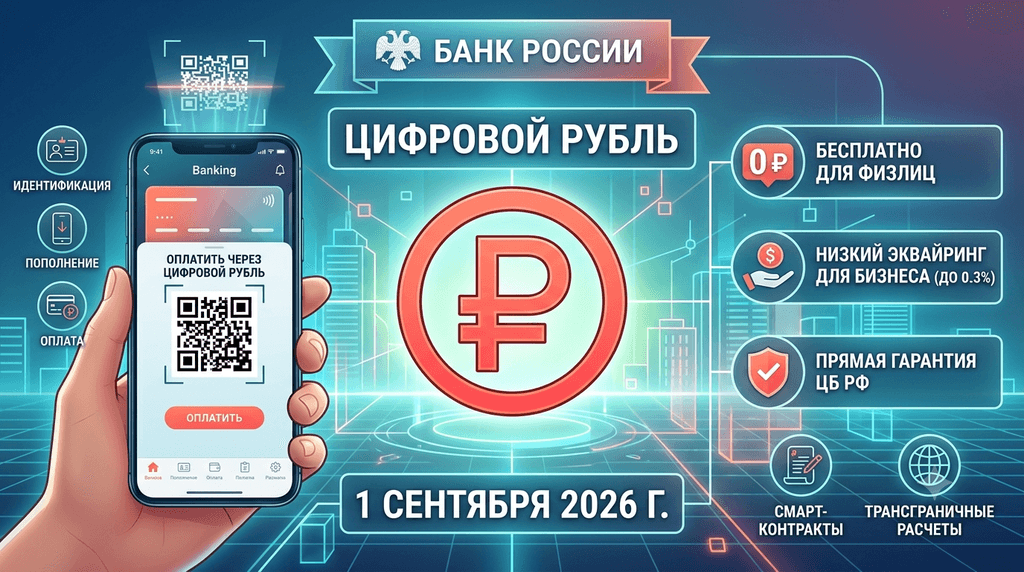
The Bank of Russia has officially approved the logo for the digital ruble and published a detailed regulation on operations with the third form of national currency ahead of its mass launch on September 1, 2026. Individuals and businesses will be able to start using the digital ruble through their familiar commercial banking mobile apps by opening a dedicated digital wallet directly on the Central Bank's platform. According to Bank of Russia data from August 2026, the new form of money is designed to significantly reduce costs for businesses and increase the accessibility of financial services across the country. All transactions for individuals will remain completely free of charge and indefinite, with funds receiving a direct state guarantee from the regulator. For full functionality, citizens simply need to complete identification with their bank and transfer electronic rubles to their digital wallet.
What Does the New Digital Ruble Logo Look Like, and What Is the History of Its Creation?
The official logo of the digital ruble consists of the international ruble symbol ₽ inscribed within a circle of a rich coral-red color. According to the official brand book of the Bank of Russia presented on August 31, 2026, this visual symbol was developed specifically to ensure instant recognition of the national digital payment method on smart terminal screens, mobile banking interfaces, and universal payment QR codes.
The graphic concept of the logo is built on strict geometry and visual concise design. The vertical line of the letter "Р" is positioned at a distance of exactly one-third of the circle's diameter and harmoniously connects with the outer coral circle. A mandatory protective clear zone is set around the emblem, inside which third-party text or design elements are strictly prohibited, guaranteeing brand integrity across all payment systems.
The development of the digital ruble's corporate identity was conducted by the regulator with integration into the country's unified payment infrastructure in mind. Starting September 1, 2026, this logo will be displayed at checkout zones of major retail chains, self-service checkouts, and mobile applications of all Russian banks with a universal license. The visual ID emphasizes that the digital ruble is an equal third form of money alongside cash and electronic funds.
How Can an Individual Start Using the Digital Ruble?
An individual can open a digital wallet and begin operations through the mobile application of any commercial bank connected to the Bank of Russia platform. The onboarding process does not require visiting CBR branches or installing additional software, as integration occurs seamlessly through the existing banking infrastructure.
The step-by-step procedure for citizens to open a digital account is as follows:
-
App Login: The user logs into their primary commercial bank's mobile application and selects the "Digital Ruble" section.
-
Agreement Execution: The citizen signs an electronic agreement with the Bank of Russia to open and maintain a digital account.
-
Wallet Opening: The regulator opens a personal digital wallet directly on its isolated platform.
-
Account Top-Up: The user transfers electronic rubles from their regular bank account into the digital wallet.
According to Bank of Russia data from August 2026, a limit of 300,000 rubles per month is set for individuals to top up their digital wallets from bank accounts. In an interview with RIA Novosti, Alla Bakina, Director of the National Payment System Department at the Bank of Russia, explained that this limit fully covers the average monthly needs of citizens for everyday payments. However, no limits are imposed on disposing of funds already in the wallet—users can transfer or spend any available amount.
Paying for store purchases is done by scanning a universal QR code at the checkout. The customer scans the code through their mobile bank, selects "digital ruble" as the payment method, and confirms the operation, resulting in instant credit to the seller. Withdrawing funds back to a regular card or into cash is processed 1:1 without restrictions or fees.
What Guarantees of Privacy, Security, and Zero Fees Does the CBR Provide?
Digital ruble transactions for individuals are completely free of charge, and the funds are protected by banking secrecy and direct guarantees from the regulator. The legislative framework of the Russian Federation guarantees citizens a high level of rights protection and security of personal information.
The Bank of Russia officially stated that the Digital Ruble is fully subject to banking secrecy laws. Information on transactions and account balances is unavailable to third parties without valid legal court orders. Additionally, the regulator debunked popular myths by confirming that there are no "expiration dates" or restrictions on spending categories: digital rubles do not expire over time and cannot be forcibly limited to purchasing specific categories of goods.
The security of storing money on the CBR platform exceeds standard banking guarantees. Unlike ordinary electronic bank deposits, which are insured by the Deposit Insurance Agency (ASV) only up to 1.4 million rubles, digital rubles are held directly with the Central Bank. This eliminates the risk of losing funds even in the event of a license revocation or bankruptcy of the servicing commercial bank.
The regulator's fee policy completely excludes costs for the public:
-
Transfers between digital wallets of individuals — 0 rubles.
-
Payment for goods, works, and services — 0 rubles.
-
Wallet top-up and withdrawal to a bank account — 0 rubles.
Furthermore, the regulator is developing and actively testing an offline payment mode (Offline Payments). This technology will allow citizens to make secure transfers and pay for goods even in the absence of an internet connection or in areas with unstable cellular coverage.
What Are the Key Differences Between the Digital Ruble, SBP, and Traditional Cashless Payments?
The main difference between the digital ruble, the Faster Payments System (SBP), and bank cards lies in its architecture: funds are stored directly at the Central Bank rather than on the accounts of commercial banks. This distinction forms fundamentally different financial and technological operating conditions.
When using standard bank cards or SBP, the issuer of electronic money is a specific commercial bank. If a bank faces liquidity issues, access to money may be restricted. In the case of the digital ruble, the liability to the account holder is borne directly by the State represented by the Bank of Russia.
The second fundamental difference is the absence of limits on interbank transfers. In SBP, the fee-free transfer limit between citizens is 100,000 rubles per month (excluding transfers to oneself up to 30 million rubles), after which a 0.5% fee applies. In the digital ruble system, absolutely all transfers within the platform are free regardless of the amount or frequency of transactions.
For a clear comparison of key payment system parameters, see the table below:
| Comparison Parameter | Digital Ruble (CBDC) | Faster Payments System (SBP) | Bank Cards (Visa, Mir) |
| Issuer & Custodian | Central Bank of Russia | Commercial banks | Commercial banks |
| Individual Transfer Fees | 0% permanently | 0% up to 100k RUB/mo, then 0.5% | Dependent on bank tariff |
| Merchant Fee (Acquiring) | Capped at 0.3% | From 0.4% to 0.7% | From 1.2% to 2.5% |
| Bank Bankruptcy Protection | 100% CBR guarantee | ASV insurance up to 1.4M RUB | ASV insurance up to 1.4M RUB |
| Interest on Balance | 0% (prohibited by law) | Accrued per bank terms | Accrued per bank terms |
The digital ruble platform functions as a single unified settlement ledger. It operates without interbank intermediary nodes, ensuring instantaneous settlement 24/7/365.
What Benefits Does the Digital Ruble Provide to Businesses and Commercial Enterprises?
Accepting digital ruble payments reduces merchant acquiring costs for commercial enterprises by more than fourfold due to a legislatively capped fee rate of 0.3%. According to a TASS report from August 2026, this fundamental shift reduces the financial burden on retail and the service sector.
The fee schedule for legal entities and sole proprietors is strictly regulated by the Bank of Russia:
-
Grace Period: Until December 31, 2026, payment acceptance and transfer fees for businesses are completely waived (0%).
-
Base Rate from 2027: The fee for accepting payments for goods and services is 0.3% of the transaction amount, capped at 1,500 rubles per operation.
-
Utility Payments (ЖКХ): Fees for utility service providers are capped at 0.2% (maximum 10 rubles).
-
B2B Transfers: A fixed fee for transfers between legal entities will be 15 rubles per transaction.
By law, starting September 1, 2026, the obligation to accept digital rubles applies to merchants with annual revenues exceeding 120 million rubles, and from 2027 to those with revenues over 30 million rubles. However, the law exempts retail locations with annual revenues under 5 million rubles and businesses operating in areas lacking internet access.
An additional benefit for businesses is protection against "consumer fraud" and unjustified chargebacks. Automatic debiting of funds from a seller's account by a commercial bank based on a buyer's request becomes impossible. Refunds for purchases can only occur either through the voluntary initiative of the merchant or via a court order.
How Does the Central Bank Protect the Banking System from Liquidity Outflows?
The Bank of Russia implemented a system of protective barriers, including zero interest on balances and top-up caps, to prevent a massive outflow of deposits from commercial banks. Sudden movement of liquidity from the commercial sector to the CBR platform could weaken bank lending capacity, prompting the regulator to enforce strict preventive measures.
The first protective mechanism is the legislative ban on accruing interest on balances in digital wallets. The digital ruble is positioned strictly as a payment instrument, not a savings or investment vehicle. It is financially unviable for citizens and businesses to hold large reserves in digital wallets, as these funds are not protected against inflation by bank interest.
The second protective element is a strict top-up cap of 300,000 rubles per month for individuals. Even if a citizen wishes to move all their savings into digital rubles, they cannot do so instantaneously, preventing panic bank runs during times of market volatility.
For legal entities, there is no top-up limit; however, the absence of interest yields forces companies to quickly transfer incoming revenue from digital wallets back to traditional commercial bank checking accounts to participate in deposit and treasury programs. As a result, the commercial banking sector preserves its resource base and credit potential.
What Are the Prospects for Using the Digital Ruble in Smart Contracts and Cross-Border Settlements?
The CBR digital platform supports built-in smart contracts and technological interfaces for direct interaction with digital currencies of other nations. This expands the functional capabilities of the national currency far beyond standard payments.
Smart contracts on the digital ruble platform operate as executable algorithms that automatically transfer funds from payer to recipient only upon the fulfillment of strictly defined conditions. In practice, this enables:
-
Secure B2B Transactions: Automated payment for goods delivered only after verification of cargo entry at a warehouse.
-
Transparency in Public Procurement: Tagging targeted budget funds and tracking their execution strictly according to intended allocations.
-
Automated Retail & Real Estate Deals: Secure purchases of real estate, automobiles, and service payments upon completion of work without relying on expensive letters of credit.
In international trade, the digital ruble was engineered to bypass geopolitical restrictions. The platform's architecture allows direct connection between the CBR registry and Central Bank Digital Currency (CBDC) platforms of friendly nations.
According to RBC Crypto data from 2026, the regulator is holding negotiations to establish bilateral and multilateral payment bridges with digital yuan (e-CNY) projects and CBDC initiatives across BRICS nations. Direct inter-platform communication between regulators completely bypasses the SWIFT system and Western correspondent banking accounts, providing robust resistance against external sanctions.
Why Is the Digital Ruble Not a Cryptocurrency, and How Does It Differ From Bitcoin?
The digital ruble is categorically not a cryptocurrency, as it represents a centralized state currency with a fixed face value and a guaranteed 1:1 exchange rate to the physical ruble. Representatives of the Bank of Russia have repeatedly highlighted the fundamental difference between state digital currencies (CBDCs) and decentralized crypto assets.
Cryptocurrencies (such as Bitcoin or Ethereum) are issued algorithmically on decentralized networks, lack a central authority, and are not backed by state obligations. Their valuation is subject to high market volatility and is driven purely by market supply and demand dynamics.
Conversely, the digital ruble is issued exclusively by the Central Bank of Russia and serves as official legal tender. Its value is strictly equal to traditional currency: 1 digital ruble always equals 1 physical ruble and 1 electronic ruble on a bank card.
Below is a detailed comparison between the digital ruble and standard cryptocurrencies:
| Assessment Criterion | Digital Ruble (CBR CBDC) | Cryptocurrency (Bitcoin, Ethereum) |
| Issuance & Governance | Centralized by the Bank of Russia | Decentralized (miners / validators) |
| Backing | Fully backed by the State | Unbacked (except asset-backed stablecoins) |
| Price Volatility | Zero (strictly 1:1 to physical cash) | High (market price fluctuations) |
| Investment Potential | None (cannot profit from appreciation) | High (potential for speculative gain) |
| Legal Status in RF | Official legal tender | Prohibited as a payment medium in RF |
| Anonymity | User identification (Banking secrecy) | Pseudo-anonymous addresses |
The digital ruble lacks investment potential or opportunity for speculative capital appreciation. It cannot be used for trading or passive yield generation.
KuCoin Offers A More Stable Option in A Volatile Market
If you worry about the frequent ups and downs in the market, and pursue a more stable option to earn money passively, KuCoin is the right place to come:
Simple Earn: Deposit and withdraw tokens anytime, earning stable returns.
Kucoin Earn: Earn stable profits with professional asset management.
Hold to Earn: Earn rewards by holding assets in Funding, Trading, Margin, Futures, Mining, and Unified Accounts.
Staking: Unlock the earning potential of on-chain assets.
Advanced Investments: Advanced Investments offer a variety of structured products to help your money grow in any market.
Shark Fin: Principal Protection and Guaranteed Gains
Dual Investment: Buy low and sell high with transparent return calculations.
Snowball: High yields, with price protection.
Discount Buy: Buy crypto at discount prices.
KCS Loyalty: Level up to enjoy exclusive perks by staking ≥ 1 KCS.
KuCoin Wealth: Discover future value and begin your smart investing journey.
KCS Benefits: Hold and stake KCS to access benefits across the platform.
KCS Staking 2.0: Participate in KCS on-chain governance to earn yield.
Conclusion
The unveiling of the digital ruble logo and the publication of official operating rules by the Bank of Russia mark the national financial system's transition into a new technological era. The mass launch of Russia's third currency form on September 1, 2026, provides citizens with a free, secure payment tool while allowing businesses to cut acquiring fees down to 0.3%. Implemented banking secrecy protections, the absence of fund expiration rules, and a monthly top-up cap of 300,000 rubles strike a balance between user convenience and commercial banking stability.
At the same time, smart contract integration and preparations for cross-border settlements in national digital currencies open new horizons for international trade. However, lacking investment yield and volatility, the digital ruble remains purely a medium of exchange. To preserve and grow capital, investors continue to leverage global cryptocurrency markets, pairing the reliability of state payment rails with the expansive capabilities of digital assets.
Frequently Asked Questions (FAQs)
1. Do I have to exchange my physical cash for digital rubles?
Transitioning to the digital ruble is entirely voluntary. Citizens retain the right to continue using physical cash, plastic bank cards, or the Faster Payments System (SBP) as usual without any restrictions.
2. Is interest paid on funds held in the CBR digital wallet?
No interest is accrued on digital ruble balances. By law, the digital ruble is engineered strictly as a payment and transfer mechanism, not as an instrument for savings or passive income generation.
3. Do banks charge fees for transferring digital rubles between individuals?
All transfers, payments, and operations in digital rubles for individuals are completely free (0% fee) on a permanent basis.
4. How do I transfer money from my digital wallet back to a bank card?
Withdrawals occur instantly through your bank's mobile application. You enter the desired amount and transfer digital rubles back to your standard bank account at a 1:1 ratio with zero fee.
5. Can the digital ruble be used without an internet connection?
The Bank of Russia is developing and testing a dedicated offline payment mode. Once launched, this technology will enable citizens to pay with digital rubles even in environments completely lacking cellular coverage or internet access.
Disclaimer : This material is provided for informational purposes only and does not constitute financial, investment, legal, or tax advice. Transactions involving cryptocurrencies and tokenized assets carry substantial risks — including price volatility, limited liquidity, counterparty exposure, and the potential for total loss of invested capital. Readers should conduct their own research and, where appropriate, consult a qualified professional before making any financial decisions.