

Russia's Crypto Market Under the Central Bank: How Legal Digital Asset Trading Will Work
2026/07/29 11:18:00
Introduction
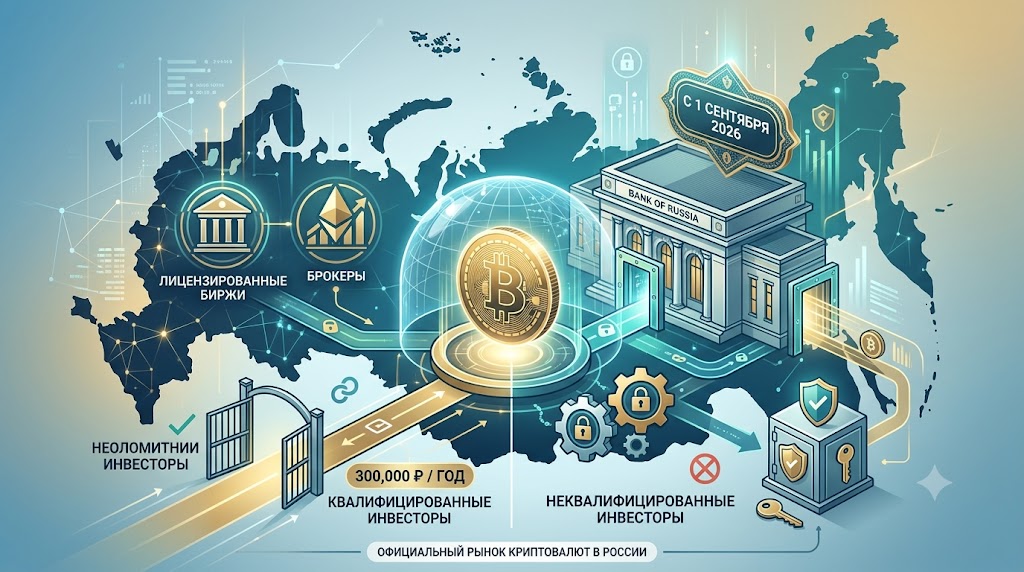
On July 27, 2026, the Bank of Russia published the first drafts of regulatory acts launching an official cryptocurrency market in the country. The answer to the main question is simple: starting September 1, 2026, buying and selling digital currencies in Russia will only be possible through licensed intermediaries — exchanges, brokers, and exchangers connected to trade organizers. Anonymous P2P schemes and gray-market exchangers are becoming a thing of the past, while trading itself moves under the regulator's direct oversight, including disclosure of trade data and calculation of an official market price.
This is not liberalization, but the integration of the crypto market into a controlled infrastructure — complete with its own depositories, investor limits, and tax consequences. In this article, we break down exactly how the new system will work, who will get access to it, and what changes for those already trading cryptocurrency.
What the Bank of Russia Actually Launched
The Bank of Russia has created a regulatory framework for organized trading in digital currencies and digital rights — the first package of bylaws following the passage of the base law. According to the regulator's release dated July 27, 2026, the specific trading regime will be set by each exchange in its own rules: the trade organizer itself will calculate the market price and the weighted average price for digital assets.
The State Duma passed the base law "On Digital Currency and Digital Rights" a week earlier, and it takes effect on September 1, 2026. Until that date, market participants have a transition period to prepare their infrastructure — registering depositories, setting up reporting to the Central Bank, and connecting to trading platforms. Liability for illegal intermediary activity in the crypto market will follow later, from July 1, 2027, modeled on penalties for illegal banking activity.
An important detail for traders: paying for goods and services with digital currency inside the country remains prohibited. The law regulates investment turnover specifically — buying, selling, and recordkeeping of assets — not their use as a means of payment.
The transition period leading up to September 1 matters not only for the regulator but for market participants themselves. During this time, exchanges must approve internal trading regulations, depositories must build up the required capital and complete registration, and intermediaries must set up real-time reporting channels to the Bank of Russia. All the draft regulatory acts are currently published for regulatory impact assessment, meaning market participants and experts can submit comments before the final versions are approved.
Who Will Be Allowed to Conduct Cryptocurrency Transactions
Only licensed intermediaries — exchanges, brokers, and exchangers registered with the Bank of Russia — will be able to conduct transactions in digital currencies. Directly buying cryptocurrency on foreign platforms without connecting to Russia's regulated infrastructure formally remains outside the legal scope of the new system.
A separate provision applies to foreign crypto exchanges: they will be able to operate in Russia through subsidiary companies registered with and accountable to the Russian regulator. This opens a path into the local market for major international platforms, but obligates them to meet the same capital, reporting, and disclosure requirements as Russian players.
Where and How Digital Assets Will Be Traded
Trading in digital currencies will take place on organized venues — exchanges and over-the-counter (OTC) channels connected to licensed intermediaries. The format and rules of specific trading sessions are set by each exchange, but the obligations to the regulator are the same across all venues.
Every trade organizer is required to:
-
calculate the market price and weighted average price at the close of trading sessions;
-
publicly disclose trading information to investors;
-
transmit trade data to the Bank of Russia in real time.
This model resembles how traditional stock exchanges operate: price is formed transparently, rather than in closed chats and uncontrolled exchange points. For a trader, this means a BTC or ETH quote on a Russian regulated venue will be an official reference price, not an arbitrary rate set by an individual intermediary.
At the same time, each exchange retains fairly broad freedom in setting its own trading regulations — session hours, tick size, the composition of traded pairs, and settlement procedures are determined independently, within the Central Bank's general requirements. The regulator sets the framework — mandatory price transparency and data transmission — while the specific content of the rules is left to the trade organizer's discretion, allowing different venues to compete for clients through their range of instruments and terms.
What Will Be Available to Buy First
The list of tradable assets at launch will be limited, consisting of the most liquid instruments. The Bank of Russia's preliminary list includes bitcoin, ethereum, and the stablecoin USDT — these are the assets that will get access to organized trading first. The regulator plans to gradually expand the broader list, including less liquid tokens, as risk statistics accumulate.
Who Can Buy Cryptocurrency: Qualified and Non-Qualified Investors
Access to trading is split between two investor categories with different rules — the same setup long used in the stock market. Non-qualified investors will only be able to purchase assets from the Central Bank's approved list of liquid instruments, with a limit of up to 300,000 rubles per year through a single intermediary. Since the limit applies per intermediary, it is theoretically possible to invest more by using several different exchanges, though every transaction still remains under monitoring.
Qualified investors get significantly broader access: they are allowed to work with virtually any cryptocurrency except anonymous assets — tokens whose smart contracts conceal information about transfers between addresses. There is no limit on transaction volume for this category, but a mandatory condition remains passing a special test to demonstrate understanding of the risks.
| Parameter | Non-Qualified Investors | Qualified Investors |
| Available assets | Limited list of liquid assets (BTC, ETH, USDT at launch) | Virtually any cryptocurrency except anonymous ones |
| Transaction limit | Up to 300,000 rubles per year through one intermediary | No volume limit |
| Transfer-freeze threshold | Domestic — from 300,000 rubles; cross-border — from 100,000 rubles | From 1 million rubles |
| Admission requirement | Acknowledging a risk disclosure notice | Passing testing, confirming status |
Qualified investor status will not be limited to professional market participants. The Bank of Russia does not prevent ordinary people from obtaining this status — criteria include property qualifications, experience (including prior cryptocurrency transactions), and education, and eventually the status will also be obtainable by passing a special exam.
There are no formal limits on the amount of cryptocurrency either category of investor can withdraw abroad — a position publicly confirmed by Bank of Russia Governor Elvira Nabiullina. But such withdrawals carry a practical risk: outside Russia, an investor loses the protection of Russian law, and foreign platforms may freeze funds over so-called cryptocurrency "coloring" — suspicion that a wallet is linked to Russia. For more on how this risk plays out in practice, see a separate breakdown of Russia's crypto market regulation.
Digital Depositories: Who Will Store and Record the Assets
Recordkeeping for cryptocurrencies and digital rights will be handled by digital depositories — a new type of regulated organization with a mandatory minimum capital requirement. Under Central Bank requirements, their own capital must range from 50 to 250 million rubles, with the specific amount depending on the nature of the activity — for example, whether the depository works with open distributed ledgers or handles settlement of trading results.
Similar capital requirements apply to electronic platform operators — organizations that will effectively perform the functions of information system operators and carry out settlements for digital financial assets through nominal accounts. The Bank of Russia also intends to maintain a separate registry of such depositories and define rules for recording digital currencies, the composition of information about depositors, and who gets access to the system.
For a retail investor, this means their digital assets will no longer simply "sit" in an anonymous wallet disconnected from the regulated infrastructure — recordkeeping of rights to those assets will be as strict as recordkeeping of securities at stock-market depositories. The high capital threshold works as a filter here: it screens out smaller companies without sufficient financial stability.
Taxes and Card Freezes: What Changes for Traders
Connecting to the official infrastructure makes all cryptocurrency transactions transparent to the tax authorities. As soon as a trade goes through a licensed exchange or broker, the data automatically becomes available to fiscal authorities, meaning payment of personal income tax on cryptocurrency trading income shifts from a voluntary practice to a mandatory requirement.
A separate practical upside of the new system concerns bank card freezes. Private P2P transfers between wallets will continue to fall under strict anti-money-laundering scrutiny under Federal Law 115-FZ, and banks will keep freezing suspicious transfers between individuals. But withdrawing funds through an official exchange and a licensed financial intermediary goes through a legitimate payment channel — one that is inherently transparent to the bank, reducing the risk of the accidental card freezes typical of ordinary P2P transfers.
That said, even within the regulated system, transactions aren't immune to temporary holds. The regulator has built in a "cooling-off" mechanism that can suspend a transaction for up to 48 hours to check suspicious details — a measure that won't apply to every trade, only to transactions flagged as risky by the anti-money-laundering system based on the amount and direction of the transfer.
The threshold that triggers "cooling-off" differs by investor category and transfer direction. For non-qualified investors, the system flags domestic transfers of 300,000 rubles or more and cross-border transfers of 100,000 rubles or more — amounts comparable to the annual cryptocurrency investment limit. For qualified investors, the threshold is significantly higher, starting at 1 million rubles, reflecting the regulator's greater degree of trust in this category of participants.
Anonymity and KYC: Why Privacy in Crypto Is Disappearing
Russia's official crypto market is built on full identification of participants, which means anonymous digital asset transactions cease to exist within this system. Every intermediary — exchange, broker, or exchanger — is required to carry out a full KYC (Know Your Customer) procedure before admitting a client to trading.
That's precisely why qualified investors, despite their expanded rights, are still barred from buying anonymous cryptocurrencies — tokens whose smart contracts technically conceal information about the movement of funds between addresses. The regulator treats the very ability to hide sender and recipient as incompatible with controlling money-laundering and illegal-financing risks.
For traders accustomed to decentralized, anonymous P2P schemes, this creates a choice: stay in the gray zone, with the risks of card freezes and legal uncertainty after July 1, 2027, or move into the regulated system with full identity disclosure to an intermediary.
Why the Central Bank Allowed a Crypto Market at All
The decision to legalize the crypto market reflects a change in the form of control, not its abandonment — the regulator is channeling already-existing demand into a manageable stream instead of trying to fight it with bans. Building an official legal framework and a settlement-and-depository system, including capital requirements for depositories, allows the Bank of Russia to actually see cryptocurrency operations inside the country, rather than merely guessing at their scale from indirect data.
There are two practical reasons behind this decision. First, a legal crypto market addresses part of the need for compliant foreign-trade settlements under sanctions restrictions — businesses have long used digital assets for cross-border payments, and folding this process into a regulated infrastructure reduces the opacity of such transactions. Second, legalization channels capital that previously circulated in the gray zone through uncontrolled exchangers into networks accountable to the state and the tax authorities.
How to Trade Cryptocurrency on KuCoin Right Now
While Russia's regulated infrastructure goes through its transition period leading up to September 1, 2026, traders who want to work with cryptocurrency today can open an account on the international exchange KuCoin. The platform provides access to trading bitcoin, ethereum, stablecoins, and hundreds of other assets, along with spot and derivatives instruments for different strategies — from long-term investing to active trading.
Signing up on KuCoin takes just a few minutes: provide an email address, complete verification, and fund the account through a convenient method. Built-in risk management tools, including limit orders and stop-losses, help manage market volatility, while a wide selection of trading pairs makes it possible to diversify a portfolio beyond the narrow list of assets available at launch to non-qualified investors under Russia's new system.
Before starting to trade, it's worth soberly assessing the risks: the crypto market remains highly volatile, and Russia's regulatory environment continues to evolve. A sensible approach is to start with small amounts, use only funds you can afford to lose, and keep a close eye on new requirements as the law takes effect.
Join KuCoin 9th Anniversary Trading Campaign
KuCoin is celebrating its 9th anniversary with a special platform campaign filled with exclusive rewards, trading activities, and limited-time offers. Don’t miss the chance to participate and enjoy the benefits as the exchange marks nine years of growth and innovation. Visit the official campaign page now:
Conclusion
The Bank of Russia is launching an organized cryptocurrency market modeled on something familiar to stock-market participants: licensed exchanges and brokers, official price calculation, mandatory digital depositories with capital of 50 to 250 million rubles, and a split between qualified and non-qualified investors. The law takes effect on September 1, 2026, while liability for operating outside the licensed infrastructure arrives on July 1, 2027.
The key changes for traders are full identification of participants with no room for anonymity, mandatory tax payment on trading income, and different access limits depending on investor status: up to 300,000 rubles per year for non-qualified investors versus essentially unrestricted access for qualified ones. At the same time, withdrawing funds through official channels reduces the card-freeze risk typical of private P2P transfers.
While Russia's infrastructure is still being built out, access to global cryptocurrency markets remains available through platforms like KuCoin, which already offer a broad selection of assets and trading tools today.
Frequently Asked Questions
1. Will it be possible to pay for purchases with cryptocurrency in Russia?
No. The new law permits investment turnover of digital currencies — buying, selling, and recordkeeping — but not their use as a means of payment. Paying for goods and services in cryptocurrency inside Russia remains prohibited.
2. What happens to crypto exchangers and P2P platforms once the official market launches?
Only transactions through licensed intermediaries connected to trade organizers will formally remain legal. Private P2P transfers will continue to face enhanced scrutiny under Federal Law 115-FZ, and liability for intermediary activity outside the licensed infrastructure takes effect on July 1, 2027.
3. How do you obtain qualified investor status to trade cryptocurrency?
Status is granted based on several criteria — property qualifications, experience (including prior cryptocurrency transactions), and education. The Bank of Russia plans to introduce a special exam, passing which will allow investors to confirm their status without meeting the property thresholds.
4. Why might cryptocurrency transactions freeze for 48 hours?
This is part of the anti-money-laundering control mechanism. The suspension doesn't apply to every trade — only to transactions the system flags as suspicious, for example when a transfer exceeds the threshold amount set for the relevant investor category.
5. Do foreign exchanges like KuCoin fall under Russia's new regulated system?
Foreign platforms will only be able to operate in Russia through subsidiary companies registered with and accountable to the Bank of Russia. Until such registration is completed, traders using international exchanges directly operate outside the perimeter of the new national infrastructure.
Disclaimer : This material is provided for informational purposes only and does not constitute financial, investment, legal, or tax advice. Transactions involving cryptocurrencies and tokenized assets carry substantial risks — including price volatility, limited liquidity, counterparty exposure, and the potential for total loss of invested capital. Readers should conduct their own research and, where appropriate, consult a qualified professional before making any financial decisions.