Withholding Tax in Austria
Disclaimer: This is for general information use only — not tax, legal, or investment advice. Crypto tax treatment is personal and changeable. You should consult an independent professional tax advisor before making any tax-related decisions. While KuCoin EU has prepared this article with reasonable care, we do not guarantee that the information is accurate, complete, or up to date, and we accept no liability for any actions taken in reliance on it.
What is withholding tax on cryptocurrencies?
New rules governing the taxation of cryptocurrencies came into effect on 1 March 2022 in Austria. Therefore, we are legally required to withhold and remit the withholding tax to the Austrian tax authorities on your behalf, ensuring full compliance with new Austrian tax regulations.
Under new Austrian tax regulations, cryptocurrency holdings are treated as "income from capital investments" and are subject to a special withholding tax rate of 27.5%. These regulations apply if you are an Austrian tax resident, regardless of your nationality.
Who is subject to withholding tax in Austria?
According to Austria's new tax regulations, KuCoin EU is required to calculate and withhold a 27.5% tax on cryptocurrency income for users who are tax residents of Austria.
You are generally deemed an Austrian tax resident if:
- You have a permanent home ("Wohnsitz") in Austria, or
- You have a habitual abode (“gewöhnlicher Aufenthalt”) in Austria. A habitual abode is where you stay under circumstances that indicate you are not just temporarily present at that place. In any case, if you stay in Austria for more than 183 days a calendar year, you have a habitual abode in Austria.
You are generally NOT deemed as an Austrian tax resident if:
- You have neither a permanent home ("Wohnsitz") nor a habitual abode (“gewöhnlicher Aufenthalt”) in Austria, or
- You only have a secondary residence (“Zweitwohnsitz”) according to the Secondary Residence Ordinance (“Zweitwohnsitzverordnung”) in Austria, i.e. the centre of your life interest has been abroad for more than five years and this
apartment, alone or together with other domestic residences, is used for not more than 70 days a calendar year. A record of the days of domestic residential use is maintained. Furthermore, there is no domestic residency of a potentially fully taxable spouse/partner from whom you are not permanently separated.
Note:
How is it determined whether you are considered subject to Austrian withholding tax?
You will be asked the following question in the Self Certification: Tax Residency section:
"Are you an Austrian tax resident?"
-
If you answer "Yes":
- You will be treated as subject to Austrian withholding tax.
- You must include Austria in one of your Jurisdiction(s) of Tax Residence.
- You must also provide your Austrian Tax Identification Number (TIN).
-
If you answer "No":
- You will be treated as not subject to Austrian withholding tax.
- You should not include Austria in your Jurisdiction(s) of Tax Residence, as this would be inconsistent with your answer to the question.
Important: Please ensure that all information provided in your tax self-certification is complete, accurate, and consistent. We use your self‑certified responses to apply the correct tax treatment. If you have any doubts about your tax residency status, we recommend consulting your tax advisor. We will generally treat you based on your self-certification unless additional information indicates otherwise.
Why am I asked to include my Country of Main Residence as one of my Tax Residence Jurisdictions?
During onboarding, you will first provide your Country of Main Residence and later declare your Jurisdiction(s) of Tax Residence.
In most cases, a person's Country of Main Residence is also one of their Tax Residence Jurisdictions. To help ensure your tax self-certification is complete and internally consistent, we check whether your declared Country of Main Residence is also included in your Tax Residence Jurisdictions. If not, you are required to provide a reasonable explanation and upload supporting documents. Please review your information carefully to ensure all declarations are accurate and consistent before proceeding.
When does Austrian withholding tax apply?
Income from cryptocurrencies that were acquired on or after 1 March 2021 are subject to Austrian withholding tax of 27.5%. The taxable income comprises current income (e.g. interest from lending) as well as realized profits from crypto trading. Such profits arise also when cryptocurrencies are swapped against fiat currency (e.g. EUR or USD) or used to buy a product or a service (e.g. to book a hotel room and pay the invoice with cryptocurrencies).
Are all transactions subject to Austrian withholding tax?
The following transactions are tax exempt:
- Sales of cryptocurrencies acquired before 1 March 2021
- Exchange of cryptocurrency for another cryptocurrency
- Staking, airdrops, bounties and hardforks
Please be aware that cryptocurrencies earned in the course of staking or as an airdrop and bounty will be valued at acquisition costs of zero. Consequently, upon the sale of such units, the full amount of the proceeds will be taxed.
What if I bought cryptocurrency before 1 March 2021 but deposited it to KuCoin EU after 1 March 2021?
Your cryptocurrencies are classified as "Old Stock". This means that capital gains from these assets are generally not subject to Austrian withholding tax. However, any current income generated from these assets (e.g. lending interest or similar rewards) remains subject to Austrian withholding tax.
What if I bought cryptocurrencies on or after 1 March 2021 and deposited it to KuCoin EU?
Your cryptocurrencies are classified as "New Stock". They are considered taxable under the Austrian withholding tax regime.
Please provide the following if known:
- Acquisition date or the acquisition period, if the cryptocurrencies were acquired in succession
- Acquisition Cost (The total amount you paid, converted to EUR)
Important: For cryptocurrencies bought in multiple batches, you can provide the date range of your purchases, and the total amount spent.
How do I declare a deposit containing cryptocurrencies acquired partly before and partly on or after 1 March 2021?
If your deposited cryptocurrencies were acquired partly before and partly on or after 1 March 2021, please split the total amount into separate entries based on the respective acquisition periods. For the portion acquired before 1 March 2021, select "Bought before March 2021". For the remaining portion acquired on or after 1 March 2021, provide the corresponding acquisition information separately.
How is withholding tax calculated?
Your capital gain is the difference between the selling price (the value you receive when disposing of cryptocurrency) and your acquisition cost (the amount you originally paid for that cryptocurrency, including any transaction fees). Withholding tax is calculated at 27.5% of the capital gain of each transaction.
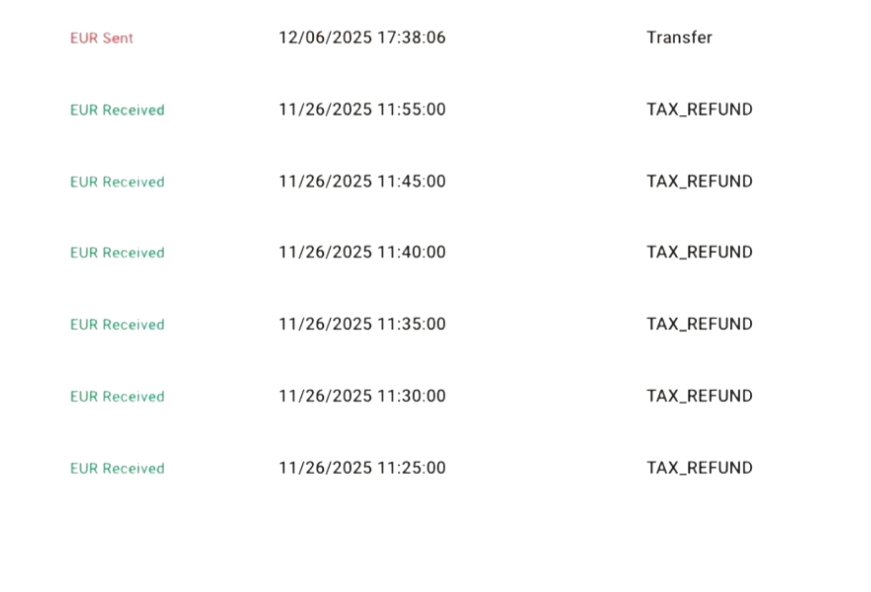
How does the "Tax Refund" works?
In Austria, a special tax rate of 27.5% generally applies to taxable income derived from cryptocurrencies. To the extent that KuCoin EU is legally required to withhold capital gains tax (KESt), the tax due on the taxable income will be calculated and withheld in accordance with applicable Austrian tax regulations.
The tax actually owed may differ from the tax initially withheld, particularly due to factors such as the tax-relevant acquisition costs, realized capital gains, losses, and applicable loss offsetting rules.
If the final tax calculation reveals that an amount exceeding the actual capital gains tax due was withheld, the corresponding difference will be credited to the customer, provided this is permissible under applicable legal and tax requirements.