

The Digital Ruble Enters Logistics: What PEK’s First Payment Means for Businesses and Customers
2026/08/13 12:21:00
Introduction
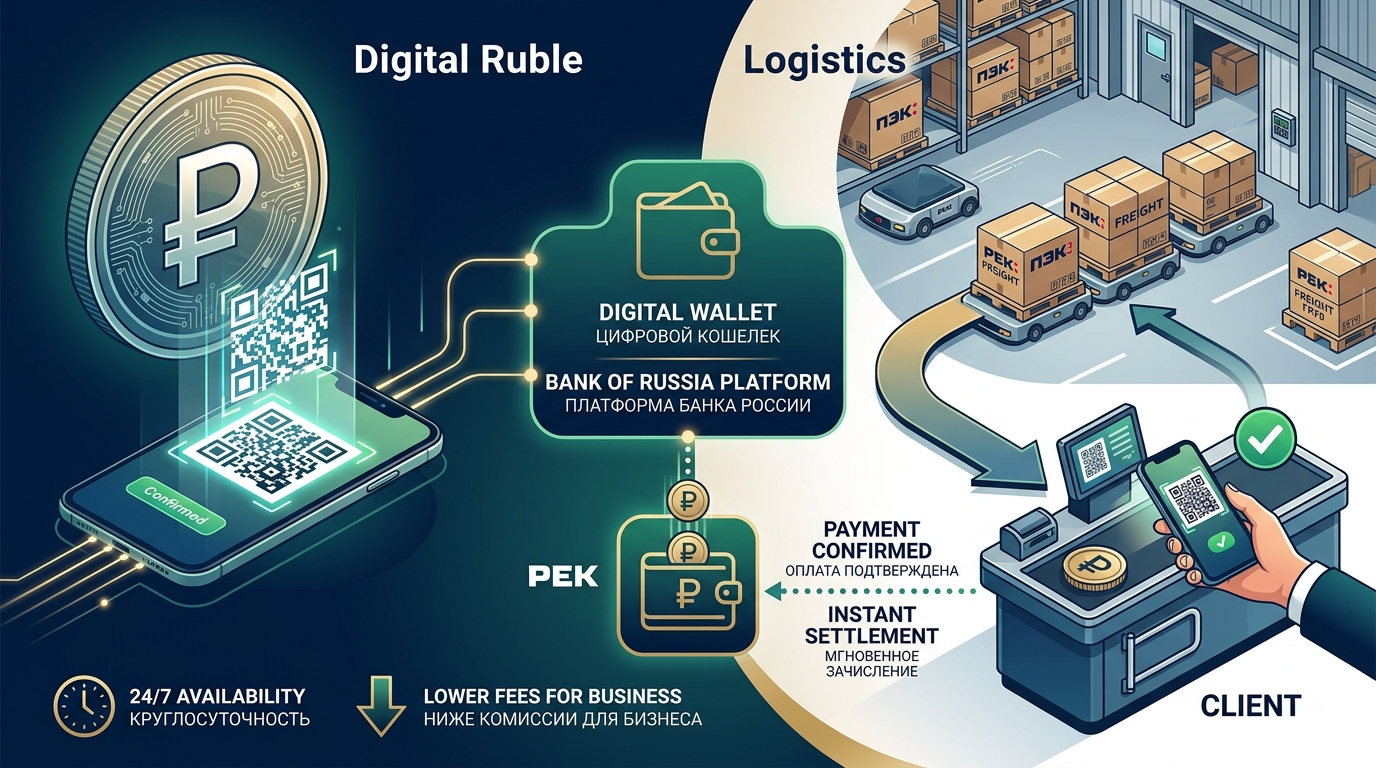
What happens when the digital ruble is used not only in a banking pilot but also to pay for a real logistics service? Russia now has an answer: on July 28, 2026, PEK processed its first payment in digital rubles at a Moscow branch, where an individual customer paid for cargo handling. The news matters not because of the transaction size, but because a central bank digital currency entered an everyday commercial scenario at the intersection of payment, warehousing, and cargo collection. The customer scanned a QR code through a banking app, confirmed the debit from a digital wallet, and the funds reached the company’s account almost immediately.
This does not mean that the digital ruble has already replaced cash, bank cards, or the Faster Payments System. However, PEK’s case shows how a new form of national currency can address a specific logistics challenge: shortening the interval between payment and payment confirmation. The main question going forward will not be the QR code itself, but B2B settlements and smart contracts.
What happened at PEK, and why did the transaction become news?
The key fact is that PEK became the first publicly known operator of consolidated cargo transportation in Russia to start accepting digital ruble payments for its services. The first transaction took place on July 28, 2026, at the company’s headquarters in Moscow. The customer paid for cargo handling at the warehouse rather than simply testing an abstract wallet-to-wallet transfer.
PEK describes the launch as a full integration of the digital ruble into its commercial infrastructure. According to industry reports, customers can use this payment method for consolidated cargo transportation, warehouse handling, and additional services. Therefore, the phrase that the digital ruble has “reached the warehouses” is a journalistic shorthand. It refers to incorporating a new payment method into logistics branches and warehouse processes, not to digital rubles circulating independently inside warehouses.
The publication appeared approximately two weeks after the first transaction. PEK may have first needed to test its cash-register software, payment scenarios, fund settlement, and employee procedures before presenting a completed business case to the media. The reports do not state the direct reason for the delay, so it would be inappropriate to claim that the company deliberately concealed the transaction. A more cautious interpretation is that the announcement coincided with preparations to expand the use of the digital ruble from September 1, 2026.
PEK’s industry status should also be described accurately. The company has been identified as the first in the consolidated cargo transportation segment to publicly announce that it accepts digital ruble payments. However, there is no unified register of all logistics deployments, so the phrase “the first company in the entire Russian logistics industry” should be used with qualifications.
How does a customer pay for a service in digital rubles?
The payment process resembles a familiar QR payment, but the source of funds is a digital wallet on the Bank of Russia’s platform. A customer scans a QR code at a PEK branch through the mobile app of a participating bank, selects the digital wallet, and confirms the debit. According to the company, the transaction takes several seconds, and the service is available around the clock, including weekends and public holidays.
The digital ruble is not held as an ordinary balance in a bank account. The wallet is located on the Bank of Russia’s platform, while access to it is provided through an app of a bank connected to the relevant infrastructure. For users, this means that the banking app serves as the interface, while the payment platform itself differs from traditional card acquiring.
The cargo-release process is also important. PEK links the release of a shipment to the confirmation that funds have been credited. If the company has to wait for confirmation of an interbank transfer, the customer may receive the cargo later. With a digital ruble payment, confirmation comes directly through the digital payment infrastructure, theoretically shortening the time between payment and cargo collection.
At the same time, the digital ruble does not make the logistics service free and does not cancel PEK’s commercial rules. It changes the settlement method: the price of transportation, handling, or an additional service is still determined by the company’s contract and tariffs.
Which PEK services can be paid for with digital rubles?
At the launch stage, digital rubles can be used for more than warehouse handling. PEK announced that settlements are available for the operator’s core and additional services. These include consolidated cargo transportation, LTL shipments, warehouse cargo handling, and service operations connected with logistics support.
This scope is important for evaluating the project’s practical value. If the digital ruble were used only for one demonstration transaction, its role would remain limited. Connecting several types of services makes it possible to test different scenarios: payment at a branch, confirmation of cargo release, payment for additional operations, and potential future use in corporate contracts.
However, the published materials do not disclose several user-facing details. They do not name the amount of the first transaction, the customer’s specific bank, the name of the digital wallet, or the refund rules. They also do not explain how a failed payment, an order cancellation, or a duplicate debit would be handled. An article should therefore distinguish between confirmed functionality and procedures that the company has not yet publicly disclosed.
From September 1, 2026, PEK plans to make digital ruble payments available to individuals at 163 branches across Russia. This would represent a broader customer-service rollout rather than a one-off Moscow case.
Why could the digital ruble be useful for logistics companies?
The main advantage for logistics is the speed of payment confirmation, not simply the use of a new currency format. The industry processes a large number of payments every day, and even a small confirmation delay can affect cargo release, employee workload, and branch throughput.
PEK points to two economic effects: funds are credited faster, and payment acceptance costs may decrease. Customers, in turn, can receive their cargo immediately after payment confirmation without waiting for bank reconciliation.
ComNews provides indicative digital ruble fees: for payments accepted from individuals, the business fee is stated as 0.3% of the transaction amount, capped at 1,500 rubles per transaction; transfers between legal entities are expected to cost a fixed 15 rubles. For comparison, the publication mentions card-acquiring fees of approximately 1%–3%. According to the report, accepting digital rubles for businesses should remain free through the end of 2026. These conditions should be treated as published parameters for a specific rollout stage, not as a universal guarantee for every bank and transaction type.
For logistics, the value lies in the combination of several factors: round-the-clock availability, a standardized QR scenario, fast confirmation, and potentially lower fees. However, the actual benefit will depend on infrastructure reliability, the share of customers with active digital wallets, and how easily companies can process refunds, reconciliation, and accounting close procedures.
|
Parameter
|
Digital ruble in the PEK scenario described
|
Traditional payment scenario
|
|
Payment at a branch
|
QR code and participating-bank app
|
Card, cash, bank transfer, or another available method
|
|
Source of funds
|
Digital wallet on the Bank of Russia’s platform
|
Bank account, card, or cash register
|
|
Confirmation
|
Practically immediate crediting, according to the company
|
May require waiting for bank confirmation
|
|
Availability
|
24/7 service has been announced
|
Depends on the payment method and bank infrastructure
|
|
Business fees
|
The publication specifies separate fees for different transactions
|
Acquiring fees are often higher but depend on the bank agreement
|
Are Russian citizens required to use the digital ruble?
No. The use of the digital ruble remains voluntary for individuals. The obligation discussed in the reports applies to retail and service businesses that must accept this payment method when they meet certain criteria. In other words, a company may be required to provide the option, but a customer is not required to choose the digital ruble instead of cash, a card, or another lawful payment method.
According to ComNews, from September 1, 2026, the obligation is expected to apply to retail and service businesses with annual revenue above 120 million rubles that are served by systemically important banks. From September 1, 2027, the rules are expected to expand to organizations with revenue above 30 million rubles that work with banks holding a universal license. Further expansion is expected from September 1, 2028. Retail points with annual revenue below 5 million rubles are reportedly excluded from this obligation.
These thresholds and dates should be checked against the regulations in force before an updated version of the article is published. The regulatory timetable may be clarified, and the precise application of the rules depends on the bank category, company revenue, and status of the retail or service business.
For users, the main conclusion is straightforward: the presence of digital ruble payments at PEK does not mean that all customers will be forced to switch to one payment instrument. The purpose of the reform is to expand the available payment methods and gradually create compatible infrastructure for businesses.
How does the digital ruble differ from cards, cash, and the Faster Payments System?
The digital ruble is the third form of the national currency alongside cash and non-cash rubles. Its exchange rate against other forms of the ruble is 1:1, but digital balances do not earn interest. Unlike non-cash money held in a bank account, digital rubles are stored on the Bank of Russia’s platform, while banks provide customers with access to the wallet.
From a user-interface perspective, paying at PEK resembles the Faster Payments System: the customer can also scan a QR code in a banking app. The difference lies in the infrastructure and the source of funds. When paying in digital rubles, the debit comes from the digital wallet rather than an ordinary card or settlement account.
From a business perspective, the difference may appear in confirmation speed and fees. However, the digital ruble should not automatically be considered more advantageous in every situation. In practice, bank support, integration quality, limits, refunds, and the availability of a digital wallet for the customer all matter.
There is also a strategic difference: the possibility of programmable settlements. In the future, a smart contract could connect payment to a specific condition, such as delivery confirmation, the transfer of an electronic document, or the completion of a transportation stage. A card payment or ordinary transfer does not by itself create this automatic connection between a payment event and contractual conditions.
What will change in B2B logistics because of smart contracts?
The most significant potential of the digital ruble for logistics lies in the B2B segment. PEK views smart-contract settlements as the next stage of development. In such a scenario, funds are transferred automatically after a predefined condition is fulfilled, for example, after delivery of the cargo has been confirmed.
Today, a corporate payment often depends on document exchange, manual reconciliation, and approval by several departments. If the carrier, customer, and financial system use compatible digital documents, part of the process can be automated. The system could verify the delivery event and initiate settlement without a separate manual payment order.
The digital ruble cannot solve this challenge on its own. Electronic transportation documents, integration with state information systems, legally valid contractual terms, and common rules for recording a delivery event will also be required. For this reason, smart contracts should be viewed as a long-term infrastructure project rather than a feature that will instantly appear in every shipment.
The Bank of Russia planned to launch a smart-contract platform in pilot mode in 2026, while industry experts associate mass adoption with 2027–2028. PEK’s forecast suggests that digital ruble payments could account for 1%–3% of enterprise payments by the end of 2026 and exceed 10% in 2027. This points to gradual adoption rather than an immediate replacement of existing tools.
What risks and limitations remain?
The first limitation is the low maturity of the user ecosystem. Customers need a participating bank and access to a digital wallet. For now, this process is less familiar than paying by card or through the Faster Payments System. As more banks and merchants connect, this barrier should decline, but the transition will take time.
The second issue concerns refunds and disputed transactions. Public materials about PEK’s launch confirm the payment and immediate crediting of funds, but they do not explain in detail how payment cancellation, partial refunds, erroneous debits, or disputes will be handled. For mass adoption, these procedures must be clear to customers and reflected in service terms.
The third limitation is the lack of sufficient independent statistics. At present, the evidence consists of a first payment and forecasts from the company itself. Assessing the outcome will require data on transaction volume, average confirmation speed, actual savings on fees, and the share of repeat users.
Finally, the digital ruble should not be confused with cryptocurrency. It is a centralized form of the Russian ruble issued and serviced through the Bank of Russia’s infrastructure. It is not designed for free trading like bitcoin or other crypto assets and does not use the same decentralized model.
How to buy or trade the digital ruble on KuCoin?
The digital ruble should not be treated as a standard crypto asset available for purchase or trading on KuCoin. It is a national digital currency used in Russia’s payment infrastructure, not a token automatically listed on an international crypto exchange. Users should therefore not expect the digital ruble to be available on KuCoin as an ordinary trading pair.
KuCoin provides access to the digital-asset market, including cryptocurrencies and tokens listed on the platform in accordance with its rules and regional availability. If a reader is studying the digital ruble as part of the broader development of digital finance, KuCoin can be used to independently research the cryptocurrency market, blockchain-project structures, and the risks of digital assets. Before registering or carrying out any transaction, users should check regional restrictions, available products, fees, and identification requirements.
The key distinction should be stated clearly: the digital ruble is primarily intended for settlements in the Russian economy, while crypto assets on KuCoin belong to a separate market with a different technological, legal, and pricing model. Users should not transfer funds or open a position simply because both categories are associated with digital finance.
Join KuCoin 9th Anniversary Trading Campaign
KuCoin is celebrating its 9th anniversary with a special platform campaign filled with exclusive rewards, trading activities, and limited-time offers. Don’t miss the chance to participate and enjoy the benefits as the exchange marks nine years of growth and innovation. Visit the official campaign page now:

Conclusion
PEK’s first digital ruble payment is a small event in terms of transaction scale but an important step in the development of Russia’s payment infrastructure. On July 28, 2026, an individual customer paid for cargo handling at the company’s Moscow branch using a QR code and a digital wallet. PEK said that digital rubles could later be used for consolidated cargo transportation, warehouse handling, and additional services, and that the company planned to make the option available at 163 branches across Russia from September 1.
For customers, the value lies in fast payment confirmation and the possibility of collecting cargo without waiting for bank reconciliation. For businesses, the potential benefits include round-the-clock availability, lower transaction costs, and standardized settlements. At the same time, citizens are not required to use the digital ruble: the obligation is gradually being applied to companies that meet the relevant criteria.
The project’s real strategic significance will appear in the B2B segment. If the digital ruble is linked to smart contracts, delivery confirmation, and electronic transportation documents, it could automate part of corporate settlement. Before mass adoption, however, the industry must address compatibility, refunds, data, and user-experience issues. PEK’s case is therefore not the conclusion of the reform but an early practical signal of how a central bank digital currency is beginning to enter the real economy.
Frequently Asked Questions
1. Can customers pay for PEK delivery with digital rubles at any branch?
According to the published information, from September 1, 2026, PEK plans to make digital ruble payments available to individuals at 163 branches across Russia. The list of specific addresses and the actual availability of the service may depend on the readiness of each branch and the relevant banking infrastructure.
2. Is it necessary to open a separate digital wallet?
Yes. Payment uses a digital wallet on the Bank of Russia’s platform, and access is provided through the app of a participating bank. The exact process for opening and funding the wallet depends on the bank, so customers should check the availability of the function in their banking app in advance.
3. Do digital ruble balances earn interest?
No. According to the ComNews materials, digital rubles maintain a 1:1 rate with cash and non-cash rubles, but no interest is paid on the balance of the digital wallet.
4. Can digital rubles be converted into cryptocurrency on KuCoin?
Such a conversion should not automatically be considered available. The digital ruble and cryptocurrencies are different categories of digital assets, and the availability of deposits, withdrawals, and exchanges depends on the platform’s rules, banks, and applicable law. Users should check the current terms of KuCoin and their financial intermediary before conducting any transaction.
5. What happens if a customer does not want to use the digital ruble?
The use of the digital ruble remains voluntary for individuals. A customer may choose another available payment method if it is provided for under the tariffs and rules of the specific PEK service. A business’s obligation to accept digital rubles does not become an obligation for citizens to pay with them.
Disclaimer : This material is provided for informational purposes only and does not constitute financial, investment, legal, or tax advice. Transactions involving cryptocurrencies and tokenized assets carry substantial risks — including price volatility, limited liquidity, counterparty exposure, and the potential for total loss of invested capital. Readers should conduct their own research and, where appropriate, consult a qualified professional before making any financial decisions.