

Legalization of Cryptocurrencies in Russia: A Comprehensive Guide to the New 2026 Law
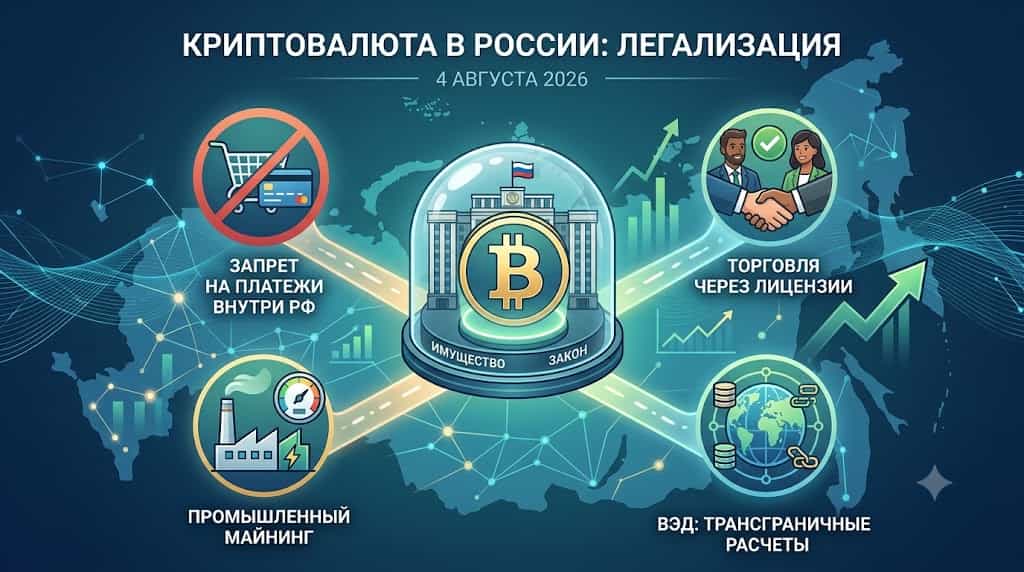
Vladimir Putin signed a historic law on the legalization of cryptocurrencies in Russia on August 4, 2026, officially recognizing digital currencies as property and establishing rules for their circulation. Starting September 1, 2026, Russian citizens and companies will have the legal right to buy, sell, and store crypto assets through licensed intermediaries. This reform ends a multi-year period of legal uncertainty, transforming the "gray" market into a regulated industry with clear rules for investors, miners, and participants in foreign economic activity.
How to Legally Buy and Sell Cryptocurrency in Russia Now?
Buying and selling cryptocurrency in Russia as of September 1, 2026, becomes a fully legal operation, provided it is conducted through organizations included in a special registry of the Bank of Russia. According to the new law "On Digital Currencies and Digital Rights," such intermediaries include licensed crypto exchanges, brokers, trust managers, and digital depositories. The main goal of the regulation is to bring transactions out of the shadows and ensure judicial protection for the rights of digital asset owners.
The market infrastructure will be built on the basis of existing financial institutions and new specialized platforms. The Bank of Russia will maintain a registry of operators who are required to comply with strict requirements for information protection and customer identification. A transition period has been established until July 1, 2027, during which market participants must obtain the appropriate licenses. After this date, any crypto exchange activity outside the licensed circuit will be considered illegal.
It is important to note that the law recognizes cryptocurrency as property. This means that rights to it are subject to judicial protection even if the owner has not previously declared their assets. However, to fully utilize all the benefits of legal status, investors are advised to follow the reporting rules, which will be clarified by tax authorities in the near future. According to RIA Novosti data from August 4, 2026, judicial protection will be provided regardless of prior declaration, which is a significant step toward users.
Who Are Qualified and Non-Qualified Investors in the New Law?
The new law divides Russian crypto investors into two categories—qualified and non-qualified—establishing different levels of asset access and transaction limits for each. This division is aimed at protecting retail investors from the high risks of the volatile market. According to Bank of Russia data published in July 2026, both categories of investors are required to pass preliminary testing before making their first transaction on a licensed platform.
|
Investor Category
|
Available Assets
|
Purchase Limits
|
|
Non-Qualified
|
Only "highly liquid" currencies (BTC, ETH, etc.)
|
Up to 300,000 rubles per year through one intermediary
|
|
Qualified
|
Any crypto assets and digital rights
|
No limits on transaction amounts
|
For ordinary citizens (non-qualified investors), an annual limit on cryptocurrency purchases is set at 300,000 rubles through a single licensed intermediary. Additionally, they only have access to a limited list of assets recognized by the regulator as "highly liquid." This list traditionally includes market leaders such as Bitcoin (BTC) and Ethereum (ETH). Qualified investors who have confirmed their experience or the presence of certain capital are not limited in amounts and can acquire any digital currencies, including new tokens and complex financial instruments.
According to explanations from KuCoin experts on July 22, 2026, testing will cover knowledge of risks, understanding of blockchain technology, and the basics of market volatility. If an investor fails the test, they can try again after some time or limit themselves to minimum amounts that will be determined by by-laws. This approach allows for the filtering out of those who do not realize the risks of total capital loss when working with digital assets.
Is Payment for Goods and Services with Cryptocurrency Prohibited Within the Country?
The use of cryptocurrency as a means of payment for goods, works, or services on the territory of the Russian Federation remains strictly prohibited. Despite the legalization of crypto as an investment asset, the Russian ruble retains its status as the only legal tender. According to the text of the law, any attempts by businesses to accept payment in Bitcoins or stablecoins within the country will be suppressed, and advertising of such settlements is prohibited.
This restriction is a fundamental position of the regulator. The Bank of Russia aims to prevent the creation of a parallel monetary system that could weaken control over money circulation and inflation. Thus, you can legally own Bitcoin as digital gold or a share, but you cannot buy coffee in a Moscow coffee shop or pay for food delivery with it. According to T-Bank (formerly Tinkoff) data from January 2026, businesses accepting crypto risk facing large fines and account blocks through financial monitoring.
For individuals, this means that cryptocurrency must first be converted into rubles through a licensed exchanger or exchange, and only then can the funds be used for daily purchases. Violation of this rule may lead to administrative and, in some cases, criminal liability for both parties to the transaction. At the same time, the law does not prohibit gifting cryptocurrency or transferring it by inheritance, as in these cases, it acts precisely as an object of property, not a means of payment.
How Will Crypto Legalization Help Russian Businesses in International Settlements?
The law introduces a special legal regime (EPR) for the use of cryptocurrencies in foreign economic activity (FEA), allowing Russian companies to conduct cross-border settlements bypassing the traditional banking system. This key innovation is aimed at supporting exporters and importers under sanctions pressure. According to the new rules, any types of cryptocurrencies and stablecoins can be used for international transactions without retail limits.
Cross-border operations will take place under the strict control of the Bank of Russia and the FSB. Each transaction within FEA must be recorded in special information systems, ensuring transparency of money flows for the state. This allows companies to legally pay for import supplies and receive export revenue using the advantages of blockchain—speed and independence from Western financial infrastructure. According to KuCoin data from July 23, 2026, the use of stablecoins like USDT is becoming the main tool for fast payment for goods without the risk of blocks in the SWIFT system.
|
FEA Parameter
|
Conditions Under the New Law
|
|
Asset Types
|
Any cryptocurrencies and stablecoins (USDT, USDC, etc.)
|
|
Amount Limits
|
None for FEA participants
|
|
Oversight
|
Transparent reporting to the CB and FSB
|
This approach creates a "green corridor" for businesses that were previously forced to use gray schemes for settlements with foreign counterparties. Now, working with crypto in foreign trade becomes transparent, which reduces the risks of account blocks within Russia and simplifies accounting. It is important to remember that each such operation requires "penetrating" reporting, meaning the regulator must see the ultimate recipient of funds to prevent sanctions evasion or financing of illegal activities.
What Will Change for Miners and P2P Traders from September 2026?
Cryptocurrency mining in Russia is officially recognized as a type of economic activity requiring registration in a special registry for legal entities and compliance with energy consumption limits for individuals. The law introduces clear definitions for concepts such as "mining pool" and "mining infrastructure operator." According to data from the Ministry of Energy and RIA Novosti publications from July 31, 2026, regions with power deficits, such as the Moscow region, may introduce full bans on digital currency mining to prevent accidents in power grids.
For home miners (individuals), registration is not mandatory if they do not exceed the established electricity consumption limits. However, industrial mining is now fully entering the legal field: companies are required to pay taxes and report on mined assets. For evasion of registration or conducting activity in prohibited zones, severe punishments are provided—up to imprisonment for a term of up to 5 years if the damage to the state or income exceeds 13 million rubles.
The P2P market also awaits transformation. Until July 2027, the possibility of conducting transactions between individuals remains, but banks are already strengthening control under Law 115-FZ. After the transition period ends, most P2P operations must pass through licensed intermediaries. Crypto exchanger status will be required for any person making more than two transactions per month for an amount exceeding 3.5 million rubles. This effectively means the end of the era of mass uncontrolled "card-to-card" exchange for professional traders.
How Does the 48-Hour "Cooling-Off Period" for Crypto Transactions Work?
To combat financial fraud, the law introduces a mandatory 48-hour "cooling-off period" for cryptocurrency transfers to non-custodial wallets if the transaction amount exceeds 100,000 rubles. This rule applies to transfers from licensed platforms to users' personal wallets, such as MetaMask or Ledger hardware devices. During this time, funds will be temporarily frozen on the platform's side.
The "cooling-off period" mechanism is designed to protect investors, especially elderly people, from the actions of scammers who often force victims to send funds quickly. A two-day pause gives the user a chance to realize their actions, cancel the transaction, or contact support if they realize they have been deceived. According to RIA Novosti data from August 4, 2026, this measure was proposed by the Central Bank as one of the key tools for protecting the rights of financial services consumers.
Although this innovation may cause inconvenience for active traders, the regulator considers it a necessary compromise between freedom of asset disposal and citizen safety. It is important to understand that this rule does not apply to transfers between accounts within the same licensed exchange or to transactions within foreign economic activity, where speed is of critical importance. For most retail users, 48 hours will become a reliable safety buffer against social engineering.
Can Cryptocurrency Be Exchanged for Russian Stocks and Bonds?
Starting September 1, 2026, Russian investors receive a unique opportunity to officially exchange cryptocurrency for domestic securities, including stocks and bonds registered in the Russian Federation. This mechanism allows for the conversion of digital capital into traditional financial instruments without the need for preliminary withdrawal of funds into fiat currency. According to the law, such transactions must be conducted exclusively through licensed brokers or digital depositories.
The exchange process works as follows: the investor submits an order to an intermediary, who debits the cryptocurrency from their account and credits an equivalent amount of securities to the investor's depo account. The value of assets is fixed in rubles at the time of the transaction. This opens the way for the creation of hybrid investment portfolios where crypto assets can act as collateral or a source of funds for purchasing shares of leading Russian companies. According to KuCoin data from July 23, 2026, such market integration promotes the inflow of new liquidity into the Russian stock sector.
However, there are important limitations. Exchange is only possible for securities that are accounted for within the Russian infrastructure. Foreign stocks held in foreign depositories do not fall under this provision. For non-qualified investors, the possibility of such an exchange is also limited by an annual limit of 300,000 rubles, while qualified market participants can conduct such operations without amount limits. This creates an additional incentive for investors to obtain qualified player status.
Common Misconceptions About Crypto Legalization in Russia
Many myths have arisen around the new law, the most common of which is the belief that cryptocurrency is now equated with ordinary money. In fact, the law clearly defines it as property, not as currency. This means that while you can own it and transfer it by inheritance, it does not possess the status of legal tender. According to expert analysis from July 2026, confusion in terms often leads to users attempting to make purchases directly, which is a violation of the law.
Another misconception concerns anonymity. Many believe that legalization will preserve transaction confidentiality; however, the reality is the opposite: working through licensed intermediaries implies full identification (KYC). Any transaction over 100,000 rubles or suspicious activity will fall under the scrutiny of Rosfinmonitoring. Thus, the law makes the market transparent, not anonymous.
A third myth states that mining in Russia is now completely prohibited. This is not the case—bans only apply to energy-deficient regions and industrial mining without registration. Ordinary users can continue to mine at home if their equipment does not create a critical load on the grid and does not violate fire safety rules. It is important to distinguish between a "home hobby" and "industrial business," as the latter is subject to entirely different tax and regulatory requirements.
Finally, there is an opinion that all foreign exchanges will become inaccessible. The law regulates activity within the country and establishes rules for Russian intermediaries, but it does not prohibit citizens from using foreign platforms. However, in doing so, users must independently bear the risks associated with the lack of a Russian license for such platforms and notify tax authorities of the presence of assets in foreign accounts if the total amount exceeds the thresholds established by law.
The Role of Licensed Depositories in the New System
Digital depositories become a central link in the new infrastructure, responsible for the reliable storage and accounting of rights to crypto assets of Russian citizens. Unlike ordinary wallets, depositories provide an institutional level of security and guarantee that the record of asset ownership will be legally significant. According to the Bank of Russia registry, which will begin forming in September 2026, only organizations with a capital of at least the established minimum will be able to obtain this status.
The work of a depository consists of recording every change of owner in a distributed ledger synchronized with state databases. This eliminates the possibility of losing access to assets due to loss of a password—in case of force majeure, rights can be restored through judicial or administrative procedures. For large investors, this is a decisive factor, as it ensures the safety of capital at the level of bank deposits.
Additionally, depositories will perform the functions of tax agents in some cases, simplifying the process of paying fees for their clients. They will automatically calculate the tax base when conducting buy-sell transactions or exchanges for securities. This reduces the administrative burden on investors and makes the process of owning crypto assets as similar as possible to working with traditional shares on an exchange.
Should You Invest in Cryptocurrency on KuCoin Under the New Conditions?
Investing in cryptocurrency through reliable international platforms like KuCoin remains a popular tool for capital diversification in the new regulatory reality in Russia. Despite the development of internal infrastructure, global exchanges offer a significantly wider choice of assets, high liquidity, and access to advanced trading tools that may be unavailable on local platforms initially.
KuCoin provides users with access to hundreds of promising tokens, staking tools, and futures trading, allowing for flexible responses to market changes. In the context of the new Russian law, using large international platforms helps qualified investors implement complex strategies that go beyond the standard list of "highly liquid" assets of the CB. According to internal KuCoin data, Russian users actively use the platform to access new projects at early stages (Launchpads).
Furthermore, KuCoin prioritizes the security of user funds and compliance with international KYC/AML standards. At a time when the Russian market is just beginning to build its licensing system, the experience and technological base of a global industry leader provide an additional level of stability for your digital portfolio. Registering on KuCoin today is a step toward professional crypto asset management using world-class service standards.
Join KuCoin 9th Anniversary Trading Campaign
KuCoin is celebrating its 9th anniversary with a special platform campaign filled with exclusive rewards, trading activities, and limited-time offers. Don’t miss the chance to participate and enjoy the benefits as the exchange marks nine years of growth and innovation. Visit the official campaign page now:
Conclusion
The adoption of the law on the legalization of cryptocurrencies in Russia is a fundamental shift that transforms digital assets from an "off-system" phenomenon into a full-fledged part of the national economy. Starting September 1, 2026, investors gain legal status, miners gain transparent rules of operation, and businesses gain an effective tool for international settlements. Although the law introduces a number of restrictions, such as the ban on domestic payments and limits for beginners, it creates the necessary foundation for the safe development of the industry.
The transition period until July 2027 gives all market participants time to adapt to the new requirements. The main advantage of the reform lies in predictability: now every Bitcoin owner in Russia knows that their rights are protected by law and their activity is transparent to the state. In the long term, this will attract institutional capital to the industry and make Russia one of the significant centers of the global crypto market. According to expert forecasts, the volume of legal crypto operations in the RF could grow 5-7 times in the very first year of the law's operation.
Frequently Asked Questions (FAQs)
1. Can I legally buy Bitcoin in Russia right now?
Yes, buying Bitcoin in Russia is legal, and starting September 1, 2026, it will be regulated by new rules through licensed intermediaries. Until the law comes into full force, you can acquire cryptocurrency on international platforms; however, remember the need to comply with banking rules and tax reporting. According to RIA Novosti data from August 2026, legalization applies to all major types of coins.
2. What limit is set for ordinary (non-qualified) investors?
Ordinary investors can buy cryptocurrency for an amount up to 300,000 rubles per year through one licensed intermediary after passing a test. This limit may be revised by the Bank of Russia in the future, but at the initial stage, it serves as a measure to protect retail clients. Qualified investors, according to the law, have no limits on purchases.
3. Can I pay with cryptocurrency in Russian stores?
No, payment for goods and services with cryptocurrency within Russia is categorically prohibited by law. Cryptocurrency is recognized as property and an investment asset, but not as legal tender. For purchases, you must first sell your crypto for rubles. Any advertising of such payments is also illegal.
4. Is mining in an apartment considered legal?
Mining at home is legal if you do not exceed the electricity consumption limits established in your region. If your activity takes on industrial proportions, you must register in the registry and pay taxes as an entrepreneur. In some regions, such as the Moscow area, temporary restrictions may apply.
5. Do I need to pay taxes on the sale of cryptocurrency?
Yes, income from the sale of cryptocurrency is subject to personal income tax (PIT) or corporate income tax for companies. The legalization of assets as property confirms the obligation of owners to declare income and pay the appropriate fees to the RF budget. The tax rate for individuals is usually 13% or 15% depending on the amount of annual income.
Disclaimer : This material is provided for informational purposes only and does not constitute financial, investment, legal, or tax advice. Transactions involving cryptocurrencies and tokenized assets carry substantial risks — including price volatility, limited liquidity, counterparty exposure, and the potential for total loss of invested capital. Readers should conduct their own research and, where appropriate, consult a qualified professional before making any financial decisions.