

Digital Ruble and Cryptocurrency in Russia in 2026: Differences, Rules for Businesses and Investors
Introduction
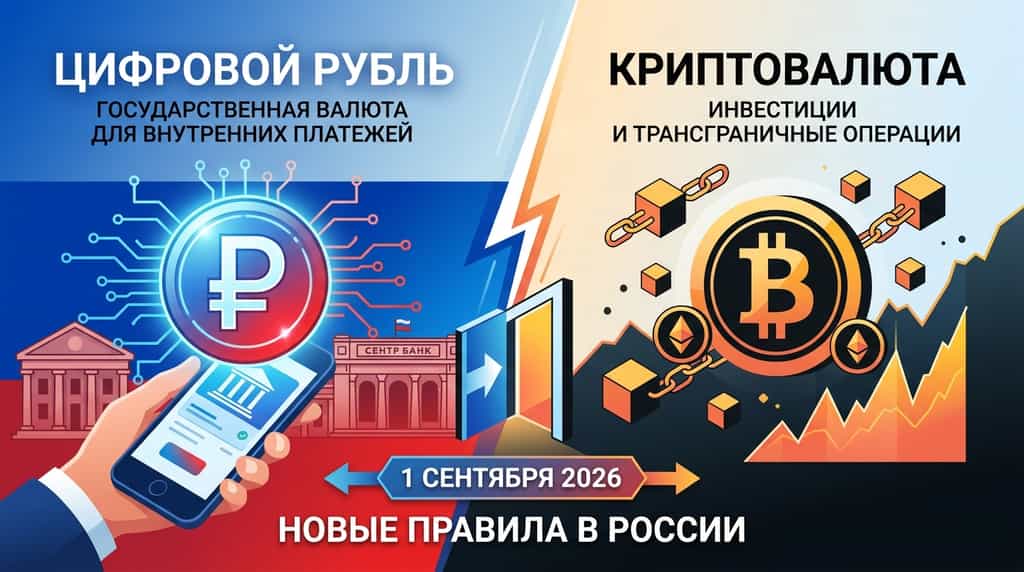
What do the digital ruble and Bitcoin have in common if one is issued by a central bank while the other operates without a single issuer? As of September 1, 2026, Russia is simultaneously moving the digital ruble from its pilot phase into full-scale operation and introducing a new framework for cryptocurrency circulation. These instruments do not replace one another: the digital ruble is becoming a third form of the national currency for domestic payments, while cryptocurrency is entering a regulated framework primarily for investment and cross-border transactions.
The key difference lies in their status and purpose. The digital ruble is equal to the ordinary ruble on a one-to-one basis, is issued by the Bank of Russia, and is used within the country's payment infrastructure. Cryptocurrency is an independent digital asset whose price is determined by the market and can change sharply. Russia therefore needs both instruments: the first improves the efficiency and manageability of the domestic economy, while the second expands cross-border settlement options and brings part of the existing market out of the gray zone.
What Is the Digital Ruble, and How Does It Differ From Cryptocurrency?
The digital ruble is a digital form of Russia's national currency, not a new monetary unit or a cryptocurrency. The Bank of Russia is its issuer, and each digital unit has a denomination of one ruble. An individual or company converts ordinary cash or non-cash rubles into digital rubles on the Bank of Russia's platform through a connected bank. Digital rubles do not have a separate exchange rate and are not intended for speculative trading.
Cryptocurrency works differently. Bitcoin, for example, has no central government issuer: issuance and transaction validation are linked to the blockchain protocol and consensus mechanisms. Other tokens may be created by private projects, funds, or decentralized networks. Their value is not guaranteed by the Bank of Russia, while liquidity depends on supply, demand, technological risks, and market sentiment.
|
Criterion
|
Digital Ruble
|
Cryptocurrency
|
|
Issuer
|
Bank of Russia
|
Usually no single government issuer
|
|
Denomination and price
|
One digital ruble equals one ruble
|
Market price can change significantly
|
|
Primary purpose
|
Domestic, budgetary, and corporate payments
|
Investment and permitted cross-border transactions
|
|
Legal status
|
Form of the national currency
|
Digital asset within a regulated framework
|
|
Return on balance
|
None
|
Potential profit or loss from price changes
|
|
Main risk
|
Technological and operational readiness of the infrastructure
|
Volatility, liquidity, counterparty, and regulatory risk
|
The main practical conclusion is straightforward: the digital ruble should not be viewed as a deposit or a Bitcoin equivalent. Digital ruble balances do not earn interest, so the digital ruble does not replace a bank deposit. Its purpose is to make payments programmable, inexpensive, and verifiable. Cryptocurrency, by contrast, can be used as an investment asset but does not guarantee preservation of value.
Why Does Russia Need the Digital Ruble?
Russia needs the digital ruble primarily to make domestic settlements more efficient and automate controls over the targeted use of funds. The most significant impact is expected not in ordinary retail purchases but in B2B transactions, government financing, construction, banking support, letters of credit, guarantees, subsidies, and social payments.
The digital ruble platform can link a payment to predetermined conditions. For example, a government subsidy could be designated exclusively for the purchase of specific equipment, while funds under a contract could be released after confirmation that a work stage has been completed. In this context, a smart contract does not mean that the system can think independently; it is a set of programmed rules that executes agreed conditions. Such a mechanism can reduce the number of manual checks, accelerate settlements, and lower the cost of financial intermediation.
The transparency of budget flows is also important for the government. If the purpose of a payment is recorded in digital infrastructure, oversight bodies can more easily compare its source, recipient, and permitted use. This may reduce the scope for misuse of funds, although it does not automatically eliminate corruption or management risks. Effective control still depends on the quality of the rules, data access, internal audits, and the accountability of participants.
For citizens, the rollout does not mean a forced abandonment of cash and non-cash money. According to a Secretmag publication dated August 17, 2026, the digital ruble is expected to circulate alongside the two familiar forms of money, while opening a digital account and transferring salaries or social benefits require the person's consent. The digital ruble is therefore an additional payment channel, not an announced replacement for bank cards or cash.
Why Does Russia Need Cryptocurrency?
Russia needs cryptocurrency for a separate external and investment framework, not to replace the ruble domestically. Russian businesses already face restrictions on traditional international payments, so digital assets may be used for cross-border settlements where permitted by established rules and properly reflected in accounting, tax, and currency-control records.
This approach is particularly important for foreign trade. Crypto assets and stablecoins may reduce the number of intermediaries and accelerate the transfer of value between counterparties in different jurisdictions. However, this does not mean an automatic circumvention of sanctions or the elimination of compliance requirements. A company must verify the counterparty, payment route, applicable restrictions, and the method for recording the transaction. Using cryptocurrency outside the legal framework creates risks of frozen funds, regulatory claims, and additional tax assessments.
The second regulatory objective is to bring the existing market out of the shadows. According to an estimate cited by Fomag and attributed to publicly available expert assessments, the Russian crypto market may be worth as much as 10-15 trillion rubles. This is not official statistics and is not a precise estimate of all holders or transactions. However, the existence of substantial turnover helps explain why the government is seeking to create intermediaries, accounting rules, and taxation mechanisms instead of ignoring the market altogether.
For investors, legalization does not mean the disappearance of risk; it means clearer access rules. Transactions must go through regulated infrastructure in which participants identify clients, verify their investor category, and record operations. For the government, this creates an opportunity to collect taxes and manage financial risks. For the market, it offers a chance to replace opaque P2P schemes with standardized procedures.
Can Cryptocurrency Be Used for Payments in Russia?
No. Cryptocurrency still cannot be used inside Russia to pay for goods and services. The Bank of Russia has expressly stated that cryptocurrency transactions are permitted within the established investment and cross-border framework, but domestic payments in cryptocurrency remain prohibited. Domestic settlements must be made in rubles — in cash, non-cash, or digital form.
This rule separates cryptocurrency from the digital ruble. A company cannot legally replace its cash register, pricing, or supplier payments within the Russian economy with a digital asset merely because token transfers may be technically fast. Any advertising statement about "complete freedom of crypto payments" would mislead users.
The situation may be different in foreign economic activity. Exporters and importers will be able to use cryptocurrency for cross-border settlements without restrictions based on the type of wallet or digital asset, but only within the new framework and in compliance with documentation and reporting requirements. For residents, transactions abroad are linked to the use of foreign bank accounts, and cryptocurrency recorded abroad must be reported to the tax authorities.
What Investor Rules Will Take Effect on September 1, 2026?
Starting September 1, 2026, an unqualified investor will be able to purchase the most liquid cryptocurrencies through an intermediary after passing a suitability test, but only up to 300,000 rubles per year through one intermediary. After passing the test, qualified investors will have access to any cryptocurrency without a monetary limit.
The limit does not make cryptocurrency a safe asset. It restricts the amount of access available to mass-market investors in a volatile market, but it does not protect them from price declines, infrastructure hacks, lost keys, suspended withdrawals, or an intermediary's bankruptcy. Before trading, an investor should understand which asset is available, where it is held, who is responsible for executing the order, and how fees are calculated.
Intermediaries and infrastructure providers will also receive new obligations. The regulated framework will include crypto exchanges, digital depositories, brokers, and asset managers. On organized markets, cryptocurrency may be bought and sold through participants authorized by law, while rights to digital assets may be recorded in digital depositories. Foreign stablecoins will be subject to requirements applied to cryptocurrencies.
The law provides for a transitional period until July 1, 2027, during which market participants must obtain the necessary licenses and bring their operations into compliance. Investors should therefore check not only an app's popularity or interface convenience but also the official status of the platform, intermediary, and asset custody arrangements.
|
Who
|
What Changes
|
Practical Takeaway
|
|
Unqualified investor
|
Suitability testing and a 300,000-ruble annual limit through one intermediary
|
Study the asset, pass the test, and use verified infrastructure
|
|
Qualified investor
|
After testing, any cryptocurrency is available without a monetary limit
|
Assess complex risks and document transactions
|
|
Crypto exchange or broker
|
Must operate within the regulated framework
|
Verify licensing, client-identification procedures, and transaction records
|
|
Exporter or importer
|
Permitted cross-border cryptocurrency settlements
|
Check currency-control, tax, and sanctions restrictions
|
What Should Businesses Do?
Businesses should divide their preparations into two independent projects: connecting to the digital ruble for domestic payments and using cryptocurrency transparently and legally in foreign trade. Mixing these frameworks is dangerous because they have different purposes, accounting rules, and risks.
Companies included in the first rollout phase should agree with their bank in advance on the technical connection process, acceptance of digital rubles, refunds, payment reconciliation, and conversion into ordinary rubles. According to recent reports about the launch, the largest banks and part of the large-business sector are expected to be ready for the infrastructure from September 1, 2026, while further integration will take place in stages. Specific obligations depend on the organization's category and applicable regulations, so businesses should verify them with their bank and through official guidance.
Companies should also review their contracts with suppliers and contractors. If a payment is linked to targeted financing or a work stage, programmable conditions may reduce the number of manual approvals. Before implementation, however, the company must determine who can change the smart-contract conditions, how an error will be handled, and what happens in the event of a dispute. Technological automation does not eliminate contractual responsibility.
Companies using cryptocurrency for foreign settlements should establish procedures for verifying wallets and counterparties, appoint people responsible for sanctions and financial monitoring, prepare supporting documents, and define asset-valuation rules. All transactions must be reflected in accounting records and reported in accordance with applicable tax rules. A transfer through an unofficial P2P channel may appear cheaper, but it creates a risk that a bank account will be frozen and that the company will be unable to explain the origin of the funds.
What Is Russia's Main Strategy: Two Frameworks Instead of One?
The two-framework model allows Russia to preserve control over its domestic monetary system while giving businesses a legal instrument for external digital exchange. The digital ruble addresses how national money can move more efficiently inside the country. Cryptocurrency regulation addresses how digital assets should be recorded in investment and foreign economic activity.
This separation reduces the risk that a volatile asset will become a mass domestic means of payment. If cryptocurrency were freely used for everyday settlements, sellers and buyers would have to bear exchange-rate risk, while the financial system would have to monitor a larger volume of unstable money flows. By keeping the ruble as the foundation of domestic payments, digital assets can develop in narrower and more controlled segments.
At the same time, the digital ruble and cryptocurrency are not complete opposites. Both use digital infrastructure and may accelerate the transfer of value. The difference lies not in the technology alone but in the issuer, legal claim, circulation regime, and economic function. These are the criteria that should be used for comparison, rather than the presence of the word "digital" in the name.
How to Buy or Trade Cryptocurrency on KuCoin
Before trading cryptocurrency on KuCoin, users should independently verify whether their jurisdiction permits the relevant activities and should consider Russian requirements for investors, intermediaries, tax reporting, and cross-border transfers. For a user in Russia, the availability of an interface or a particular KuCoin product does not by itself confirm that a specific transaction complies with Russian law.
A practical approach begins with verifying investor status, completing any required suitability testing, assessing the applicable limit, and understanding custody risks. Do not use borrowed money, funds needed for essential expenses, or treat a stablecoin as fully equivalent to a bank ruble. Before depositing or withdrawing, check fees, the network, country restrictions, verification rules, and procedures for confirming the source of funds.
For a business, a trading platform may be only one part of the process. A contractual framework, internal controls, tax accounting, and counterparty screening are also required. If a transaction is a cross-border settlement, it must not be disguised as an ordinary domestic payment. Registering on a platform does not remove the obligation to comply with Russian and applicable international rules.
KuCoin Offers A More Stable Option in A Volatile Market
If you worry about the frequent ups and downs in the market, and pursue a more stable option to earn money passively, KuCoin is the right place to come:
Simple Earn: Deposit and withdraw tokens anytime, earning stable returns.
Kucoin Earn: Earn stable profits with professional asset management.
Hold to Earn: Earn rewards by holding assets in Funding, Trading, Margin, Futures, Mining, and Unified Accounts.
Staking: Unlock the earning potential of on-chain assets.
Advanced Investments: Advanced Investments offer a variety of structured products to help your money grow in any market.
Shark Fin: Principal Protection and Guaranteed Gains
Dual Investment: Buy low and sell high with transparent return calculations.
Snowball: High yields, with price protection.
Discount Buy: Buy crypto at discount prices.
KCS Loyalty: Level up to enjoy exclusive perks by staking ≥ 1 KCS.
KuCoin Wealth: Discover future value and begin your smart investing journey.
KCS Benefits: Hold and stake KCS to access benefits across the platform.
KCS Staking 2.0: Participate in KCS on-chain governance to earn yield.
Conclusion
The digital ruble and cryptocurrency serve different purposes in Russia. The digital ruble is the third form of the national currency, issued by the Bank of Russia and intended for domestic payments, corporate settlements, budget programs, and automated transaction conditions. It does not generate interest, does not replace a deposit, and is not an asset comparable to Bitcoin.
Cryptocurrency remains an independent and volatile digital asset. From September 1, 2026, a regulated market framework is being established: after testing, unqualified investors will have access to the most liquid assets within a limit of 300,000 rubles per year through one intermediary, while qualified investors will have access to any cryptocurrency without a monetary limit. Domestic crypto payments are prohibited, but cross-border transactions are permitted within the framework established by law.
For individuals, the main lesson is not to confuse the convenience of the digital ruble with the potential returns of cryptocurrency. For businesses, it is to prepare payment interfaces in advance while building a separate compliance framework for external settlements. The two-framework model gives Russia a way to modernize domestic money and formalize external digital turnover, but it does not eliminate financial, technological, or legal risks for market participants.
Frequently Asked Questions
1. Can the digital ruble earn interest?
No. The digital ruble is not a bank deposit and does not generate interest on its balance. Its function is to facilitate payments and settlements, including transactions with programmable conditions.
2. Will a digital wallet be opened automatically?
No. According to published explanations, a digital-ruble account should not be opened automatically for a citizen, and transferring a salary, pension, or social benefit requires the owner's consent.
3. Can the digital ruble be exchanged for cash?
Yes. The digital ruble is a form of the Russian ruble, so it can be converted into cash or non-cash rubles through the applicable banking infrastructure. This is not an exchange at a market rate but a change in the form of the same national currency.
4. How is a stablecoin different from the digital ruble?
A stablecoin is a crypto asset that generally seeks to maintain its value relative to a currency or another form of collateral. The digital ruble is issued by the Bank of Russia and has a one-to-one denomination with the ruble. Even a collateralized stablecoin does not have the same status or government guarantees as the national currency.
5. Can a Russian company accept Bitcoin from a Russian buyer?
No. Cryptocurrency is prohibited as a means of paying for goods and services inside Russia. A company may consider crypto assets only within permitted frameworks, including the established rules for cross-border settlements, and must separately verify documentation, tax accounting, and applicable restrictions.
Disclaimer : This material is provided for informational purposes only and does not constitute financial, investment, legal, or tax advice. Transactions involving cryptocurrencies and tokenized assets carry substantial risks — including price volatility, limited liquidity, counterparty exposure, and the potential for total loss of invested capital. Readers should conduct their own research and, where appropriate, consult a qualified professional before making any financial decisions.