

What Is Crypto? A Complete Beginner’s Guide for Australians
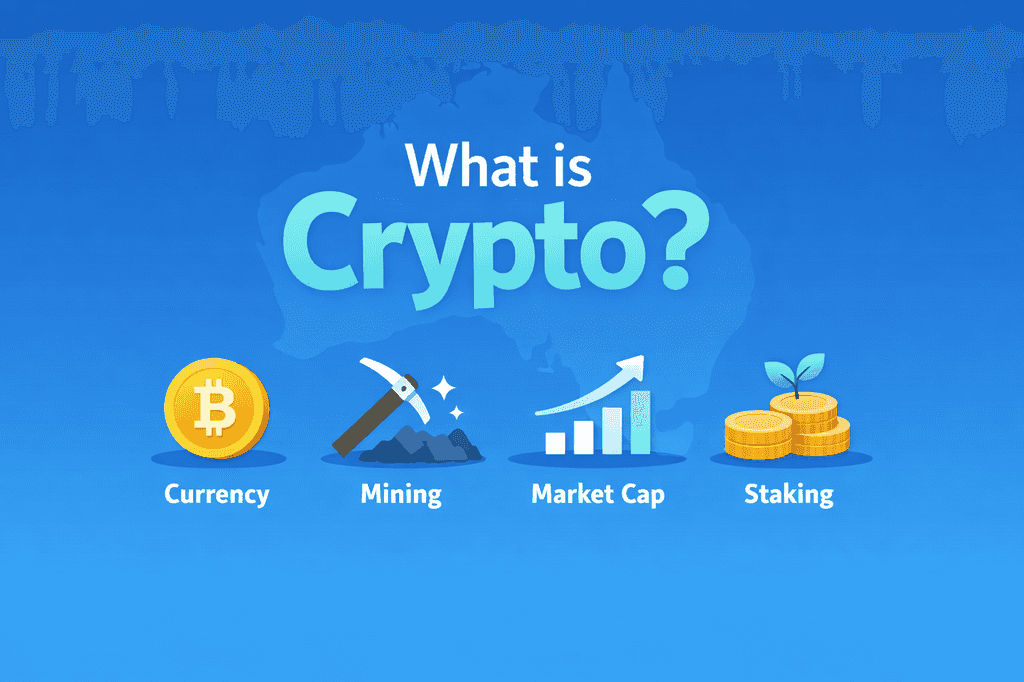
Introduction
What is crypto, and why has it become one of the most talked-about financial innovations in Australia over the past decade? From Bitcoin headlines to discussions around digital assets, staking yields, and blockchain technology, cryptocurrency is no longer a niche topic reserved for tech enthusiasts. It is now part of mainstream financial conversations, investment strategies, and even policy discussions in Australia.
At its core, crypto refers to a new form of digital money that operates without traditional banks, relying instead on decentralised technology. For Australians, understanding what is crypto currency matters not only for investment decisions, but also for navigating issues such as AUD conversions, tax obligations, and regulatory oversight. Whether you are completely new or simply looking to build a solid foundation, this guide explains what crypto is, how it works, and how Australians interact with the crypto ecosystem today.
What Is Crypto and How Does It Work?
To understand what is crypto, it helps to start with the basics. Crypto, short for cryptocurrency, is a form of digital asset that uses cryptographic technology to secure transactions. Unlike traditional money issued by governments, crypto operates on decentralised networks called blockchains. These networks are maintained by computers distributed around the world rather than a single authority.
In practical terms, crypto allows people to send value directly to one another without relying on banks or payment processors. Transactions are recorded on a public ledger, making them transparent and verifiable. In Australia, this appeals to users who value efficiency, global access, and independence from legacy financial systems. Platforms like KuCoin Australia provide local users with access to crypto markets while supporting AUD-related use cases.
What Is Cryptocurrency and How Is It Different from Traditional Money?
When people ask what is crypto currency, they are often comparing it to fiat money such as the Australian dollar. Traditional money is issued and controlled by central banks, and its supply is managed through monetary policy. Cryptocurrency, by contrast, typically has predefined rules governing supply and issuance, which are enforced by code rather than institutions.
Another key difference is how ownership works. Crypto assets are controlled through private keys held in digital wallets, meaning users retain direct custody of their funds. For Australians, this represents both an opportunity and a responsibility, as managing crypto securely requires understanding wallet safety and transaction mechanics. Unlike cash, crypto can also be programmed, enabling applications such as decentralised finance and staking.
What Is Crypto in Everyday Use?
Many newcomers ask what is crypto and whether it functions like cash. In practice, crypto can be used in several ways. Some Australians use crypto as a long-term store of value, while others use it for trading, remittances, or participation in blockchain-based applications. Certain merchants also accept crypto payments, although this remains less common than traditional methods.
Crypto is borderless, meaning it can be transferred internationally without exchange rate intermediaries. This feature has attracted Australians who work globally or send funds overseas. However, crypto prices can be volatile, which is why understanding market dynamics is essential before using crypto as a medium of exchange or investment.
What Is Crypto Mining and Why Does It Matter?
A common question is what is crypto mining, especially in relation to Bitcoin. Crypto mining is the process by which transactions are validated and added to a blockchain. In proof-of-work systems, miners use computing power to solve complex mathematical problems. Successful miners are rewarded with newly created coins and transaction fees.
From an Australian perspective, crypto mining is less about individual participation and more about understanding how networks remain secure. Mining plays a critical role in maintaining decentralisation and preventing fraud. While large-scale mining operations are more common overseas due to energy costs, Australians benefit from the security and resilience that mining provides to global crypto networks.
What Is Crypto Market Cap and Why Do Investors Care?
Understanding what is crypto market cap is essential for anyone evaluating digital assets. Market capitalisation refers to the total value of a cryptocurrency, calculated by multiplying the current price by the circulating supply. It provides a high-level view of a project’s relative size and market importance.
For Australians comparing different crypto assets, market cap is often used alongside other metrics such as trading volume and utility. A higher market cap may suggest greater adoption, while smaller market caps can indicate higher risk and potential volatility. Tools like the KuCoin crypto prices page help users track market movements and understand how different assets are valued within the broader crypto ecosystem. You can explore real-time valuations through KuCoin Crypto Prices.
What Is Crypto Staking and How Do Australians Use It?
Another frequently searched topic is what is crypto staking. Staking involves locking up certain cryptocurrencies to help secure a blockchain network that uses a proof-of-stake mechanism. In return, participants receive rewards, often described as yield or interest.
For Australians, crypto staking has become a popular way to earn passive income on digital assets. Unlike mining, staking does not require specialised hardware, making it more accessible. However, staking also carries risks, including price volatility and lock-up periods. Educational resources from trusted platforms can help Australians understand how staking works and whether it aligns with their financial goals.
How the Crypto Market Works in Australia
The crypto market in Australia operates within a growing regulatory framework. While crypto is not considered legal tender, it is legally recognised as property for tax purposes. This means activities such as trading, staking rewards, and asset disposal may trigger tax obligations under Australian law.
Australian users typically access crypto through global exchanges that support local compliance and AUD-friendly features. Market participation ranges from long-term holding to active trading and educational exploration. To stay informed, many users rely on localised insights and updates from platforms like the KuCoin Australia Blog, which covers market trends, product updates, and beginner education relevant to AU users.
Why Crypto Education Matters for Australians
As crypto adoption grows, education becomes increasingly important. Misunderstanding basic concepts such as private keys, volatility, and market cap can lead to poor decisions. Australians entering the crypto space benefit from taking a measured approach, focusing on learning before committing capital.
Educational content tailored to Australia helps users understand how global crypto concepts apply locally, including AUD conversions and compliance considerations. Platforms serving Australian users aim to bridge this gap by offering accessible explanations and region-specific guidance.
Getting Started with Crypto as an Australian User
For Australians interested in exploring crypto, the first step is understanding the fundamentals. This includes learning what crypto is, how transactions work, and how market dynamics affect prices. From there, users can explore different use cases, from holding major cryptocurrencies to participating in staking or simply tracking the market.
Choosing a platform that supports Australian users and offers educational resources is critical. Many Australians start by creating an account, exploring price data, and gradually building familiarity with the ecosystem before making significant commitments.
Conclusion: What Is Crypto and Why It Matters in Australia
So, what is crypto in the Australian context? It is a rapidly evolving digital asset class that offers new ways to store value, transfer money, and participate in decentralised networks. From understanding what is crypto currency to exploring concepts like mining, market cap, and staking, education is the foundation of responsible participation.
As crypto continues to develop, Australians who take the time to learn the basics will be better positioned to navigate opportunities and risks. Whether you are curious about the technology or considering deeper involvement, starting with trusted information is key.
If you are ready to explore crypto in a way that is accessible to Australian users, you can begin your journey here: Get started with crypto on KuCoin Australia.
Frequently Asked Questions (FAQ)
Q: What is crypto and how is it used in Australia?
A: Crypto is a form of digital money that operates on decentralised networks. In Australia, it is commonly used for investment, trading, and participation in blockchain-based applications.
Q: What is cryptocurrency compared to Australian dollars?
A: Cryptocurrency is decentralised and digital, while AUD is government-issued fiat money. Crypto prices fluctuate based on market demand rather than central bank policy.
Q: What is crypto mining and does it affect Australians?
A: Crypto mining secures blockchain networks by validating transactions. While most mining occurs overseas, Australians benefit from the security it provides to global crypto systems.
Q: What is crypto market cap and why should beginners care?
A: Crypto market cap shows the total value of a cryptocurrency. It helps Australians compare different assets and assess relative market size and risk.
Q: What is crypto staking and is it popular in Australia?
A: Crypto staking allows users to earn rewards by supporting blockchain networks. It has become increasingly popular among Australians seeking passive income from digital assets.