

NVIDIA’s Q2 FY2027 Revives AI Momentum Across Global Markets
Introduction
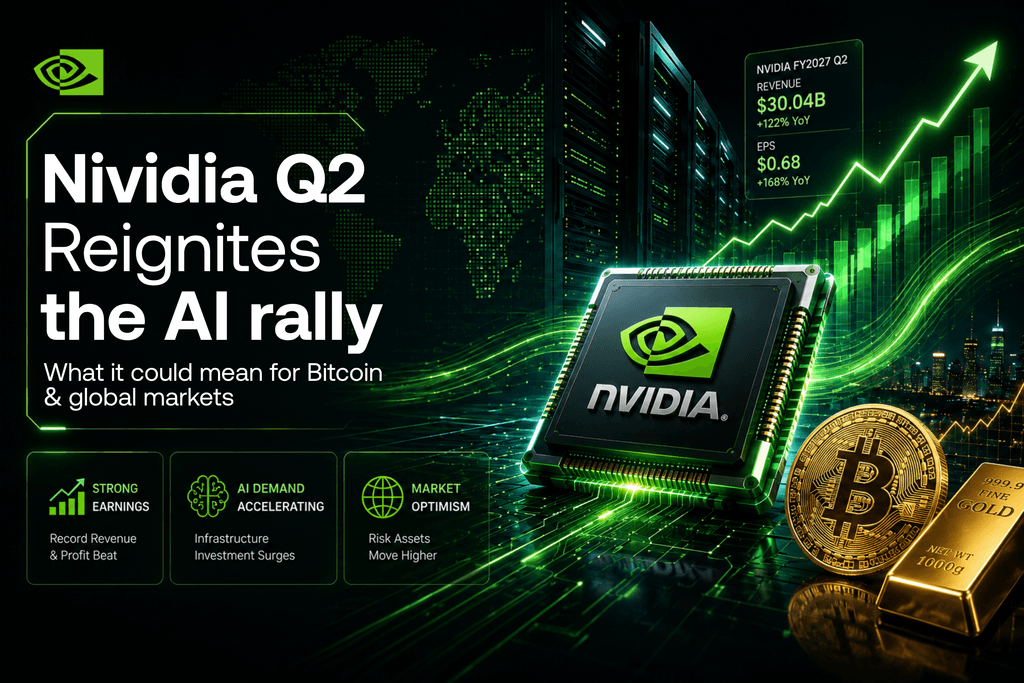
NVIDIA once again delivered results that reset market expectations. The company reported fiscal second-quarter 2027 revenue of $96.22 billion on August 26, 2026, exceeding Wall Street expectations of roughly $92.17 billion and rising 106% year over year. Adjusted earnings per share reached $2.22, above the expected range of around $2.09–$2.10 and up 120% from the same period a year earlier.
GAAP net income came in at $59.69 billion, implying a net margin of roughly 62%, while management guided for approximately $108 billion in Q3 revenue, also ahead of consensus. The market reaction was initially cautious. NVIDIA shares fell about 4% in after-hours trading before reversing sharply and gaining more than 5% as management provided a stronger outlook for demand into fiscal 2028.
The shift in sentiment highlights a broader question for investors: is the AI investment cycle still accelerating, or are expectations becoming increasingly difficult to exceed?
How Strong Were NVIDIA’s Q2 FY2027 Results?
NVIDIA’s latest quarter showed strength across nearly every major financial metric. For the quarter ended July 26, 2026, total revenue reached $96.221 billion, representing an 18% increase from the previous quarter and a 106% increase from the same period last year.
The company’s Data Center business remained the primary growth engine. Data Center revenue reached $89.0 billion, up 117% year over year and 18% sequentially. That segment alone represented roughly 92% of NVIDIA’s total quarterly revenue.
Hyperscale customers contributed approximately $48.71 billion, while AI cloud, industrial, and enterprise customers generated around $40.31 billion, up 138% from a year earlier. Profitability also remained exceptionally high. Both GAAP and non-GAAP gross margins were 75.0%. GAAP EPS reached $2.46, while non-GAAP EPS came in at $2.22.
At this scale, NVIDIA’s ability to maintain margins above 70% remains a central reason investors continue to treat the company as the benchmark for AI infrastructure demand. The company is not only growing rapidly but also generating enough profit to finance capacity expansion, capital returns, and broader ecosystem investment without placing excessive pressure on its balance sheet.
The initial decline reflected one of the biggest challenges facing NVIDIA: expectations are already extremely high. When earnings were first released, shares fell roughly 4% after hours despite the company beating revenue and earnings estimates.
The market appeared to be looking for more than another strong quarter. Investors wanted evidence that AI infrastructure demand could remain elevated beyond the current fiscal year. That evidence came during management commentary.
CFO Colette Kress said NVIDIA expects fiscal 2028 revenue growth of approximately 70%, significantly above Wall Street expectations of around 44%–45%. She also indicated that customer forecasts suggest underlying demand could support even stronger growth, but current guidance remains constrained by available supply.
CEO Jensen Huang went further, saying demand growth is closer to 100% and would be significantly higher without supply limitations. Huang described AI as having moved beyond an experimental phase and into a stage where companies increasingly view computing capacity as a direct driver of revenue.
This changed the market narrative. Instead of focusing solely on whether NVIDIA had beaten expectations for one quarter, investors began pricing in stronger earnings potential over the next one to two years. That shift was enough to reverse the initial decline and push NVIDIA shares more than 5% higher after hours.
Related memory and optical-communications stocks also benefited as investors reassessed demand across the broader AI hardware supply chain.
What Could Still Challenge NVIDIA’s AI Growth Story?
The strong earnings report did not eliminate the risks surrounding NVIDIA. In fact, some of the same factors that drove the post-earnings rally could make future expectations harder to meet.
Margin Pressure Could Increase
Management has already acknowledged that rising memory prices and higher component costs could weigh on profitability. Kress indicated that gross margin may fall toward 71%–72% in the fourth quarter, compared with the 75% level reported in Q2.
That would still represent unusually strong profitability, but it highlights the cost pressures associated with rapidly scaling advanced AI infrastructure.
Supply Constraints Remain Important
Demand continues to exceed available supply in several parts of NVIDIA’s ecosystem. Management expects supply limitations to remain relevant through at least fiscal 2028.
This creates an unusual situation: strong demand supports long-term growth, but limited supply can also restrict NVIDIA’s ability to fully convert that demand into revenue.
Expectations Have Moved Higher
NVIDIA’s stronger fiscal 2028 outlook has raised the market’s expectations for future quarters. The next major test will be whether the company can deliver its $108 billion Q3 revenue guidance and maintain confidence in the approximately 70% fiscal 2028 growth framework.
The stronger the expectations become, the greater the risk that even solid future results may disappoint investors if they fail to exceed increasingly aggressive forecasts.
Why Are Gold and Bitcoin Rising at the Same Time as AI Stocks?
One of the more notable developments around NVIDIA’s earnings is that investors are not choosing between AI growth and scarce assets. They appear to be allocated to both.
Over the previous five trading days, gold and Bitcoin ETFs attracted a combined approximately $7 billion in inflows, according to the market data cited in the original report. State Street’s SPDR Gold Shares received around $3.4 billion, while BlackRock’s iShares Bitcoin Trust attracted roughly $1.5 billion. Both ranked among the largest U.S. ETF inflow recipients during the period.
The common driver appears to be broader macro liquidity conditions rather than a shift away from technology stocks. Following signals of larger long-term U.S. Treasury buybacks, long-term yields and the U.S. dollar weakened, while both gold and Bitcoin moved higher.
Gold gained approximately 13% in August and traded above $4,600 per ounce, while Bitcoin returned to the $80,000 region.
This suggests investors may be pursuing two strategies simultaneously. On one hand, NVIDIA provides exposure to the long-term growth of AI infrastructure and computing demand. On the other hand, gold and Bitcoin can serve as scarce asset exposures during periods of fiscal expansion, softer monetary conditions, and concerns about currency dilution.
The two investment themes are therefore not necessarily competing with each other.
What Does NVIDIA’s Earnings Beat Mean for Bitcoin and Crypto Markets?
NVIDIA’s earnings are primarily a technology-sector event, but the market reaction provides useful information for crypto investors. The key connection is broader risk appetite and liquidity.
Strong NVIDIA results reinforce confidence in AI-related growth and can support sentiment toward high-growth assets. At the same time, declining yields, a weaker dollar, and improving liquidity conditions can also support Bitcoin and other digital assets.
This helps explain why NVIDIA, gold, and Bitcoin have all attracted investor attention during the same period. The important point is that crypto price movements increasingly interact with developments outside the crypto industry itself.
Technology earnings, U.S. monetary policy, Treasury-market conditions, currency movements, and regulatory developments can all influence crypto-market sentiment. Users should therefore monitor both digital-asset-specific catalysts and broader global financial conditions when assessing market movements.
How Can Australian Users Access Bitcoin on KuCoin AU?
Australian users who want to access Bitcoin can do so through supported KuCoin AU products after completing account registration and identity verification.
Fund Your Account Before Participating
Users can fund their KuCoin AU account through AUD or crypto deposit methods before purchasing Bitcoin. Periods of heightened market activity can involve significant volatility, so users should consider their own risk tolerance and avoid making decisions based solely on short-term price movements.
Buy & Sell Bitcoin Through Spot Trading
Eligible users can access supported BTC Spot pairs on KuCoin AU. Spot Trading allows users to buy, hold and sell Bitcoin while using standard market and limit orders to manage execution.
Use Fast Trade for a Simpler Purchase Process
Users who prefer a more straightforward purchasing experience can access supported crypto purchase services through KuCoin AU Fast Trade. Fast Trade is designed to simplify crypto purchases and sales without requiring users to navigate traditional order-book interfaces.
Conclusion
NVIDIA’s fiscal Q2 2027 results reinforced the strength of the current AI infrastructure cycle. Revenue reached $96.22 billion, representing 106% year-over-year growth, while Data Center revenue climbed to $89.0 billion. Adjusted EPS reached $2.22, net margin remained near 62%, and management guided for approximately $108 billion in Q3 revenue.
The most important development, however, came from the outlook. Management’s approximately 70% fiscal 2028 growth expectation, combined with Jensen Huang’s view that underlying demand growth is closer to 100%, changed the market’s interpretation of the earnings report and turned an initial after-hours decline into a gain of more than 5%.
At the same time, the market continues to price significant risks. Rising component costs, lower future gross margins, supply constraints, and elevated expectations all remain important factors.
The broader market reaction also shows that AI equities and scarce assets can rise together. Approximately $7 billion in combined five-day inflows into gold and Bitcoin ETFs suggests investors are simultaneously seeking exposure to AI growth and assets that may benefit from easier financial conditions and fiscal expansion.
For crypto investors, NVIDIA’s earnings matter less as a direct Bitcoin catalyst than as another indicator of global liquidity, risk appetite, and capital allocation trends.
FAQs
Did NVIDIA beat Wall Street expectations in Q2 FY2027?
Yes. NVIDIA reported revenue of $96.22 billion and adjusted EPS of $2.22, both above consensus expectations. Data Center revenue and Q3 guidance also exceeded market forecasts.
Why did NVIDIA stock initially fall after earnings?
The initial decline reflected extremely high investor expectations and concerns that AI growth may already have been priced into the stock. Shares reversed after management provided a much stronger fiscal 2028 growth outlook.
What does NVIDIA expect for fiscal 2028 growth?
Management indicated that fiscal 2028 revenue growth could be approximately 70%, compared with Wall Street expectations of around 44%–45%.
Why could NVIDIA’s margins decline?
Management expects higher memory prices and component costs to pressure margins, with gross margin potentially declining toward 71%–72% in the fourth quarter.
Why are Bitcoin and gold rising alongside NVIDIA?
The moves appear to reflect different but compatible investment themes. NVIDIA benefits from AI growth expectations, while Bitcoin and gold are benefiting from improving liquidity conditions, lower yields, a weaker dollar, and demand for scarce assets.
Disclaimer: This article is for informational purposes only and does not constitute financial, legal, or investment advice. Always conduct your own research before interacting with digital assets.